Overview

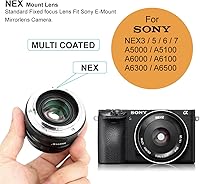
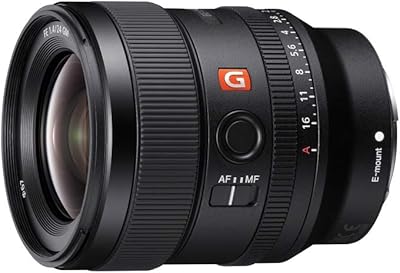
The Meike 25mm F1.8 Sony E-Mount Lens occupies an interesting space in the third-party prime market — offering a fully manual, all-metal optic at a fraction of what Sony's native glass costs. It launched back in 2018 and has quietly built a loyal following among APS-C shooters who are comfortable taking control of focus themselves. That manual-only design isn't a compromise; it's a deliberate philosophy, one that attracts photographers who want full creative control rather than the convenience of autofocus. For the price, the solid metal construction alone sets it apart from the plasticky alternatives crowding the budget lens segment.
Features & Benefits

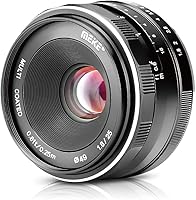
At 25mm on an APS-C sensor, this Meike prime delivers a field of view roughly equivalent to a 37.5mm full-frame lens — wide enough for street scenes and environmental portraits without the distortion of an ultra-wide. The F1.8 maximum aperture gives you genuinely soft background separation and keeps things usable in dim cafés or evening light. Optically, the 7-element, 5-group design with multi-layer coatings does a respectable job controlling flare. A minimum focus distance of just 0.25m adds versatility, letting you get surprisingly close to small subjects. At 6.7 oz with a metal shell, it's compact enough to forget it's even on the camera.

Best For

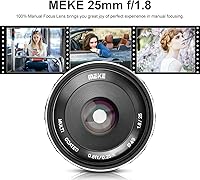
The 25mm manual lens is a natural fit for a specific type of shooter, and it knows it. If you're learning photography on a Sony APS-C body and want to train your eye by focusing manually, this is an affordable way to build that skill without risking much. Street and travel photographers will appreciate how small and unobtrusive it is — nobody gives a second glance to a tiny metal lens. Videographers on A6xxx bodies also benefit from the smooth focus ring for manual iris pulls. Just verify your specific model's compatibility, particularly on older NEX bodies, before purchasing.

User Feedback

With a 4.4-star average across nearly 340 ratings, this compact wide-angle has clearly resonated with its intended audience. Buyers frequently call out the build quality as a genuine surprise — sturdy, well-machined, and nothing like what you'd expect at this price tier. The focus ring earns particular praise from video users for its smooth, consistent action. That said, a recurring criticism is chromatic aberration at F1.8, especially near the frame edges — worth factoring in if you shoot high-contrast subjects wide open. One practical note almost every buyer mentions: enable the ″Release Without Lens″ setting in your Sony camera menu, or the lens simply won't fire.

Pros

  • All-metal construction feels genuinely premium and durable, well above what the price tier typically delivers.
  • The F1.8 aperture produces smooth, flattering background blur for portraits and close-up subjects.
  • At just 6.7 oz, this compact wide-angle barely adds weight to your camera bag or shoulder.
  • The focus ring action is consistently smooth — a genuine asset for video shooters pulling manual focus.
  • A 0.25m minimum focus distance opens creative close-up possibilities rarely found on wide primes at this level.
  • Multi-layer optical coatings keep flare and ghosting manageable in typical everyday shooting conditions.
  • The 25mm focal length on APS-C gives a natural, versatile field of view well suited to street and travel work.
  • Strong community consensus: 4.4 stars across hundreds of verified ratings reflects reliable, consistent user satisfaction.
  • No electronic components mean zero firmware issues, zero connectivity problems, and nothing to malfunction over time.

Cons

  • No autofocus at all — a hard stop for anyone shooting fast-moving or unpredictable subjects.
  • Chromatic aberration is noticeable wide open, particularly along high-contrast edges near the frame corners.
  • Corner sharpness at F1.8 is soft enough to require stopping down for critical edge-to-edge image quality.
  • Vignetting wide open is pronounced and will need correction in post for evenly lit subjects.
  • No electronic contacts means no EXIF aperture data and no communication with in-body stabilization systems.
  • The lens ships with minimal documentation, and the required Sony menu setup step catches many first-time buyers off guard.
  • No weather sealing of any kind limits usability in rain, dust, or humid outdoor conditions.
  • The shorter focus throw makes ultra-fine adjustments at close focusing distances harder to nail consistently.
  • Lens cap quality feels noticeably cheap relative to the otherwise solid metal barrel.
  • Flare control deteriorates quickly when shooting directly toward strong point light sources without a hood.

Ratings

The Meike 25mm F1.8 Sony E-Mount Lens has been put through its paces by hundreds of real-world buyers — from hobbyist street photographers to indie filmmakers — and our AI-driven scoring system has analyzed that verified global feedback while actively filtering out incentivized, duplicate, and bot-generated reviews. The scores below reflect an honest synthesis of where this compact wide-angle genuinely excels and where it falls short, with no glossing over the frustrations real users have encountered.
Build Quality
88%
The all-metal barrel consistently surprises buyers who expect plastic at this price tier. Reviewers repeatedly describe it as feeling dense and well-machined in hand, with no creaking or wobble at the mount. For a lens you're tossing in a travel bag or city backpack, that physical solidity builds real confidence.
A few users noted that while the exterior feels premium, the lens cap fits loosely and feels cheap by comparison. There are also occasional reports of slight internal dust accumulation over time, suggesting the barrel sealing is functional but not weather-resistant in any meaningful way.
Optical Sharpness
74%
26%
Center sharpness at F2.8 and beyond is genuinely impressive for the category, producing clean, detailed images that hold up well when cropped. Street photographers shooting at middle apertures tend to be consistently pleased with the clarity of fine details like signage and textures in daylight conditions.
Wide open at F1.8, sharpness drops noticeably toward the edges and corners — a common trade-off at this price point, but still worth flagging. Users shooting architecture or landscapes who need edge-to-edge clarity will likely find this frustrating and need to stop down to F4 or beyond.
Bokeh & Background Blur
81%
19%
The F1.8 aperture produces smooth, pleasing out-of-focus backgrounds that genuinely flatter close-up portraits and product shots. At the 0.25m minimum focus distance, subject isolation looks well above what you would expect from a lens in this segment, and reviewers shooting flat-lay or detail work praise the rendering warmly.
Bokeh highlights can show slight nervousness or onion-ring patterning under critical examination, which more experienced photographers may find distracting in high-contrast scenes. It is not the silky rendering of premium glass, and users comparing it directly to Sony G-series lenses will notice the difference immediately.
Low-Light Performance
77%
23%
The F1.8 maximum aperture gives this Meike prime a real advantage in available-light situations — indoor events, evening café shoots, and dimly lit street scenes all become workable without bumping ISO to noise-heavy levels. Multiple reviewers specifically called out its usefulness for natural-light indoor photography.
Because focus is entirely manual, acquiring and holding focus in genuinely dark environments takes practice and patience. Users coming from autofocus lenses often report a frustrating adjustment period in low-light scenarios where focus peaking alone does not always catch subtle misses until reviewing the shot.
Manual Focus Experience
83%
The focus ring is consistently described as one of the smoothest in its class — damped just enough to allow precise, controlled pulls without being stiff. Video shooters in particular appreciate the analog feel, using it for deliberate rack-focus moves that would otherwise require expensive cine lenses or follow-focus rigs.
There is no distance scale marked on the barrel, which limits zone focusing technique that street photographers often rely on. A handful of users also noted that the focus throw is on the shorter side, making ultra-precise fine-tuning at closer distances slightly tricky until you develop muscle memory with it.
Value for Money
91%
Relative to Sony's own native primes or even other third-party autofocus options, this 25mm manual lens delivers a genuinely compelling package for the outlay. The metal build, F1.8 aperture, and optical coating quality are not things buyers expect at this price tier, and the positive surprise is a recurring theme across reviews.
The value equation weakens slightly when you factor in the manual-only limitation for users who eventually want autofocus capability. If your shooting style evolves toward fast-moving subjects or event photography, you may find yourself outgrowing the lens before its optical quality becomes a bottleneck.
Chromatic Aberration
61%
39%
Stopped down to F4 and beyond, color fringing is well controlled and rarely visible in real-world shots. Buyers shooting landscapes or architecture at mid-apertures generally report clean, neutral rendering without needing heavy post-processing correction passes in Lightroom or Capture One.
At F1.8, purple and green fringing along high-contrast edges — think bare tree branches against a bright sky — is a recurring complaint, especially toward the frame corners. It is correctable in editing but adds a post-processing step that some users find irritating, particularly when shooting in volume.
Flare & Ghosting Resistance
72%
28%
The multi-layer coatings do a respectable job in typical shooting conditions, handling overcast skies and diffused artificial light without obvious ghosting artifacts. For everyday street and travel use where you are not deliberately shooting into strong light sources, most users find flare a non-issue.
Point a strong light source — a street lamp, a car headlight, direct sun near the frame edge — and flare becomes visible fairly quickly. The lens lacks a dedicated hood in most configurations, and the compact front element design limits how much any aftermarket hood actually helps in challenging backlit scenarios.
Portability & Size
93%
At just 6.7 oz and barely over 1.6 inches long, this compact wide-angle practically disappears on a Sony APS-C body. Travel photographers and street shooters who want a pocketable kit love how it transforms an A6000-series camera into something genuinely discreet and unintimidating in public spaces.
The compact size does mean the focus ring has less surface area to grip, which some users with larger hands find slightly awkward for precise adjustments. It is a minor ergonomic complaint rather than a functional flaw, but worth noting if you typically prefer a more substantial barrel to hold.
Camera Compatibility
79%
21%
The Sony E-mount fit is consistent across the full A6xxx range and the newer bodies like the A6700, with no adapters or modifications required. Users on current Sony APS-C bodies report a secure, wobble-free mount connection that inspires confidence in day-to-day use.
On older NEX-series bodies, some users ran into initial confusion because the camera refused to fire without first enabling the Release Without Lens option buried in the menu settings. This is a one-time setup step, but it catches enough buyers off guard that it generates regular one-star reviews that are really a setup issue, not a product defect.
Image Contrast & Color Rendering
76%
24%
Colors tend to be neutral to slightly warm, which works well for street scenes and environmental portraits without requiring heavy white balance adjustments in post. Reviewers shooting JPEGs straight from Sony bodies generally describe the output as natural and usable with minimal editing intervention.
In flat or overcast lighting, images can appear slightly low in micro-contrast compared to pricier optics, giving a mildly hazy quality that requires a contrast or clarity boost in editing to fully resolve. It is a subtle issue that beginners may not notice, but more experienced photographers do pick up on it.
Minimum Focus Distance
84%
The 0.25m minimum focus distance opens up a range of creative close-up possibilities that typical wide-angle primes in this class do not offer. Buyers shooting product details, food styling, or botanical close-ups have been pleasantly surprised by how much subject magnification is achievable without a macro lens.
At minimum focus distance and wide aperture simultaneously, depth of field becomes razor thin and manual focus precision demands are high. Without focus peaking well-calibrated to your specific shooting style, getting a consistent keeper rate in this zone takes a noticeable amount of practice and patience.
Ease of Setup
68%
32%
Once the camera is configured correctly, mounting and using the lens is straightforward — there are no electronic connections to worry about, no firmware to update, and no app pairing required. The purely mechanical operation means there is essentially nothing to go wrong from a setup standpoint once you clear the initial hurdle.
That initial hurdle — specifically the need to dig into Sony menu settings and enable manual lens release — trips up a disproportionate number of first-time buyers. The lens ships with minimal documentation, and the setup requirement is not prominently flagged on the product page, leading to avoidable frustration.
Vignetting
63%
37%
At F2.8 and smaller apertures, corner shading is mild enough that most photographers either do not notice it or find it aesthetically pleasing for portrait-style shots, adding a natural framing effect without any post-processing effort required.
Wide open at F1.8, corner vignetting is fairly pronounced and visible without in-camera or software correction. Buyers shooting evenly lit scenes — flat lays, document photography, or interiors — may find the darkened corners distracting and will need to apply a lens correction profile or manual adjustment in editing.

Suitable for:

The Meike 25mm F1.8 Sony E-Mount Lens is a strong fit for hobbyist photographers on Sony APS-C bodies who want to develop their craft without committing to the cost of native Sony glass. If you shoot street photography, travel, or everyday life and value a discreet, lightweight kit that does not draw attention, this compact wide-angle slots in naturally. The 25mm focal length — roughly equivalent to 37.5mm on a full-frame body — gives you a view close enough to how your eye sees the world, which makes candid and environmental shooting feel intuitive once you are comfortable with manual focus. Videographers who prefer pulling focus by hand for cinematic control will genuinely appreciate how smooth and damped the focus ring feels during a take. It also works well for photographers who want to experiment with close-up and near-macro work on a budget, given the 0.25m minimum focusing distance. Older NEX-series users looking for an affordable, modern prime that physically fits and optically outperforms kit glass will find this Meike prime a practical upgrade worth considering.
Not suitable for:

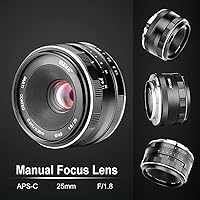
The Meike 25mm F1.8 Sony E-Mount Lens is a poor match for anyone who relies on speed — sports photographers, event shooters, parents chasing kids around, or wildlife photographers will find the manual-only focus system an immediate dealbreaker. There is no autofocus whatsoever, and no amount of familiarity with the lens changes that fundamental constraint. Photographers who shoot in busy, fast-changing environments where capturing a fleeting expression or moment is the priority should look at autofocus alternatives, even if it means spending more. If edge-to-edge sharpness wide open matters to your work — think real estate interiors, architectural photography, or flat-lay product shots — the pronounced corner softness at F1.8 will be a recurring frustration. The lack of any weather sealing also rules it out for photographers who regularly shoot in rain, dust, or humid conditions. And if you are moving from a fully electronic autofocus lens and expecting any EXIF data, exposure automation via aperture control, or in-body image stabilization communication, none of that is present here — the lens is entirely mechanical with no electronic contacts.
Specifications

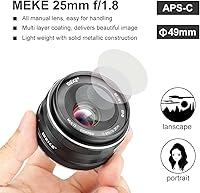
  • Focal Length: Fixed 25mm focal length designed for APS-C sensors, delivering a diagonal field of view of 61°.
  • Full-Frame Equivalent: On an APS-C sensor with a 1.5x crop factor, the 25mm focal length produces a field of view roughly equivalent to 37.5mm on a full-frame camera.
  • Maximum Aperture: Maximum aperture of F1.8 enables shallow depth of field and improved light gathering in low-light environments.
  • Minimum Aperture: Minimum aperture of F16 provides extensive depth of field for landscape or zone-focus street shooting.
  • Lens Construction: 7 optical elements arranged in 5 groups, with multi-layer coatings applied to reduce flare, ghosting, and internal reflections.
  • Focus Type: Fully manual focus only — no autofocus motor or electronic focus assist communication is present in this lens.
  • Minimum Focus: Minimum focusing distance of 0.25m from the focal plane, enabling close-up creative work beyond typical wide-angle prime capability.
  • Mount: Sony E-mount, compatible with all Sony APS-C mirrorless bodies in the NEX and A6xxx series without adapters.
  • Sensor Coverage: Designed exclusively for APS-C format sensors; use on a full-frame Sony body will produce significant vignetting.
  • Body Material: Full metal barrel construction with no plastic exterior components, contributing to durability and a premium in-hand feel.
  • Dimensions: Measures 2.38 × 2.38 × 1.61 inches (approximately 60.5 × 60.5 × 40.9mm), making it one of the more compact E-mount primes available.
  • Weight: Weighs 6.7 oz (approximately 190g), light enough for all-day carry without adding meaningful strain to a mirrorless kit.
  • Filter Thread: Front filter thread diameter is 49mm, compatible with standard 49mm screw-in filters including UV, polarizer, and ND types.
  • Aperture Blades: The aperture diaphragm uses rounded blades to produce smoother, rounder bokeh highlights compared to straight-bladed alternatives.
  • Field of View: Diagonal field of view of 61°, with a horizontal angle of 50° and a vertical angle of 35° on APS-C sensors.
  • Electronic Contacts: No electronic contacts are present — aperture, focus, and all optical functions are fully mechanical with no EXIF data transmission.
  • Manufacturer: Designed and manufactured by Meike, a Chinese optical brand specializing in affordable manual and autofocus lenses for mirrorless and DSLR systems.
  • First Available: This lens was first listed for sale in May 2018 and remains an active, non-discontinued product in Meike's lineup.

Related Reviews
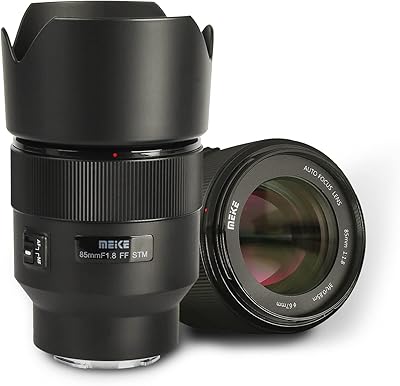
Meike 85mm F1.8 AF STM Sony E Mount Lens
85%
92%
Value for Money
88%
Autofocus Speed and Accuracy
90%
Image Quality
85%
Bokeh and Background Blur
78%
Low-Light Performance
More
VILTROX 16mm F1.8 FE Lens for Sony E Mount
88%
89%
Image Quality
91%
Autofocus Speed and Accuracy
85%
Low-Light Performance
87%
Build Quality
93%
Portability
More
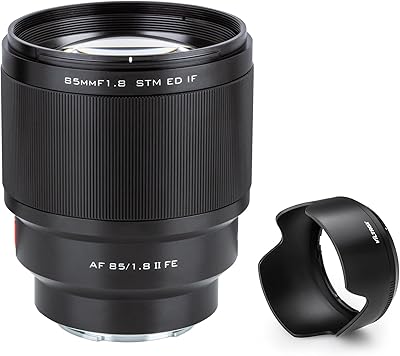
Viltrox AF 85mm F1.8 Mark II Lens
81%
86%
Autofocus Speed
91%
Autofocus Noise
88%
Center Sharpness
63%
Edge & Corner Sharpness
79%
Bokeh Quality
More
Meike 50mm F1.8 Sony E Mount Lens
76%
93%
Value for Money
74%
Autofocus Speed & Accuracy
81%
Image Sharpness
86%
Bokeh Quality
68%
Build Quality & Feel
More
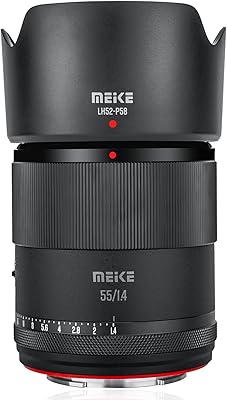
Meike 55mm F1.4 Sony E-Mount Prime Lens
76%
83%
Image Sharpness
88%
Bokeh Quality
76%
Autofocus Speed & Accuracy
81%
Low-Light Performance
63%
Build Quality & Materials
More
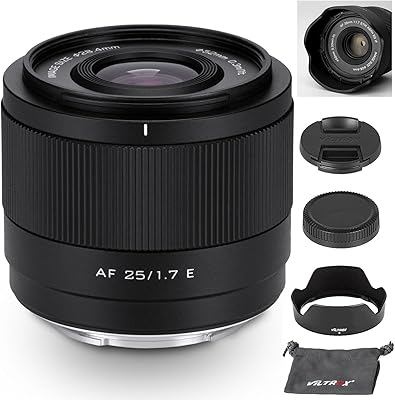
Viltrox 25mm f/1.7 E-Mount Prime Lens
81%
88%
Autofocus Performance
83%
Image Sharpness
86%
Aperture & Background Rendering
71%
Build Quality & Feel
87%
Low-Light Capability
More
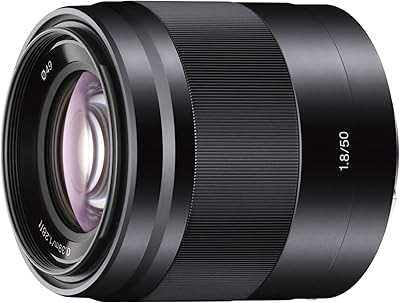
Sony E 50mm F1.8 OSS Portrait Lens
86%
89%
Image Quality
74%
Autofocus Performance
92%
Bokeh and Background Blur
80%
Low-Light Performance
85%
Build Quality
More
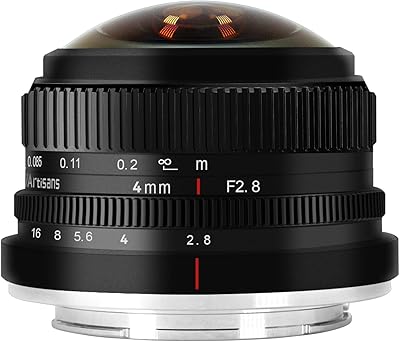
7Artisans 4mm F2.8 Fisheye Lens for Sony E-Mount
82%
88%
Image Quality
93%
Portability
75%
Manual Focus Control
82%
Build Quality
70%
Low-Light Performance
More
Sony SEL24F14GM 24mm F1.4 GM Wide-angle Lens
84%
96%
Sharpness Wide Open
93%
Bokeh Quality
94%
Low-Light Performance
89%
Autofocus Speed & Accuracy
88%
Build Quality & Weather Sealing
More
ZEISS Batis 135mm f/2.8 Lens for Sony E Mount
89%
95%
Image Quality
78%
Autofocus Performance
90%
Build Quality
92%
Weather Sealing
85%
Portability
More

FAQ

Yes — and this is the single most important setup step. On your Sony camera, go into the menu and enable the option labeled Release Without Lens or Shoot Without Lens, depending on your model. Without this setting activated, the camera will refuse to fire because it detects no electronic communication from the lens. It is a one-time change and takes about 30 seconds to find and toggle.

Yes, the 25mm manual lens mounts directly onto all Sony APS-C bodies using the E-mount, including the full A6xxx range — A6000, A6100, A6300, A6400, A6500, A6600, and A6700. It also fits older NEX bodies, though those users should double-check the menu setting mentioned above, as the option name can vary slightly between older firmware versions.

Physically, yes — it will mount without issue. But the lens is designed to cover an APS-C image circle only, so on a full-frame sensor you will see heavy vignetting around the edges and corners. You can shoot in APS-C crop mode on full-frame bodies to work around this, but you will be giving up most of your megapixels in the process.

It takes some adjustment if you are coming from autofocus lenses, but most users find it manageable within a few outings. The focus ring is smooth and well-damped, which helps with deliberate control. The practical tip most buyers share is to use your camera's focus peaking feature — this highlights the edges of in-focus areas in a bright color on the LCD or EVF, making accurate manual focus much faster and more reliable.

For its category, yes. At F1.8 and with subjects reasonably close to the camera, background blur is smooth and flattering — particularly at the 0.25m minimum focus distance where subject isolation gets quite dramatic. Wide open, bokeh highlights can show slight texture under close inspection, but in real-world portraits and close-up shots, the rendering is pleasant and well above what you would expect at this price point.

It is worth knowing about but not a dealbreaker for most shooting scenarios. The fringing is most visible at F1.8 along sharp, high-contrast edges — like light-colored objects against a dark background or branches against a bright sky. Stop the lens down to F2.8 or F4 and it largely disappears. In post-processing, Lightroom and Capture One both handle CA correction quickly and effectively if it shows up in your shots.

Yes. The front element uses a 49mm filter thread, which is a common size with wide availability. Standard 49mm screw-in filters — UV, circular polarizer, or variable ND — all fit without any adapter needed. This makes it straightforward to add ND filters for video work or outdoor shooting at wide apertures in bright conditions.

This is one of the areas where the 25mm manual lens earns consistent praise. The focus ring has a well-judged amount of resistance — smooth enough for fluid pull-focus moves, but with enough damping to prevent accidental slippage mid-shot. Videographers on APS-C Sony bodies regularly cite it as a strong choice for cinematic-style shooting, especially for narrative or short-film work where manual focus control is a deliberate part of the craft.

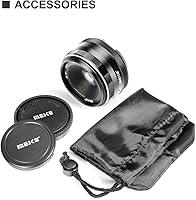
Typically, the lens ships with front and rear lens caps and sometimes a simple lens pouch, though the included accessories can vary by seller. A lens hood is generally not included, and given that the front element can be susceptible to flare in backlit situations, picking up a compatible 49mm screw-on hood separately is a worthwhile addition.

The all-metal barrel is genuinely solid and holds up well to the bumps and minor knocks of regular travel and street shooting. That said, there is no weather sealing or gasket protection on the mount or barrel, so it should not be used in rain, blowing dust, or high-humidity conditions without protection. For dry outdoor environments and urban shooting, durability is not a concern most users report.

Where to Buy