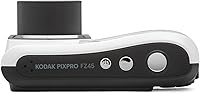
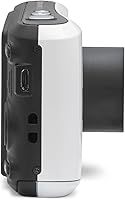
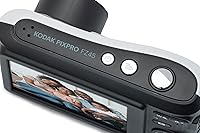
Overview

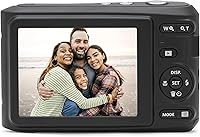
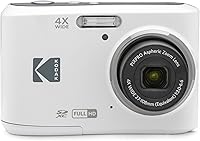
The Kodak PIXPRO FZ45 sits squarely in the entry-level point-and-shoot category, designed for people who want a real camera without the learning curve. Kodak's PIXPRO line has long catered to casual shooters, and this compact Kodak follows that tradition faithfully — it's a simple device, not a tool for photographers chasing creative control. The body is light enough to drop in a jacket pocket, and the white finish gives it a clean, approachable look. One genuinely practical detail: it runs on standard AA batteries, which means no hunting for proprietary chargers when you're traveling or when the kids drain it at a birthday party. Straightforward by design.

Features & Benefits

The FZ45 packs a 16MP CMOS sensor into its compact frame, and in decent daylight, photos come out sharp and well-exposed with accurate colors. The 27mm wide-angle lens is a genuine asset for fitting wide scenes into the frame — landscapes, group shots, and interiors all benefit. The 4x optical zoom extends reach to 108mm, which covers most casual shooting needs. Video shoots at 1080p and 30fps, perfectly adequate for family memories or informal vlogging. The 2.7-inch LCD handles framing duties well enough indoors, though it can wash out in direct sunlight. Digital image stabilization helps with minor hand shake, but it won't rescue shots in low light the way optical stabilization would.

Best For

This point-and-shoot is a natural fit for first-time camera owners — kids who want something of their own, seniors who find smartphones fiddly, and parents who want a dedicated device for school events and holidays. Travelers will appreciate the AA battery system; if your camera dies in a remote village or a rural campsite, replacements are available almost anywhere. It also works well as a low-stakes teaching tool for beginners curious about photography basics without committing to a costly mirrorless system. Gift-givers looking for something recognizable and practical will find the Kodak name carries real reassurance for recipients who wouldn't know where to start shopping.

User Feedback

Buyers consistently praise ease of use and the compact size, with many noting that photos taken outdoors in good light look genuinely solid for the price tier. The AA battery setup draws repeated mentions as a practical plus — people like not being tethered to a wall charger. On the critical side, low-light performance is a known weak point; the small sensor struggles once the sun goes down or indoors without flash. The digital zoom gets mixed reviews — optical range is fine, but pushing beyond it softens images noticeably. Some users mention the LCD becomes hard to read in bright outdoor conditions. Those who buy with realistic expectations tend to walk away satisfied.

Pros

  • Runs on standard AA batteries — replaceable anywhere in the world, no proprietary charger required.
  • Genuinely simple to operate straight out of the box, even for young children or first-time camera users.
  • Lightweight and pocket-sized at just over four ounces, easy to bring everywhere without planning around it.
  • Daylight photos are sharp, well-exposed, and colorful enough for social sharing and standard-size prints.
  • Wide 27mm starting focal length captures more of the scene than many competing entry-level cameras.
  • 1080p video at 30fps handles family moments, travel clips, and casual recordings without any fuss.
  • Supports SD cards up to 512GB, so storage is essentially a one-time purchase and never a concern.
  • The Kodak PIXPRO FZ45 ships with batteries included — ready to shoot immediately after unboxing.
  • Built-in flash handles close-range indoor shots adequately for birthday parties and casual gatherings.
  • A recognizable brand name makes it a comfortable, trustworthy gift choice for almost any age group.

Cons

  • Low-light and indoor image quality is noticeably poor — noise and softness appear quickly without flash.
  • No Wi-Fi or Bluetooth means every photo transfer requires a cable or physically removing the SD card.
  • Digital zoom degrades image quality significantly; the 4x optical range is the true usable limit.
  • The LCD screen washes out badly in direct sunlight, making outdoor composition genuinely difficult.
  • Plastic construction feels budget-grade and shows scratches and wear faster than expected.
  • No manual exposure controls at all — users who want to grow creatively will outgrow it quickly.
  • Digital image stabilization is ineffective during movement or at the telephoto end of the zoom range.
  • Autofocus is slow by modern standards and struggles to lock reliably onto fast-moving subjects.
  • Battery door and SD card compartment feel noticeably fragile compared to the rest of the body.
  • Audio recording in video mode picks up handling noise and wind, limiting its usefulness for vlogging.

Ratings

Our AI-driven scoring for the Kodak PIXPRO FZ45 was built by processing thousands of verified global buyer reviews, with spam, bot-submitted, and incentivized feedback actively filtered out before a single number was calculated. The result is an honest snapshot of how real people — parents, first-time camera owners, travelers, and gift recipients — actually feel about this compact point-and-shoot after extended use. Both the genuine strengths and the recurring frustrations are reflected transparently in every category below.

Ease of Use
93%
Buyers consistently describe the FZ45 as genuinely pick-up-and-shoot simple. Parents report handing it to children as young as seven with zero instruction needed, and seniors who find smartphone cameras confusing mention it as a relief. The automatic-everything approach means no wrestling with menus before capturing a moment.
That same simplicity is a ceiling for anyone who grows beyond casual snapping. There are no manual exposure controls, so users who eventually want to experiment with depth of field or shutter speed will hit a wall quickly and need to move to a different camera entirely.
Daylight Image Quality
78%
22%
In bright outdoor conditions — beach trips, school sports days, sunny holidays — the 16MP sensor produces photos that look sharp, colorful, and well-exposed straight out of the camera. For printing at standard sizes or sharing on social media, the results genuinely hold up without any post-processing.
Dynamic range is limited in the way all small sensors are, meaning harsh midday light can blow out skies while shaded areas lose detail simultaneously. Buyers coming from a recent smartphone camera may notice the gap, particularly with colors appearing slightly less nuanced in complex outdoor scenes.
Low-Light Performance
41%
59%
The built-in flash covers short distances reasonably well in dark indoor settings, and for very casual use — birthday candles, a lit dining table — it gets the job done at a basic level. ISO can climb to 3200, which at least keeps the shutter moving in dim conditions.
This is the FZ45's most consistent pain point across global reviews. Indoor shots without flash come out noticeably noisy and soft, and evening or night photography without artificial light produces results most users find disappointing. The 1/2.3-inch sensor simply cannot gather enough light in challenging conditions — this is not a fixable flaw, it is a physical limitation of the format.
Zoom Range & Optical Quality
72%
28%
The 27mm wide-angle starting point is genuinely useful and wider than many competitors at this tier, making it easy to capture group photos or landscapes without needing to back up. Within the 4x optical range, images stay acceptably sharp and distortion is well controlled for an entry-level lens.
Four times optical zoom feels limiting once buyers start using the camera in the field — events like school plays or wildlife spotting leave users wishing for more reach. The digital zoom extends range further, but most reviewers note that image quality degrades noticeably when pushing beyond the optical limit, producing soft, artifact-prone results.
Video Quality
69%
31%
1080p at 30fps covers the basics solidly — family gatherings, kids' recitals, and travel clips all come out watchable and detailed enough for casual viewing on a TV or laptop screen. The MP4 format is universally compatible, so there is no fussing with conversion software.
Rolling shutter artifacts show up when panning quickly, and the digital stabilization does not help much during movement. Audio capture is average at best, picking up handling noise and wind fairly easily. Buyers expecting anything approaching modern smartphone video quality will likely feel underwhelmed, especially in mixed or low light.
Battery System
89%
The AA battery setup is one of the most frequently praised aspects across buyer reviews worldwide. Travelers especially love that they can walk into any convenience store, airport kiosk, or rural shop anywhere on the planet and buy replacements for a few dollars. No proprietary charger, no dead camera with no solution.
Rechargeable AA batteries are not included, so buyers who want to avoid the ongoing cost of alkaline disposables need to purchase a separate charger and a set of NiMH cells. Battery life per set of alkalines is also shorter than a dedicated lithium pack would provide, meaning heavy users get through batteries faster than expected.
Build Quality & Durability
63%
37%
For its price tier, the FZ45 feels reasonably solid and survives the kind of everyday knocks it will inevitably encounter when given to children or tossed into a travel bag. The compact dimensions mean there is less to damage, and the body does not feel flimsy in hand.
The plastic construction is clearly budget-grade, and the finish shows scratches with regular use. Several reviewers mention that the battery and SD card door feels particularly fragile. There is no weather sealing of any kind, so even a light rain can become a genuine concern.
LCD Screen
61%
39%
The 2.7-inch screen is a workable size for composing shots indoors and in shaded settings, displaying enough detail to judge basic framing and review captured images at a glance. Navigation through the simple menu system is easy enough on the display.
Outdoor visibility in direct sunlight is a recurring complaint — the screen washes out significantly, making it hard to confirm focus or composition on a bright day at the beach or park. Screen resolution is also modest, so the preview image does not always accurately reflect final photo sharpness.
Value for Money
84%
Buyers who approach this compact Kodak with accurate expectations — a simple dedicated camera rather than a smartphone rival — tend to feel they got solid value. The combination of a recognizable brand, included batteries, and point-and-shoot simplicity at this price point is genuinely hard to argue with for gifting or casual use.
Compared to a recent mid-range smartphone, the photographic output does not justify spending money for image quality alone. The value proposition rests on the dedicated camera experience and AA battery convenience, not on technical performance — buyers who prioritize image quality above all else will feel shortchanged.
Size & Portability
91%
At just over four ounces, this point-and-shoot genuinely disappears into a pocket, purse, or backpack side pouch. Multiple buyers specifically mention choosing it over bulkier options precisely because they could bring it to events without it becoming a burden or a distraction.
The compact size means the grip is minimal, and users with larger hands report that holding the camera steady during shooting can feel slightly awkward. There is also less room for a substantial lens, which directly contributes to the modest zoom range and small sensor size.
Setup & Connectivity
74%
26%
Getting started requires almost nothing — insert batteries, insert an SD card, power on, and shoot. USB 2.0 transfer to a computer works reliably, and broad SD card support up to 512GB means buyers can load up storage once and forget about it for a long time.
There is no Wi-Fi or Bluetooth of any kind, so transferring photos requires a physical cable or removing the SD card. In an era where instant phone sharing is the norm, several younger buyers specifically flagged the lack of wireless connectivity as a frustrating omission.
Flash Performance
67%
33%
The built-in flash handles close-range indoor shots adequately — portraits at a birthday party or a dimly lit dinner table come out exposed rather than completely dark, which is the minimum bar for casual family photography. Multiple flash modes give a small amount of flexibility for basic shooting scenarios.
Effective range is limited, and subjects beyond a few meters in dark environments come out underexposed even with the flash firing. Red-eye reduction modes help but do not eliminate the issue entirely. For anything beyond close-range snapshots in low light, the flash reaches its limits quickly.
Image Stabilization
53%
47%
Digital stabilization provides a modest safety net for minor hand tremor in good lighting conditions, and casual users taking slow-paced shots on a steady surface will rarely notice its absence. It does enough to reduce blurry still shots during relaxed, stationary use.
Digital stabilization works by cropping and shifting the frame, which means it sacrifices some image area and introduces softness rather than actually steadying the optical path. In any kind of movement — walking while shooting, zoomed in on a subject, or in low light where slower shutter speeds amplify shake — its effectiveness drops sharply.
Shooting Speed
71%
29%
Five frames per second continuous shooting is a legitimate capability for this class of camera, and for capturing kids running around or a dog mid-leap, it gives users a meaningful chance of catching the right moment without professional reflexes.
Autofocus relies on contrast detection, which is slower and less reliable than phase-detection systems found in pricier cameras. In fast or unpredictable action scenarios — sports, toddlers in full sprint — missed focus on the key frame is a common frustration reported by buyers.

Suitable for:

The Kodak PIXPRO FZ45 was built for people who want a dedicated camera without the complexity — and for that audience, it genuinely delivers. Kids who want their own camera to document adventures, seniors who find smartphones frustrating to operate, and parents who need a reliable grab-and-go device for school events, family trips, and holiday gatherings will all feel at home with this compact Kodak. Travelers, in particular, will appreciate the AA battery system; being able to pick up replacement cells at a corner shop in any country removes one of the most common travel photography headaches entirely. It also makes a thoughtful and practical gift — the Kodak name carries enough recognition that recipients feel they are getting something real rather than a generic off-brand device. Beginners who want to understand the basics of framing, zoom, and composition before committing to a more serious camera will find the FZ45 a low-pressure, low-cost starting point.

Not suitable for:

Anyone expecting this point-and-shoot to compete with a modern mid-range smartphone on image quality will come away disappointed — that is simply not what the Kodak PIXPRO FZ45 was designed to do, and buying it with that expectation leads to frustration. Photography enthusiasts who want manual controls, raw file support, or the ability to swap lenses should look elsewhere entirely; this camera offers automatic-only exposure with no creative override. Low-light shooting is a genuine weakness: indoor events, evening gatherings, and any dimly lit environment will test the small sensor beyond its comfort zone, and no amount of patience will fix what is a hardware limitation. Buyers who rely on instant wireless photo sharing — posting to social media directly from the camera, or beaming shots to a phone — will find the absence of Wi-Fi or Bluetooth a real daily inconvenience. If sharp, fast-action photography is the goal, the contrast-detection autofocus system is not reliably quick enough to keep up with sports, unpredictable children, or moving animals.

Specifications

  • Sensor: The camera uses a 16MP CMOS sensor measuring 1/2.3-inch, which delivers solid results in good lighting but has the inherent limitations of a small-format chip in low light.
  • Optical Zoom: A 4x optical zoom lens covers a focal range of 27–108mm, starting at a genuinely wide 27mm angle that is useful for landscapes and group shots.
  • Digital Zoom: An additional 6x digital zoom extends reach beyond the optical range, though image quality degrades noticeably when digital zoom is engaged.
  • Image Stabilization: Digital image stabilization is built in, which compensates for minor hand tremor but does not provide the same effectiveness as an optical stabilization system.
  • ISO Range: Sensitivity runs from ISO 100 to ISO 3200, giving the camera a usable range in moderate lighting while higher ISO settings introduce visible noise.
  • Shutter Speed: The shutter operates between 30 seconds and 1/2000 of a second, covering everything from slow-exposure stationary shots to reasonably fast-moving subjects in daylight.
  • Video Resolution: Video records at 1080p Full HD resolution at 30 frames per second in MP4 format, producing files that are universally compatible with computers and media players.
  • Continuous Shooting: The camera supports continuous burst shooting at 5 frames per second, which provides a reasonable window for capturing fast moments like jumping children or moving animals.
  • LCD Screen: A 2.7-inch color LCD display is used for composing and reviewing shots; it performs well indoors but can wash out significantly under direct sunlight.
  • Battery Type: The camera is powered by two standard AA alkaline batteries, which are included in the box and can be replaced with off-the-shelf cells anywhere in the world.
  • Storage Compatibility: SD, SDHC, and SDXC cards are all supported up to a maximum of 512GB, with a minimum write speed of Class 10 required for reliable video recording.
  • File Formats: Still images are saved as JPEG files and video is captured in MP4 format, both of which are widely compatible without requiring conversion software.
  • Connectivity: A single USB 2.0 port handles wired photo transfer to a computer; there is no Wi-Fi, Bluetooth, or any wireless connectivity of any kind.
  • Aperture: The lens has a maximum aperture of f/3.0, which is fixed and not user-adjustable, as exposure is handled automatically by the camera at all times.
  • Weight: The camera body weighs 4.13 ounces without batteries, making it genuinely lightweight and easy to carry in a pocket or small bag for extended periods.
  • Metering: Center-weighted metering is used to determine exposure, prioritizing the central portion of the frame, which suits the straightforward automatic shooting this camera is designed for.
  • Flash: A built-in flash supports multiple modes including auto, fill-in, red-eye reduction, slow sync, and combinations of these, covering the most common casual indoor shooting scenarios.
  • Self-Timer: A 10-second self-timer is available, allowing the photographer to step into the frame before the shutter fires — useful for group photos without a second person.
  • Aspect Ratios: The camera supports multiple aspect ratios including 4:3, 16:9, and 1.5:1, giving users a small degree of flexibility in how their images are framed and cropped.
  • Warranty: Kodak provides a limited one-year manufacturer warranty covering defects in materials and workmanship from the date of original purchase.

Related Reviews
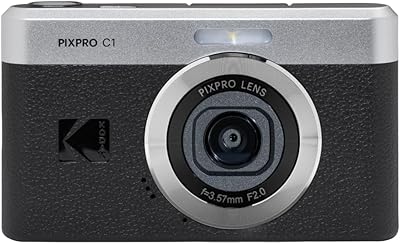
Kodak Pixpro C1
Kodak Pixpro C1
73%
72%
Image Quality (Daylight)
47%
Low-Light Performance
88%
Flip Screen Usability
83%
Waterproofing & Durability
69%
Video Quality
More
Kodak PIXPRO WPZ2 Waterproof Camera
83%
90%
Build Quality & Durability
94%
Waterproof Performance
84%
Ease of Use
80%
Photo Quality
78%
Video Quality
More
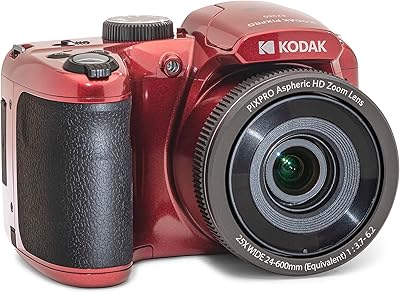
KODAK PIXPRO AZ255 Digital Camera
78%
92%
Value for Money
89%
Ease of Use
85%
Zoom Performance
80%
Image Stabilization
78%
Video Quality
More
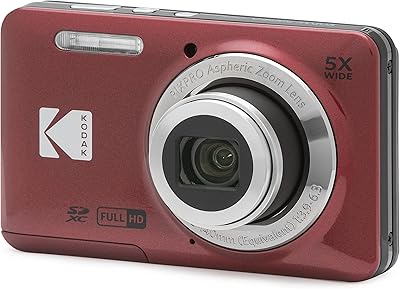
Kodak PIXPRO FZ55-RD Digital Camera
81%
88%
Value for Money
93%
Ease of Use
81%
Image Quality
77%
Build Quality
85%
Video Quality
More
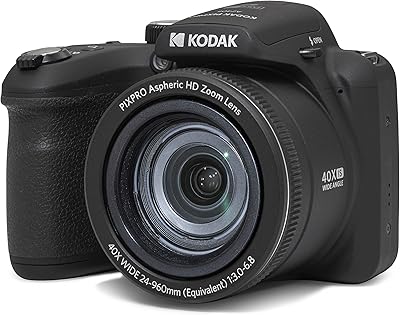
Kodak Pixpro AZ405
Kodak Pixpro AZ405
72%
91%
Optical Zoom Range
78%
Image Quality in Good Light
52%
Low-Light Performance
74%
Optical Image Stabilization
67%
Video Quality
More
Kodak PIXPRO AZ425-BK Digital Camera
84%
90%
Zoom Performance
85%
Image Quality
88%
Ease of Use
83%
Video Quality
75%
Battery Life
More
Kodak PIXPRO SP360 4K Dual Pro Pack VR Camera
81%
88%
Video Quality
82%
Ease of Use
90%
Portability
75%
Battery Life
68%
Software/Editing Tools
More
Kodak M38 35mm Film Camera
82%
89%
Ease of Use
75%
Photo Quality
91%
Portability
80%
Build Quality
78%
Low-Light Performance
More
KODAK 120″ Projector Screen with Stand
87%
94%
Ease of Setup
88%
Portability
85%
Image Clarity
90%
Sturdiness of Stand
91%
Size/Screen Area
More
Kodak Ultra Mini Portable Projector
85%
94%
Portability
90%
Ease of Use
89%
Picture Quality in Dark Environments
60%
Brightness in Well-Lit Rooms
83%
Battery Life
More

FAQ

You will need an SD card before you can save any photos — the camera does not include one. AA batteries are included, so you can power it up immediately. Grab a Class 10 card in any capacity you like up to 512GB and you are ready to shoot within minutes of opening the box.

Honestly, for pure image quality, a recent mid-range smartphone will outperform this compact Kodak in most conditions, especially indoors and in low light. Where the FZ45 wins is in the dedicated camera experience — a real zoom lens, physical buttons, no distractions, and the ability to hand it to a child or elderly relative without worrying about them accidentally accessing your messages or apps.

Not at all. The camera is fully automatic, so there are no settings to adjust or modes to navigate. Point at something, press the shutter button, done. Kids tend to get comfortable with it very quickly, and the light weight makes it easy for smaller hands to hold.

Yes, standard NiMH rechargeable AA batteries work perfectly well in this point-and-shoot. You will need to buy the batteries and a separate charger, but over time it is more economical and less wasteful than buying alkalines repeatedly, especially if the camera gets heavy use.

With the flash enabled, it handles close-range indoor shots reasonably well — people within a few meters come out properly exposed. Beyond that range or in very dim lighting without flash, the small sensor starts to struggle, producing grainy, soft images. For brightly lit indoor events it is fine; for dark venues, keep your expectations in check.

Any SD, SDHC, or SDXC card rated at Class 10 or higher will work. For everyday photography a 32GB or 64GB card is more than enough, but if you plan to record a lot of video, stepping up to 128GB is a sensible choice. Cards larger than 512GB are not supported, though you are very unlikely to need that much storage.

No, this camera has no wireless capability whatsoever — no Wi-Fi, no Bluetooth, no app pairing. To get photos onto a phone or computer you either connect the camera directly via USB cable or remove the SD card and use a card reader. If instant wireless sharing is important to you, this is a genuine limitation worth considering.

It depends on how you use it. Handheld video while standing still comes out reasonably smooth, and the digital stabilization helps with minor tremor. Walking while filming or shooting at the longer end of the zoom range is where it becomes more obvious — clips can look shaky. For static recording, like a child's school play filmed from a fixed position, it is perfectly adequate.

It is plastic construction, so it is not built for serious drops or rough treatment, but it is sturdy enough to survive the everyday bumps and handling that come with kids using it for normal activities. The battery and card door are the weakest points mechanically. A basic protective pouch is a sensible investment if young children will be the primary users.

Four times optical zoom takes you from a wide 27mm all the way to 108mm, which covers most casual shooting scenarios like portraits, small wildlife, and events reasonably well. Where it falls short is anything that requires real telephoto reach — stadium sports, birds, or distant architecture. The digital zoom can push further, but the image quality drop is noticeable enough that most users prefer to simply crop a photo afterward rather than rely on it.