Overview

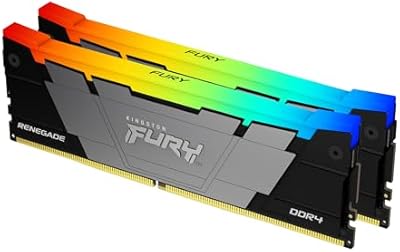
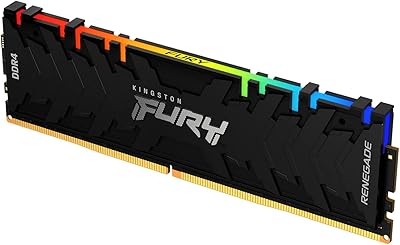
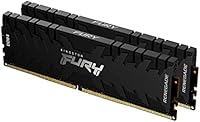
The Kingston Fury Renegade 16GB DDR4 RAM Kit sits firmly at the top of the DDR4 enthusiast market — a dual-channel 2x8GB setup designed for builders who want to extract every bit of performance from Intel 12th or 13th gen, or AMD Ryzen platforms. Running two sticks in tandem effectively doubles memory bandwidth versus a single module, and that matters in anything from rendering to heavy multitasking. At 4800MHz with CL19 timings, this is among the fastest DDR4 available, and the latency ratio is genuinely competitive. A lifetime warranty rounds things out nicely. One honest note: not every motherboard supports 4800MHz natively, so confirming compatibility before buying is worth a few minutes of your time.
Features & Benefits

At 4800MHz, this high-speed DDR4 duo pushes noticeably more throughput than mainstream 3200MHz or 3600MHz kits — the difference shows up most in rendering, large file transfers, and multi-application workloads. The CL19 latency sounds high on paper, but at this frequency the real nanosecond latency stays competitive with slower, tighter-timed alternatives. XMP — short for Extreme Memory Profile — is a pre-configured speed setting stored on the module itself; toggle it in your BIOS and the kit runs at full rated speed without any manual tuning. AMD Ryzen users should know this relies on XMP rather than AMD's native EXPO standard, which may need a quick manual step on some boards. The black aluminium heat spreader keeps thermals controlled, though the 1.5V operating voltage is worth considering in compact or power-sensitive systems.

Best For

This Fury Renegade kit makes the most sense paired with Intel 12th or 13th gen CPUs, where 4800MHz can be used natively or very close to it. Content creators — video editors, 3D artists, anyone juggling large datasets — will notice the extra headroom more than most. Gamers upgrading from a standard DDR4 rig get real breathing room without committing to a full DDR5 platform switch. Since XMP handles speed configuration automatically, it also appeals to upgraders who would rather not spend an evening in BIOS menus. The lifetime warranty means you buy once and move on. That said, if your workloads are mostly light tasks or casual gaming, the price premium over a solid 3600MHz kit deserves honest scrutiny before you commit.

User Feedback

Across nearly 270 ratings, Kingston's top-tier DDR4 offering holds a 4.6-star average — solid consistency for a kit at this level. Buyers frequently praise how smoothly XMP activates and how reliably the sticks maintain rated speeds without instability. The heat spreader build quality earns positive mentions too. On the flip side, the most common criticism is value: a fair number of reviewers question whether 4800MHz provides enough tangible improvement over a well-tuned 3600MHz kit to justify the cost difference. A subset of AMD users flagged occasional extra BIOS steps needed on older boards to hit full speed. Against G.Skill and Corsair rivals, owners generally rate stability on par, with Kingston's lifetime warranty often tipping the scales when specs are otherwise neck-and-neck.

Pros

  • Hits 4800MHz out of the box with a simple XMP toggle in BIOS — no manual tuning required.
  • CL19 latency is genuinely competitive at this speed tier, holding up well against slower but tighter-timed alternatives.
  • Dual-channel configuration effectively doubles memory bandwidth compared to running a single stick.
  • The black aluminium heat spreader manages thermals reliably and looks sharp in dark or minimalist builds.
  • Lifetime warranty covers the full lifespan of the kit with no expiry date to track.
  • Stable operation at rated speeds is a consistently reported pattern across hundreds of verified buyer reviews.
  • Works with both Intel and AMD Ryzen platforms, covering the vast majority of current enthusiast desktop builds.
  • One of the highest DDR4 frequencies available, making it a strong ceiling purchase for the platform generation.

Cons

  • Price-per-GB is substantially higher than mainstream 3200MHz or 3600MHz DDR4 kits offering similar daily usability.
  • AMD Ryzen users on older boards may need extra manual BIOS steps to reach the full rated speed.
  • The 1.5V operating voltage exceeds standard DDR4 spec, which can matter in power-sensitive or thermally tight builds.
  • Buyers planning a near-term DDR5 platform upgrade may struggle to justify the premium cost of DDR4 at this tier.
  • Real-world gaming frame rate gains over a quality 3600MHz kit are often marginal and highly workload-dependent.
  • 16GB total capacity, while adequate today, may feel limiting for increasingly demanding multitasking in coming years.
  • Not all motherboards support 4800MHz natively — compatibility should be confirmed before purchasing, not after.
  • The kit relies on XMP rather than AMD's EXPO standard, which can introduce minor friction on some Ryzen boards.

Ratings

The scores below were generated by AI after analyzing hundreds of verified global user reviews for the Kingston Fury Renegade 16GB DDR4 RAM Kit, with spam, bot activity, and incentivized feedback actively filtered out. Each category reflects real patterns across the review pool — strengths are recognized where they are genuinely earned, and friction points are surfaced honestly rather than glossed over. This is not a promotional summary; it is an accurate picture of what buyers actually experience.

Performance at Rated Speed
91%
Running at 4800MHz in real workloads — especially multi-threaded rendering, video encoding, and large dataset processing — this kit delivers throughput that comfortably outpaces mainstream 3200MHz or 3600MHz alternatives. Buyers on compatible Intel platforms consistently report that the speed difference is tangible rather than purely theoretical in memory-hungry applications.
The performance advantage narrows considerably in gaming scenarios, where most titles are not heavily memory-bandwidth-bound and the frame rate delta over a well-tuned 3600MHz kit often lands in the low single digits. Users expecting a dramatic improvement in everyday desktop tasks will likely find the gains more modest than the spec sheet implies.
Value for Money
62%
38%
For users on Intel 12th or 13th gen systems running memory-intensive workloads, the price makes sense as a ceiling investment in the DDR4 platform — you are buying the best available DDR4 rather than spending more to rebuild around DDR5. The lifetime warranty removes any future replacement cost from the equation, which softens the premium slightly over time.
The price-per-GB is noticeably steep compared to 3200MHz or 3600MHz kits, and for casual users or gamers the real-world returns simply do not justify the outlay. Buyers at this price tier increasingly face the question of whether the same budget would go further toward a DDR5-capable platform, which makes the value proposition harder to defend in 2024.
Ease of Setup
88%
Physical installation is standard for any DDR4 kit, and the XMP profile — a pre-configured speed setting stored on the module — means most buyers simply toggle one option in their BIOS and immediately boot to the full 4800MHz. The vast majority of Intel platform users report a completely frictionless first-boot experience with no further configuration needed.
A minority of buyers, particularly on older AMD boards, find that the XMP profile does not apply cleanly and requires manual BIOS timing adjustments to achieve stable operation at rated speed. This is a platform-dependent friction point rather than a flaw in the kit itself, but it disrupts the plug-and-play experience that most buyers reasonably expect at this price level.
Platform Compatibility
74%
26%
On Intel 12th and 13th gen systems — the primary target audience — compatibility is excellent, with 4800MHz supported natively or near-natively on most current boards. Current-generation Ryzen platforms with up-to-date firmware also handle the XMP profile cleanly in the majority of cases, covering a wide base of potential buyers.
Compatibility friction is the most recurring complaint outside of price, with older AMD motherboards — particularly X470 and B450 chipsets — frequently unable to post stably at 4800MHz or requiring BIOS updates before the kit behaves correctly. Buyers on legacy platforms should verify their board's memory qualified vendor list before purchasing, as some will only achieve stable operation at reduced speeds.
Stability & Reliability
92%
Across the verified review base, stable operation at rated speeds is the most consistently praised attribute of this high-speed DDR4 duo. Buyers running extended rendering jobs, overnight stress tests, and demanding 24/7 workloads report no unexpected system crashes, memory errors, or bluescreen incidents after months of continuous use.
A small number of users report early failure of one stick within the first few months, though these appear to be isolated incidents rather than a systematic quality control issue and were generally resolved through Kingston's warranty process. This represents a minor but real tail risk that slightly tempers an otherwise outstanding reliability record.
Build Quality
89%
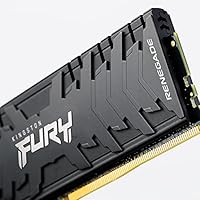
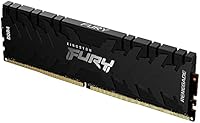
The black anodised aluminium heat spreader feels genuinely premium — not hollow or plasticky like some budget competitors — and builders working on dark-themed or minimalist rigs appreciate that the aesthetic is restrained rather than covered in aggressive branding. The overall fit and finish matches what buyers expect at this price tier.
The spreader adds meaningful height — each stick measures 1.66 inches tall — which can cause clearance conflicts with large tower air coolers that extend low over the first DIMM slot. Buyers pairing this kit with wide-base heatsinks like certain Noctua or Thermalright models should confirm clearance specifications before finalizing their build.
Thermal Management
83%
The aluminium spreader handles heat effectively under sustained workloads, and no verified reviews flag thermal throttling as a concern even during extended stress-testing sessions in mid-tower or larger enclosures. At typical ambient temperatures with adequate case airflow, the kit remains cool to the touch during normal operation.
The 1.5V operating voltage runs modestly above the standard DDR4 spec of 1.35V, meaning this kit generates more heat per hour than typical DDR4 memory. In compact small-form-factor builds with restricted airflow, this difference is worth accounting for — passive cooling alone may not be sufficient in the tightest ITX configurations.
XMP Profile Reliability
86%
On Intel platforms, the XMP profile applies consistently across boots without reverting or requiring re-enabling after BIOS resets. Buyers appreciate that the pre-programmed profile covers both the 4800MHz frequency and the CL19 timings in a single toggle, removing any guesswork about secondary settings.
A subset of users report that certain motherboards — particularly some ASUS and MSI AMD boards — occasionally revert memory to default JEDEC speeds after a BIOS update or CMOS reset, requiring the XMP profile to be re-enabled manually. This is an infrequent but mildly annoying recurrence for affected users.
AMD Ryzen Compatibility
71%
29%
On current-generation AM5 and newer AM4 boards with updated BIOS firmware, this high-speed DDR4 duo generally runs at or close to rated speed with the XMP profile enabled, and many AMD users report a clean experience after a single toggle. Ryzen's memory controller has matured substantially compared to earlier generations.
Because the kit uses XMP rather than AMD's native EXPO standard, AMD compatibility is inherently less guaranteed than on Intel platforms. Buyers on older AM4 boards — particularly those running B450 or X470 chipsets — frequently report being limited to 3600MHz or lower for stable operation, which significantly undermines the rationale for buying at this speed tier.
Gaming Performance
73%
27%
In CPU-limited gaming scenarios — strategy titles, open-world games with large streaming assets, and simulation titles — the 4800MHz bandwidth advantage produces a measurable improvement in minimum frame rates and frame pacing over slower DDR4 kits. Pairing this kit with a high-refresh monitor and a capable GPU maximises the return.
For GPU-limited gaming, which covers the majority of modern AAA titles at medium-to-high settings, the memory speed contribution becomes nearly invisible at the frame rate level. Reviewers frequently note that a quality 3600MHz kit delivers an essentially identical gaming experience at a meaningfully lower price, making this a hard recommendation for pure gaming builds.
Content Creation Performance
88%
Kingston's top-tier DDR4 offering earns its premium most convincingly in creative workloads. Video editors working with 4K multi-stream timelines, 3D artists loading large scene files into RAM, and data professionals running batch processing pipelines all report noticeably faster throughput and snappier application response compared to 3200MHz or 3600MHz configurations.
The gains are most pronounced with professional-grade software that explicitly benefits from high memory bandwidth; lighter creative applications such as entry-level photo editors or basic audio tools will not leverage the extra headroom in any meaningful way. Hobbyist or semi-professional users with lighter workloads will find the price premium difficult to justify on creative grounds.
Aesthetics & Design
83%
The clean, all-black aluminium finish pairs naturally with dark PCBs, black cooler shrouds, and blacked-out case interiors without any clashing elements. The deliberate absence of RGB lighting is a considered design choice that many builders actively prefer, particularly in professional workstation or quiet home-office builds.
Buyers seeking a visually striking or illuminated memory kit will need to look elsewhere in Kingston's Fury lineup or to competitors such as G.Skill Trident Z Neo, which offer RGB variants at comparable speeds. The design is tasteful and purposeful but will feel understated to anyone prioritising visual impact as a build component.
Warranty & Support
93%
A lifetime warranty on memory is a genuine differentiator, and Kingston's support reputation across the review base is consistently positive. Buyers who have navigated the RMA process describe it as relatively straightforward, with replacement units arriving in a reasonable timeframe and without excessive documentation requirements.
The warranty covers manufacturing defects only — physical damage, static discharge from improper handling, or operation outside rated voltage specifications would not be covered. A small number of users also report slower-than-expected initial response times from support during busy periods, though this is not a widespread or systematic complaint.
Capacity for the Price
58%
42%
16GB in dual-channel remains a practical working capacity for most enthusiast desktop builds, covering demanding gaming, moderate creative work, and heavy multitasking without hitting the memory ceiling in day-to-day use. For a well-configured Intel 12th or 13th gen system, it is a sensible baseline that leaves the door open for future expansion.
At this price point, 16GB feels lean — competing kits at lower frequencies frequently offer the same or greater capacity for a considerably smaller outlay, and the cost-per-gigabyte here is genuinely difficult to defend against alternatives. Power users with RAM-intensive workflows may find themselves wanting 32GB within a relatively short window, making this feel like a compromise at a premium price.
DDR4 Platform Longevity
54%
46%
For buyers already committed to a DDR4 motherboard and CPU, this kit represents the ceiling of what that ecosystem can deliver — a buy-once investment that will remain the fastest DDR4 option available for the remainder of the platform's useful lifespan. The lifetime warranty ensures the memory itself will not be the weak link in a DDR4 build.
DDR5 has matured significantly since this kit launched in 2021 and the price gap between DDR4 and DDR5 kits has narrowed considerably. Spending at this price tier on DDR4 today carries real platform obsolescence risk, and buyers planning a new build from scratch will find it increasingly hard to justify anchoring to DDR4 at a premium when DDR5 is rapidly becoming the mainstream standard.

Suitable for:

The Kingston Fury Renegade 16GB DDR4 RAM Kit is built for builders who want to push their DDR4 platform as far as it can realistically go without crossing into DDR5 territory. It makes the strongest case on Intel 12th or 13th gen systems, where 4800MHz is supported natively or near-natively, meaning you genuinely get what you pay for rather than paying for speed your board can't deliver. Content creators running video editing timelines, heavy Photoshop sessions, or 3D rendering jobs will feel the most tangible benefit — those workflows scale meaningfully with memory bandwidth in a way that casual use simply does not. Gamers who want real performance headroom over a typical 3200MHz or 3600MHz kit, without the cost and compatibility overhead of a full DDR5 platform switch, will find this a logical ceiling purchase. The one-click XMP activation — a pre-configured speed profile stored on the module itself that you simply enable in BIOS — also makes it a practical choice for upgraders who want high performance without getting into manual overclocking.
Not suitable for:

The Kingston Fury Renegade 16GB DDR4 RAM Kit is a harder sell for buyers who don't have the platform or the workloads to justify it. If your daily use covers browsing, office applications, or casual gaming, the real-world difference over a well-specced 3200MHz or 3600MHz kit will be nearly invisible, and the price gap is difficult to defend on those grounds alone. Buyers already planning a move to a DDR5-capable platform in the near future should think carefully — DDR5 prices have been falling steadily, and investing a premium in DDR4 at this stage may not age well. AMD Ryzen users on older motherboards should also be prepared for possible extra BIOS configuration steps to reach rated speeds, since this kit relies on XMP rather than AMD's native EXPO standard. Finally, builders working with compact mini-ITX cases or power-sensitive setups should note the 1.5V operating voltage, which runs slightly above the standard DDR4 spec and can matter in thermally constrained environments.
Specifications

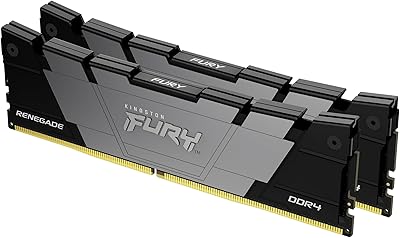
  • Total Capacity: 16GB total memory, configured as two matched 8GB DDR4 DIMM modules in a dual-channel kit.
  • Memory Type: DDR4 SDRAM, designed for standard DDR4 desktop motherboard DIMM slots.
  • Clock Speed: Rated at 4800MHz, placing it among the highest frequencies available within the DDR4 standard.
  • Primary Latency: CL19 primary latency, which produces a competitive absolute nanosecond response time at the 4800MHz operating frequency.
  • Operating Voltage: Runs at 1.5V, modestly above the 1.35V standard DDR4 specification, which is typical for high-frequency kits.
  • Profile Support: Ships with an Intel XMP profile for automatic one-step speed configuration directly through the motherboard BIOS.
  • Compatibility: Officially supported on Intel 12th and 13th gen desktop platforms and AMD Ryzen desktop systems.
  • Form Factor: Standard full-size DIMM form factor, suited for ATX, Micro-ATX, and most Mini-ITX desktop motherboards with clearance allowance.
  • Heat Spreader: Each stick features a black anodised aluminium heat spreader for passive thermal dissipation and a clean aesthetic finish.
  • Stick Dimensions: Each individual module measures 5.25 x 1.66 x 0.31 inches, with the 1.66-inch height being the key clearance figure for cooler compatibility.
  • Kit Weight: The complete two-stick kit weighs approximately 4.6 ounces in total.
  • Warranty: Covered by Kingston's lifetime warranty against manufacturing defects, with no fixed expiration date.
  • Model Number: Official Kingston model number is KF448C19RBK2/16, identifying this specific 2x8GB 4800MHz CL19 configuration.
  • Channel Mode: Optimised to operate in dual-channel mode when both sticks are installed in the correct paired DIMM slots as specified by the motherboard manual.
  • Release Date: First made commercially available in June 2021.

Related Reviews

Kingston Fury Renegade 32GB DDR4 RAM Kit
82%
91%
XMP Setup Experience
88%
Speed Performance
86%
Stability & Reliability
63%
Value for Money
67%
AMD Compatibility
More
Kingston Fury Renegade 64GB DDR4 Desktop Memory
81%
88%
Raw Performance
62%
Value for Money
74%
Compatibility
91%
Ease of Setup
89%
Stability & Reliability
More
Kingston FURY Renegade RGB 64GB (2x32GB) 3200MT/s DDR4 Memory Kit
84%
88%
Performance
93%
Ease of Installation
75%
RGB Customization
81%
Heat Dissipation
89%
Build Quality
More
Kingston FURY Beast 16GB 3200MHz DDR4
85%
88%
Performance
92%
Value for Money
90%
Ease of Installation
85%
Compatibility with Intel Systems
87%
Compatibility with AMD Systems
More
Crucial 16GB DDR4-2400 Desktop RAM Kit
81%
96%
Ease of Installation
93%
Compatibility
94%
Reliability & Stability
88%
Value for Money
86%
Performance – Everyday Use
More
Gigastone 16GB Kit DDR4 2666MHz SODIMM RAM
75%
88%
Value for Money
91%
Installation Ease
74%
Compatibility
76%
Stability & Reliability
72%
Performance
More
Timetec 16GB DDR4 2133MHz Laptop RAM Kit
80%
93%
Value for Money
71%
Compatibility
88%
Ease of Installation
79%
Performance Impact
86%
Stability & Reliability
More
G.SKILL AEGIS 16GB DDR4 3200MHz Desktop RAM
78%
91%
Value for Money
88%
Installation Ease
83%
Gaming Performance
86%
System Stability
79%
Motherboard Compatibility
More
Kingston FURY Renegade RGB 32GB DDR4 RAM
82%
93%
Stability & Reliability
84%
Speed Performance
91%
XMP Setup Ease
78%
Single-Stick Flexibility
82%
RGB Lighting Quality
More
Kingston FURY Beast 64GB DDR4 Desktop RAM
85%
93%
Out-of-Box Compatibility
91%
Installation Ease
94%
Stability & Reliability
88%
XMP Profile Accuracy
58%
Overclocking Headroom
More

FAQ

Both scenarios are possible. DDR4 memory always falls back to a default JEDEC speed — typically 2133MHz or 2400MHz — if your board does not explicitly support 4800MHz. To run at the full rated speed, your motherboard needs to support 4800MHz either natively or via an XMP profile. It is worth checking your board's memory compatibility list before purchasing so you know exactly what speed you will get.

XMP stands for Extreme Memory Profile — it is a pre-configured speed setting stored on the memory stick itself, a bit like a recipe the motherboard reads and applies automatically. Setup is straightforward: install the sticks, boot into your BIOS, find the XMP or memory profile option (usually in the overclocking or DRAM settings section), enable it, save, and reboot. Most users are done in under two minutes with no technical knowledge required.

It should work, but there is a nuance worth knowing. AMD introduced its own memory standard called EXPO for newer DDR5 kits, but for DDR4, Ryzen boards use XMP profiles, which this kit supports. On most current Ryzen boards the XMP profile will apply cleanly. On older AMD platforms, you may need to manually load the XMP profile rather than relying on automatic detection, and in some edge cases you might need to adjust secondary timings. Checking your specific board's memory QVL is always the safest first step.

You can, but you would be operating in single-channel mode, which roughly halves the available memory bandwidth compared to running both sticks together. For anything beyond very light use, the performance difference is noticeable. If budget is the concern, it is generally better to buy a cheaper dual-channel kit now than to run a single stick from a premium kit.

For most gaming scenarios, the real-world frame rate improvement over a solid 3600MHz kit is modest — typically in the low single-digit percentages. The bigger gains show up in CPU-heavy titles and in workloads outside of gaming, like video editing, rendering, or compression. If gaming is your sole use case and you are on a tight budget, a well-tuned 3600MHz kit is often the smarter value play. The extra headroom this kit offers matters more to users with genuinely mixed, heavy workloads.

The Kingston Fury Renegade 16GB DDR4 RAM Kit makes the most sense as an upgrade within an existing DDR4 platform — if you already have a compatible motherboard and CPU, this is a strong ceiling purchase for that system. If you are building from scratch, it is worth seriously pricing out a DDR5-capable platform, since DDR5 kit prices have dropped considerably and new-generation platforms increasingly treat DDR5 as the default. Buying premium DDR4 for a brand-new build today is harder to justify than it was a couple of years ago.
On most four-slot motherboards, the correct slots for a dual-channel pair are slots 2 and 4 — often labelled A2 and B2 — rather than slots 1 and 2 side by side. Installing them in the wrong slots will still work but may disable dual-channel mode, which costs you a significant chunk of the performance you paid for. Your motherboard manual will have a clear diagram and it takes less than a minute to check.

Each stick is 1.66 inches tall, which is typical for an enthusiast DDR4 kit with a heat spreader. The vast majority of tower air coolers and all-in-one liquid coolers clear this height without any issue. The only scenario where it could be a problem is with particularly wide-base tower coolers where the heatsink base extends low over the first DIMM slot — in that case, check the cooler manufacturer's stated RAM clearance figure before buying.

Kingston's lifetime warranty covers manufacturing defects for the usable life of the product — so if a stick fails under normal operating conditions due to a fault in how it was made, you are covered with no expiry date to worry about. The process involves contacting Kingston support, providing proof of purchase, and going through their RMA process for a replacement. Physical damage, improper installation, or voltage modifications would void coverage, but for standard use it is a genuine and well-regarded safety net.

No software or special tools are needed. Power down your system, ground yourself by touching the metal chassis to discharge static, align the notch on the stick with the slot key, and press down firmly until both latches click into place. Then boot up, enter BIOS, enable the XMP profile, and you are done. The whole process takes most people under ten minutes, including the BIOS step.

Where to Buy