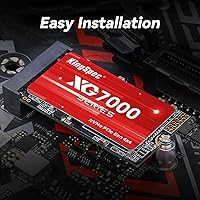
Overview

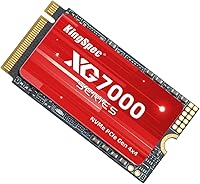
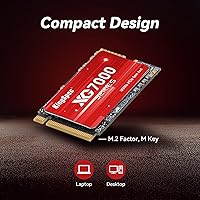
The KingSpec XG7000 1TB M.2 2242 NVMe SSD occupies a genuinely uncommon space in the storage market: a PCIe 4.0 drive built in the shorter 2242 form factor, measuring just 42mm long rather than the standard 80mm. Most drives ignore this size entirely, leaving users of compact laptops, mini-PCs, and niche handheld devices with slow or limited options. KingSpec has been quietly building a reputation as a credible budget-to-midrange storage brand, and this drive is one of their more ambitious entries. At 1TB, the capacity hits a practical sweet spot — enough for a primary OS drive or solid secondary storage without overpaying for space you may not use.

Features & Benefits

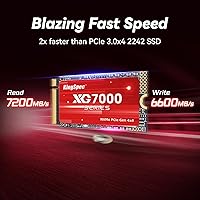
On paper, the specs for this compact NVMe drive are hard to ignore for the form factor. It runs on a PCIe 4.0 x4 interface, with sequential read speeds reaching 7200MB/s and writes up to 6600MB/s — figures that translate to fast boot times and snappy application launches when paired with a Gen 4-capable host slot. Drop it into a PCIe 3.0 system and it still functions fine, just at reduced throughput. The 3D NAND TLC flash keeps costs reasonable while delivering adequate endurance for everyday workloads. Built-in bad sector management adds passive data protection, and a 3-year warranty provides reasonable peace of mind for a drive at this price tier.

Best For

This 2242 SSD is a focused solution, not a universal recommendation. It makes the most sense if your device physically requires the shorter 2242 format — think older ultrabooks with tight chassis constraints, handheld gaming PCs like the GPD Win series, or compact mini-PCs where a full-length drive simply will not fit. It also works well as a secondary drive in laptops that already have a 2280 SSD in the primary slot. Students and light content creators who want fast, reliable storage without flagship pricing will find it performs comfortably. If your machine accepts standard 2280 drives, though, you will have far more competitive options at this capacity.

User Feedback

With around 58 ratings and a 4.3-star average, the KingSpec Gen 4 drive has earned a cautiously positive reception — though that sample size is too small to draw firm long-term reliability conclusions. Buyers most commonly praise the straightforward installation and the noticeable speed jump over older SATA drives in the same machines, with handheld PC users making up a notable share of satisfied reviewers. On the downside, a handful of buyers question whether peak speeds hold under sustained workloads, raising mild concerns about thermal throttling given the drive's limited surface area for heat dissipation. After-sales support feedback is sparse but generally neutral.

Pros

  • One of the very few PCIe 4.0 NVMe options available in the compact 2242 form factor.
  • Offers 1TB of storage — a practical capacity that covers most everyday use cases comfortably.
  • Advertised sequential read speeds translate to noticeably fast boot times and application launches.
  • Backward compatibility with PCIe 3.0 slots means it works in a wider range of older devices.
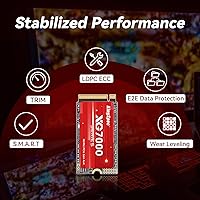
  • Built-in bad sector management provides passive protection without any user configuration needed.
  • 3-year limited warranty is reassuring for a drive in this price bracket.
  • Early buyers report straightforward installation with no special tools or adapters required.
  • Compact size and light weight make this 2242 SSD easy to handle during installation in tight chassis.
  • Competitive price for Gen 4 performance in a form factor where options are genuinely scarce.
  • TLC NAND keeps costs down without sacrificing reasonable endurance for typical daily workloads.

Cons

  • Only around 58 user ratings exist, making long-term reliability conclusions difficult to draw with confidence.
  • Thermal throttling under sustained workloads is a realistic concern given the drive's limited surface area.
  • Peak Gen 4 speeds are only achievable on a PCIe 4.0-capable host slot — many target devices run PCIe 3.0.
  • Real-world sustained write speeds may fall short of the advertised 6600MB/s figures during extended transfers.
  • KingSpec lacks the brand recognition and independent review coverage of established storage manufacturers.
  • After-sales support feedback is sparse, making it hard to evaluate how warranty claims are handled in practice.
  • No published TBW (terabytes written) endurance rating is readily available, complicating direct comparisons.
  • Users outside the 2242 niche will find better-value and better-tested alternatives in the 2280 market.
  • Limited thermal headroom in the compact form factor could be a concern in passively cooled mini-PCs.
  • The drive is not well-suited for workstation or prosumer tasks that demand consistent, heavy write performance.

Ratings

The scores below reflect an AI-driven analysis of verified global buyer reviews for the KingSpec XG7000 1TB M.2 2242 NVMe SSD, with spam, bot activity, and incentivized feedback actively filtered out to ensure the results represent genuine user experiences. With roughly 58 confirmed ratings at the time of analysis, the sample is modest but consistent enough to identify clear patterns. Both the standout strengths and the real-world frustrations are reflected honestly in every category score.

Sequential Read Speed
83%
Buyers who tested this compact NVMe drive on Gen 4 systems reported noticeably fast boot times and snappy application launches that matched or came close to the advertised figures in benchmark tools. For handheld gaming PC users especially, the speed advantage over older SATA or Gen 3 drives was immediately apparent in game load screens.
Hitting anywhere near 7200MB/s requires a confirmed PCIe 4.0 host slot, which many of the target devices — older ultrabooks, budget mini-PCs — simply do not have. Users on Gen 3 systems saw roughly half the advertised throughput, which is expected but still disappointing when the marketing leads with Gen 4 numbers.
Sequential Write Speed
71%
29%
For short bursts — copying a game install folder, moving a batch of photos — write speeds felt fast and the drive responded well. Users doing typical laptop or handheld PC tasks reported no noticeable lag or stutter during file operations under normal conditions.
Sustained write performance under prolonged heavy loads raised concerns among a portion of buyers, with some noting speed drops that suggest the drive's write cache fills up faster than expected on longer transfers. TLC NAND at this tier is known to throttle once the SLC cache is exhausted, and this drive appears to follow that pattern.
Form Factor Fit
92%
For the specific audience this drive targets, the 2242 footprint is the entire reason to buy it — and it delivers exactly what is promised. Users upgrading GPD Win handhelds, compact mini-PCs, and ultrabooks with fixed-length M.2 slots reported a clean, snug fit with no compatibility surprises during installation.
The 2242 form factor is inherently a niche, and a small number of buyers purchased this without confirming their device's slot requirements, leading to returns. The drive itself is blameless here, but the narrow compatibility window means mistakes happen more often than with standard 2280 drives.
Installation Experience
89%
Reviewers consistently highlighted how painless installation was — no proprietary connectors, no adapter required, just slide it into the M.2 slot and secure the screw. Even users who had never swapped internal storage before described the process as straightforward and confidence-inspiring.
A small number of users noted that their device required BIOS configuration to switch the M.2 slot from SATA to NVMe mode, which caught first-timers off guard. No setup guide is included in the box, so less experienced buyers may need to spend time searching for device-specific instructions online.
Thermal Performance
62%
38%
Under light to moderate everyday workloads — web browsing, document editing, casual gaming — the KingSpec Gen 4 drive maintained stable temperatures without any reports of throttling. For users running it in well-ventilated mini-PCs or laptops with decent airflow, heat was not a practical concern.
The 2242 footprint means there is significantly less PCB surface area to shed heat compared to a 2280 drive, and users pushing sustained workloads in passively cooled or cramped chassis reported signs of thermal throttling. Without a heatspreader included, buyers in thermally constrained devices are on their own for heat management.
Value for Money
86%
At its price point, finding a PCIe 4.0 NVMe drive in the 2242 form factor at 1TB is genuinely difficult, and most buyers acknowledged they were paying a fair rate for something with almost no direct competition in the segment. For handheld gamers and compact laptop users, the value proposition is strong simply because alternatives are scarce.
If your device supports the standard 2280 form factor, the value calculus shifts significantly — you can buy more proven drives with better-documented endurance at comparable or lower prices. The premium here is largely a niche tax rather than a reflection of exceptional performance relative to the broader Gen 4 market.
Build Quality
74%
26%
The drive feels solid for its weight class, and the PCB construction appears consistent with what buyers expect from a midrange storage brand. No users reported physical defects, bent connectors, or obvious quality control issues out of the box.
There is no heatspreader or thermal pad included, which feels like a missed opportunity given the thermal constraints of the form factor. A few buyers also noted that the drive feels lightweight to the point of feeling insubstantial, though this is partly just physics given how small 2242 drives are.
Reliability & Endurance
66%
34%
Over the months of ownership represented in the current review pool, no major failure reports have surfaced, and the built-in bad sector management appears to work quietly in the background without user intervention. For everyday storage tasks, buyers have not raised serious red flags about data integrity.
With only around 58 reviews available, drawing confident conclusions about long-term reliability is simply not possible yet. TLC NAND at this price tier has historically shown more wear under heavy write cycles than MLC alternatives, and without published TBW figures from KingSpec, endurance projections remain uncertain.
Warranty & Support
69%
31%
The 3-year limited warranty is a reasonable commitment for a drive in this price bracket, and KingSpec's stated permanent technical support adds some reassurance for users who are new to upgrading internal storage. Contact details and support channels are accessible without much searching.
Actual warranty claim experiences are barely represented in the current review pool, making it hard to judge how smoothly the process works in practice. KingSpec does not have the same established support infrastructure as major brands, so the warranty promise is only as good as the follow-through, which remains largely untested here.
Software & Ecosystem
51%
49%
The drive is plug-and-play on modern Windows and Linux systems, with no drivers needed and no bloatware to uninstall. For users who just want to install and forget, the lack of bundled software keeps things clean.
KingSpec does not offer a dedicated drive management utility, meaning users have no first-party tool for monitoring drive health, checking temperatures, or managing firmware updates. Buyers relying on third-party tools like CrystalDiskInfo or hdparm can get by, but the absence of any ecosystem support feels like a gap compared to more established competitors.
Compatibility Range
78%
22%
PCIe 3.0 backward compatibility genuinely expands the drive's usefulness beyond pure Gen 4 systems, and buyers confirmed it worked without issue across a range of host platforms including older laptops and embedded systems. NVMe protocol support is broad enough that OS compatibility was never raised as a concern.
The 2242 form factor itself limits the buyer pool considerably, and users who assumed M.2 meant universal compatibility were occasionally caught out. Compatibility with very old systems that lack NVMe boot support in the BIOS is also a potential issue that is not clearly flagged in the product listing.
Packaging & Presentation
58%
42%
The drive arrives safely packed and in good condition according to buyers, with no reports of transit damage or poor packaging choices. For a budget-to-midrange product, the unboxing experience is functional and adequate.
There is minimal documentation included, no thermal pad, and no accessory of any kind beyond the drive itself. Buyers expecting a mounting screw, installation guide, or even basic quick-start card will find the package barebones compared to some competing brands that include at least rudimentary accessories.

Suitable for:

The KingSpec XG7000 1TB M.2 2242 NVMe SSD was built for a specific audience, and if you fall into that group, it is genuinely hard to find a better alternative at this price. It is the obvious choice for anyone upgrading storage in a device that physically requires the shorter 2242 form factor — a constraint common in handheld gaming PCs like the GPD Win series, older ultrabooks, and various compact mini-PCs where a standard 2280 drive simply will not fit. Handheld PC gamers in particular stand to benefit the most, since 1TB of Gen 4 storage means faster game load times and enough space to keep a decent library installed. It also works well as a secondary drive in laptops that have a spare 2242 slot sitting unused alongside an occupied 2280 primary slot. Students and light creative users who want a meaningful speed upgrade over aging SATA storage, without spending on a premium-tier brand, will find this compact NVMe drive a sensible, practical choice.

Not suitable for:

If your device accepts the full-length 2280 form factor, the KingSpec XG7000 1TB M.2 2242 NVMe SSD is not where you should be shopping — the 2280 market at this price range is far more competitive, with more proven drives from brands carrying longer track records. Buyers who run sustained, heavy workloads like large video exports, continuous database writes, or extended file transfers should approach TLC NAND drives at this tier cautiously, as write speed consistency under prolonged load is not guaranteed and thermal throttling is a realistic concern given the drive's small physical footprint. Users who prioritize long-term reliability data and large community-verified reviews will find the current sample size of roughly 58 ratings too thin to place full confidence in. Those needing enterprise-grade endurance ratings or warranty terms beyond three years should look at higher-tier options. And if you already own a PCIe 3.0 system, you will not get anywhere near the advertised peak speeds, which significantly changes the value equation.

Specifications

  • Form Factor: This drive uses the M.2 2242 format, measuring 42mm x 22mm x 3.5mm, which is significantly shorter than the common 2280 standard.
  • Interface: It connects via a PCIe 4.0 x4 interface, offering up to four lanes of Gen 4 bandwidth for high-throughput data transfer.
  • Protocol: The drive operates over the NVMe protocol, which provides much lower latency and higher throughput compared to older AHCI-based storage.
  • Read Speed: Sequential read speeds are rated at up to 7200MB/s under optimal conditions on a compatible PCIe 4.0 host system.
  • Write Speed: Sequential write speeds reach up to 6600MB/s, though sustained workloads may see some variance depending on thermal conditions.
  • Capacity: The drive offers 1TB of usable storage, suitable as a primary OS drive or a high-capacity secondary storage option.
  • Flash Type: Storage cells use 3D NAND TLC (Triple-Level Cell) flash, balancing affordable pricing with adequate endurance for typical daily use.
  • Compatibility: The drive is backward compatible with PCIe 3.0 M.2 slots, though speeds will be limited to the host interface's maximum bandwidth.
  • Bad Sector Mgmt: Built-in bad sector management monitors and remaps failing cells automatically, providing passive protection against data corruption without user intervention.
  • Weight: The drive weighs approximately 0.317 ounces (around 9 grams), making it one of the lightest internal storage options available.
  • Series: This drive belongs to KingSpec's XG7000 series, which represents the brand's current flagship PCIe 4.0 product line.
  • Warranty: KingSpec covers this drive with a 3-year limited warranty and states that permanent technical support is available to registered users.
  • Installation: The drive is designed for internal installation only and requires no external power connector beyond the M.2 slot itself.
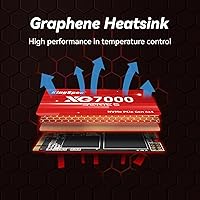
  • Color: The drive ships in black with a standard M.2 form factor PCB, with no heatspreader included in the default package.
  • Compatible Devices: Designed for use in laptops, ultrabooks, handheld gaming PCs, mini-PCs, and servers that include an M.2 2242 PCIe slot.
  • PCIe Generation: The drive is built on the PCIe 4.0 specification, which doubles the per-lane bandwidth available compared to PCIe 3.0 drives.

Related Reviews

KingSpec XG7000 1TB M.2 2242 SSD
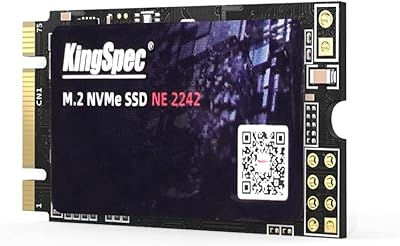
88%
94%
Performance
96%
Read Speed
89%
Build Quality
90%
Reliability
85%
Compatibility
More
KingSpec NE-512 2242 512GB M.2 NVMe SSD
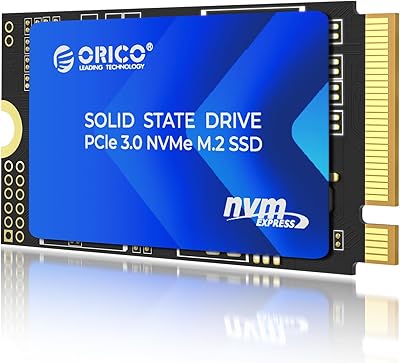
77%
88%
Value for Money
79%
Read Performance
71%
Write Performance
93%
Installation Ease
91%
Form Factor Compatibility
More
ORICO M.2 2242 NVMe SSD 1TB
87%
89%
Performance
92%
Value for Money
88%
Heat Dissipation
75%
Installation Ease
91%
Build Quality
More
KingSpec 1TB M.2 2230 SSD NVMe Gen3x4
87%
94%
Performance
92%
Read Speed
88%
Compatibility with Small Devices
65%
Ease of Installation
89%
Durability (Shock Resistance)
More
KingSpec NN900S 1TB M.2 NVMe SSD
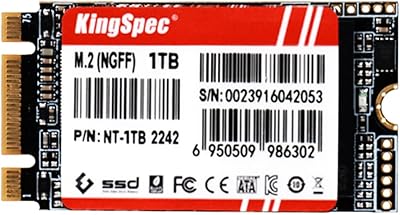
73%
83%
Read & Write Performance
88%
Value for Money
79%
Build & Form Factor
54%
NAND Flash Transparency
91%
Installation & Compatibility
More
KingSpec OneBoom X400 1TB M.2 NVMe SSD
88%
91%
Performance
94%
Read Speed
85%
Thermal Management
88%
Ease of Installation
89%
Compatibility
More
KingSpec NT Series 1TB M.2 2242 SATA SSD
86%
89%
Performance Boost Over HDDs
93%
Ease of Installation
85%
Compatibility with Devices
88%
Speed (Read/Write)
92%
Value for Money
More
KingSpec NX Series 1TB NVMe M.2 SSD
74%
91%
Value for Money
78%
Read Speed Performance
67%
Write Speed Performance
93%
Installation & Compatibility
61%
Long-Term Reliability
More
KingSpec XG7000 1TB NVMe SSD
88%
93%
Performance in Gaming
90%
Ease of Installation
94%
Read Speed
88%
Write Speed
85%
Thermal Management
More
GAMERKING 1TB M.2 NVMe SSD
87%
89%
Performance
92%
Speed (Read/Write)
80%
Durability (MTTF)
91%
Compatibility
94%
Ease of Installation
More

FAQ

Check your device's manual or the manufacturer's spec page and look for the M.2 slot description — it should list supported form factors like 2242, 2260, or 2280. The number refers to width and length in millimeters, so 2242 means 22mm wide and 42mm long. Some motherboards and laptops support multiple lengths on the same slot, but others are fixed. If you are unsure, physically measuring the slot or checking an enthusiast forum for your specific device model is the safest approach before purchasing.

Yes, it will work. The KingSpec XG7000 1TB M.2 2242 NVMe SSD is backward compatible with PCIe 3.0 slots, so your system will recognize and use it without any issues. The catch is that you will not get anywhere near the 7200MB/s read speeds — on a Gen 3 system, expect roughly half that in sequential throughput. For most everyday tasks like booting Windows or launching applications, you likely will not notice the difference in practice.

It is one of the better options available specifically because most handheld gaming PCs require the shorter 2242 form factor and Gen 4 drives in that size are rare. You get 1TB of fast storage in a footprint that actually fits the hardware. Just confirm your specific handheld model uses an M.2 2242 slot before ordering, since some use proprietary or different-length slots.

It is a fair concern. The 2242 form factor is physically smaller than a 2280 drive, which means there is less surface area to dissipate heat. Under light to moderate use, most users report no issues. However, during extended, sustained workloads — think large file transfers or prolonged game installs — there is a possibility of thermal throttling. If your device has poor airflow around the M.2 slot, it is worth monitoring temperatures after installation using a tool like CrystalDiskInfo.

For typical tasks — booting your OS, opening applications, loading game levels — you will notice this compact NVMe drive feels fast and responsive. The peak sequential figures of 7200MB/s are benchmark numbers that require ideal conditions and a Gen 4 host. In real use on mixed workloads, expect practical speeds closer to 3000–5000MB/s reads, which is still a substantial step up from SATA SSDs or any spinning hard drive.

KingSpec does not bundle migration software in the box. If you are replacing an existing drive, you will need to use a third-party tool like Macrium Reflect Free or Clonezilla to clone your current drive, or do a fresh OS install. Both approaches are well-documented online and are straightforward for most users.

TLC flash stores three bits per cell, which gives you more storage density at a lower cost, but it does wear out faster under heavy write loads compared to MLC (two bits per cell). For everyday use — browsing, gaming, document work, media storage — TLC is perfectly adequate and will last many years. If you are writing terabytes of data every month, a more endurance-focused drive would be a better fit.

It works well as a primary boot drive, and that is actually one of its strongest use cases in devices where it is the only available storage slot. Fast NVMe speeds mean your OS loads quickly and applications feel snappy. If your device has two M.2 slots and you already have a 2280 drive as the primary, this 2242 SSD slots in nicely as fast secondary storage for games or files.

KingSpec has been around for over a decade and has built a reasonable reputation in the budget-to-midrange storage space, though they do not have the same track record volume as brands like Samsung or Western Digital. The 3-year warranty is legitimate, and their support channel is accessible, but user feedback on the warranty claim process is limited given the relatively small number of reviews currently available. Keeping a backup of important data is always wise regardless of brand.

On modern systems running Windows 10 or 11, no additional drivers are needed — the OS includes native NVMe support. For best performance, make sure your BIOS has the M.2 slot set to NVMe mode rather than SATA or AHCI mode, which some motherboards default to. On Linux, NVMe support is built into the kernel and should work out of the box on any reasonably recent distribution.