
Overview

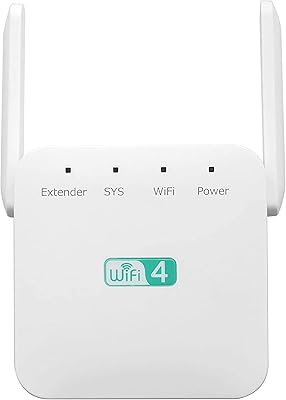
The Hyzom WiFi Extender Repeater entered the market in mid-2025 as a single-band repeater built to push wireless signal into the corners of larger homes, garages, and outdoor spaces where routers simply can't reach. Hyzom is a relatively new name in networking hardware, but this signal booster makes a confident debut with its four-antenna design and a claimed coverage area suited to sprawling floor plans. It supports two setup paths — WPS button activation or browser-based configuration — keeping things accessible for people who have never touched a router menu. Worth stating upfront: this is not a mesh system or a dual-band upgrade. It extends what you already have, and real-world results will depend heavily on your existing router's quality and home layout.

Features & Benefits

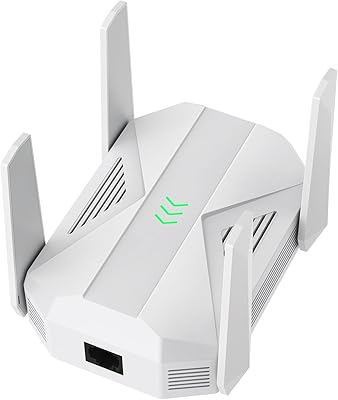
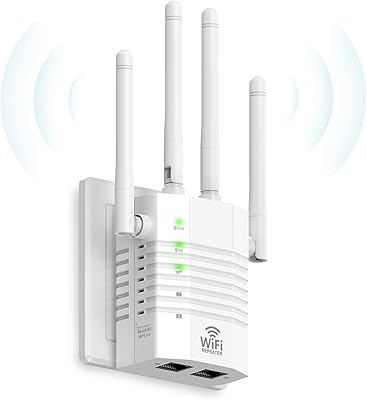
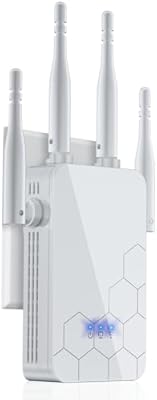
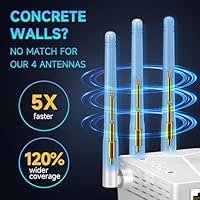
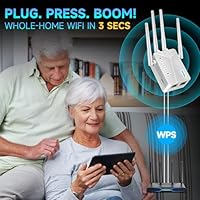
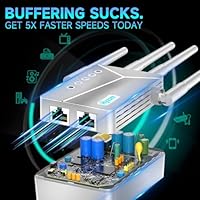
The four high-gain antennas are the hardware story here — designed to push signal through concrete walls, multiple floors, and appliance-dense rooms that typically punish wireless performance. Single-band operation works well enough for browsing, smart home devices, and video calls, but heavy users running simultaneous 4K streams or competitive online gaming may bump against its ceiling. The built-in Ethernet port is a practical addition, letting you wire a PC or console directly for lower latency without relying on wireless alone. Setup is genuinely fast: press the WPS button on both devices and you're connected in under a minute, or configure through a browser if you prefer more control. At under 6.5 inches long and just over 6 ounces, placement options are flexible.

Best For

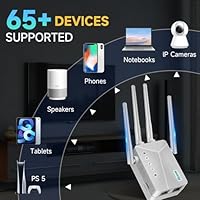
This signal booster makes the most sense for homeowners dealing with dead spots in rooms far from the router — a basement office, a back bedroom, or a detached garage. Renters are a natural fit too, since running a full mesh system isn't always an option when you don't own the walls. It handles outdoor coverage reasonably well for patios and backyard work areas, provided you position it carefully to minimize interference. Smart home users with connected cameras, TVs, and IoT gadgets should find the 65-device capacity sufficient for most households. If router menus make your eyes glaze over, the one-press WPS activation means you likely won't need to open one.

User Feedback

Buyers consistently highlight two things: how fast the setup actually is, and the real improvement in coverage within previously dead areas of their homes. The criticisms cluster around predictable limitations. Single-band performance draws the most feedback — users expecting full-speed streaming or lag-free gaming at distance often find the signal workable but not impressive under heavy load. Several reviews stress that antenna placement matters more than expected; repositioning by even a few feet can meaningfully change results. A smaller number of users flag occasional quirks with less common router brands, and a few who deployed it outdoors raised questions about long-term weather durability. Most buyers, weighing the trade-offs honestly, consider it a fair value for the use case.

Pros

  • WPS setup takes under a minute, making installation accessible for non-technical users.
  • Four external antennas give this signal booster meaningful reach through walls and across floors.
  • The built-in Ethernet port is a genuinely useful addition for wiring a PC or console directly.
  • Compatible with a wide range of routers including Google and Eero, reducing compatibility headaches.
  • Compact and lightweight enough to place discreetly without dominating a room.
  • Handles 65-plus connected devices, which covers most smart-home-heavy households comfortably.
  • WPA/WPA2-PSK encryption keeps the extended network secure for both indoor and outdoor use.
  • Browser-based setup option gives more control to users who want to configure things manually.
  • Landed at a strong category rank shortly after launch, suggesting broad initial buyer satisfaction.
  • Outdoor placement works reasonably well for patios and workshops when positioned thoughtfully.

Cons

  • Single-band operation means speeds drop more noticeably under heavy simultaneous use than dual-band alternatives.
  • Real-world range falls short of the maximum claimed figure in homes with dense walls or heavy interference.
  • Antenna placement is more sensitive than expected — small repositioning changes can significantly affect performance.
  • Not all router brands play nicely with it; a small number of users report pairing issues with less common models.
  • No dual-band support means devices cannot automatically switch to a less congested frequency.
  • Long-term outdoor durability has not yet been proven given the product only launched in mid-2025.
  • Users upgrading from a modern mesh system will find the feature set a noticeable step down.
  • Single-band congestion becomes apparent in households where multiple users stream video simultaneously.

Ratings

The scores below for the Hyzom WiFi Extender Repeater were generated by our AI review engine after analyzing verified purchase feedback from buyers worldwide, with spam, bot-submitted, and incentivized reviews actively filtered out before scoring. Each category reflects the honest spread of real user experience — where this signal booster earns strong marks and where it genuinely falls short. Nothing has been softened to protect the brand.

Ease of Setup
92%
Users across all technical skill levels consistently describe the WPS pairing process as one of the fastest they have experienced with any networking device — most report being connected in under two minutes. Even buyers who typically dread router configuration found the process straightforward without needing to read any instructions.
A small subset of users with older or less common routers hit a wall with WPS compatibility and had to fall back on browser-based setup, which, while still workable, added friction they were not expecting. A clearer troubleshooting guide in the box would prevent most of these frustrations.
Coverage Range
74%
26%
In open-plan homes and single-story layouts, this signal booster delivers a meaningful and noticeable improvement over the unaided router, pushing usable signal into garages, back bedrooms, and backyard areas that previously had none. Many users in suburban homes report the improvement as immediately obvious.
Buyers in homes with thick concrete walls, multi-story layouts with dense floor construction, or heavy appliance interference report falling noticeably short of the maximum claimed range. The gap between ideal-condition specs and real-world performance is a consistent thread in critical reviews.
Wireless Speed Performance
61%
39%
For everyday tasks — web browsing, smart home device polling, standard-definition video calls, and music streaming — the signal booster delivers reliably stable throughput that satisfies the majority of its core audience. Users replacing a dead zone with any usable connection are often genuinely satisfied.
The single-band architecture is the hard ceiling here, and users who expected dual-band-level throughput at range are frequently disappointed. Households running simultaneous 4K streams or online gaming sessions on the extended network report speed drops that make the limitation difficult to ignore.
Router Compatibility
79%
21%
Pairing with mainstream router brands including Google Nest WiFi and Eero is consistently smooth, and the broad compatibility claim holds up well for the large majority of standard home setups. Users who buy this to complement a common consumer gateway rarely report any connection issues.
A recurring pattern in one-star reviews involves less common or ISP-issued router models where WPS handshakes fail or the extended network behaves inconsistently. These edge cases are not widespread, but they are real, and buyers with non-standard router setups should factor in some risk.
Device Capacity Handling
71%
29%
Households loaded with smart home gadgets — Ring cameras, smart plugs, connected TVs, voice assistants — report that this WiFi extender holds up well under the concurrent load of 20 to 40 low-bandwidth devices. The 65-device ceiling rarely becomes an issue for typical smart home deployments.
When the connected device mix shifts toward bandwidth-intensive clients all active at once, the single-band limitation becomes a bottleneck that no device count ceiling can compensate for. Users running a media-heavy household on the extended network notice congestion during peak hours.
Ethernet Port Utility
83%
Buyers who wire a gaming console or desktop PC directly to the Ethernet port consistently describe the result as a noticeably more stable and reliable connection than anything the wireless extended signal provides at range. For mixed households where one user needs low latency, this port pulls real weight.
There is only one port, which limits wired connections to a single device unless the buyer adds a switch. Users who wanted to wire both a PC and a streaming box simultaneously found this a genuine inconvenience that the product does not address.
Outdoor Performance
66%
34%
Buyers who deploy this signal booster for covered patio areas, backyard workshops, or home offices in detached structures report solid results when placement is thoughtful and the unit is shielded from direct exposure. The range in open outdoor environments often exceeds what users experience indoors.
Because the product only launched in mid-2025, long-term outdoor durability data simply does not exist yet, and a handful of early reviewers have raised questions about weather resilience over time. Users in harsher climates should treat outdoor deployment as a moderate risk for now.
Antenna Placement Sensitivity
58%
42%
Users who take the time to experiment with antenna orientation and unit positioning often report finding a configuration that produces genuinely strong results, and the adjustable external antennas at least give buyers some control over the signal direction.
The sensitivity to placement is higher than most buyers expect — repositioning by just a few feet or rotating an antenna changes results enough that some users spend considerable time troubleshooting what should be a simple install. This is a recurring frustration in mid-tier reviews.
Build Quality & Design
76%
24%
The unit feels solid in hand for its weight class and the four antennas have a secure feel when adjusted. At 6.3 oz and a compact footprint, it tucks away without drawing attention and does not feel cheap despite the mid-range price point.
A few buyers note that the plastic housing picks up scuffs easily and the antennas, while functional, feel less robust than those on competing devices in the same category. Nothing feels like it will fail imminently, but premium it is not.
Value for Money
78%
22%
For renters, non-technical users, and homeowners dealing with a specific and clearly defined dead zone, this signal booster lands at a price point that makes the trade-offs easy to accept. Users who go in with accurate expectations tend to rate the value positively and feel the purchase was worth it.
Buyers who compare it against dual-band extenders at a similar or slightly higher price often conclude in retrospect that the extra outlay would have bought them meaningfully better performance. The value case weakens when the buyer's use case involves any serious bandwidth demand.
Security Features
81%
19%
WPA/WPA2-PSK encryption is the right baseline for a consumer-grade repeater, and users who extend their network outdoors particularly appreciate that the security layer does not degrade when the signal leaves the house. Setup does not require the buyer to configure security separately.
Advanced users note the absence of WPA3 support, which is increasingly standard in newer networking hardware. For security-conscious buyers or those on enterprise-adjacent home networks, this omission is worth considering before purchasing.
Instruction Quality
63%
37%
The WPS path is intuitive enough that most buyers never consult the manual at all, and for that audience the minimal documentation is not a problem. Users who stay on the happy path find everything they need to get connected quickly.
Anyone who encounters a compatibility issue or wants to configure advanced settings finds the included documentation thin and unhelpful. Several reviews specifically mention that a better-written quick-start guide or online resource would have saved them significant troubleshooting time.

Suitable for:

The Hyzom WiFi Extender Repeater is a practical pick for anyone living in a larger home where the main router simply cannot reach every corner — think sprawling ranch-style layouts, multi-story houses with thick interior walls, or properties with a detached garage or backyard workshop. Renters are especially well-served here, since installing a full mesh network often isn't feasible without landlord approval or rewiring, and this signal booster plugs in without any infrastructure changes. Non-technical users will appreciate that the WPS setup path requires almost no prior knowledge — if you can press a button, you can get connected. Households running a collection of smart home devices like security cameras, smart TVs, and voice assistants will find the capacity headroom useful, since the load is spread across many low-bandwidth gadgets rather than a few demanding ones. It also handles outdoor coverage reasonably well for anyone trying to get a stable connection to a patio, shed, or home office in a separate structure.

Not suitable for:

The Hyzom WiFi Extender Repeater is not the right tool for users whose primary frustration is slow internet speeds rather than weak coverage — extending a congested or underpowered signal does not make it faster, it just moves it further. Because this is a single-band device, anyone who relies heavily on bandwidth-intensive tasks like competitive online gaming, simultaneous 4K streaming across multiple screens, or large file transfers will likely find the wireless performance underwhelming at distance. Buyers who already own or are considering a dual-band or tri-band mesh system should not view this as an equivalent alternative; mesh systems handle roaming, backhaul, and load balancing in ways a standalone repeater simply cannot replicate. Users in apartments or smaller homes with a capable modern router probably do not need this at all — the money would be better spent on a router upgrade. Those in areas with heavy wireless interference from neighboring networks may also find that single-band performance degrades more noticeably than they expect.

Specifications

  • Brand: Manufactured by Hyzom, a networking hardware brand that entered the repeater market in mid-2025.
  • Dimensions: The unit measures 6.3 x 3.7 x 1.4 inches, keeping the footprint compact enough for shelf or wall-adjacent placement.
  • Weight: At 6.3 oz, the device is lightweight and easy to reposition without any mounting hardware.
  • Antennas: Equipped with 4 external high-gain antennas designed to extend signal range through walls, floors, and interference-heavy environments.
  • Wireless Band: Operates on a single wireless band, which handles long-range signal distribution for general browsing, smart home, and moderate streaming tasks.
  • Coverage Area: Hyzom claims a maximum coverage area of up to 10,000 sq ft under ideal open-space conditions, though real-world range will vary by environment.
  • Device Capacity: Supports up to 65 simultaneous connected devices, covering typical smart-home and multi-user household loads.
  • Ethernet Port: Includes one Ethernet port for wired connections, enabling lower-latency access for PCs, gaming consoles, or set-top boxes.
  • Setup Methods: Supports WPS one-press activation for instant pairing or browser-based manual configuration for users who prefer more control.
  • Router Compatibility: Compatible with most standard consumer routers including Google Nest WiFi, Eero, and other common residential gateway devices.
  • Security Protocol: Secured with WPA/WPA2-PSK encryption, providing network-level protection for both indoor home networks and outdoor installations.
  • Use Environment: Designed for both indoor and outdoor use, including garages, backyard patios, workshops, and detached home office structures.
  • Category Rank: Ranked #37 in the Amazon Repeaters category at the time of listing, reflecting strong early adoption following its July 2025 launch.
  • Availability: First made available for purchase in July 2025, making it a recent addition to the consumer WiFi extender market.

Related Reviews
WAVLINK WN588HX3 WiFi 6 Outdoor Access Point
75%
83%
Outdoor Signal Range
91%
Build Quality & Weatherproofing
78%
Installation & Mounting
61%
Setup & Configuration Experience
86%
WiFi 6 Performance
More
Xilkoze WiFi Range Extender
76%
88%
Ease of Setup
63%
Signal Coverage
67%
Connection Stability
54%
Wireless Speed
82%
Ethernet Port Utility
More
MIKKOA 1200Mbps Dual-Band WiFi Range Extender
71%
88%
Ease of Setup
62%
Signal Coverage
71%
Connection Stability
83%
Value for Money
79%
Ethernet Port Performance
More
AOOEPU N1 WiFi Range Extender
68%
83%
Ease of Setup
71%
Signal Range Improvement
62%
Connection Stability
78%
Value for Money
58%
Speed Performance
More
YKMBFEQC 300Mbps WiFi Extender
83%
93%
Ease of Setup
85%
WiFi Coverage Range
88%
Dual-Band Performance
80%
Signal Stability
87%
Compatibility with Devices
More
Linksys RE7000 WiFi Extender
86%
89%
Ease of Setup
87%
Performance (Range & Speed)
91%
Dual-Band Connectivity
83%
Gigabit Ethernet Port
95%
Compatibility with Routers
More
HMTYQNB M-A27 AC2100 Dual-Band WiFi Extender
73%
88%
Ease of Setup
74%
WiFi Coverage
71%
Signal Stability
91%
Gigabit Ethernet Port
63%
Real-World Speeds
More
Reyee RG-REX12 AC1200 Dual-Band WiFi Extender
77%
74%
Signal Coverage
63%
Throughput Speed
78%
Wall Penetration
88%
Ease of Setup
86%
Wired Connectivity
More
Aimery Speedwave 300Mbps WiFi Range Extender
70%
88%
Ease of Setup
74%
Signal Improvement
58%
Speed Performance
61%
Coverage Range
79%
Value for Money
More
Cyseed WiFi Extender
73%
91%
Ease of Setup
67%
Signal Coverage
62%
Speed Performance
74%
Device Capacity
83%
Operating Mode Flexibility
More

FAQ

It works with most standard home routers, including popular options like Google Nest WiFi and Eero. As long as your router supports WPS or has a browser-accessible admin page, you should be fine. A small number of users with less common router brands have reported occasional pairing quirks, but for the vast majority of households it connects without issue.

Not at all. The easiest route is the WPS method: press the WPS button on your router, then press the corresponding button on this signal booster, and the two pair automatically within about a minute. If you want more control over network naming or settings, there is also a browser-based setup option, but most people never need to go that far.

It extends coverage, not raw speed. If your internet plan delivers strong speeds at your router, this WiFi extender will push a usable portion of that signal further into your home. What it cannot do is boost a slow or congested internet connection — you will get coverage in areas that previously had none, but do not expect speeds identical to what you get standing next to your router.

No, this is a single-band device. Dual-band extenders broadcast on both 2.4 GHz and 5 GHz simultaneously, giving devices the option to connect on whichever frequency is less congested. Single-band units like this one broadcast on one frequency, which is typically 2.4 GHz, offering longer range but lower peak throughput. For browsing, smart home gadgets, and standard video calls it is plenty — for heavy simultaneous 4K streaming or competitive gaming at range, dual-band would serve you better.

It is positioned for outdoor use cases like patios and backyard workshops, and many users have had success in those environments. That said, since the product only launched in mid-2025, long-term outdoor durability data is still limited. Placing it in a covered or sheltered spot rather than direct rain exposure would be the cautious approach until more real-world longevity reports come in.

The device is rated for 65-plus simultaneous connections. In practice, that covers most smart homes comfortably — think a mix of cameras, TVs, phones, tablets, and smart speakers. Where you may notice strain is if several of those devices are doing bandwidth-heavy things at the same time, like multiple 4K streams or large downloads, since the single-band architecture shares available throughput across all connected clients.

Yes, meaningfully so. Wiring a console or PC directly via the Ethernet port bypasses wireless congestion entirely, giving you a more stable and consistent connection than any wireless client will get. If you are placing this extender near a TV or gaming setup, it is worth using the wired option rather than relying on the wireless connection alone.

The sweet spot is roughly halfway between your main router and the dead zone you are trying to cover — close enough to receive a strong source signal, far enough to actually extend it into the problem area. Antenna orientation matters too; users consistently report that small adjustments in antenna angle or unit position can produce noticeable differences in coverage. Avoid placing it inside cabinets or behind large appliances.

Most users configure it to broadcast under the same network name as their main router, so devices connect automatically without manually switching networks as you move through the house. You can also set it up with a distinct network name if you prefer to manage the two separately — the browser-based configuration gives you that option.

Probably, yes. If your apartment is under 1,500 sq ft and your current router is reasonably modern, a extender is unlikely to make a meaningful difference. This signal booster is built for larger spaces with real coverage gaps. In a compact apartment, the better investment would be repositioning your existing router or upgrading to a newer model rather than adding a repeater into the mix.