Overview

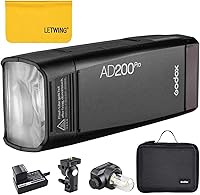
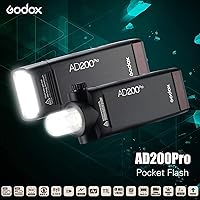
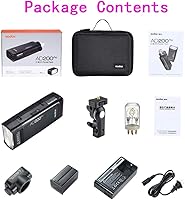
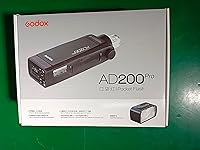
The Godox AD200 Pro occupies a genuinely useful middle ground in the flash market — compact enough to slip into a camera bag yet powerful enough to hold its own against larger studio heads. At 200 watts of output, it punches well above what any on-camera speedlight can deliver, while remaining a fraction of the size and weight of a full monolight. It works across Canon, Nikon, Sony, Fujifilm, Olympus, Panasonic, and Pentax systems, so switching camera brands rarely means starting from scratch. Ranked among the top sellers in its category, the trust the photography community places in it is hard to ignore. The inclusion of two interchangeable heads — bare bulb and Fresnel — means one unit can handle genuinely different lighting styles without buying extras.

Features & Benefits

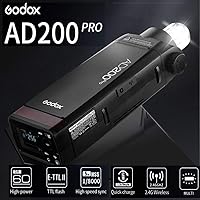
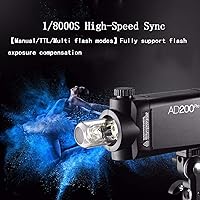
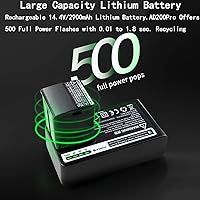
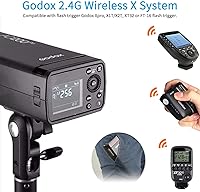
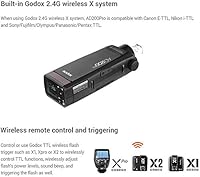
The built-in 2.4G wireless system lets this pocket strobe slot into an existing Godox setup without extra receivers — a real convenience for photographers already in that ecosystem. High-speed sync up to 1/8000s is the headline for outdoor shooters, making wide-aperture portraits in direct sunlight entirely achievable. The two included flash heads serve meaningfully different purposes: the bare bulb spreads light broadly for soft, wrapping results, while the Fresnel head delivers a more focused, directional beam. A 2900mAh battery supports up to 500 full-power flashes, and a fast recycle time of as little as 0.01 seconds keeps up with busy event work. Nine stops of manual power control in 1/10-stop steps adds genuine precision without overcomplicating the experience.

Best For

This compact monolight makes the most sense for photographers who spend significant time shooting on location — wedding and portrait photographers especially, where power matters but so does not exhausting yourself hauling gear. Travel photographers and content creators working from a single bag will appreciate how little space it demands relative to what it delivers. If you are already using Godox triggers or other Godox flashes, adding the AD200 Pro to the mix is logical; ecosystem compatibility alone removes a lot of friction. Small studio operators wanting reliable, repeatable output will find it holds up to regular professional demands. And for photographers moving past speedlights for the first time, TTL auto-exposure offers a comfortable entry point while manual control grows alongside confidence.

User Feedback

The general consensus among buyers is that build quality and consistency exceed what the price point typically suggests, particularly when compared to pricier alternatives from other markets. The Godox ecosystem comes up repeatedly as the reason people choose and stay with this unit — once a compatible trigger is in hand, expanding a lighting setup becomes straightforward. The main frustration that surfaces consistently is the proprietary battery system; spare packs are an additional cost, and sourcing them while traveling internationally takes forward planning. Most users gravitate toward the bare bulb head for broader, more flattering light, reserving the Fresnel for tighter, more controlled situations. Battery stamina generally holds up well, though a handful of shooters find the 500-flash rating optimistic under sustained high-power use.

Pros

  • 200W output in a body that genuinely fits in a jacket pocket is a rare and practical combination.
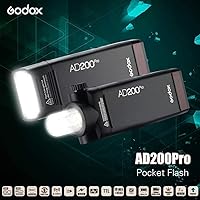
  • Both bare bulb and Fresnel flash heads are included in the box — no upselling required.
  • HSS up to 1/8000s makes open-shade and midday sun portraits with wide apertures fully achievable.
  • The built-in 2.4G receiver eliminates the need for a clip-on wireless receiver on each light.
  • Nine stops of manual power control in 1/10-stop increments gives photographers precise, repeatable results.
  • Compatible with Canon, Nikon, Sony, Fujifilm, Olympus, Panasonic, and Pentax out of the box.
  • The AD200 Pro slots cleanly into the broader Godox ecosystem without firmware conflicts or workarounds.
  • Recycle times at mid-power are fast enough to handle event work without missing key moments.
  • The metal flash bracket with umbrella holder and quick-lock button holds up under daily professional use.
  • Output consistency across a full shooting day earns consistent trust from photographers with paying clients.

Cons

  • A compatible Godox wireless trigger is required separately to unlock full TTL and HSS remote control.
  • Spare proprietary batteries carry an additional cost and can be difficult to source quickly when traveling internationally.
  • Real-world full-power flash count frequently falls short of the 500-flash manufacturer claim under sustained heavy use.
  • The bare bulb mount is proprietary, limiting compatibility with popular third-party modifier systems.
  • TTL accuracy varies noticeably across supported camera brands, with Sony users reporting the most inconsistency.
  • The plastic outer body shows cosmetic damage relatively quickly after accidental drops or rough bag handling.
  • No weather sealing of any kind limits confident use in light rain, heavy humidity, or dusty environments.
  • Button layout becomes fiddly in low light or cold conditions until the control interface is thoroughly memorized.
  • Full-power recycle time of up to 1.8 seconds can feel slow during rapid-fire bursts at maximum output.
  • The overall cost including trigger and spare battery pushes the real investment noticeably above the unit price alone.

Ratings

The scores below for the Godox AD200 Pro were generated by our AI system after analyzing thousands of verified purchase reviews worldwide, with spam, bot-submitted, and incentivized feedback actively filtered out before any scoring was calculated. What you see reflects the honest distribution of real photographer experiences — the genuine strengths that keep buyers recommending this compact strobe, as well as the recurring frustrations that surface often enough to warrant attention.

Output Power & Consistency
93%
Photographers consistently report that 200W of output holds steady across a full shooting day without noticeable color shift or power drift between flashes. Wedding and portrait shooters in particular praise how reliably it exposes the same scene the same way, shot after shot, which matters enormously when culling hundreds of frames.
A small number of users shooting in very hot outdoor conditions noted minor inconsistencies at maximum power after extended continuous use. This is uncommon but worth monitoring if you regularly push the unit hard for hours in direct summer heat.
Portability & Form Factor
91%
At under 600g for the body alone, this pocket strobe genuinely fits into a jacket pocket or the side pouch of a camera bag without drama. Travel photographers frequently mention being able to pack a complete two-light setup in carry-on luggage, something that was simply not practical with traditional battery-powered strobes at this power level.
Once you add the flash head and battery, the balance point shifts noticeably, and the unit can feel slightly front-heavy when mounted on a lightweight stand. A few users also wish the overall grip area were slightly wider for more secure one-handed operation during quick repositioning.
Battery Life & Charging
78%
22%
Under real-world shooting conditions — mixed power levels rather than constant full blasts — most users comfortably get through a four to five hour portrait session or a full wedding reception on a single charge. The fast recycle time means the battery drain per unit time is manageable even during burst-heavy moments.
The manufacturer's 500 full-power flash claim gets challenged by heavy shooters who consistently report figures closer to 350 to 400 at sustained maximum output. The proprietary battery format is the bigger long-term complaint: spare packs carry an additional cost, and international travelers have flagged difficulty sourcing replacements quickly when abroad.
HSS & Sync Performance
89%
High-speed sync up to 1/8000s is one of the reasons photographers actively choose this compact monolight over cheaper alternatives. Outdoor portrait work in midday sun — where you want a wide aperture to separate your subject from the background — becomes genuinely achievable rather than a compromise.
HSS does reduce effective flash power, and users shooting at very high shutter speeds occasionally find themselves wishing for just a bit more output reserve. TTL accuracy in HSS mode can also vary slightly depending on which camera body and trigger combination you are using, so some initial testing is advisable.
Wireless Ecosystem Integration
88%
Photographers already using other Godox flashes or triggers describe adding the AD200 Pro to their kit as close to plug-and-play. The built-in 2.4G receiver means no separate clip-on receiver is needed, and controlling power remotely from the camera position during a shoot saves significant time compared to walking to each light.
Full wireless TTL and HSS control requires a compatible Godox trigger purchased separately, which is an extra cost that first-time buyers sometimes overlook when budgeting. A small number of users also report occasional connection dropouts in environments with heavy 2.4G radio congestion, such as large event venues.
Interchangeable Flash Heads
86%
The fact that both the bare bulb and Fresnel heads ship in the box is genuinely appreciated — it is not a token gesture, as each head produces a meaningfully different quality of light. Portrait photographers tend to favor the bare bulb for its broader, softer spread, while product and commercial shooters gravitate toward the Fresnel for its more controlled, punchy output.
Swapping heads mid-shoot requires care, and a few users have noted the connection point feels slightly less robust after repeated changes over months of heavy use. Third-party head compatibility is also limited, so expansion options outside the Godox accessory lineup are narrow.
Build Quality & Durability
84%
The metal flash bracket in particular earns consistent praise as a sign that Godox did not cut corners on the components that matter most in field use. Overall, the unit feels dense and purposeful rather than hollow or plasticky, which builds confidence when it is mounted on a stand at a paid shoot.
The outer body is primarily plastic, and while it holds up well under normal professional use, a few users have reported cosmetic scuffing and minor cracks after accidental drops onto hard surfaces. There is no weather sealing of any kind, which limits its use in light rain or dusty environments without protective measures.
Recycle Speed
87%
At lower to mid power settings, the recycle time is fast enough to keep up with fast-paced event work without missing expressions or action. Photographers shooting reception dances or active children consistently mention that they rarely feel held back waiting for the strobe to be ready.
At full power, recycle time extends to around 1.8 seconds, which is serviceable but not exceptional for this output class. Users who frequently shoot at maximum power in rapid-fire situations may find this a bottleneck compared to mains-powered studio alternatives.
TTL Accuracy
76%
24%
For run-and-gun event work where manually dialing power between every setup is impractical, the TTL mode handles changing environments reasonably well. Photographers moving between brightly lit reception halls and darker corners report that TTL keeps exposures in an acceptable range without constant intervention.
TTL is not perfectly consistent across all supported camera brands, and Sony users in particular sometimes report more exposure variation than Canon or Nikon users experience. Most experienced photographers treat TTL as a starting point and fine-tune manually rather than relying on it exclusively for critical shots.
Manual Power Control
91%
Nine stops of range adjustable in 1/10-stop increments is a genuinely fine level of control that studio-trained photographers immediately appreciate. Being able to nudge power by tiny increments to match a changing ambient or a different modifier without blowing the exposure is a practical daily benefit.
Navigating the control interface for quick power adjustments in the dark takes some practice, and new users occasionally overshoot their intended setting during fast-moving shoots until the button layout becomes muscle memory.
Camera Compatibility
92%
Supporting Canon, Nikon, Sony, Fujifilm, Olympus, Panasonic, and Pentax in a single unit makes this compact monolight one of the most versatile options for photographers who work across multiple systems or shoot alongside colleagues with different gear. Mirrorless users on Sony and Fujifilm in particular appreciate that TTL and HSS work properly rather than being an afterthought.
Compatibility depth varies slightly by brand — some advanced functions like certain multi-flash modes behave more predictably on Canon and Nikon bodies than on less common mounts. Checking the current firmware version before a major shoot is advisable to ensure all features function as expected.
Value for Money
88%
Relative to what competing brands charge for comparable battery-powered strobes with similar feature sets, the AD200 Pro sits at a point where most buyers feel they are getting a meaningful return on their investment. The dual flash heads included at no extra cost is a frequently cited factor in purchase decisions.
This is not an entry-level purchase, and budget-conscious beginners sometimes feel the sting of also needing a compatible Godox trigger to unlock the full wireless feature set. Factoring in the cost of a spare battery and a trigger can push the real-world total noticeably above the base unit price.
User Interface & Controls
79%
21%
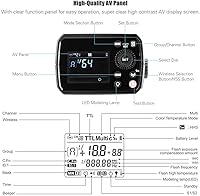
The LCD panel clearly displays current power settings and remote strobe status at a glance, which speeds up multi-light management during a shoot. Most photographers report that the core functions — power adjustment, mode switching, group selection — become intuitive after a session or two.
The button layout is compact by necessity, and shooters with larger hands occasionally find precise button presses fiddly, especially when wearing gloves in cold outdoor environments. The learning curve for less common modes like multi-flash and rear curtain sync is steeper than the core TTL and manual controls.
Modifier & Accessory Ecosystem
83%
The included umbrella holder and metal bracket make basic light shaping immediately accessible, and the broader Godox accessory lineup offers a reasonable range of compatible softboxes, beauty dishes, and magnetic round-head modifiers. For photographers who want to shape light meaningfully, the options are there without needing to source third-party adapters.
The bare bulb head uses a proprietary mount that limits compatibility with non-Godox modifiers, which frustrates photographers who have invested in accessories designed around standard Bowens or Elinchrom fittings. Adapters exist but add bulk and introduce one more potential failure point in a field setup.

Suitable for:

The Godox AD200 Pro was built for photographers who spend most of their working life outside a fixed studio — wedding shooters, on-location portrait artists, and editorial photographers who need serious, consistent output without the weight and bulk of a traditional monolight. If you regularly find yourself setting up lights in parking lots, parks, or event halls where no mains power is available, this compact monolight solves a real problem rather than a theoretical one. Travel photographers and content creators who live out of a single carry-on bag will appreciate that a capable two-light setup can now fit alongside a camera body and two lenses without checking luggage. Photographers already using Godox triggers or other Godox flashes will find it integrates into an existing workflow with minimal friction, making it a logical expansion rather than a disruptive new system to learn. Even relative newcomers graduating from on-camera speedlights will find the TTL mode a reassuring safety net while they build confidence with manual off-camera flash — the learning curve is real but manageable.

Not suitable for:

Photographers who shoot exclusively in a permanent studio with reliable mains power will find little practical reason to accept the trade-offs of the Godox AD200 Pro when a corded monolight at the same output level offers more flashes, faster recycle at full power, and no proprietary battery dependency. Shooters on a strict entry-level budget should also pause before committing, because the true cost of ownership includes a compatible Godox wireless trigger and at least one spare battery — neither of which is included — and that combined outlay may stretch beyond what the purchase alone suggests. Photographers who own significant investments in Bowens or Elinchrom modifiers may also find the proprietary bare bulb mount a genuine obstacle, as native adapter options are limited and third-party solutions add bulk and unreliability. Anyone expecting weather-sealed construction for consistent work in rain, heavy humidity, or dusty outdoor environments will need to look elsewhere or invest in additional protective measures. Finally, high-volume event photographers who routinely fire at maximum power for hours at a stretch may find the real-world battery endurance falls short of the headline figure often enough to cause disruption mid-shoot.

Specifications

  • Output Power: The unit delivers 200W of flash output, equivalent to a guide number of 60m at ISO 100.
  • Power Range: Manual power adjusts across 9 stops from full power down to 1/256, in precise 1/10-stop increments.
  • HSS Sync Speed: High-speed sync is supported up to 1/8000s, enabling wide-aperture shooting in bright ambient light.
  • Flash Duration: With the Fresnel head attached, flash duration ranges from 1/220s to 1/15380s; the bare bulb head ranges from 1/220s to 1/13510s.
  • Recycle Time: Recycle time spans 0.01s at low power settings to 1.8s at full power output.
  • Battery: A 14.4V / 2900mAh lithium polymer battery is included and rated for up to 500 full-power flashes per charge.
  • Battery Runtime: Under typical mixed-power shooting conditions, the battery supports approximately 6 hours of continuous use.
  • Flash Heads: Two interchangeable heads are included in the box: a bare bulb head for broad, soft coverage and a Fresnel speedlite head for directional output.
  • Wireless System: A built-in 2.4G Godox X wireless transceiver enables master and slave operation without an external receiver.
  • Flash Modes: Supported modes include TTL, manual, multi-flash (stroboscopic), front curtain sync, rear curtain sync, and modeling light.
  • Compatible Mounts: Native TTL and HSS support covers Canon, Nikon, Sony Alpha, Fujifilm, Olympus, Panasonic, and Pentax camera systems.
  • Body Dimensions: The flash body measures 172 x 54 x 75mm, excluding the flash head and battery pack.
  • Net Weight: Body weight without flash head or battery is 590g; total shooting weight will be higher depending on head and battery configuration.
  • Display: An LCD panel on the body shows current power settings, mode status, and remote strobe information at a glance.
  • Flash Bracket: The included metal bracket supports continuous angle adjustment, features an umbrella holder, and uses a quick-lock button for secure stand mounting.
  • Connectivity: A PC sync port is available for tethered triggering when wireless operation is not preferred or available.
  • Charging: The lithium polymer battery charges via a dedicated Godox charger; the unit does not support USB or pass-through charging.
  • Weather Sealing: The AD200 Pro has no official weather or dust sealing rating and should be protected from moisture and heavy particulate environments.

Related Reviews

Ubiquiti UniFi Dream Machine Pro UDM-Pro
86%
94%
Performance
88%
Ease of Use
90%
Reliability
92%
Connectivity
85%
Network Security Features
More
DS18 PRO-DR1PK44 Compression Driver with PRO-H44/BK Horn
86%
96%
High-Frequency Loudness
93%
Sensitivity & Efficiency
88%
Vocal Clarity & Naturalism
86%
Build Quality & Materials
81%
Installation Versatility
More
DS18 PRO-ZXI10MBASS 10-inch Pro Audio Mid Bass Loudspeaker
86%
88%
Sound Quality
91%
Bass Performance
85%
Ease of Installation
87%
Durability and Build Quality
92%
Value for Money
More
Cinema Secrets Pro Cosmetics Ultimate Corrector 5-In-1 Pro Palette No.1
86%
91%
Effectiveness for Color Correction
88%
Blendability
84%
Coverage Customization
85%
Longevity of Wear
93%
Suitability for All Skin Tones
More
Apple MacBook Pro 14-inch M1 Pro 16GB RAM 1TB SSD
87%
95%
Performance
92%
Display Quality
89%
Battery Life
91%
Build Quality
82%
Value for Money
More
Cinema Secrets Pro Cosmetics Ultimate Foundation 5-In-1 Pro Palette 500A
88%
93%
Coverage & Pigmentation
85%
Skin Compatibility (Sensitive Skin)
88%
Ease of Application
90%
Longevity & Wear
91%
Versatility (Contouring & Concealing)
More
HP Pro Tower 290 G9 Desktop (i5-12500, 32GB RAM, 1TB SSD)
81%
96%
Multitasking Capability
91%
Value for Money
88%
Port Selection
84%
Thermal & Acoustic Performance
93%
Boot Speed & Storage
More
UTILYZE Radiant Pro
UTILYZE Radiant Pro
87%
94%
Cleansing Effectiveness
91%
Exfoliation Quality
88%
Skin Comfort
85%
Build Quality
82%
Battery Life
More
WiMiUS P62 Pro
WiMiUS P62 Pro
86%
91%
Display Quality
78%
Brightness Performance
88%
Audio & Speakers
85%
Connectivity Options
90%
Smart App Integration
More
RØDE VideoMic Pro+
RØDE VideoMic Pro+
85%
93%
Audio Clarity
88%
Build Quality
91%
Shock Mount & Isolation
89%
Safety Channel
86%
Power Flexibility
More

FAQ

The unit has a built-in 2.4G receiver, so it can act as a slave and be controlled remotely without clipping a receiver onto it. However, you will still need a compatible Godox transmitter — such as the XPro or X2T — mounted on your camera's hot shoe to actually send those wireless commands. That trigger is not included and is a separate purchase.

Yes, full TTL and HSS functionality is supported on Sony Alpha cameras when paired with a compatible Godox trigger built for the Sony system. Just make sure you purchase the Sony-specific version of the trigger, as the connector and communication protocol differ from Canon or Nikon variants.

Under laboratory conditions firing at full power every time, 500 flashes is achievable. In real-world use — where you mix power levels across a shoot — most photographers report comfortably completing a full wedding reception or portrait session on one charge. That said, if you are hammering maximum power repeatedly in fast succession, expect figures closer to 350 to 400 before the battery needs a rest or a swap.

The bare bulb head emits light in a roughly spherical pattern, which makes it well-suited for bouncing into umbrellas or large modifiers where you want a soft, wrapping result. The Fresnel head focuses the light forward more like a traditional speedlight, which gives a slightly harder, more directional beam and works well for direct flash or in smaller softboxes. Both are useful, and having both included means you can choose based on the shot rather than the gear you happen to own.

This depends on which flash head you are using. The Fresnel speedlite head accepts modifiers designed for speedlight heads. The bare bulb head uses a proprietary Godox mount that is not natively Bowens-compatible, though Godox and third-party brands offer adapters. Those adapters add a small amount of bulk and an extra connection point, which some photographers prefer to avoid in field setups.

Spare WB29 batteries are available from Godox and from various third-party sellers online. Within most major markets they are not hard to source, but if you travel internationally — particularly to smaller cities — stocking up before you leave is wise. The proprietary format means you cannot substitute a generic battery in a pinch.

Yes, and this is one of the strongest reasons photographers already in the Godox ecosystem add this compact monolight to their kit. It communicates on the same 2.4G X system as other Godox flashes, so you can mix it with V1s, V860IIIs, or AD600 Pros all controlled from one trigger on your camera. Group and channel management works the same way across the system.

At mid-power settings — which cover the majority of indoor event shooting scenarios — the recycle time drops to well under a second and keeps pace comfortably with documentary-style shooting. At full power it extends to around 1.8 seconds, which is noticeable if you are firing rapidly. For most wedding work this is manageable, but photographers who regularly shoot bursts of full-power frames may occasionally feel the pause.

Yes, the unit includes an optical slave mode that fires the flash when it detects a burst of light from another flash, which is useful for simple setups without wireless gear. However, optical slave mode does not support TTL or HSS — it simply fires the flash at a preset manual power level when triggered by light. For full remote control and advanced features, a Godox wireless trigger is still necessary.

The included lithium polymer battery is within IATA carry-on limits for most airlines, but you should always verify current regulations with your specific carrier before flying. Carrying spare batteries in your carry-on rather than checked luggage is both a regulatory requirement and a practical habit. If traveling internationally, bringing the battery documentation or product packaging can help avoid questions at security screening.