



Overview

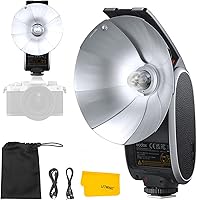
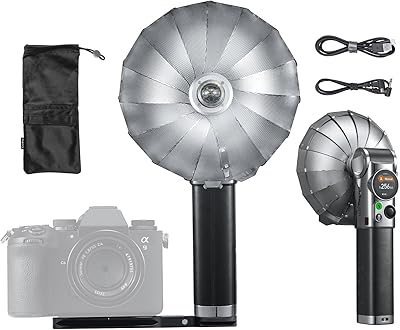
The Godox Lux Senior Retro Camera Flash arrives at a time when photographers are actively rediscovering the appeal of older shooting styles, and this retro flash fits that mood without sacrificing practicality. Its most immediately striking feature is the foldable fan-style reflector, which snaps open to reveal a silver bowl that shapes light rather than just blasting it forward. It slides onto any standard hotshoe, covering Canon, Fujifilm, Nikon, Olympus, Panasonic, and Sony users without adapters. Think of it as a capable close-range companion, not a high-powered tool for large venues. The built-in rechargeable battery — no AA cells required — is a genuinely useful convenience that frequent travelers and run-and-gun shooters will notice immediately.

Features & Benefits

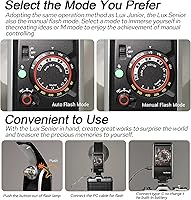
At its core, the Lux Senior runs on a GN14 guide number, which delivers enough power for portraits, street shooting, and close-range indoor work but will start to feel limited beyond a few meters. Color temperature sits at 6000K with a ±200K variance, so the light stays consistent across a session — a subtle detail that matters when matching exposures in post. Auto mode handles exposure decisions on the fly, keeping things approachable for beginners. Switch to manual and you get direct control over output. The silver reflector softens and shapes the burst rather than firing raw, and the whole unit folds down to near-smartphone dimensions that slip into a jacket pocket. Sync speed tops out at 1/250s, compatible with the vast majority of modern cameras.

Best For

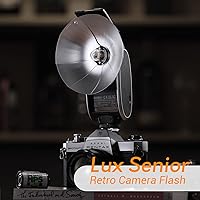
This vintage-style speedlight is most at home in the hands of photographers who care as much about the look of their kit as the results it produces. Fujifilm X-series shooters, in particular, tend to find it a natural fit — the aesthetic matches that camera line's retro character well. It also appeals to hobbyists and content creators for whom gear is part of the visual story they tell. For someone new to external flash photography, the auto mode removes a meaningful amount of guesswork. That said, if your work involves fast-paced event coverage, large rooms, or you depend on TTL metering, this retro flash will leave you working around its limitations rather than leaning on its strengths.

User Feedback

Buyers who have spent real time with the Lux Senior generally come away impressed by the build — materials feel solid, and the hotshoe connection holds firm across different camera bodies. The auto mode draws consistent praise for reliability, particularly from photographers newer to off-camera light. On the other side, the most common frustrations cluster around two points: the absence of TTL support, which forces manual adjustments whenever light conditions shift, and a guide number ceiling that shows its limits in any room larger than a small studio. A handful of users flag slower recycle times and noticeable battery drain during extended sessions. Even so, the prevailing view is that the design quality and pocketable size represent a reasonable trade at its price point.

Pros

  • Solid, premium-feeling build that sits firmly on the hotshoe of multiple camera brands without wobble.
  • Foldable fan reflector softens light noticeably, reducing harsh shadows compared to a bare-bulb speedlight.
  • Auto mode handles exposure reliably, making it a low-barrier entry point for new flash users.
  • Built-in rechargeable lithium battery removes the recurring hassle and cost of hunting down AA cells.
  • Folds down to near-smartphone dimensions, slipping easily into a jacket pocket or small camera bag.
  • Color output stays consistent at 6000K with tight variance, reducing color correction work in post.
  • Works with Canon, Fujifilm, Nikon, Olympus, Panasonic, and Sony cameras straight out of the box.
  • Retro aesthetic pairs especially well with vintage-style mirrorless bodies and adds visual interest on location.
  • Manual mode gives experienced photographers direct, hands-on control over output when precision matters.

Cons

  • No TTL support means output must be adjusted manually any time ambient light or distance changes.
  • GN14 guide number runs out of useful range in spaces larger than a small room or studio.
  • Recycle times slow noticeably during sustained bursts, risking missed moments in fast-moving situations.
  • Battery capacity under prolonged continuous shooting falls short of what a full day of event work demands.
  • No built-in wireless triggering limits off-camera flash use without purchasing additional accessories.
  • Fixed 28mm coverage with no zoom function reduces control over light spread at varying distances.
  • The folding reflector mechanism raises reasonable long-term durability questions under heavy daily use.
  • Lack of TTL also rules it out as a reliable fill flash in complex, multi-light setups requiring automation.

Ratings

Our scores for the Godox Lux Senior Retro Camera Flash were produced by an AI system that analyzed verified buyer reviews from global markets, actively filtering out spam, bot submissions, and incentivized feedback before any scoring was calculated. Every category score reflects the real distribution of praise and frustration found across thousands of genuine owner experiences worldwide. Both the consistent strengths this vintage-style speedlight earns and the recurring pain points buyers encounter are weighted transparently into each rating.

Build Quality
84%
Photographers consistently note that the Lux Senior feels more substantial than its price suggests, with a hotshoe foot that seats firmly and a body that does not flex or creak under normal handling. Reviewers mounting it on Fujifilm and Sony bodies report a tight, rattle-free connection that holds position reliably during active street sessions.
The folding reflector hinge is the one component that raises long-term durability questions, with some users wondering how it holds up under daily open-and-close cycles over many months. A subset of frequent shooters have noted the reflector feels slightly looser after extended use, though this remains a minority experience in the broader feedback pool.
Light Output Power
58%
42%
For close-range portraits, product shots within a small studio, and street subjects within 2 to 3 meters, the GN14 output is sufficient and produces clean, properly exposed results without pushing ISO uncomfortably high. Photographers working in tight indoor spaces or at cafe distances find it handles the job without demanding workarounds.
Beyond a few meters, the GN14 ceiling becomes a hard constraint — subjects at 4 meters or more are routinely underexposed even with aperture adjustments factored in. Users covering larger rooms, outdoor events, or any shooting situation involving distance quickly reach a wall that no setting adjustment on the flash itself can resolve.
Color Accuracy
88%
The 6000K output with a tight ±200K variance is noticeably consistent across a session, which portrait photographers appreciate when matching a batch of images in post without fighting unpredictable color shifts. Reviewers specifically highlight that skin tones under this retro flash look natural and warm, without the greenish or overly cool cast common in cheaper units.
A smaller group of users report the color rendering occasionally reads slightly cooler than the rated 6000K in mixed-light environments, though this appears influenced more by ambient light interaction than a product flaw. Those blending it with window light or tungsten sources note that manual white balance adjustment is often needed to maintain consistent results.
Auto Mode Performance
76%
24%
Beginners picking up their first external flash find the auto mode on this retro flash genuinely reliable at close range, handling exposure with minimal fuss across portrait sessions and casual street work. Reviewers regularly describe the onboard sensor as accurate and responsive when the subject stays within the effective 2 to 3 meter working distance.
Without TTL integration, the auto mode cannot adapt to fast-changing subject distances or dynamic backgrounds the way a camera-linked TTL system would, which limits its usefulness in unpredictable shooting environments. Users working varied-distance scenes or high-contrast locations report that the auto mode requires frequent manual overrides to stay on target.
Manual Mode Control
72%
28%
Experienced photographers who prefer hands-on control appreciate that manual mode lets them set a specific output level without automation interfering, making this vintage-style speedlight a clean tool for deliberate, creative flash work. The switch between modes is straightforward and does not require navigating any menus or submenus.
The manual power adjustment offers limited output step granularity compared to higher-end speedlights that allow fractional increments down to 1/128 power, which frustrates photographers trying to nail a precise exposure match. Fewer selectable steps make it harder to dial in subtle changes when working in a controlled environment where exact output consistency matters.
Portability & Size
93%
Folded to near-smartphone dimensions and weighing only 8 ounces, the Lux Senior slips into a jacket pocket or compact shoulder bag without adding meaningful bulk to a street or travel kit. Photographers who previously left their flash at home due to size and weight consistently report carrying this one daily without a second thought.
The compact form factor limits which light modifiers can attach to it, as there is no standard accessory mount for softboxes, barn doors, or gels that fit conventional speedlight heads. Photographers looking to expand their modifier options quickly find the pocketable size and unconventional shape become an accessory compatibility constraint.
Battery Life
63%
37%
The USB-rechargeable lithium-ion cell is a genuine daily convenience, eliminating the ongoing expense and hassle of AA replacements entirely. For short portrait sessions or casual street walks of an hour or two at moderate power, the majority of users report the charge comfortably lasting through the session without interruption.
Under sustained shooting — high-frequency bursts, full-day events, or extended street sessions — battery drain becomes a recurring complaint, with many reviewers reporting the charge depleting before the shoot wraps. The internal, non-removable battery compounds this issue because there is no option to swap in a fresh set of cells mid-session when power runs out.
Ease of Use
82%
18%
First-time flash users find the learning curve genuinely low, with a simple mode switch and auto settings that produce usable results straight out of the box without needing to read an in-depth manual. The minimal physical interface reduces the friction that keeps many beginners from ever successfully incorporating an external flash into their workflow.
More experienced photographers may find the stripped-down controls limiting when they need to fine-tune output quickly between shots in changing conditions. The absence of a digital power readout or clear indicator means veterans sometimes have to estimate their manual settings by feel rather than confirming them at a glance, which slows precise, deliberate work.
Hotshoe Compatibility
91%
The standard ISO hotshoe connection works consistently and without misfires across Canon, Fujifilm, Nikon, Olympus, Panasonic, and Sony bodies, and multi-brand reviewers confirm the fit feels secure regardless of which system they mount it on. No adapter is required for any of the listed brands, removing a common frustration with third-party flash accessories.
While physical compatibility is broad, the absence of electronic TTL communication means the flash cannot access any advanced camera-specific features — wireless grouping, radio triggering, or automatic power adjustment — leaving every supported brand with the same basic sync-only connection regardless of what the camera body itself supports.
Reflector Design
87%
The fan-type silver reflector does genuine practical work beyond its distinctive appearance — the shaped bowl softens and spreads the burst in a way that visibly reduces harsh shadows on close subjects compared to bare-bulb output. Portrait and street photographers consistently note the light character it produces is more flattering than a standard compact speedlight firing raw.
The reflector has no tilt or swivel capability, which rules out bouncing light off a ceiling or nearby wall — a standard technique for softening flash indoors. Photographers who routinely bounce their speedlight find this a meaningful creative limitation, as the fan design works only in its one fixed forward-facing orientation.
Recycle Speed
57%
43%
For single shots or relaxed shooting cadences at lower power settings, recycle time is workable and does not interrupt the flow of a casual portrait session or a slow-paced street walk. Dialing down manual power output is an effective and commonly recommended strategy for improving recycle speed and extending battery life simultaneously.
At higher power levels or during rapid continuous shooting, recycle times become sluggish enough to cause missed moments — a significant drawback for anyone covering events or trying to shoot bursts. Multiple reviewers specifically cite this as the area where the Lux Senior falls most noticeably behind conventional speedlights, where capacitor-based recycle is substantially faster at comparable price points.
Value for Money
74%
26%
For photographers who genuinely want the retro aesthetic and shoot primarily at close range within the flash's effective operating distance, the mid-range price feels justified given the build quality, broad compatibility, and built-in rechargeable battery. The overall package offers real practical value for the right buyer rather than charging purely for looks.
Photographers prioritizing raw output power, TTL automation, or fast recycle times will find comparable or stronger-performing options available at similar price points from other manufacturers. The pricing implicitly assumes the distinctive design is part of the value — buyers who are indifferent to the retro styling are effectively paying a premium for aesthetics they will not use.
Aesthetic Design
94%
The retro styling draws genuine attention on location, and Fujifilm X-series users in particular report it feels like a natural extension of their camera body rather than a visually mismatched accessory bolted onto it. The build quality supports the visual impression — it does not look or feel like a cheap novelty item with a retro skin applied.
A small contingent of reviewers notes the retro look can feel out of place mounted on modern, angular camera bodies where the styling contrast is less harmonious and more jarring. The single available finish also limits personalization options for style-conscious buyers who want to match specific color schemes or camera body colorways.
Sync Speed
79%
21%
The 1/250s maximum sync speed covers the standard shutter speeds of most modern digital cameras without ghosting or banding, and photographers working in controlled indoor settings report clean, sharp flash-lit exposures across a range of camera systems. For the primary use cases this retro flash is designed for — portraits and street work — this ceiling is rarely a limiting factor.
Without high-speed sync support, using the flash in bright outdoor conditions requires stopping down the aperture to stay at or below 1/250s, which limits creative control over depth of field in daylight portrait situations. Photographers who regularly shoot wide-open apertures outdoors in strong ambient light will find this constraint surfaces quickly and without a workaround.

Suitable for:

The Godox Lux Senior Retro Camera Flash is genuinely well-matched to photographers who shoot at close to medium range and care about the character of their images as much as raw technical output. It fits naturally into the kits of Fujifilm X-series users, street photographers, and portrait shooters working in cafes, small studios, or outdoor settings where subjects stay within a few meters. Content creators and hobbyists who want gear that earns a second look — and doubles as a conversation piece on set — will find the retro design a real practical draw rather than just surface-level styling. The built-in auto mode also makes this a sensible entry point for anyone picking up their first external flash, lowering the learning curve before they are ready to work fully in manual. Anyone shooting intimate street portraits, lo-fi aesthetic projects, or close-range documentary work will find the Lux Senior a characterful and capable addition to their bag.

Not suitable for:

The Godox Lux Senior Retro Camera Flash is simply not designed for photographers who need serious reach, fast recycle times, or smart camera communication. Without TTL support, you are entirely responsible for adjusting output as lighting conditions shift, which becomes a real burden during fast-moving events like weddings, concerts, or anything where subjects and ambient light are constantly changing. The GN14 guide number runs out of steam quickly in larger rooms or open outdoor spaces, making it a poor fit for event photographers covering ballrooms or stages. Shooters who depend on high-volume continuous bursts will notice the battery drain and recycle pauses adding up over a long session. If your work demands a workhorse flash with full camera automation, extended range, and reliable output under pressure, this vintage-style speedlight is likely to create friction rather than solve problems.

Specifications

  • Guide Number: Rated GN14 at ISO 100, providing practical effective range for subjects within approximately 2 to 3 meters at typical portrait apertures.
  • Color Temperature: Output is rated at 6000K with a tight ±200K tolerance, producing consistent warm-neutral light that requires minimal color correction in post-processing.
  • Focal Coverage: Fixed 28mm focal length with no zoom mechanism; the foldable silver reflector shapes and softens the light spread rather than concentrating it.
  • Flash Modes: Offers two operating modes: auto, which uses an onboard sensor to regulate exposure, and manual, which gives the photographer direct control over output power.
  • Sync Speed: Maximum flash sync speed of 1/250s, compatible with the native shutter sync speeds of most modern digital cameras without ghosting or banding.
  • Mount Type: Standard ISO hotshoe mount with center-pin sync contact, allowing direct attachment to cameras from Canon, Fujifilm, Nikon, Olympus, Panasonic, and Sony.
  • TTL Support: No TTL, E-TTL, i-TTL, or high-speed sync capability; the flash communicates only via the standard sync signal and does not integrate with the camera metering system.
  • Battery: Built-in 3.7V / 1700mAh lithium-ion cell, pre-installed and included in the box; the battery is internal and not user-replaceable.
  • Charging: Internal battery charges via a standard USB connection, eliminating the need for a proprietary charger or disposable AA cells.
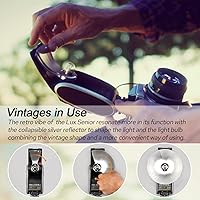
  • Reflector Style: Fan-type silver reflector that folds flat against the body for storage and unfolds during use to shape, diffuse, and direct the flash output.
  • Dimensions: Measures 3.31 x 4.49 x 6.93 inches in the folded position, giving it a footprint roughly comparable to a large smartphone.
  • Weight: Weighs 8 oz (approximately 227g) including the built-in battery, making it one of the lighter hotshoe flash units in its category.
  • Compatibility: Officially listed as compatible with Canon, Fujifilm, Nikon, Olympus, Panasonic, and Sony cameras; may also function on other brands equipped with a standard hotshoe.
  • Manufacturer: Produced by Godox under the model designation G-Lux Senior, a photographic lighting brand based in China with wide international distribution.

Related Reviews
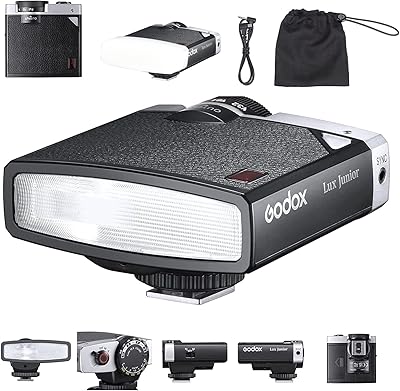
Godox Lux Junior Retro Hot Shoe Flash
74%
83%
Build Quality
91%
Retro Design & Aesthetics
62%
Flash Output Power
84%
Manual Control & Power Range
31%
TTL & Automation
More
Godox Lux Master Retro TTL Camera Flash
82%
91%
Build Quality & Design
88%
Touchscreen Usability
84%
TTL Accuracy
82%
High-Speed Sync (HSS) Performance
67%
Flash Power Output
More
Godox TT520III Hot Shoe Flash
80%
91%
Value for Money
88%
Ease of Setup
84%
Wireless Performance
79%
Light Output & Power
86%
Manual Control Precision
More
Godox TT520II Speedlite Flash
76%
91%
Value for Money
78%
Build Quality
84%
Wireless Performance
82%
Flash Output Consistency
76%
Ease of Use
More
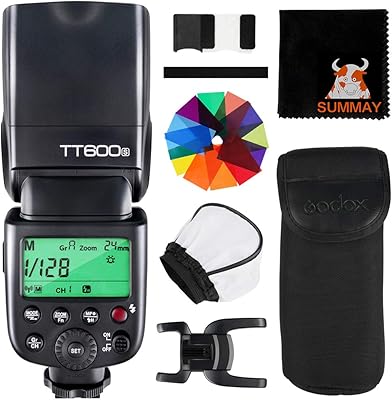
Godox TT600S Speedlight Camera Flash
79%
93%
Value for Money
88%
Wireless Performance
84%
Build Quality
91%
Output Consistency
76%
High-Speed Sync
More
Godox iA32 Mini Hot Shoe Flash
75%
93%
Portability & Form Factor
78%
Build Quality
61%
Flash Output Power
54%
Auto Mode Usability
84%
Manual Mode Control
More
Godox V100S Sony Camera Flash
83%
96%
Flash Power Output
91%
Build Quality
88%
Touchscreen Interface
93%
Battery Performance
94%
Global Shutter Sync
More
Godox TT350O Mini TTL Speedlite
79%
96%
Portability
78%
TTL Accuracy
91%
High-Speed Sync
88%
Wireless Performance
74%
Build Quality
More
Godox V860III-S Speedlight Flash
81%
93%
Battery Life
84%
TTL Accuracy on Sony Bodies
88%
High-Speed Sync Performance
89%
Recycle Time
81%
Build Quality & Durability
More
Godox V1S Round Head Camera Flash
83%
93%
Light Quality
91%
TTL Accuracy on Sony Bodies
89%
Battery Life & Endurance
86%
Recycle Time
88%
Wireless System Integration
More

FAQ

The Godox Lux Senior Retro Camera Flash uses a standard ISO hotshoe mount, so it physically fits and fires on Canon, Fujifilm, Nikon, Olympus, Panasonic, and Sony cameras without any adapter. Keep in mind it only communicates via the basic sync pin, so there is no TTL, no high-speed sync, and no wireless control through the camera body. You mount it, set your mode, and shoot.

No, and that is an important thing to know before buying. The Lux Senior offers auto mode and manual mode only. Auto mode uses a small sensor on the flash body to read reflected light and cut the flash duration accordingly, but it is not connected to the camera metering system the way TTL is. If your event work depends on the flash adapting instantly to changing backgrounds and distances, this unit will require manual adjustments that TTL would normally handle for you.

Charging is done via a standard USB cable plugged directly into the flash body, so any USB power adapter or power bank you already own will work. The battery is built-in and not designed to be removed or swapped by the user. Most owners report a full charge takes around 2 to 3 hours based on real-world use, though Godox does not publish an official figure.

User reports suggest somewhere in the range of 150 to 200 flashes at moderate power settings before the battery needs recharging, though output level and recycle demands will affect that number. At full manual power with frequent bursts, expect the battery to drain faster. It is comfortable for a street session or a short portrait shoot, but if you are planning a long day, having a USB power bank on hand is a smart backup.

At ISO 100 and an aperture around f/5.6, a GN14 flash reaches roughly 2.5 meters before the light becomes too weak for a proper exposure. Wider apertures like f/2.8 extend that to around 5 meters, but you are still working in close-range territory. Anything beyond 4 to 5 meters in darker conditions will likely result in underexposed images, so this flash is not suited for large venues, outdoor events with distant subjects, or any setting where you need real reach.

Not out of the box. This vintage-style speedlight does not have a built-in optical slave sensor or a proprietary wireless receiver, so it cannot be triggered remotely without additional hardware. Some photographers have used it with a simple wired PC sync setup or a third-party trigger that supports passive hotshoe devices, but that requires extra accessories and some experimentation. Most buyers use it mounted directly on the camera.

The reflector folds open and closed for storage but does not zoom or tilt. Coverage is fixed at 28mm with no adjustment. What it does offer is a shaped, somewhat softened output compared to a bare-bulb design, which helps reduce harsh shadows on close subjects. If you need zoom flexibility or the ability to bounce the flash off a ceiling, this is not the right tool.

Potentially, but check your camera's sync voltage first. The retro flash works with the standard center-pin hotshoe contact, and many older film cameras do use that connection. However, some vintage bodies output higher trigger voltages that can damage modern flash electronics. If your film camera is from the 1980s or earlier, it is worth looking up its sync voltage before mounting any third-party flash on it.

The build quality feels solid for a consumer-grade flash, and the hotshoe connection in particular draws consistent praise for feeling secure across different camera bodies. The folding mechanism is well-constructed, but it is still a hinged moving part and the most likely point of wear over time with heavy daily use. Treat it with reasonable care rather than folding and unfolding it dozens of times a day, and most users find it holds up well over months of regular shooting.

Auto mode on this retro flash uses a dedicated sensor on the flash body itself — completely independent of the camera — to measure light reflected back from the subject and automatically cut the flash duration when it senses enough exposure. It is a simpler and older technology than TTL, but it works reliably at the close ranges this flash is designed for. Think of it as a basic automation layer that removes manual guesswork for straightforward shooting situations, rather than a sophisticated real-time system like modern TTL.

Where to Buy