Overview

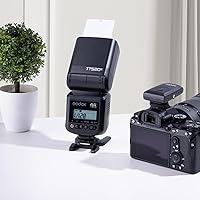
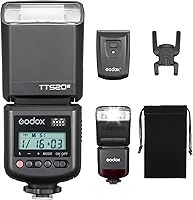
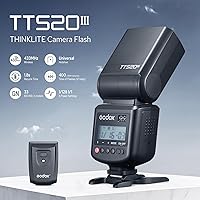
The Godox TT520III Hot Shoe Flash arrived in early 2025 as the third-generation follow-up to the TT520II, built for hobbyists and budget-conscious photographers who want dependable off-camera light without overpaying. What genuinely sets it apart at this price point is the included RT-16 transmitter — wireless triggering out of the box, no separate purchase needed. It uses a single-contact hot shoe and covers a wide range of brands, but the exclusions list is long enough to matter: several Canon mirrorless bodies, select Sony models, and a few Fuji cameras are not supported. This is a fully manual flash — no TTL, no HSS — which is a deliberate fit for photographers who already know how to work their exposure settings.
Features & Benefits

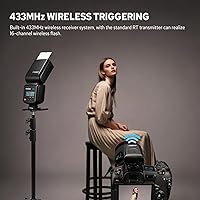
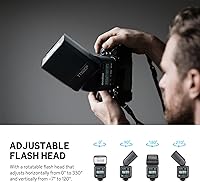
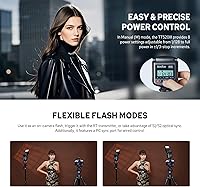
The TT520III's GN33 guide number puts it at roughly three to four meters range at full power for a correctly exposed indoor portrait — fine for headshots, small groups, or home-studio fill light. Eight manual power levels run from 1/128 up to full in 1/3-stop increments, giving you real precision once you get comfortable with manual exposure. The integrated 433MHz receiver syncs instantly with the bundled RT-16 transmitter across 16 channels, so off-camera placement requires zero additional gear. A 1.8-second recycle time and up to 400 full-power flashes per NiMH charge hold up well during events. The head tilts to 120° vertically and rotates 330° horizontally, and S1/S2 optical slave modes plus a PC sync port cover nearly every triggering scenario you'd encounter.

Best For

This manual speedlight is a natural starting point for photographers moving off a pop-up flash — people who want to understand light placement and manual exposure rather than letting the camera guess for them. Studio beginners especially benefit, since building the manual-control habit early pays off long-term. It's compact enough to drop into a camera bag without drama, making it practical for travel or small events where you need reliable wireless triggering already bundled in. Fuji, Olympus, and Pentax users in particular often have trouble finding affordable compatible speedlights — this hot shoe flash fits most single-contact setups from those brands cleanly. That said, sports shooters or anyone who depends on High-Speed Sync should look at a different unit entirely.

User Feedback

Buyers consistently highlight how fast the initial setup is — most are firing wirelessly within minutes, largely because the transmitter ships with the unit. People who upgraded from the older TT520II specifically call out the improved display panel as a genuine quality-of-life improvement for reading and adjusting settings quickly. On the other side, the compatibility exclusions generate a steady stream of complaints: Canon mirrorless models including the R7, R6II, R8, R10, and R50 are off the table, as are several Sony bodies, and shoppers who missed the fine print were understandably frustrated. The manual-only workflow also catches some beginners off guard who expected more automation. Nearly every reviewer mentions the batteries — they are not included, and alkalines noticeably slow the recycle time versus NiMH.

Pros

  • Wireless triggering is included out of the box — the RT-16 transmitter ships with the flash, no separate purchase needed.
  • Eight manual power levels in 1/3-stop increments give real exposure control for portrait and studio work.
  • The TT520III covers Fuji, Olympus, Pentax, and Panasonic bodies that many affordable flashes ignore.
  • At roughly 10 ounces, this hot shoe flash fits easily into a camera bag without adding meaningful weight.
  • Up to 400 full-power flashes per NiMH charge holds up well through portrait sessions and small events.
  • The flash head tilts and rotates extensively, making bounce and off-axis lighting genuinely accessible for beginners.
  • S1/S2 optical slave modes and a PC sync port add triggering flexibility beyond just the wireless receiver.
  • The updated display panel reads clearly at a glance, making mid-session adjustments noticeably faster than the previous generation.
  • A 1.8-second recycle time on NiMH batteries keeps pace comfortably with moderate shooting rhythms.

Cons

  • AA batteries are not included, and alkaline cells significantly degrade recycle performance — NiMH cells are effectively required.
  • The incompatibility list is long and includes popular recent Canon mirrorless bodies; many buyers miss this before purchasing.
  • GN33 output hits a ceiling quickly in large venues, high-ceiling rooms, or bright outdoor fill scenarios.
  • No TTL or High-Speed Sync means the manual speedlight cannot adapt automatically to fast-changing shooting conditions.
  • The included mini stand is unstable on uneven surfaces and lacks any standard modifier mount thread.
  • Wireless range drops noticeably in open outdoor environments, with misfires reported beyond roughly 15 meters.
  • The storage bag offers minimal padding and provides little real protection during travel or bag tossing.
  • The RT-16 transmitter only works within the Godox RT ecosystem — no cross-brand trigger compatibility.
  • New photographers expecting any automatic exposure assistance will face a steeper learning curve than the simple interface suggests.

Ratings

The Godox TT520III Hot Shoe Flash earns its scores from an AI-driven analysis of verified buyer reviews collected globally, with spam, bot-generated, and incentivized submissions actively filtered out before any scoring takes place. The ratings below reflect what real photographers — beginners, hobbyists, and semi-pros alike — actually experienced after putting this manual speedlight to work, not what the product page promises. Both the genuine strengths and the recurring frustrations are weighted equally so you get an honest picture before you buy.
Value for Money
91%
Buyers repeatedly pointed out that getting a capable manual flash and a wireless transmitter bundled together at this price tier is genuinely unusual. Most competitors at a similar price ship the unit alone, making the RT-16 inclusion feel like a meaningful bonus rather than a marketing line.
A handful of users felt the value proposition weakened once they discovered their specific camera body was on the exclusion list — essentially paying for a flash they could not use without a return. The AA batteries not being included also stings slightly at checkout.
Ease of Setup
88%
Most buyers reported being up and shooting wirelessly within five to ten minutes of unboxing, with no driver installs or app pairing required. The physical channel selector on the RT-16 transmitter is straightforward enough that even first-time flash users rarely needed the manual.
Photographers coming from fully automatic systems sometimes found the manual power-dialing process disorienting at first — there is a learning curve to getting correct exposures without TTL as a safety net. A few users wished a quick-start guide was included in print.
Wireless Performance
84%
The integrated 433MHz receiver handled triggering reliably across typical indoor shooting distances, and the 16-channel system meant minimal interference in multi-flash setups or shared studio environments. Users shooting small events appreciated not needing to purchase a separate receiver unit.
Range limitations surfaced in larger outdoor spaces — a few users reported misfires or dropped triggers beyond roughly 15 meters in open environments. The system also only works with Godox RT-series transmitters, so photographers already invested in other trigger ecosystems will find no cross-compatibility.
Light Output & Power
79%
21%
For indoor portraits, small group shots, and product photography on a table, GN33 covers the practical range comfortably — users working in rooms up to about 4 meters found full-power output more than adequate for well-exposed images at standard ISOs.
In larger venues, bright daylight fill scenarios, or situations where the head is bounced off high ceilings, GN33 starts to feel limiting. Photographers shooting in big halls or needing strong ambient-balancing power will outgrow this output level fairly quickly.
Manual Control Precision
86%
Eight power levels with 1/3-stop increments gave users a meaningful degree of exposure fine-tuning without overcomplicating the interface. Studio beginners especially appreciated being able to dial from subtle fill light at 1/128 all the way up to full punch without guessing.
The absence of TTL and High-Speed Sync is a hard wall for some workflows — there is no workaround built in. Photographers who occasionally need HSS for outdoor daylight portraits with wide apertures will need a second flash or a different unit entirely.
Build Quality & Durability
74%
26%
For a flash at this price, the physical construction impressed more buyers than it frustrated. The hot shoe mount felt solid under repeated attachment cycles, and the overall weight distribution — just over 10 ounces — felt purposeful rather than cheap.
The plastic housing shows its budget origins under close inspection, and a few long-term users noted minor cosmetic wear around the hot shoe foot after extended use. It is not a flash you would want to drop on a hard floor and expect to survive.
Flash Head Flexibility
82%
18%
The vertical tilt range of -7° to 120° and horizontal rotation up to 330° gave photographers real bounce and off-axis options without needing modifiers. Users shooting in low-ceiling rooms found the upward bounce range especially useful for softening harsh direct light.
The rotation mechanism felt slightly stiff to a few users, particularly when repositioning quickly during a fast-paced shoot. There is also no click-stop detent at the most common bounce angles, which means you need to eyeball positioning each time.
Recycle Time
81%
19%
At roughly 1.8 seconds on NiMH batteries, the recycle speed held up reasonably well during portrait sessions and small events where shooting pace is moderate. Users doing candid or documentary-style work at receptions found it kept pace without noticeable delays.
With standard alkaline batteries, recycle time stretched noticeably — some users clocked it closer to 3 or 4 seconds, which disrupts shooting rhythm. The unit requires NiMH cells to perform as advertised, and that is not clearly communicated at the point of sale.
Battery Life
76%
24%
Up to 400 full-power flashes per NiMH charge is a solid yield for event or studio use, and the standard AA format means replacement cells are available everywhere. Users shooting half-day portrait sessions reported rarely needing to swap batteries mid-job.
Batteries are not included, which is a minor but real inconvenience at unboxing. Photographers who rely on alkalines rather than rechargeable NiMH cells will see significantly worse performance in both yield and recycle speed — a tradeoff the product description buries in fine print.
Display & Interface
83%
Buyers who had used the previous TT520II consistently flagged the updated display as a meaningful upgrade — power level, mode, and channel are all readable at a glance, even in dim shooting environments. Adjustments during a live session felt noticeably faster as a result.
The display is not backlit in a way that helps in very dark environments, and the button layout takes a short adjustment period if you are switching from a different flash brand. Nothing truly problematic, but it is not a touchscreen or intuitive enough to operate completely blind.
Camera Compatibility
58%
42%
The single-contact hot shoe design covers a wide swath of cameras from Canon, Nikon, Fuji, Olympus, Pentax, and Panasonic, making it a practical choice for anyone shooting on those platforms with standard hot shoe bodies. Fuji and Olympus users in particular praised the affordable compatible option.
The exclusion list is long and contains popular recent models — Canon R7, R6 II, R8, R10, R50, Sony A9III, A99, A77, ZV-1F, and several others are incompatible. Buyers who missed this detail before purchasing generated a significant share of negative reviews, dragging this score down considerably.
Optical Slave & Sync Options
78%
22%
Having S1 and S2 optical slave modes alongside the 433MHz wireless and a physical PC sync port gives this flash meaningful versatility for multi-light setups. Users working in shared studio spaces or with legacy wired sync cables appreciated not being locked into a single triggering method.
S2 mode, designed to ignore pre-flashes from TTL systems, occasionally misfired when used alongside certain metering patterns. It functions well for most scenarios but is not a substitute for a purpose-built multi-flash wireless ecosystem if your workflow demands reliability at scale.
Portability & Size
87%
At just over 10 ounces and compact enough to sit in the accessory pocket of most camera bags, the TT520III travels well. Travel photographers and on-location portrait shooters praised the low footprint compared to larger speedlights, without feeling like they were making a significant power sacrifice for it.
The included mini stand is functional but barely — it wobbles on uneven surfaces and does not accommodate any standard light modifier mounts without an adapter. Photographers planning to use the flash off-camera on a stand will want to budget for a separate sturdier mounting solution.
Packaging & In-Box Contents
72%
28%
The kit contents — flash, RT-16 transmitter, mini stand, and storage bag — represent solid value as a ready-to-shoot bundle. The storage bag is soft but functional, and most users appreciated having something to toss into a bag rather than bare flash bouncing around.
The absence of batteries, a quick-reference card, or any instructional material beyond a brief multilingual sheet made setup feel slightly bare for true beginners. A few buyers also noted the storage bag offers minimal padding, which raises durability concerns for frequent travelers.

Suitable for:

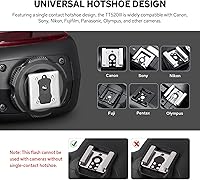
The Godox TT520III Hot Shoe Flash is a strong fit for photographers who are taking their first real step beyond a pop-up flash and want to learn lighting properly without committing to an expensive TTL system they are not ready to use yet. Hobbyists building a home portrait setup, small-event shooters, and anyone doing product or still-life photography on a table will find the output power and manual control range more than adequate for their everyday needs. It is also a genuinely practical pick for Fuji, Olympus, and Pentax users who routinely struggle to find affordable compatible speedlights — the single-contact hot shoe covers most bodies in those lineups without any adapter fuss. Travel photographers who want wireless off-camera capability but cannot justify carrying a heavier, pricier flash will appreciate the compact form factor and the fact that the RT-16 transmitter ships in the box, ready to use. For anyone treating this as a learning tool — practicing with manual exposure, experimenting with bounce angles, understanding light placement — the TT520III is purposefully designed for exactly that kind of hands-on development.
Not suitable for:

The Godox TT520III Hot Shoe Flash is the wrong tool for photographers who depend on TTL automatic metering or High-Speed Sync, full stop — neither feature exists on this unit, and there is no workaround. Sports and action photographers who need fast, camera-driven flash adjustments to keep pace with moving subjects should look at a more capable TTL speedlight from the start. Canon mirrorless users in particular need to check the exclusion list carefully before buying: the R7, R6 II, R8, R10, and R50 are all incompatible, as are several Sony bodies including the A9III, A99, A77, and ZV-1F, along with select Fuji models like the X-A3, X100F, and X100T. Photographers working in large venues, balancing strong ambient daylight, or needing to light subjects at distances beyond four to five meters will also find the GN33 output ceiling limiting. If your workflow involves fast-changing lighting conditions where dialing exposure manually between every shot is impractical, this manual speedlight will slow you down rather than help.
Specifications

  • Guide Number: Rated GN33 at ISO 100 in meters, delivering enough power for indoor portraits and small group shots at distances up to roughly 4 meters at full output.
  • Power Range: Manual power adjusts across 8 levels from 1/128 to 1/1 full power, with 1/3-stop increments for precise exposure control.
  • Flash Duration: Flash duration spans from 1/510 sec at full power to 1/31000 sec at minimum power, helping freeze motion in controlled conditions.
  • Recycle Time: Approximately 1.8 seconds on a full NiMH charge at full power, extending noticeably with alkaline batteries.
  • Battery Yield: Delivers up to 400 full-power flashes per charge when using NiMH rechargeable AA batteries.
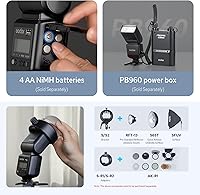
  • Battery Type: Requires 4x AA batteries, sold separately; NiMH rechargeable cells are strongly recommended for optimal recycle speed and flash yield.
  • Wireless System: Features an integrated 433MHz receiver compatible with the included RT-16 transmitter, supporting up to 16 selectable channels.
  • Sync Options: Supports four triggering methods: on-camera hot shoe, RT-16 wireless, S1/S2 optical slave modes, and a physical PC sync port.
  • TTL & HSS: This flash is fully manual with no TTL automatic metering and no High-Speed Sync support on any compatible camera brand.
  • Hot Shoe Type: Uses a single-contact universal hot shoe design, compatible with Canon, Nikon, Fuji, Olympus, Pentax, and Panasonic cameras that share this standard.
  • Head Tilt: The flash head tilts vertically from -7° to 120°, enabling direct, angled, and full ceiling-bounce flash positions.
  • Head Rotation: Horizontal rotation range covers 0° to 330°, allowing side-bounce and wide off-axis lighting angles without repositioning the camera.
  • Dimensions: The unit measures 2.36 x 2.83 x 2.91 inches, making it compact enough to fit in most camera bag accessory pockets.
  • Weight: Weighs 10.7 ounces without batteries, keeping the overall load manageable for on-camera or lightweight off-camera use.
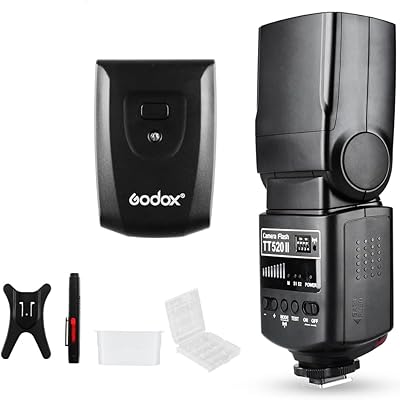
  • In-Box Contents: Each kit includes the TT520III flash unit, one RT-16 wireless transmitter, a mini stand, and a soft storage bag.
  • Predecessor: The TT520III is the third-generation successor to the TT520II, released in early 2025 with an updated display panel and refined body design.
  • Incompatible Models: Not compatible with Canon EOS R7, R6 II, R8, R10, R50, Rebel SL3, T6, T7; Sony A9III, A99, A77, ZV-1F; or Fuji X-A3, X100F, and X100T.

Related Reviews

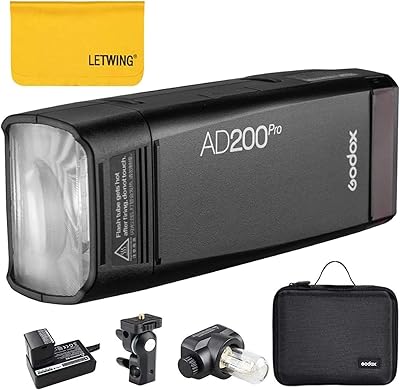
Godox AD200 Pro
Godox AD200 Pro
86%
93%
Output Power & Consistency
91%
Portability & Form Factor
78%
Battery Life & Charging
89%
HSS & Sync Performance
88%
Wireless Ecosystem Integration
More
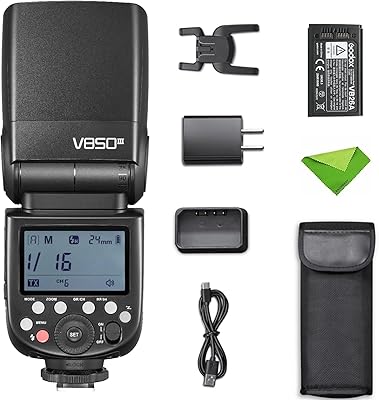
Godox V850III Flash
Godox V850III Flash
85%
88%
Performance
92%
Battery Life
86%
Ease of Use
84%
Build Quality
89%
Speed and Recycle Time
More
Godox TT600S Speedlight Camera Flash
79%
93%
Value for Money
88%
Wireless Performance
84%
Build Quality
91%
Output Consistency
76%
High-Speed Sync
More
Godox TT350F Fujifilm TTL Camera Flash
80%
88%
TTL Accuracy
76%
Build Quality
84%
HSS Performance
82%
Wireless Reliability
61%
Recycle Time
More
Godox TT520II Speedlite Flash
76%
91%
Value for Money
78%
Build Quality
84%
Wireless Performance
82%
Flash Output Consistency
76%
Ease of Use
More
Godox MF12 Macro Flash
87%
88%
Performance
90%
Ease of Use
85%
Battery Life
80%
Flash Power
92%
Wireless Control
More
Godox TT350C TTL Flash for Canon
80%
94%
Portability & Size
74%
TTL Accuracy
88%
Wireless Reliability
61%
Flash Power Output
86%
High Speed Sync (HSS)
More
Godox AD400Pro Outdoor Flash Monolight
80%
91%
Output Power & Consistency
83%
Battery Life & Reliability
71%
TTL Accuracy
88%
High-Speed Sync Performance
86%
Portability & Form Factor
More
Godox V1-NU Flash for Nikon
88%
91%
Value for Money
89%
Flash Performance
88%
Build Quality
87%
Battery Life
92%
Ease of Use
More
Godox AD600Pro Outdoor Studio Strobe Flash
81%
93%
Output Power & Consistency
78%
High-Speed Sync Performance
71%
Battery Life & Real-World Endurance
89%
Build Quality & Durability
84%
Wireless System & TTL Accuracy
More

FAQ

The RT-16 transmitter is included in the box, so you can start shooting wirelessly right away without any additional purchase. Just match the channel on both the transmitter and the flash, mount the transmitter on your camera hot shoe, and you are ready to go.

Unfortunately, no — the Canon EOS R10 is explicitly listed as incompatible, along with the R7, R6 II, R8, and R50. If you own one of those bodies, this hot shoe flash will not function correctly on it. Always cross-check the full exclusion list before purchasing.

With a guide number of GN33 at ISO 100, you can expect a well-exposed subject at roughly 3 to 4 meters in a typical indoor environment. In a large room or outdoors in daylight, that range shrinks fast, so this manual speedlight is best suited to controlled indoor spaces rather than wide-open venues.

No — the Godox TT520III Hot Shoe Flash is a fully manual flash and does not support TTL automatic metering on any camera brand, including Nikon. You set the power level yourself and adjust based on your test shots. For photographers just learning manual exposure, this is actually a useful discipline, but if you rely on TTL, you will need a different flash.

You need 4x AA batteries, which are not included. NiMH rechargeable cells are the right choice here — they keep the recycle time close to the rated 1.8 seconds and deliver the full 400-flash yield. Standard alkaline batteries work, but the recycle time stretches noticeably, sometimes to 3 or 4 seconds, which disrupts your shooting pace.

Yes — the TT520III has built-in S1 and S2 optical slave modes. S1 fires on any flash burst, while S2 is designed to ignore TTL pre-flash pulses and only trigger on the main flash. This means you can use it as a secondary off-camera light triggered by another flash or even a camera pop-up.

The main practical improvements are an updated display panel that is easier to read and navigate, a slightly refined body design, and the integrated 433MHz wireless receiver, which was also present on the II but has been carried forward. Users who upgraded consistently called out the display as the most noticeable day-to-day improvement.

It depends on the specific model. Most standard single-contact hot shoe Sony bodies are listed as compatible, but several are explicitly excluded: the A9III, A99, A77, and ZV-1F will not work with this flash. The A7 series is not on the exclusion list, but it is always worth double-checking your exact body before purchasing.

Almost — the head rotates horizontally from 0° to 330°, which covers nearly every practical bounce and off-axis angle you would encounter. It does not do a full 360°, but in practice that missing 30° of rotation rarely matters for typical portrait or event lighting setups.

The soft pouch keeps the flash and transmitter together and protects against light scratches, but it offers minimal padding against impact. For casual transport in a padded camera bag it is fine, but if you are traveling frequently or tossing gear around, a small hard case or a padded insert would give you more peace of mind.

Where to Buy