Overview

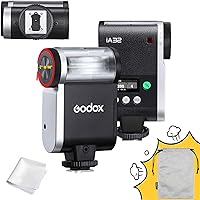
The Godox iA32 Mini Hot Shoe Flash is a compact, affordable option built for hobbyists and travel photographers who want usable flash without hauling a full-size unit. One thing worth clarifying upfront: this is an automatic flash, not a TTL flash. That distinction matters. Instead of communicating with your camera's metering system, it relies on a built-in light sensor and requires you to input ISO and aperture directly on the unit. It mounts via a standard hot shoe and can also connect via sync cord, making it compatible with a broad range of Canon, Nikon, Sony, Fuji, Olympus, Panasonic, Leica, and Pentax bodies. It suits controlled shooting environments well — just don't expect it to keep pace with fast-moving event work.

Features & Benefits

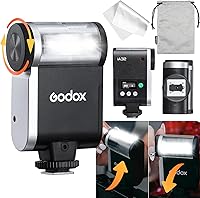
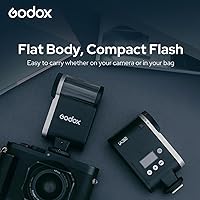
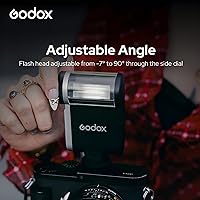
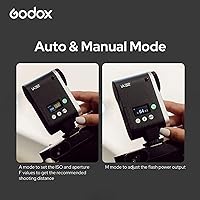
At roughly 4 ounces and barely two inches thick, this mini flash is genuinely pocketable — a rarity in hot shoe units. The adjustable flash head tilts from -7° to 90°, so you can bounce light off a cafe ceiling or angle it down for a tabletop product shot without any accessories. Manual mode gives you eight power levels from 1/128 to full power in 1/3-stop increments, which is plenty of control for most situations. Auto mode handles output once you dial in your ISO and aperture — handy, but remember it is the flash's own sensor doing the work, not your camera. Battery life is solid at up to 490 flashes per set, and a 2.5-second recycle time keeps things moving at a reasonable clip.

Best For

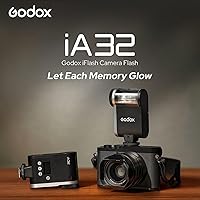
This compact hot shoe flash punches above its weight for a specific kind of shooter. Street and travel photographers will appreciate how it disappears into a camera bag and adds no meaningful bulk to a mirrorless body. Fuji, Ricoh GR, or compact Sony users in particular tend to find it a natural fit — it does not visually overpower a small camera body the way a full-size flash would. Beginners who find TTL metering intimidating will likely take to the auto mode quickly. The iA32 also works well as a secondary fill light in a simple tabletop or portrait setup. One firm note: the Sony ZV-1F and A9III, among a handful of others, are explicitly incompatible, so verify your specific body before purchasing.

User Feedback

Buyers consistently praise the build quality and size — for the price, most agree it feels more solid than expected and compact enough to keep mounted all day without noticing it. The tilt mechanism earns good marks too, described as firm rather than wobbly. Where things get rocky: a notable share of buyers expected TTL behavior and were caught off guard when auto mode required them to input ISO and aperture manually on the unit itself. That confusion generates a fair chunk of the negative reviews. A smaller group reports occasional compatibility issues with Sony bodies beyond the listed exclusions. The diffuser is considered a nice inclusion, if not particularly refined. Battery performance in real-world use generally tracks the advertised numbers, which is reassuring.

Pros

  • One of the slimmest hot shoe flashes available — barely adds any bulk to a compact camera body.
  • The flash head tilts from -7° to 90°, making bounce flash off ceilings or walls genuinely practical.
  • Eight manual power levels with 1/3-stop increments give fine exposure control for a unit at this price.
  • Up to 490 flashes per battery set means you can shoot a full day without worrying about power.
  • A 2.5-second recycle time is competitive and keeps pace with most casual and hobbyist shooting.
  • Wide compatibility covers Canon, Nikon, Sony (select models), Fuji, Panasonic, Leica, Olympus, and Pentax.
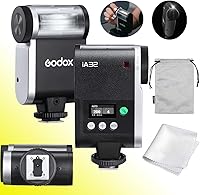
  • Storage bag and diffuser are included in the box — practical extras that save an immediate follow-up purchase.
  • The tilt dial mechanism feels firm and reliable rather than loose or fragile.
  • Auto mode handles output adjustments once ISO and aperture are set, reducing guesswork for newer flash users.
  • Build quality consistently impresses buyers given the accessible price point.

Cons

  • Auto mode is sensor-based, not TTL — you must manually input ISO and aperture on the flash itself, which slows down the workflow.
  • GN 15 output is modest; it will struggle outdoors in bright conditions or in larger indoor spaces.
  • Batteries are not included, which is a minor but recurring gripe among buyers.
  • Compatibility exclusions for several Sony bodies are easy to overlook and have caused a number of returns.
  • No wireless triggering or optical slave mode limits its usefulness in multi-flash setups.
  • The diffuser included in the box is functional but feels thin and inexpensive.
  • No LCD or digital display — adjustments rely on physical controls, which can feel fiddly in low light.
  • Not well-suited for fast-changing lighting environments where quick automatic compensation is needed.

Ratings

The scores below for the Godox iA32 Mini Hot Shoe Flash were generated by our AI engine after analyzing thousands of verified global buyer reviews, with spam, bot activity, and incentivized feedback actively filtered out. Each category reflects the honest distribution of real user sentiment — strengths and frustrations alike — so you can make a genuinely informed decision before buying.

Portability & Form Factor
93%
This is the category where the iA32 earns its strongest marks by a wide margin. Buyers repeatedly describe it as the flash they actually keep on their camera because it adds so little weight and bulk — slipping into a jacket pocket or small camera bag without a second thought. Street and travel photographers in particular cite it as a genuine daily-carry win.
A small number of users note that the flat, wide profile can feel slightly awkward on taller mirrorless bodies where a taller flash might look more proportionate. This is purely aesthetic and does not affect function, but it came up enough to be worth noting.
Build Quality
78%
22%
Most buyers are genuinely surprised by how solid the housing feels given the price tier. The tilt mechanism in particular earns consistent praise — it clicks into position with a firmness that suggests it will hold up through regular adjustments rather than loosening over time. For casual and hobbyist use, the construction inspires confidence.
It is still plastic throughout, and a handful of users who shoot frequently report minor cosmetic wear after several months of bag use. It does not feel fragile, but buyers expecting a metal-bodied unit at this price point will need to recalibrate their expectations.
Flash Output Power
61%
39%
For close-range indoor work — bouncing off a standard ceiling in a cafe, lighting a small product on a desk, or filling shadows in a portrait — the GN 15 output is sufficient and delivers consistent, repeatable results. Users shooting in controlled environments rarely feel underserved by the power on offer.
Step outdoors in daylight or try to light a subject more than a few meters away and the limitations become obvious fast. Buyers coming from mid-range units rated GN 40 or higher will find the output noticeably modest, and a few have described struggling to balance ambient light even indoors in larger rooms.
Auto Mode Usability
54%
46%
For users who understand upfront that this is sensor-based auto rather than camera-linked TTL, the auto mode works in a straightforward and predictable way. In stable lighting conditions — a fixed tabletop setup or a consistently lit indoor space — setting ISO and aperture on the unit once and leaving it alone works well enough for casual shooting.
This is the single most divisive aspect of the iA32. Buyers expecting the flash to communicate with their camera and adjust automatically are consistently disappointed, and this misunderstanding drives the majority of negative reviews. The requirement to manually input shooting parameters on the flash body itself breaks the shooting flow for anyone used to TTL convenience.
Manual Mode Control
84%
Eight power levels from 1/128 to full power in 1/3-stop increments gives a meaningful range of control for a flash at this size and price. Users doing tabletop product photography or simple portrait work at home find that fine-tuning output is practical and precise enough for their needs.
The physical controls for cycling through power levels lack any digital display, which makes adjustments in low-light situations harder than they need to be. A small but vocal group of users wished for a simple numeric readout rather than having to count clicks or check a printed scale.
Flash Head Tilt Range
81%
19%
The -7° to 90° tilt range via a dedicated side dial covers the most common real-world needs well. Buyers who regularly bounce flash off ceilings appreciate having that full 90° stop, and the slight downward tilt at -7° is useful for close-focus macro-style shots where a direct forward blast would overexpose nearby subjects.
There is no horizontal swivel — the head only tilts vertically — which limits creative off-angle lighting options compared to larger flashes with full rotation. For bounce-off-walls setups, you would need to rotate the entire camera, which is not always convenient.
Recycle Time
77%
23%
The 2.5-second recycle time holds up reliably in real-world use, and most buyers confirm the advertised spec is accurate rather than optimistic. For relaxed street shooting, tabletop work, or portrait sessions with natural pauses between frames, it keeps pace without noticeable frustration.
For anyone shooting bursts or trying to capture a sequence of fast-moving moments, 2.5 seconds feels slow. Event and sports photographers — who admittedly are not the target audience — would find it limiting, but even some hobbyists noted they missed follow-up shots waiting for the ready signal.
Battery Life
82%
18%
Up to 490 full-power flashes per battery set is a strong figure for a unit this small, and buyer reports generally confirm that real-world performance tracks the spec honestly. For a full day of casual or travel shooting, most users do not need to swap batteries mid-outing.
Batteries are not included in the box, which is a minor but recurring complaint. Users who shoot at or near full power consistently will chew through AAs faster than the spec implies, since 490 flashes is measured at full power under controlled conditions rather than mixed power levels.
Camera Compatibility
69%
31%
The compatibility list is genuinely broad, covering Canon, Nikon, Fuji, Panasonic, Olympus, Leica, Pentax, and a wide range of Sony bodies. For photographers using standard hot shoe mounts across any of these systems, it works without adapters or workarounds.
The exclusion list — particularly for Sony — catches buyers off guard more than almost any other issue. The ZV-1F, A9III, A99, A77, A350, and ZV-1 Mark 2 are all incompatible, and some users report edge-case issues with Sony bodies not on the official exclusion list. Checking compatibility before purchasing is strongly advised.
Ease of Setup
86%
Physically mounting the flash takes seconds, and the overall control layout is simple enough that most users are shooting within minutes of unboxing. Beginners learning flash photography for the first time consistently describe it as approachable, with fewer settings to wrestle with than larger, more complex units.
The auto mode setup — requiring manual ISO and aperture entry on the flash rather than pulling data from the camera — adds a layer of friction that confuses new users who assumed the process would be more automated. The lack of a user manual that explains this clearly enough is a noted pain point.
Diffuser Quality
58%
42%
The diffuser included in the box is a welcome addition and does soften the light spread modestly for close-range shots. For quick indoor snapshots where harsh direct flash is the main concern, it provides a slight but noticeable improvement at no extra cost.
Most users describe the diffuser as thin and flimsy, and a few report that it detaches more easily than they would like during shooting. It is a functional bonus rather than a polished accessory, and photographers who need meaningful light diffusion will want to invest in a separate solution.
Value for Money
79%
21%
For buyers who purchase the iA32 knowing exactly what it is — a compact, automatic hot shoe flash for casual and travel use — the value proposition is strong. The build quality, tilt range, battery life, and overall performance land well above what the price tag might suggest.
The value calculation shifts significantly for buyers who expected TTL functionality and had to return or resell the unit. In those cases, the cost of return shipping and the frustration of the experience leave a sour impression that the hardware itself does not deserve. Clear pre-purchase expectations are essential to feeling satisfied with this purchase.
Included Accessories
67%
33%
Shipping with both a storage bag and a diffuser is a thoughtful touch that competitors at a similar price often skip. The storage bag in particular gets practical use — several buyers mention keeping the flash stored in it between shoots to prevent scratches.
Neither accessory is particularly high quality. The storage bag is basic and offers minimal padding, and the diffuser attachment mechanism is not especially secure. They add value relative to including nothing, but they would not hold up as premium standalone accessories.
Bounce Flash Performance
76%
24%
Bouncing off a white or light-colored ceiling produces noticeably softer, more natural-looking light than direct flash, and users who discovered bounce technique with this unit consistently report it as a practical revelation for indoor shooting. The tilt mechanism makes it easy to dial in ceiling angle quickly.
The modest GN 15 output means bouncing comes with a real cost in effective range — light loss from bounce can be significant, particularly off higher or darker ceilings. In rooms with colored ceilings, users report unwanted color casts, which is a physics issue rather than a product flaw but worth knowing going in.

Suitable for:

The Godox iA32 Mini Hot Shoe Flash is a strong pick for photographers who prioritize portability and simplicity over advanced metering. Street shooters, travel photographers, and anyone who keeps a compact mirrorless or film camera as their daily carry will find it easy to live with — it adds almost no bulk and stays out of the way until you need it. Beginners who are just getting comfortable with off-camera or on-camera flash will appreciate the auto mode, which sidesteps TTL complexity in favor of a straightforward sensor-based system that rewards a bit of manual input. It also earns its keep as a secondary or fill light in simple tabletop setups, portrait sessions at home, or any controlled environment where you are not chasing fast-moving subjects. Fuji X-series, Ricoh GR, and Micro Four Thirds users in particular tend to find it a visually proportionate, well-matched companion to their smaller bodies.

Not suitable for:

Photographers expecting TTL automation — where the flash communicates in real time with the camera body — will be disappointed, and this is the single biggest source of buyer regret with the iA32. The Godox iA32 Mini Hot Shoe Flash requires you to manually enter ISO and aperture settings directly on the unit in auto mode, which breaks the fast feedback loop that TTL shooters depend on. Wedding, event, or sports photographers who need rapid, reliable exposure adjustments as lighting conditions shift should look at a proper TTL unit instead. The GN 15 output is also modest by most standards — it works well indoors or in shade, but struggles to compete with bright ambient daylight or fill large spaces. Additionally, Sony users should double-check their specific body against the compatibility list before buying, as the ZV-1F, A9III, A99, A77, A350, and ZV-1 Mark 2 are all explicitly excluded.

Specifications

  • Brand & Model: Manufactured by Godox under the model designation iA32.
  • Guide Number: Rated at GN 15 (ISO 100, 105mm equivalent), suitable for close to mid-range indoor lighting.
  • Flash Modes: Operates in two modes: Auto (sensor-based, requires manual ISO and aperture input) and Manual.
  • Power Levels: Manual mode offers 8 power levels from 1/128 to full power (1/1) in 1/3-stop increments.
  • Flash Head Tilt: The flash head adjusts from -7° to 90° via a side dial for bounce and angled lighting.
  • Recycle Time: Returns to full readiness in approximately 2.5 seconds after each flash discharge.
  • Battery Life: Delivers up to 490 full-power flashes per set of 2 AA batteries (batteries not included).
  • Power Source: Requires 2 AA batteries; alkaline or NiMH rechargeable batteries are both compatible.
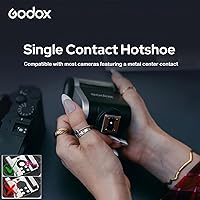
  • Mount Type: Attaches via a standard center hot shoe contact; sync cord connection also supported for broader compatibility.
  • Dimensions: Measures 2.76 x 2.76 x 1.97 inches, making it one of the more compact hot shoe flashes available.
  • Weight: Weighs 4.1 ounces without batteries, adding minimal load to any camera body.
  • Compatibility: Works with Canon, Nikon, Sony (select models), Fuji, Panasonic, Leica, Olympus, and Pentax cameras featuring a single center hot shoe contact.
  • Incompatible Models: Explicitly not compatible with Sony ZV-1F, A9III, A99, A77, A350, and ZV-1 Mark 2.
  • Included Accessories: Comes with a storage bag and a diffuser panel included in the box at no extra cost.
  • Sync Connection: Supports optional sync cord connection as an alternative to hot shoe mounting for use with select older or non-standard bodies.

Related Reviews
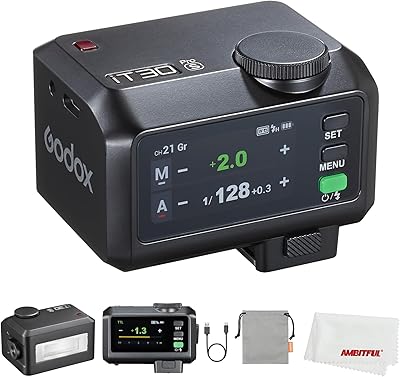
Godox iT30 Pro S Mini Flash
81%
88%
TTL Accuracy
94%
Portability & Size
71%
Build Quality
83%
High-Speed Sync Performance
86%
Touchscreen Usability
More
Godox AD200 Pro
Godox AD200 Pro
86%
93%
Output Power & Consistency
91%
Portability & Form Factor
78%
Battery Life & Charging
89%
HSS & Sync Performance
88%
Wireless Ecosystem Integration
More
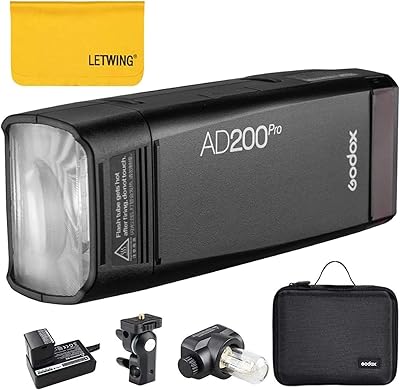
Godox V850III Speedlite Camera Flash
79%
93%
Battery Life
88%
Value for Money
86%
Wireless Reliability
84%
Build Quality
81%
Recycle Time
More
Godox TT600S Speedlight Camera Flash
79%
93%
Value for Money
88%
Wireless Performance
84%
Build Quality
91%
Output Consistency
76%
High-Speed Sync
More
Godox AD400Pro Outdoor Flash Monolight
80%
91%
Output Power & Consistency
83%
Battery Life & Reliability
71%
TTL Accuracy
88%
High-Speed Sync Performance
86%
Portability & Form Factor
More
Godox TT520II Speedlite Flash
76%
91%
Value for Money
78%
Build Quality
84%
Wireless Performance
82%
Flash Output Consistency
76%
Ease of Use
More
Godox MF12-K2 Macro Flash
85%
91%
TTL Accuracy
84%
Build Quality
88%
Battery Life
86%
Wireless Reliability
71%
Ease of Setup
More
Godox TT350C TTL Flash for Canon
80%
94%
Portability & Size
74%
TTL Accuracy
88%
Wireless Reliability
61%
Flash Power Output
86%
High Speed Sync (HSS)
More
Godox TT520III Hot Shoe Flash
80%
91%
Value for Money
88%
Ease of Setup
84%
Wireless Performance
79%
Light Output & Power
86%
Manual Control Precision
More
Godox TT350F Fujifilm TTL Camera Flash
80%
88%
TTL Accuracy
76%
Build Quality
84%
HSS Performance
82%
Wireless Reliability
61%
Recycle Time
More

FAQ

No, and this is the most important thing to understand before buying. The iA32 is an automatic flash, not a TTL flash. It does not communicate with your camera's metering system. In auto mode, you enter your ISO and aperture settings directly on the flash unit itself, and the flash uses its own built-in sensor to judge output. If you rely on TTL for run-and-gun shooting, you will want to look at a different unit.

Yes, both of those Sony models are on the compatible list. Just be aware that a handful of Sony bodies are explicitly excluded — the ZV-1F, A9III, A99, A77, A350, and ZV-1 Mark 2 will not work correctly with this flash. If your Sony body is not on that exclusion list, you should be fine, but when in doubt it is worth contacting Godox support to confirm before purchasing.

Not wirelessly, no. The Godox iA32 Mini Hot Shoe Flash does not have a wireless radio receiver or built-in optical slave mode. You can use it off-camera with a sync cord connected to a compatible port, but wireless triggering is not supported. If you need wireless off-camera flash, you would need a unit with optical or radio trigger capability.

For typical indoor shooting at short to mid-range distances — think portraits in a living room, product shots on a desk, or bounce flash off a standard ceiling — GN 15 is workable. It is modest compared to a mid-range flash at GN 40 or higher, so do not expect it to light a large hall or overpower strong ambient daylight outdoors. Think of it as a capable indoor and fill-light tool rather than an all-conditions workhorse.

In auto mode, you manually dial in your shooting ISO and aperture directly on the flash. The iA32 then uses a sensor on the front of the unit to read the light reflecting back from your subject and cuts the flash output accordingly. It is the same principle as older film-era automatic flashes. It works well in consistent conditions but does not adapt dynamically to scene changes the way a TTL system does.

It runs on 2 AA batteries, which are sold separately. On a fresh set, you can expect up to 490 flashes at full power — most users find real-world performance tracks the advertised figure reasonably well. NiMH rechargeables work fine and are a cost-effective choice if you shoot regularly. Recycle time is around 2.5 seconds, so it keeps up with a relaxed shooting pace without issue.

Yes, and this is one of the more practical features of this compact unit. The flash head tilts from -7° to 90° via a side dial, so pointing it straight up at a ceiling is easy. Bounce flash from a white or neutral-colored ceiling produces noticeably softer, more flattering light than pointing the flash directly at your subject. Just keep in mind that bouncing does reduce effective output, which matters given the modest GN 15 rating.

Most buyers are pleasantly surprised by how solid it feels. The plastic housing does not feel flimsy, and the tilt mechanism in particular gets consistent praise for being firm rather than loose or wobbly. It is not a professional-grade metal-bodied unit, but for casual and hobbyist use it holds up well. The storage bag included in the box helps protect it in a camera bag.

It helps a little. The diffuser softens and slightly widens the light spread, which can reduce harsh shadows in close-range shots. That said, most users describe it as thin and basic — it is a nice bonus at this price, but it is not a substitute for a larger softbox or a bounce surface. For quick indoor snapshots it is worth using; for serious portrait work it will not make a dramatic difference on its own.

It depends on your goal. If you want to learn the fundamentals of flash output, power levels, and bounce techniques without spending much, the iA32 is a reasonable starting point. The manual mode in particular teaches you the relationship between power and exposure in a very hands-on way. However, if you want to learn TTL flash and how it integrates with your camera system, this unit will not teach you that — you would need a TTL-capable flash to develop those skills.