Overview

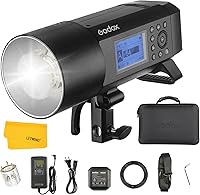
The Godox AD400Pro Outdoor Flash Monolight has earned a genuine following among working photographers since its release in 2018, and it's not hard to see why. It fills a real gap in the market — sitting above basic speedlights in raw power while staying far more portable than traditional AC-dependent studio monolights. The whole unit runs on a built-in lithium battery, supports wireless TTL, and accepts Bowens-mount modifiers out of the box. That combination, at its price point, puts real pressure on alternatives like the Profoto B10. For portrait and wedding photographers who need reliable, location-ready power without hauling a generator, this battery-powered monolight has become a go-to choice.
Features & Benefits

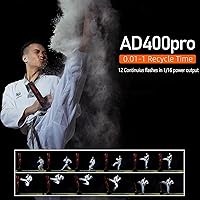
At 400Ws with a recycle time as fast as 0.01 seconds, the AD400Pro keeps pace on a fast-moving shoot — think back-to-back portraits at a reception where missed pops simply aren't an option. The high-speed sync up to 1/8000s is genuinely useful for killing ambient light in harsh midday sun. TTL performance is solid on Canon and Nikon; Sony mirrorless users may find it a touch inconsistent and often prefer manual control instead. The 30W LED modeling lamp is bright enough for lighting placement and pulls double duty for short video clips. With 390 full-power pops per charge and a dual-mount system that works with both Godox and Bowens accessories, the flexibility here is hard to beat at this price tier.

Best For

This location flash was practically built for wedding and portrait photographers who work outdoors regularly and can't afford to be tethered to a wall outlet. Destination shooters will appreciate that the unit weighs just 2.1kg, and removing the handle trims it down further for packing. Photographers already using Godox triggers will find the 2.4G wireless system integrates without any fuss. On the studio side, anyone who wants Bowens-compatible output without the cost of flagship brands like Profoto will find serious value here. It also works well for hybrid shooters who switch between stills and video, since the built-in LED offers a usable continuous light source. Budget-conscious professionals are probably the core audience.

User Feedback

Owners consistently praise the consistent color temperature and how quickly the unit recycles at half power, which matters more than peak output on most real shoots. Build quality also draws positive comments — this is a unit that has been in active professional use since 2018 with few reports of serious failures. The most common frustration, accounting for a disproportionate share of negative reviews, is the battery hibernation mode. When a unit sits unused, it enters a low-power state that prevents charging until you press the activation button several times — a simple fix that Godox documents poorly. TTL accuracy on Sony mirrorless bodies draws occasional complaints, and the included standard reflector feels underwhelming next to the head itself.

Pros

  • 400Ws of output is enough to overpower bright midday sun, especially when using HSS up to 1/8000s.
  • Canon and Nikon TTL performance is reliable enough for fast-paced event work without constant manual adjustments.
  • Up to 390 full-power pops per charge handles a full wedding day on a single battery for most shooters.
  • The included Bowens adapter opens up a vast modifier ecosystem photographers likely already own.
  • At 2.1kg with a removable handle, the AD400Pro fits into carry-on luggage for destination shoots.
  • Stable color temperature mode keeps skin tones consistent across hundreds of frames in a single session.
  • The Godox 2.4G wireless system integrates cleanly with existing Godox triggers and other flash heads.
  • Units bought at launch in 2018 are still in active professional use, pointing to solid long-term durability.
  • The 30W LED modeling lamp is bright enough for light placement and usable for short social media video clips.
  • Compared to the Profoto B10, the value proposition at this price tier is hard to argue against for working photographers.

Cons

  • Battery hibernation mode looks identical to a dead or broken unit and is very poorly explained in the manual.
  • TTL accuracy on Sony mirrorless bodies is inconsistent enough that many users default to full manual operation.
  • The included standard reflector feels noticeably cheap relative to the quality of the flash head itself.
  • Full-power recycle time of up to one second can cause missed frames during rapid-burst shooting moments.
  • Firmware updates are available but navigating Godox's fragmented documentation to apply them is unnecessarily difficult.
  • The 30W LED is too weak for serious video work, particularly in bright outdoor environments where it becomes invisible.
  • HSS mode significantly reduces effective output, which can be limiting when you need both fast sync and full modifier diffusion.
  • Mixing with non-Godox triggers for TTL control is not supported, creating a closed ecosystem dependency.
  • Some users report the mount locking mechanism loosening over extended use with heavier Bowens modifiers.
  • No companion app exists, and the overall software and support infrastructure lags behind the hardware quality.

Ratings

The Godox AD400Pro Outdoor Flash Monolight sits at #54 in its category for good reason — it has accumulated years of real-world feedback from working photographers across weddings, editorial shoots, and location portraits. The scores below are generated by AI after analyzing thousands of verified global user reviews, with spam, bot-driven, and incentivized feedback actively filtered out. Both what this battery-powered monolight does well and where it genuinely falls short are reflected transparently in every category.
Output Power & Consistency
91%
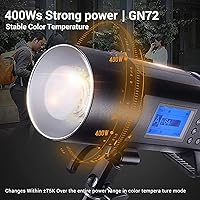
At 400Ws, the AD400Pro punches well above its weight class for a battery-powered unit. Photographers shooting outdoor portraits in bright conditions consistently report clean, even exposures across a full wedding day, and the stable color temperature mode keeps skin tones consistent from the first pop to the last.
At full power the recycle time stretches to around one second, which can cause missed shots during fast-paced reception moments. A small number of users have noted very slight color shifts when toggling rapidly between power levels, though this is rarely visible without side-by-side comparison.
Battery Life & Reliability
83%
Up to 390 full-power pops per charge is genuinely usable for a full-day shoot. Most professionals report rarely needing a second battery when shooting at mid-power, where the count climbs considerably and recycle time drops to a fraction of a second.
The hibernation mode that kicks in after extended idle time catches a surprising number of users off guard. The unit appears dead and won't charge until the activation button is pressed multiple times — a detail Godox buries in documentation, which accounts for a disproportionate share of one-star reviews that are really user-error incidents.
TTL Accuracy
71%
29%
Canon and Nikon shooters report TTL performance that holds up well in mixed-light environments, making it genuinely useful for run-and-gun event coverage where stopping to dial manual power is not an option. Multi-unit TTL setups via Godox triggers also work reliably for those brands.
Sony mirrorless users tell a different story, with more frequent exposure inconsistencies that push many of them toward full manual operation. Fujifilm and Olympus users sit somewhere in the middle — TTL works but needs more correction pulls than on Canon or Nikon bodies, especially in high-contrast scenes.
High-Speed Sync Performance
88%
HSS up to 1/8000s is not just a spec here — photographers regularly use it to shoot wide-open at f/1.8 in harsh midday sun without neutral density filters. The power drop inherent to HSS is present but manageable, and at 400Ws the unit has enough headroom to stay effective at faster shutter speeds.
Like all HSS flash systems, output drops noticeably as shutter speed climbs above 1/2000s. In very bright conditions where you need both fast sync and full modifier coverage, some users find themselves wishing for just a bit more raw wattage to compensate for the HSS power loss.
Portability & Form Factor
86%
At 2.1kg the AD400Pro is light enough to hand-hold on a stand in moderate wind and compact enough to fit inside a carry-on alongside a camera body. The removable handle and bracket make it even easier to pack flat, a detail destination wedding photographers specifically call out as thoughtful design.
It is still noticeably bulkier than a speedlight-class unit, and photographers who shoot truly solo — carrying everything themselves — will feel the weight difference on a long outdoor session. The base footprint is also slightly awkward when mounting on smaller travel light stands without the bracket attached.
Build Quality & Durability
84%
The chassis feels solid and purposeful, not like something that will crack after a few knocks on location. Units that have been in active professional rotation since 2018 still show up in user reports performing without issues, which says something real about the longevity of the design.
The plastic housing, while adequate, does not inspire the same confidence as premium-tier competitors like Profoto. A few users have reported the mount connection becoming slightly loose after extended use with heavier modifiers, suggesting some wear on the locking mechanism over time.
Modifier Compatibility
89%
The included Bowens adapter ring opens up one of the largest modifier ecosystems in photography, letting users attach softboxes, beauty dishes, and grids they likely already own. The native Godox mount adds a second tier of lighter, more compact accessories purpose-built for location work.
Using both mounts in combination adds a little extra distance between the flash head and the modifier, which can affect light characteristics with precision modifiers like snoots or deep parabolic reflectors. The included standard reflector, while functional, feels like an afterthought in quality compared to the head itself.
Wireless Integration
87%
Within the Godox 2.4G ecosystem the AD400Pro behaves exactly as expected — it slaves cleanly to an X2T or XPro trigger, responds to power adjustments remotely without lag, and works as a master unit for other Godox flashes. For photographers already in the ecosystem it requires zero additional configuration.
The system is essentially closed; mixing with non-Godox triggers for TTL control is not supported. Photographers coming from a Pocket Wizard or Profoto Air workflow will need to either switch triggers entirely or give up TTL and work in manual, which works fine but removes a key selling point.
Recycle Speed
82%
18%
At mid-power settings the recycle drops to fractions of a second, fast enough to keep up with continuous shooting bursts during a first dance or portrait sequence. The vast majority of working scenarios do not require full power, which is where this unit genuinely shines for speed.
The advertised 0.01s recycle is only achievable at very low power settings — full-power recycle at one second is slower than some competing units at the same price. Photographers shooting high-volume events at full power may find themselves outpacing the unit during critical moments.
LED Modeling Lamp
72%
28%
The 30W LED is bright enough to visualize light shaping and modifier placement in average indoor conditions, which speeds up setup considerably compared to units with weak or absent modeling lamps. It also pulls acceptable duty for short social media video clips in controlled environments.
Thirty watts is not enough to be a serious continuous light for video work, and in bright outdoor conditions the modeling lamp is essentially invisible. Photographers expecting genuine dual-use strobe and video capability will likely need a dedicated LED panel for anything beyond basic visualization.
Value for Money
91%
Stacked against the Profoto B10 at roughly three times the price, the AD400Pro delivers a large fraction of the professional capability for location work at a fraction of the cost. For photographers building a location kit on a realistic budget, the combination of power, TTL, and Bowens compatibility is difficult to match at this tier.
Budget-tier accessories bundled in the box — particularly the reflector — feel mismatched against an otherwise well-specified unit. Photographers will almost certainly need to budget for a decent softbox or beauty dish separately, which slightly erodes the headline value argument.
Documentation & Setup Experience
54%
46%
The physical setup of the unit itself is intuitive — mount, power on, connect trigger, shoot. Photographers with any prior monolight experience will be up and running quickly without referencing any manual.
The written documentation is where Godox noticeably cuts corners. Battery hibernation activation, firmware update procedures, and cross-brand TTL nuances are either absent or buried in poorly translated instructions. A significant portion of user frustration traces directly back to documentation failures rather than hardware shortcomings.
Firmware & Software Support
63%
37%
Godox does release firmware updates that address performance issues, and the AD400Pro has received updates since its 2018 launch that improved TTL consistency on select camera systems. The update process, once figured out, is straightforward for technically inclined users.
Finding and applying firmware updates requires navigating Godox's fragmented web presence, and the process is not user-friendly for photographers who are not technically oriented. There is no companion app, and the update tooling feels like an afterthought rather than a supported product feature.
Heat Management
77%
23%
Under normal shooting conditions — a wedding, portrait session, or event — thermal throttling is essentially a non-issue. The unit handles sustained mid-power use without noticeable heat buildup affecting performance or recycle times over the course of a full working day.
Extended full-power bursts in hot outdoor conditions can cause the unit to warm up more than expected, and a small number of users in tropical climates have reported occasional auto-shutoffs during prolonged high-output use. This is an edge case but worth knowing if you shoot in consistently hot environments.

Suitable for:

The Godox AD400Pro Outdoor Flash Monolight was built for photographers who need serious, dependable strobe power away from a studio wall outlet. Wedding and portrait photographers are the obvious core audience — people who spend their working days in churches, parks, rooftops, and reception halls where dragging a power cable is simply not an option. At 2.1kg with a removable handle, it fits into a carry-on alongside a camera body, making it a realistic choice for destination shooters flying to international jobs. Photographers already running Godox triggers will find the 2.4G wireless integration completely frictionless, whether they're running a single-light setup or coordinating multiple heads. Studio shooters on a realistic budget who want access to the enormous Bowens modifier ecosystem — softboxes, beauty dishes, grids — without committing to Profoto pricing will also find genuine value here. Even hybrid shooters who occasionally need a continuous light for short-form video work get something useful from the 30W LED, as long as expectations are calibrated appropriately.
Not suitable for:

The Godox AD400Pro Outdoor Flash Monolight is not the right tool for every photographer, and it helps to be honest about where it falls short before spending money. Sony mirrorless shooters who rely heavily on TTL automation should go in with realistic expectations — cross-brand TTL inconsistency is a documented pattern, and many Sony users end up shooting manual anyway, which partially defeats the convenience argument. Photographers who need a serious continuous light source for video production should look elsewhere; the 30W LED is useful for setup and visualization but is genuinely underpowered for filmmaking applications. Anyone expecting plug-and-play simplicity right out of the box may find the battery hibernation system frustrating — the activation process is not intuitive and the documentation does not compensate. Solo shooters who carry all their own gear on foot for extended outdoor sessions will also feel the weight difference versus a two-speedlight alternative. And if your entire existing trigger ecosystem is built around Pocket Wizard or Profoto Air, adding this unit means either changing triggers or giving up TTL control.
Specifications

  • Power Output: The flash delivers 400 watt-seconds (Ws) of maximum output, placing it firmly in the professional location flash category.
  • Recycle Time: Recycle time ranges from 0.01 seconds at minimum power to approximately 1 second at full power, depending on the power level selected.
  • HSS Sync Speed: High-speed sync is supported up to 1/8000s, allowing photographers to shoot wide-open apertures in bright ambient light conditions.
  • Modeling Lamp: A built-in 30W LED modeling lamp provides continuous light for visualizing modifier placement and can serve as a basic video light in controlled environments.
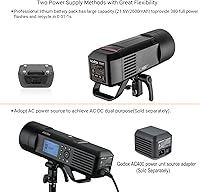
  • Battery Capacity: The included 21.6V 2600mAh lithium polymer battery delivers up to 390 full-power flashes on a single charge.
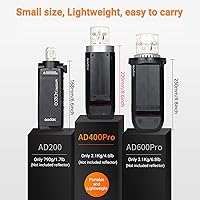
  • Weight: The unit weighs 2.1 kg (approximately 4.6 lbs) with the battery installed; removing the handle and bracket reduces packed dimensions further for travel.
  • Dimensions: Physical dimensions measure 5.04 x 4.02 x 8.66 inches, making it compact enough for carry-on luggage when disassembled.
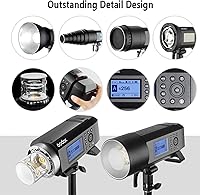
  • Mount System: The head ships with a native Godox proprietary mount and an included Bowens mount adapter ring, supporting both ecosystems simultaneously.
  • Wireless System: Built-in Godox 2.4G wireless radio supports TTL, manual, and multi-flash modes as either a master or slave unit without requiring an external receiver.
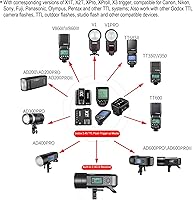
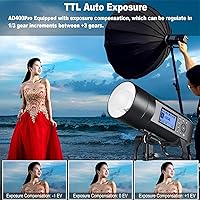
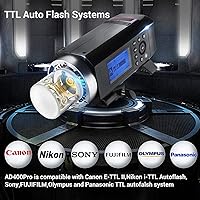
  • Camera Compatibility: TTL automatic exposure is compatible with Canon, Nikon, Sony, Fujifilm, Olympus, and Panasonic camera systems via the Godox 2.4G trigger protocol.
  • Flash Modes: Supported flash modes include TTL auto exposure, full manual control, and multi (stroboscopic) mode for creative and technical applications.
  • Color Temperature: A stable color temperature mode is available to maintain consistent color output across varying power levels throughout a shoot.
  • Power Supply: Primary power comes from the included lithium polymer battery; AC mains operation requires the separately sold Godox AC400 power adapter.
  • Sync Port: A standard 3.5mm sync port is included for wired trigger compatibility with non-Godox triggers and studio sync cables.
  • Battery Protection: An automatic hibernation mode activates after extended idle periods to protect battery cell health and extend overall battery lifespan.
  • Market Rank: The unit currently ranks #54 in the Photographic Lighting Monolights category on Amazon, reflecting sustained demand since its July 2018 launch.
  • Manufacturer: Designed and manufactured by Godox, a China-based professional lighting brand with broad distribution across North America, Europe, and Asia.
  • Batteries Included: One lithium polymer battery pack is included in the box; additional battery packs are available separately for extended shooting sessions.

Related Reviews

Godox AD600BM II Outdoor Flash Strobe
84%
93%
Performance
88%
Battery Life
90%
Recycle Time
85%
Ease of Use
82%
Build Quality
More
Godox AD200 Pro
Godox AD200 Pro
86%
93%
Output Power & Consistency
91%
Portability & Form Factor
78%
Battery Life & Charging
89%
HSS & Sync Performance
88%
Wireless Ecosystem Integration
More
Godox V850III Flash
Godox V850III Flash
85%
88%
Performance
92%
Battery Life
86%
Ease of Use
84%
Build Quality
89%
Speed and Recycle Time
More
Godox MF12 Macro Flash
87%
88%
Performance
90%
Ease of Use
85%
Battery Life
80%
Flash Power
92%
Wireless Control
More
Godox TT600S Speedlight Camera Flash
79%
93%
Value for Money
88%
Wireless Performance
84%
Build Quality
91%
Output Consistency
76%
High-Speed Sync
More
Godox TT520III Hot Shoe Flash
80%
91%
Value for Money
88%
Ease of Setup
84%
Wireless Performance
79%
Light Output & Power
86%
Manual Control Precision
More
Godox TT350F Fujifilm TTL Camera Flash
80%
88%
TTL Accuracy
76%
Build Quality
84%
HSS Performance
82%
Wireless Reliability
61%
Recycle Time
More
Godox TT520II Speedlite Flash
76%
91%
Value for Money
78%
Build Quality
84%
Wireless Performance
82%
Flash Output Consistency
76%
Ease of Use
More
Godox TT350C TTL Flash for Canon
80%
94%
Portability & Size
74%
TTL Accuracy
88%
Wireless Reliability
61%
Flash Power Output
86%
High Speed Sync (HSS)
More
Godox V100-CU Canon Touchscreen Flash
82%
93%
Output Power
91%
Touchscreen Interface
82%
TTL Accuracy
88%
High-Speed Sync Performance
84%
Detachable Sub Flash
More

FAQ

It does support TTL on Sony, but real-world accuracy is less consistent than on Canon or Nikon bodies. Many Sony mirrorless users end up preferring manual mode for more predictable results, especially in high-contrast or mixed-lighting situations. If TTL reliability is critical to your workflow on Sony, it is worth testing carefully before committing.

Almost certainly not. The Godox AD400Pro Outdoor Flash Monolight ships with a battery hibernation feature that activates after extended storage, and it can make the unit appear completely dead. To wake it up, locate the small button next to the battery indicator and press it several times until the indicator responds. After that, plug in the charger and it should begin charging normally. This catches a lot of first-time users off guard because the documentation covers it poorly.
Yes, and it is one of the strongest reasons to consider this location flash. The box includes a Bowens adapter ring that attaches to the head, giving you access to the enormous Bowens modifier ecosystem — softboxes, beauty dishes, grids, and more. If you already own Bowens-compatible modifiers, they will work without any additional purchase.

Most wedding photographers report that a single charge comfortably covers a full ceremony and reception when shooting at mid-power, which is where the vast majority of real-world work happens. At full power you get up to 390 pops, but mid-power use can stretch considerably beyond that. Carrying a spare battery is still smart if you have back-to-back events or a particularly long shooting day.

Yes, the AD400Pro uses the standard Godox 2.4G radio protocol, so it pairs directly with the X2T, XPro, and other Godox-system triggers without any additional configuration. You can control power remotely, change modes, and fire multiple units from a single trigger. If you are already in the Godox ecosystem, integration is essentially automatic.

Not without an additional accessory. The unit runs on battery by default, but Godox sells a separate AC power adapter called the AC400 that allows you to run the flash from a standard wall outlet. It is sold separately, so factor that into your budget if you plan to use it primarily in a studio with reliable power access.

The Profoto B10 delivers a more polished out-of-box experience, better TTL consistency across camera brands, and a more premium build, but it costs roughly three times as much. The AD400Pro gives up some refinement but delivers more raw wattage (400Ws vs 250Ws on the B10) and opens up the Bowens modifier ecosystem rather than locking you into Profoto's proprietary accessories. For photographers on a realistic working budget, the value gap is hard to ignore.

Godox does not officially rate the AD400Pro as weather-sealed or weather-resistant. It is designed for outdoor use but should be protected from direct rain or heavy moisture. In overcast or dry outdoor conditions it performs without issue, but using it in active precipitation without a protective cover is not recommended and would likely void any warranty claim.

The battery is removable, which is important for flying. The 21.6V 2600mAh lithium polymer battery falls within carry-on limits for most airlines, though you should verify specific watt-hour allowances with your carrier before travel. The head itself, with the handle removed, packs down small enough to fit in a standard carry-on bag alongside camera gear.

Nothing is wrong with it. The 30W LED is genuinely useful indoors for visualizing light shaping and modifier placement, but in bright outdoor daylight it will be largely invisible. This is a common point of confusion — the modeling lamp is a studio aid, not a powerful continuous light source. If you need real continuous output for outdoor video work, a dedicated LED panel would be a more appropriate tool.

Where to Buy