Overview

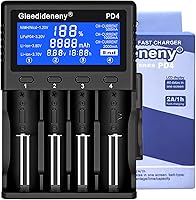
The Gleedideneny PD4 Universal Battery Charger is the kind of charger that makes sense if you regularly deal with more than one battery chemistry — think 18650s in your flashlight, IMR cells in a vape mod, and a handful of AA rechargeables rattling around a drawer. The brand, manufactured by XINSHENGLI and listed since late 2023, is newer to the space, so you won't find decades of reputation behind it. What you do get is a four-slot LCD charger with a compact build and dual AC/DC input, covering a lot of practical ground for the price. Solid, capable, and honest about its limits.
Features & Benefits

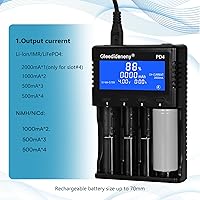
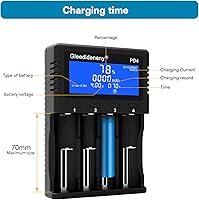
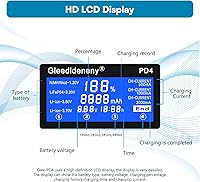
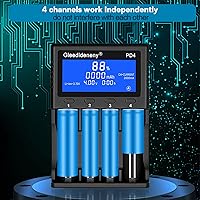
The LCD readout is one of the more useful differences between this multi-chemistry charger and cheaper LED-only alternatives — you can actually see voltage, charging current, and capacity in real time rather than guessing by a blinking light. It handles Li-ion, IMR, LiFePO4, and NiMH/NiCd chemistries, with auto-detection for Li-ion versus NiMH; LiFePO4 and IMR require a manual switch, which is fair. The four channels run independently, so a half-dead 26650 and a fresh 14500 can charge side by side without interference. One thing worth knowing upfront: 2A fast charging is exclusive to slot 4. The other three slots max out at 1A. That is not a dealbreaker, but it is something to plan around.

Best For

This universal charger is a natural fit for flashlight and EDC hobbyists who rotate through 18650s and larger cells across multiple devices. Vapers running IMR 3.8V batteries will also find it reliable and safe. The 12V DC input makes it genuinely useful for preppers or anyone who wants to charge off a car adapter when wall power isn't an option. It also works well as a single household charger for people who want their NiMH AA and AAA cells handled alongside specialty lithium formats. That said, high-volume users who need rapid 3A or faster charging across all four slots simultaneously will find this charger underpowered for that workflow — it simply isn't built for that pace.

User Feedback

Across roughly 90 ratings, the PD4 charger holds a 4.1 out of 5, which suggests most buyers are satisfied without being outright enthusiastic. The LCD display clarity and broad chemistry support draw consistent praise. On the other side, some users note the charger runs noticeably warm during 2A operation — not alarmingly so, but enough that the manual explicitly tells you to monitor heat and remove batteries once charging completes. A few buyers have also questioned how cleanly the auto-detection handles NiMH cells, which is worth watching. For a brand under two years old, the early review base is encouraging, though anyone concerned about long-term durability may reasonably want to wait for a deeper track record to develop.

Pros

  • The LCD panel displays live voltage, current, and capacity for each slot, so you are never guessing about charge status.
  • Four independent channels let a small 14500 and a large 26650 charge simultaneously at their own appropriate rates.
  • Handles Li-ion, IMR, LiFePO4, and NiMH/NiCd chemistries in one unit, consolidating what used to require multiple chargers.
  • Universal 110–240V AC input plus a 12V DC option makes this multi-chemistry charger usable at home, while traveling, or in a vehicle.
  • Three selectable charge rates give you real control over balancing charge speed against long-term battery health.
  • Built-in protections cover overcharge, short circuit, reverse polarity, and even flag cells that are too degraded to charge safely.
  • The compact body fits on a desk or nightstand without consuming meaningful space for a four-slot device.
  • Buyers consistently highlight the LCD readability and broad size compatibility as standout strengths across real-world reviews.
  • The included AC cable and wide voltage range mean no separate adapter is needed for international travel.

Cons

  • Only slot 4 supports 2A charging; the other three are capped at 1A, which is easy to miss before purchasing.
  • The unit runs noticeably warm during 2A operation, and the manual explicitly advises removing batteries and unplugging immediately after charging completes.
  • LiFePO4 and IMR chemistries require manual mode selection every session since they are not auto-detected, adding steps for less experienced users.
  • As a brand launched in late 2023, Gleedideneny has a limited track record, making long-term durability harder to assess with confidence.
  • Some reviewers have raised doubts about the accuracy of NiMH auto-detection, which is worth monitoring depending on how you use it.
  • The product manual is not considered particularly clear, yet the listing itself specifically flags it as essential reading before first use.
  • Does not support 1.5V alkaline or primary lithium cells, which can catch general consumers off guard if they expect universal compatibility.
  • With no 3A option anywhere on the unit, the charger is genuinely underpowered for anyone running a high-volume battery rotation.

Ratings

The Gleedideneny PD4 Universal Battery Charger has been evaluated using AI-assisted analysis of verified buyer reviews from global markets, with spam, bot-generated, and incentivized submissions actively filtered out before scoring. The ratings below reflect a balanced picture of what real users genuinely value about this multi-chemistry charger alongside the friction points and trade-offs that surface with consistent use. Both strengths and pain points are scored transparently so you can judge whether this charger fits your specific needs before committing.
Chemistry Compatibility
88%
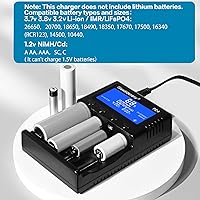
Few chargers in this price bracket handle four distinct chemistries — Li-ion, IMR, LiFePO4, and NiMH/NiCd — in one unit without requiring adapters or separate devices. Users who juggle cells across flashlights, vape mods, and AA-powered gadgets consistently appreciate not having to swap chargers depending on what they are topping up.
LiFePO4 and IMR batteries require the user to manually switch chemistry mode before charging, which catches newer users off guard who assume everything is auto-detected. This adds a real extra step to each session and creates a risk of charging at the wrong settings if you forget to switch.
LCD Display Quality
84%
The real-time display showing voltage, current draw, and capacity per slot is a meaningful step up from the blinking LED indicators found on cheaper chargers. Flashlight hobbyists especially value being able to see exactly where each cell is in its charge cycle rather than guessing based on elapsed time.
The display is functional rather than premium — the viewing angle is limited, and some users find the text small enough to require closer inspection in low-light conditions. Users accustomed to higher-end charger interfaces with backlit color screens may find the readout underwhelming in comparison.
Charging Speed
67%
33%
Three selectable charge rates — 500mA, 1000mA, and 2000mA — give users genuine flexibility to balance speed against battery longevity. Vapers who need a cell topped up quickly before heading out appreciate having a 2A option available, even if it is confined to a single slot.
The 2A fast-charge rate is available only in slot 4, meaning the three remaining slots max out at 1A — a limitation that frustrates buyers who expect full-speed charging across all four channels simultaneously. Anyone rotating a large battery collection will feel this bottleneck on busier charging days.
Safety Features
86%
The onboard protection suite covers overcharge, over-discharge, reverse polarity, and short circuit, with an added layer that flags cells too degraded to charge safely. For vapers and flashlight users who run high-drain cells hard, knowing the charger actively monitors for problems provides genuine peace of mind.
Heat during 2A operation is a notable concern — the unit runs warm enough that the manufacturer explicitly advises against unattended charging and recommends removing batteries promptly when done. This undermines the convenience of a set-and-forget workflow, especially for users who charge overnight or away from home.
Value for Money
82%
18%
For a mid-range price, buyers get four independent charging channels, multi-chemistry support, a live LCD readout, and a comprehensive safety package — a combination that typically commands a higher price from established brands. Users consistently describe it as a capable performer that delivers more features than the price tag would suggest.
The value case is tempered by open questions about long-term durability, since Gleedideneny has been on the market for under two years and lacks the track record of more established competitors. Buyers planning to rely on the charger daily for several years may reasonably feel the calculus shifts at this price point.
Build Quality
74%
26%
The housing feels solid and well-fitted for the price, with battery slots that hold cells securely without excessive play. Users report the spring contacts are firm enough to maintain good connection across the full range of supported sizes, which is a genuine concern with universal chargers of this type.
The plastic construction is functional rather than premium, and given the brand's short market history, there is limited data on how the contacts and housing hold up after heavy daily use over a year or more. Some users note the unit feels slightly lighter in the hand than pricier alternatives in the same category.
Ease of Use
71%
29%
Dropping in a battery and letting the charger auto-detect Li-ion or NiMH is genuinely straightforward, and the LCD makes it easy to confirm correct identification before walking away. For everyday NiMH and standard Li-ion users, the learning curve is minimal from the moment it comes out of the box.
Users charging LiFePO4 or IMR cells must remember to manually cycle to the correct mode each session, and the documentation does not make this process intuitive for newcomers. Several reviewers mention confusion on first use, with the manual itself drawing criticism for being hard to follow without prior battery knowledge.
Auto-Detection Accuracy
68%
32%
For the two chemistries handled automatically — standard Li-ion and NiMH — most users report reliable identification without needing to intervene, which is the core expectation for any modern smart charger. When it works correctly, it meaningfully reduces the risk of charging a cell at an inappropriate voltage or rate.
A subset of reviewers have flagged inconsistencies in NiMH detection, particularly with older or lower-capacity cell formats that may not always be identified correctly. LiFePO4 and IMR are excluded from auto-detection entirely, which is a meaningful gap given how common those chemistries are among the intended audience.
Heat Management
58%
42%
At lower charge rates of 500mA or 1A, the unit stays at an acceptable operating temperature and poses no unusual concern, covering the majority of NiMH and moderate Li-ion charging sessions where outright speed is not the priority.
Running at 2A in slot 4 generates enough heat that the manufacturer warns users to monitor it and remove batteries immediately upon completion — a real limitation for anyone expecting to charge unattended. Thermal performance at maximum current is the single most consistently cited concern across genuine buyer reviews.
Size Compatibility
91%
The breadth of supported cylindrical formats — from compact 10440 cells up to large 26650s, plus standard AA and AAA — means most users will rarely encounter a rechargeable battery this charger cannot accommodate. For collectors who mix and match formats across multiple devices, this range is a standout practical advantage.
The adjustable slide rail that accommodates different battery lengths can occasionally feel imprecise with unusual or less-common formats, requiring manual adjustment to ensure solid contact. Additionally, 21700 cells — increasingly common in high-performance flashlights — are not explicitly listed as supported, which is a gap worth noting for that buyer segment.
Travel Friendliness
83%
The 110–240V AC input eliminates the need for a voltage converter when traveling internationally, requiring only a physical plug adapter for the local wall socket shape. The optional 12V DC input adds genuine off-grid flexibility for campers and road trippers who want to charge from a vehicle without carrying extra gear.
At just under 11 oz and roughly 5 inches by 4 inches, the unit is not insignificant in a carry-on or travel backpack, and it occupies meaningful space compared to single-slot alternatives. The DC car adapter cable is not included in the box, so users who want that option need to source it separately.
Documentation Quality
52%
48%
The manual does cover the essential operational steps, including the critical instruction to select manual mode for LiFePO4 and IMR chemistries, meaning the right information is technically present for users willing to read carefully before their first session.
The listing itself flags the manual as essential reading before use — an unusual warning that signals the documentation is not intuitive on its own. Multiple reviewers have cited poor translation quality and vague step-by-step instructions, making it harder for newcomers to get started with confidence.
Brand Reliability
61%
39%
The early review pool — over 90 ratings averaging 4.1 out of 5 — is a reasonable initial signal that the product performs as described for most buyers. Manufacturing is handled by XINSHENGLI, suggesting an established supply chain even if the Gleedideneny label itself is relatively new to the market.
With under two years on the market and fewer than 100 reviews, there is simply not enough longitudinal data to assess how well the charger holds up under sustained daily use over several years. Buyers who have been disappointed by short-lived electronics from newer brands will reasonably approach this one with measured caution.
Independent Channel Performance
79%
21%
The four channels genuinely operate independently, so inserting a depleted 26650 alongside a half-charged 18650 causes no cross-interference — each slot reads and charges its own cell at the appropriate rate. This is the core behavior buyers expect from a multi-slot charger and it delivers consistently.
The maximum aggregate output is shared across all four channels, meaning filling every slot simultaneously — especially when combining 2A in slot 4 with 1A loads in the others — can stretch overall charge times beyond single-slot benchmarks. Users charging a full bay of large-capacity cells should plan for longer sessions accordingly.

Suitable for:

The Gleedideneny PD4 Universal Battery Charger is a strong fit for anyone who regularly works across multiple battery chemistries and is tired of juggling separate dedicated chargers for each one. Flashlight collectors and EDC enthusiasts who rotate through 18650s, 26650s, and similar cylindrical cells will get the most practical value from its four independent slots and wide size range. Vapers relying on IMR 3.8V cells will appreciate the manual mode override that lets them set the correct chemistry rather than trusting auto-detection alone. The 12V DC input is a genuine advantage for preppers and off-grid users who need to charge from a car adapter during outages or extended trips. It also suits the casual NiMH user who wants a single charger to handle everyday AA and AAA rechargeables alongside specialty lithium formats without purchasing two separate devices.
Not suitable for:

The Gleedideneny PD4 Universal Battery Charger is not the right tool for power users who need aggressive, high-speed charging across every slot at once — only slot 4 supports 2A, and anyone expecting simultaneous fast charging on all four channels will be frustrated quickly. If you manage a large rotating fleet of cells for photography, industrial equipment, or high-drain professional devices, the throughput here simply will not keep pace with that kind of demand. Buyers who place a premium on brand heritage and long-term manufacturer support should also give this one careful thought, since Gleedideneny is a newer label without a multi-year reliability record to point to. Those who want fully automatic chemistry handling for LiFePO4 or IMR cells should know that both require manual mode selection every session, which adds friction if you want a truly set-it-and-forget-it experience. Anyone hoping to charge standard 1.5V alkaline or primary lithium cells should look elsewhere entirely, as this charger does not support them.
Specifications

  • Brand: This charger is sold under the Gleedideneny brand label.
  • Model: The model designation is Gleedideneny-PD4.
  • Manufacturer: The unit is physically manufactured by XINSHENGLI.
  • Dimensions: The charger body measures 5.23″ deep by 3.93″ wide by 1.35″ tall.
  • Weight: The unit weighs 10.9 oz, making it compact and easy to move between locations.
  • Slot Count: There are four independent charging channels, each managed by its own dedicated microprocessor.
  • Chemistries: Supported battery chemistries include Li-ion 3.7V, IMR 3.8V, LiFePO4 3.2V, and NiMH/NiCd 1.2V.
  • Compatible Sizes: Compatible cylindrical formats include 10440, 14500, 16340, 17500, 17670, 18350, 18490, 18650, 20700, and 26650, as well as AA, AAA, SC, and C cells.
  • Charge Currents: Selectable charge rates are 500mA, 1000mA, and 2000mA, with the 2000mA rate restricted exclusively to slot 4.
  • AC Input: The AC input accepts 110–240V at 50/60Hz, making it compatible with standard household power in most countries worldwide.
  • DC Input: An optional 12V 1A DC input allows the charger to operate from a car adapter or similar 12V power source.
  • Display: An LCD screen provides real-time readout of voltage, charging current, and accumulated capacity for each individual slot.
  • Auto Detection: The unit automatically identifies Li-ion and NiMH/NiCd chemistries; LiFePO4 and IMR modes must be selected manually by the user.
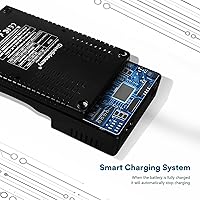
  • Safety Features: Onboard protections cover overcharge, over-discharge, short circuit, and reverse polarity, and the charger can also flag damaged or unserviceable cells.
  • Color: The unit is available in black.
  • Market Entry: This product was first listed for sale in November 2023.

Related Reviews

Tenergy TN299 Universal Battery Charger
74%
83%
Chemistry Compatibility
88%
Slot Independence
71%
Ease of Use
81%
Display & Monitoring
62%
Battery Fit & Compatibility
More
Intelligence 8 Bay Universal Battery Charger
86%
90%
Charging Speed
88%
Usability
93%
Safety Features
85%
Display Clarity
87%
Build Quality
More
Tenergy TN456 Universal Battery Charger
82%
93%
Battery Chemistry Compatibility
91%
Independent Slot Operation
88%
LCD Display & Data Readouts
86%
Capacity TEST Mode
79%
Charging Speed & Current Control
More
Tenergy TN486U 5-Bay Universal Battery Charger
80%
91%
Versatility
88%
USB Connectivity
84%
LCD Display
87%
Safety Features
58%
Charging Speed
More
MiBOXER C8 8-Bay Battery Charger
82%
88%
Charging Performance
91%
Battery Compatibility
93%
LCD Display Clarity
86%
Internal Resistance Measurement
89%
Safety Features
More
Opus BT-C2400 Battery Charger Analyzer
77%
91%
Measurement Accuracy
88%
Internal Resistance Testing
93%
Channel Independence
54%
Charging Speed
83%
Refresh Mode Effectiveness
More
XTAR VC4SL 4-Bay Battery Charger
82%
88%
Charging Accuracy
91%
LCD Display Quality
93%
Battery Compatibility
84%
Grade Mode Usefulness
82%
Build Quality
More
Koshore Universal Rechargeable Battery Charger
72%
88%
Format Versatility
83%
LCD Display Clarity
61%
Build Quality
69%
Charging Speed
78%
Discharge Function
More
Energizer Recharge Universal Charger
86%
88%
Charging Speed
93%
Battery Compatibility
91%
Ease of Use
86%
Build Quality
92%
Value for Money
More
XTAR VC2SL Battery Charger
84%
85%
Charging Performance
88%
Ease of Use
80%
Build Quality
90%
Portability
92%
Battery Compatibility
More

FAQ

Yes, all four channels operate completely independently, so you can drop in a 26650 in one slot, a couple of 18650s in another two, and an AA cell in the last one, and each will charge at its own pace without interfering with the others.

It is one of the formats this charger handles most naturally. Just insert the cell, let it auto-detect the Li-ion chemistry, and set your preferred charge rate. If you are using LiFePO4 18650s specifically, you will need to switch to that mode manually since those are not auto-detected.

It matters if you are in a hurry and have a large-capacity cell to top up. For everyday use at 500mA or 1A, any slot works fine. Where it becomes a real consideration is if you have four big cells and want them all fast-charged simultaneously — that simply is not possible here. Prioritize slot 4 for your highest-capacity or most time-sensitive cell.

The charger includes overcharge protection that cuts the current when a cell is full, but the manufacturer explicitly advises removing both the batteries and the charger from power once charging is done. It also runs noticeably warm at 2A, so it is worth checking on it periodically rather than setting it overnight and forgetting about it completely.

Yes, it supports 1.2V NiMH and NiCd cells in AA, AAA, SC, and C formats. The one thing to be aware of is that it does not charge 1.5V alkaline or primary lithium AA batteries — only rechargeable NiMH and NiCd types are compatible.

The charger automatically distinguishes between Li-ion and NiMH chemistries without any input from you. LiFePO4 and IMR cells are the exceptions — for those, you need to manually select the correct mode before charging, since the auto-detection will not identify them correctly on its own.

Yes — the Gleedideneny PD4 Universal Battery Charger accepts a 12V 1A DC input, so you can run it from a car adapter when wall power is not an option, which makes it a practical companion for road trips, camping, or off-grid situations.
The AC input is rated for 110–240V at 50/60Hz, which covers virtually every country's standard household voltage. You will just need a physical plug adapter to match the local wall socket shape — no voltage converter required.

The LCD screen displays live voltage, current, and capacity for each slot, and as a cell nears full charge you will see the current draw drop significantly. The display also indicates a completed charge state so there is no ambiguity about which slots are done.

Some warmth during operation is normal, particularly in slot 4 at 2A. The manual flags heat as something to monitor and recommends placing the unit on a hard, non-flammable surface. If it feels uncomfortably hot, dropping to 500mA or 1A will run noticeably cooler and is gentler on the batteries over time as well.