Overview

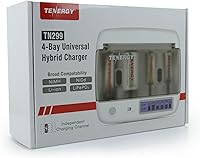
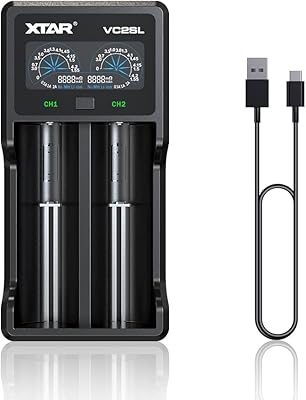
The Tenergy TN299 Universal Battery Charger is built around a simple premise: one charger for every rechargeable battery in your home. It handles the usual consumer sizes — AA, AAA, C, D, and 9V — alongside cylindrical lithium cells like the 18650, 14500, and 10440. At its mid-range price, it sits comfortably above the cheapest single-chemistry options without venturing into serious hobbyist territory. One thing worth knowing upfront: flat-top lithium cells are not supported — only button-top versions fit properly. The 12V adapter is included, so there is nothing extra to source before you get started.
Features & Benefits

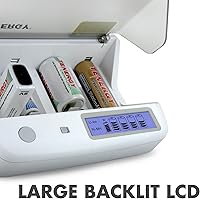
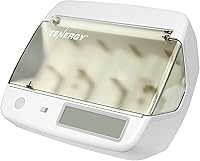
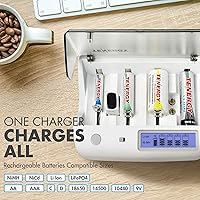
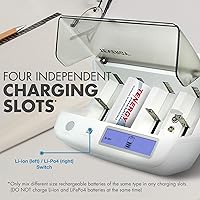
The TN299 uses four independent charging bays, each governed by its own IC — so dropping a half-dead AA next to a freshly depleted 18650 is not a problem. NiMH and NiCd batteries are detected automatically, but lithium chemistries require you to flip a manual toggle switch to select either Li-ion or LiFePO4 before charging. Critically, you cannot run both lithium types at the same time. Charging current adjusts based on how many slots are occupied: lithium cells get 800mA with one or two loaded, falling to 400mA across three or four. A backlit LCD display on each bay gives you live status at a glance, which is genuinely useful in a dim garage or utility room.

Best For

This hybrid battery charger makes the most sense for households juggling several device categories at once — TV remotes, digital cameras, flashlights, and any EDC gear running on 18650s. It is also a solid pick for off-grid preparedness, since it covers nearly every common rechargeable format without requiring a second unit. Casual 18650 users who stick to button-top cells will find it fits their needs well. What it is not is a tool for battery enthusiasts who want capacity readouts, discharge cycling, or internal resistance testing — those buyers should look at more specialized chargers. For everyone else, replacing two or three separate units with one practical device is a straightforward improvement.

User Feedback

Across roughly 320 ratings, this multi-chemistry charger lands at 4.0 out of 5 — respectable, though the spread between glowing and frustrated reviews tells a useful story. Buyers consistently praise the independent slot behavior and how readable the LCD is compared to similarly priced competitors. The friction points are more specific: the manual Li-ion/LiFePO4 toggle catches people off guard, and a handful of users report that longer protected 18650 cells do not always seat properly. Long-term durability draws some skepticism, with a portion of critical feedback appearing after a year or more of regular use. None of these are dealbreakers for typical home users, but they are worth factoring in before buying.

Pros

  • Four independent bays mean different battery types can charge simultaneously without interfering with each other.
  • Auto-detects NiMH and NiCd chemistry, removing guesswork for the most common household battery types.
  • Backlit LCD display on each slot makes it easy to monitor charge status in a dim room or garage.
  • Covers an unusually wide range of formats: AA, AAA, C, D, 9V, 18650, 14500, and 10440 in one unit.
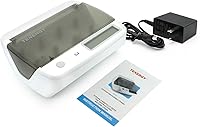
  • Ships with a 12V adapter included — no additional accessories required to get started.
  • Charging current scales intelligently based on slot count, helping protect lithium cells from overload.
  • Replaces two or three separate chargers, reducing both cost and counter clutter over time.
  • The 50mA trickle rate for 9V packs is appropriately gentle and less likely to stress older cells.

Cons

  • Flat-top 18650, 14500, and 10440 cells are not compatible — a meaningful restriction for many lithium battery users.
  • Switching between Li-ion and LiFePO4 requires manually toggling a physical switch, which is easy to forget and can lead to charging errors.
  • Li-ion and LiFePO4 batteries cannot be charged in the same session, forcing multiple charging rounds if you own both types.
  • Some protected 18650 cells with slightly extended lengths do not seat properly in the bays.
  • No capacity readout, discharge function, or internal resistance testing — basic diagnostics that more advanced chargers provide.
  • Durability reports from users past the 12-to-18-month mark are inconsistent, suggesting the build quality may not hold up under heavy daily use.
  • The manual chemistry toggle creates a real risk of user error that a fully automatic detection system would eliminate.
  • Charging current drops noticeably when all four lithium slots are in use, which can slow down charging sessions significantly.

Ratings

The scores below reflect our AI-driven analysis of verified global buyer reviews for the Tenergy TN299 Universal Battery Charger, with spam, bot submissions, and incentivized feedback actively filtered out before scoring. Every category captures both what real users genuinely appreciate and where this multi-chemistry charger falls short in everyday use. Nothing is glossed over — the numbers reflect the full picture.

Chemistry Compatibility
83%
Users consistently appreciate the ability to charge NiMH, NiCd, Li-ion, and LiFePO4 cells without swapping devices. For households running a mix of AA-powered remotes and 18650-based flashlights, this breadth of support is a genuine convenience that similarly priced chargers rarely match.
The inability to charge Li-ion and LiFePO4 in the same session is a real limitation that catches mixed-lithium users off guard. It reduces the practical flexibility that the chemistry list implies at first glance.
Slot Independence
88%
The four independent bays with individual ICs are among the most praised aspects of this charger. Buyers routinely note that they can drop in a partially drained C cell alongside a fresh-from-storage 18650 without either slot affecting the other.
While the independence is real, the reduced 400mA current when all four lithium slots are active means full-load charging sessions run noticeably longer. Users charging four 18650s at once should expect that tradeoff.
Ease of Use
71%
29%
NiMH and NiCd batteries drop in and charge without any manual input, which most casual users find refreshingly simple. The physical layout is intuitive enough that first-time rechargeable battery owners rarely report confusion during initial setup.
The manual Li-ion/LiFePO4 toggle switch is a recurring source of user error — people forget to flip it and end up charging lithium cells under the wrong profile. This single design choice generates a disproportionate share of the negative feedback.
Display & Monitoring
81%
19%
The per-slot backlit LCD is one of the most favorably mentioned features in buyer reviews, particularly among users who store their charger in a garage or utility room. Being able to glance at charge status in low light without picking up the unit adds real convenience.
The display shows status rather than detailed metrics — there is no percentage readout, voltage display, or estimated time-to-full. Users who want more granular feedback will find the information it provides a bit thin.
Battery Fit & Compatibility
62%
38%
For standard button-top 18650s and everyday NiMH sizes, fit is generally described as snug and reliable. Users running common, unprotected lithium cells or name-brand NiMH batteries rarely report seating problems.
Protected 18650 cells with slightly extended lengths are a documented pain point, with a meaningful subset of buyers finding their cells simply do not make consistent contact. Flat-top lithium cells are outright unsupported, which excludes a significant portion of the 18650 market.
Build Quality
67%
33%
The charger feels reasonably solid for its price tier — the bay springs have adequate tension and the housing does not flex noticeably during normal use. Most users describe the physical construction as acceptable and fitting for a mid-range product.
Durability feedback becomes more critical past the 12-to-18-month mark, with a pattern of reported failures suggesting the internal components may not hold up under daily heavy-cycle use. It does not feel engineered for longevity the way more expensive units do.
Charging Speed
69%
31%
With 1A for AA and larger NiMH cells, charging times are competitive for this class — a standard AA typically reaches full charge in two to three hours, which most household users find perfectly adequate. Single or dual lithium slot use at 800mA is also reasonable.
Filling all four lithium slots simultaneously cuts the per-cell current in half, which can push total charge time well past four hours for high-capacity 18650s. For users with a large 18650 rotation, that pacing gets frustrating quickly.
Value for Money
78%
22%
Buyers who are consolidating two or three separate chargers into one unit tend to come away feeling the price is justified. The combination of format breadth, independent slots, and an included adapter makes it a competitive offer at its mid-range price point.
Users who primarily charge one battery type, or who later discover the flat-top or mixed-lithium limitations, often feel they overpaid for features they cannot fully use. The value calculation is highly dependent on how well your specific battery inventory matches what the TN299 actually supports.
Setup & Out-of-Box Experience
84%
The included 12V adapter means there is nothing extra to source — buyers can plug in and start charging within minutes of opening the box. The straightforward physical layout requires almost no learning curve for NiMH users in particular.
The manual chemistry switching requirement for lithium cells is not clearly communicated in the packaging for all buyers, and some users only discover it after a failed or incorrect charge cycle. Better out-of-box guidance on the toggle switch would prevent a lot of early frustration.
Safety Features
74%
26%
Each bay monitors its cell independently, which means a problem in one slot does not cascade to others. Users report that the charger correctly stops charging completed cells rather than continuing to push current, which is a basic but important safeguard.
There is no overtemperature indicator visible to the user, and the manual lithium chemistry toggle introduces a real safety dependency on the user setting it correctly. A charger that relies on manual input for chemistry selection places more responsibility on the buyer than fully automatic alternatives.
Portability & Footprint
76%
24%
At 337g and a modest 6.4″ by 5.6″ footprint, the TN299 sits comfortably on a shelf or in a drawer without dominating the space. Buyers with limited counter real estate appreciate that it does not require a dedicated charging station.
The 12V DC input means it is tied to the included wall adapter and is not USB-powered, limiting its usefulness for travel or off-grid scenarios where standard outlets are unavailable. It is compact, but not truly portable in the modern sense.
9V Battery Support
72%
28%
The inclusion of 9V charging at a conservative 50mA trickle is a notable differentiator from many competing units in this price range. Users with smoke detectors, guitar pedals, or other 9V-dependent gear appreciate not needing a separate charger for that format.
At 50mA, a 9V rechargeable pack takes a very long time to fully charge — often overnight or longer. It works, but users expecting the same pace as the AA slots will be surprised by how slow the 9V process actually is.
Long-Term Reliability
58%
42%
Many buyers report trouble-free operation for the first year of regular household use, and units used lightly — charging a few batteries per week — tend to generate fewer complaints about premature failure.
A consistent thread in longer-term reviews points to charger degradation or outright failure after 12 to 18 months of heavier use. The longevity data is mixed enough that buyers relying on this as a primary daily charger should keep that in mind.

Suitable for:

The Tenergy TN299 Universal Battery Charger is a natural fit for anyone tired of keeping multiple single-chemistry chargers around the house. If your home runs on a mix of NiMH AAs for remotes and cameras, plus 18650 cells for flashlights or EDC tools, this multi-chemistry charger covers all of it from one outlet. It works equally well for preppers or off-grid households that want broad battery format coverage without hauling multiple devices. Casual 18650 users who consistently buy button-top cells — rather than experimenting with various protected formats — will find the fit and charging behavior reliable. Anyone looking to consolidate drawer clutter and simplify their recharging routine will get solid, practical value here.
Not suitable for:

The Tenergy TN299 Universal Battery Charger is not the right tool for anyone who works seriously with batteries beyond basic recharging. If you need capacity testing, discharge cycle data, or internal resistance measurements to evaluate battery health, this charger simply does not offer those functions — dedicated units in a higher price bracket do. Buyers who regularly use flat-top 18650, 14500, or 10440 cells should also steer clear, since those variants are not compatible with this charger's bay design. Users who own both Li-ion and LiFePO4 batteries simultaneously will find the manual chemistry toggle and the restriction against charging both types at once genuinely inconvenient. And if long-term durability under heavy daily use is a priority, the mixed feedback from users past the one-year mark suggests some caution is warranted.
Specifications

  • Manufacturer: This charger is made by Tenergy, a US-based brand focused on rechargeable battery products since 2004.
  • Model: The unit is identified by model number TN299, first available in October 2016.
  • Chemistries: Supports NiMH, NiCd, Li-ion, and LiFePO4 rechargeable battery chemistries in a single device.
  • Compatible Sizes: Charges AA, AAA, C, D, and 9V cylindrical cells, plus 18650, 14500, and 10440 lithium formats (button-top only).
  • Charging Slots: Features 4 fully independent bays, each with its own IC controller for individual monitoring and charging.
  • Li-ion Current: Delivers 800mA per lithium slot when 1 or 2 cells are loaded, automatically reducing to 400mA when 3 or 4 slots are occupied.
  • NiMH/NiCd Current: Charges AA, C, and D cells at 1A; AAA cells at 0.5A; and 9V packs at a conservative 50mA trickle rate.
  • Input Power: Requires a 12V/1A DC input; a compatible power adapter is included in the box.
  • Output Voltage: Delivers a maximum output voltage of 4.2V, appropriate for standard Li-ion cell termination.
  • Chemistry Switch: NiMH and NiCd batteries are detected automatically; lithium chemistries require manual selection via a physical Li-ion/LiFePO4 toggle switch.
  • Display: Each charging bay has its own backlit LCD panel showing real-time charging status and progress.
  • Dimensions: The charger measures 6.4″ in length, 5.6″ in depth, and 2.4″ in height.
  • Weight: The unit weighs 337g (0.74 lb), making it compact enough for shelf or drawer storage.
  • Operating Temp: Rated for use in environments between 0°C and 40°C (32°F to 104°F).
  • Flat-Top Support: Flat-top variants of 18650, 14500, and 10440 cells are explicitly not compatible with this charger.
  • Mixed Lithium Use: Li-ion and LiFePO4 batteries cannot be charged simultaneously; only one lithium chemistry type may be active per session.
  • Adapter Included: A 12V/1A DC power adapter is included in the package, so no separate power supply purchase is needed.
  • Launch Date: The TN299 was first made available for purchase in October 2016 and remains an active product.

Related Reviews

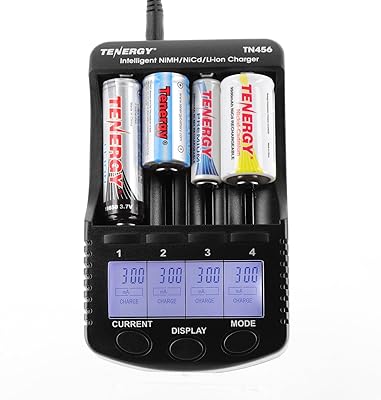
Tenergy TN456 Universal Battery Charger
82%
93%
Battery Chemistry Compatibility
91%
Independent Slot Operation
88%
LCD Display & Data Readouts
86%
Capacity TEST Mode
79%
Charging Speed & Current Control
More
Tenergy TN486U 5-Bay Universal Battery Charger
80%
91%
Versatility
88%
USB Connectivity
84%
LCD Display
87%
Safety Features
58%
Charging Speed
More
Tenergy T4s Intelligent Universal Charger
86%
96%
Battery Compatibility
75%
Charging Speed
91%
Safety Features
88%
Ease of Use
84%
Build Quality
More
Tenergy T9688 Universal Battery Charger
78%
88%
Charging Versatility
91%
Ease of Use
86%
LCD Display & Readability
72%
Charging Speed – AA, AAA, C, D
41%
9V Charging Speed
More
Intelligence 8 Bay Universal Battery Charger
86%
90%
Charging Speed
88%
Usability
93%
Safety Features
85%
Display Clarity
87%
Build Quality
More
Tenergy TN160 12-Bay AA/AAA Battery Charger
83%
91%
Charging Reliability
58%
Battery Compatibility
83%
Per-Slot Display Clarity
86%
Refresh & Conditioning Function
88%
Build Quality & Durability
More
MiBOXER C8 8-Bay Battery Charger
82%
88%
Charging Performance
91%
Battery Compatibility
93%
LCD Display Clarity
86%
Internal Resistance Measurement
89%
Safety Features
More
Opus BT-C2400 Battery Charger Analyzer
77%
91%
Measurement Accuracy
88%
Internal Resistance Testing
93%
Channel Independence
54%
Charging Speed
83%
Refresh Mode Effectiveness
More
XTAR VC2SL Battery Charger
84%
85%
Charging Performance
88%
Ease of Use
80%
Build Quality
90%
Portability
92%
Battery Compatibility
More
XTAR VC4SL 4-Bay Battery Charger
82%
88%
Charging Accuracy
91%
LCD Display Quality
93%
Battery Compatibility
84%
Grade Mode Usefulness
82%
Build Quality
More

FAQ

Yes, you can. The four bays operate independently, so you can load a mix of NiMH AAs and Li-ion 18650s and each slot will handle its own chemistry and current. Just make sure the Li-ion/LiFePO4 toggle switch is set to Li-ion before you start.

No, flat-top cells are not compatible. The Tenergy TN299 Universal Battery Charger is designed specifically for button-top 18650, 14500, and 10440 cells. If your lithium batteries have a flat positive terminal, they will not make proper contact with the bay and will not charge safely.
For NiMH and NiCd batteries, no — the charger detects them automatically. For lithium batteries, yes. There is a physical toggle switch on the unit that you need to set to either Li-ion or LiFePO4 before charging. It is easy to overlook, so it is worth double-checking before you walk away.

No, and this is an important limitation. The charger uses a single manual switch for lithium chemistry selection, meaning both lithium battery types share that setting. Mixing Li-ion and LiFePO4 cells in the same session is not supported and could result in incorrect charging.

For lithium cells, the current per slot drops from 800mA to 400mA when three or four bays are occupied. For NiMH and NiCd batteries, the rates stay fixed regardless of how many slots are loaded, so a full set of AAs will still charge at 1A each.

A 12V/1A DC power adapter is included in the box, so the charger is ready to use right away. You do not need to source any additional power supply.

Each of the four bays has its own backlit LCD display that shows the current charging status. When a cell reaches full charge, the display updates to reflect that. The backlight makes it easy to check at a glance even in a dim room.

No, it cannot. This multi-chemistry charger is a straightforward charging unit — it does not offer capacity readouts, discharge functions, or internal resistance measurements. If those features matter to you, you would need to look at a more advanced charger designed for battery analysis.

It can be. Some protected 18650 cells have a slightly longer overall length than unprotected button-top versions, and a portion of real-world buyers have reported fit issues with these. If the cell is too long to seat properly in the bay, it may not make reliable contact and should not be forced in.

The TN299 includes intelligent IC control per slot that monitors each cell individually, which is a reasonable safeguard for a charger in this class. That said, general best practice for any lithium battery charger is to avoid leaving it completely unattended for extended periods, particularly with Li-ion cells. For NiMH and NiCd batteries, overnight charging is more commonly considered low-risk with a charger that has proper termination logic.

Where to Buy