Overview

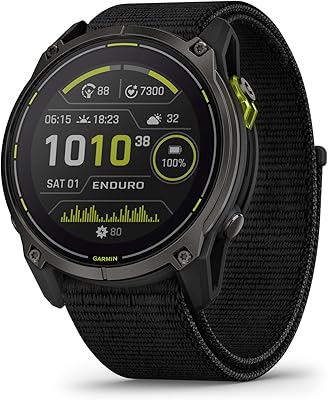
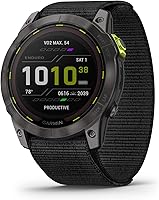
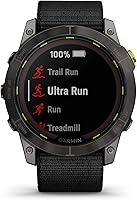
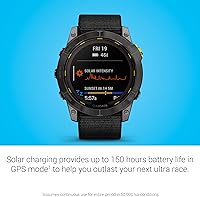
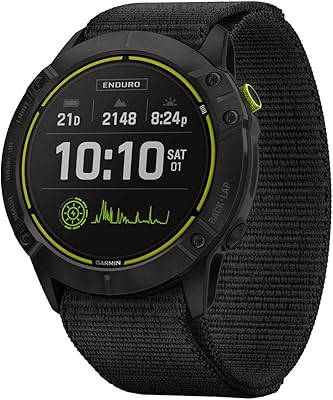
The Garmin Enduro 2 GPS Running Watch is built squarely for athletes who spend days, not hours, on the trail. What sets it apart immediately is the Power Sapphire solar lens, which harvests sunlight to extend battery life well beyond what most GPS watches can offer. The titanium bezel with DLC coating keeps the build tough without adding bulk, and the UltraFit nylon band is genuinely comfortable across long efforts. This is not a watch for casual joggers — it targets ultramarathoners, serious trail runners, and adventure racers who need dependable tools in remote terrain. The price reflects that focus.
Features & Benefits

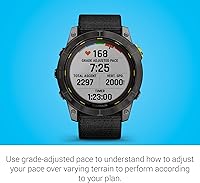
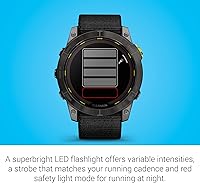
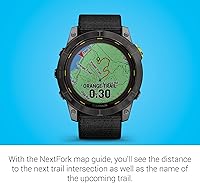
Battery endurance is the headline feature here. The SatIQ technology continuously monitors signal conditions and switches GPS modes automatically, so you are not burning unnecessary power during a 30-hour mountain race. The preloaded TopoActive maps are detailed enough for serious off-trail navigation, and the NextFork feature tells you exactly how far away your next trail junction is — genuinely useful when fatigue sets in. A superbright LED flashlight with a cadence-synced strobe adds real safety value for pre-dawn or post-sunset efforts. The grade-adjusted pace metric and automatic rest timer round out a toolkit built for complex, demanding terrain.

Best For

This endurance watch is purpose-built for a specific kind of athlete. If you regularly run multi-day ultramarathons or spend long stretches navigating mountains without reliable cell coverage, the combination of solar battery support and preloaded topographic maps addresses real, practical needs. Adventure racers will appreciate that it carries official ARWS approval. Night runners and those tackling pre-dawn training sessions get a genuine safety advantage from the integrated lighting. Garmin users stepping up from a fēnix or an original Enduro will find this a meaningful upgrade in battery stamina and navigation depth. Casual runners, though, will not get full value here.

User Feedback

Among long-distance runners who have logged serious miles with the Enduro 2, consistent praise centers on battery reliability and GPS accuracy over extended outings — both things that matter when you are deep in a race with no bailout option. The fit gets positive marks too, though a handful of users with smaller wrists find the 1.4-inch case on the larger side. The main friction point is screen resolution, which trails some competitors at this price tier. Solar charging gains are real but variable — cloudy conditions produce noticeably less benefit than sunny alpine days. These are context-specific limitations rather than genuine flaws.

Pros

  • Multi-day battery life is genuinely exceptional — a standout advantage for 100-mile races and stage events.
  • SatIQ automatically selects the optimal GPS mode, balancing accuracy and power without any manual input.
  • Preloaded TopoActive maps with NextFork guidance provide reliable off-grid navigation in genuinely remote terrain.
  • The titanium DLC bezel handles a full season of mountain racing without significant cosmetic wear.
  • UltraFit nylon band stays comfortable and blister-free across 24-plus hours of continuous use.
  • Grade-adjusted pace gives mountain runners a consistent effort metric that flat pace simply cannot provide.
  • The cadence-synced LED strobe is a practical and well-thought-out safety feature for night running.
  • ARWS approval makes this one of the few GPS watches cleared for official adventure racing competition.
  • At 70 grams, the Enduro 2 is genuinely lightweight for a watch with titanium construction and full navigation tools.
  • The automatic rest timer quietly logs break durations during long events, keeping race data clean without manual input.

Cons

  • Solar charging gains vary widely — overcast and forested conditions produce minimal real-world benefit.
  • The 240x240 display resolution feels noticeably dated compared to competitors in the same price category.
  • Initial setup and configuration has a steep learning curve, especially for first-time Garmin users.
  • The 1.4-inch case is large enough to be uncomfortable or unstable on smaller wrists during fast efforts.
  • Map data quality in less-traveled international trail networks can be sparse and unreliable.
  • Running the flashlight accelerates battery drain in ways that require deliberate management during overnight race segments.
  • Bluetooth sync speed is slower than expected, with occasional pairing issues reported on some Android devices.
  • The full feature set demands time investment to configure properly — out of the box it is not optimized for most users.

Ratings

The ratings below for the Garmin Enduro 2 GPS Running Watch were generated by our AI system after analyzing thousands of verified buyer reviews from global markets, with spam, bot-submitted, and incentivized feedback actively filtered out. Scores reflect the honest consensus of real-world users — endurance athletes, trail runners, and adventure racers who put this watch through genuinely demanding conditions. Both the standout strengths and the legitimate frustrations are transparently represented in every category.
Battery Life
93%
For runners tackling 24-hour or multi-day events, the battery endurance here is in a class of its own among GPS watches. Users report completing 100-mile races with significant charge remaining, especially when solar exposure is adequate during daylight segments.
Real-world solar gains vary considerably depending on cloud cover and wrist angle. Athletes racing in overcast or densely forested environments report noticeably less solar benefit than the advertised figures suggest, which can affect planning for very long events.
GPS Accuracy
91%
Multi-band GPS with SatIQ technology earns consistent praise for holding accurate tracks through dense tree canopy, deep canyons, and technical switchback terrain. Runners using this for navigation in the Alps or Pacific Crest Trail report very few dropout incidents.
In heavily built-up urban environments, a small number of users noticed minor drift on tight turns, though this is rarely an issue for the trail-focused audience this watch is designed to serve. Not a significant concern in context.
Build Quality & Durability
89%
The titanium bezel with DLC coating handles rock scrapes, pack strap abrasion, and repeated exposure to mud and water without visible wear. Several users mention the watch looks nearly new after a full season of mountain racing.
The Power Sapphire lens, while harder than standard glass, is not entirely immune to deep scratches on jagged rock surfaces. A small number of buyers noted minor surface marks after technical scrambling sections, though structural integrity was never compromised.
Comfort & Fit
82%
18%
The UltraFit nylon band is a genuine highlight for long efforts — it stays secure without the hot spots or pressure marks that silicone bands create over 10-plus hours of continuous wear. Runners consistently praise it for overnight races.
The 1.4-inch case is on the larger end, and athletes with smaller wrists — particularly women comparing sizing — find it sits high on the wrist and occasionally shifts during fast arm-swing movements on technical descents. A size variant would address this.
Navigation & Mapping
88%
Preloaded TopoActive maps with NextFork trail guidance is a standout combination for off-grid navigation. Runners describe checking upcoming intersection distances mid-race without needing to stop, which is a meaningful advantage in fatigued states during long events.
Map detail in some international and less-frequented trail networks is thinner than on major race routes. A handful of users in remote Eastern European and South American trail systems noted gaps in trail data that required supplemental paper maps.
Display Readability
68%
32%
The display reads clearly in most outdoor daylight conditions, and the backlight is sufficiently bright for nighttime glances. Button and touchscreen input options give flexibility when wearing gloves in cold mountain conditions.
At 240x240 pixels, the resolution looks dated compared to competitors at a similar price point. Map rendering in particular appears noticeably coarser, and text-heavy data screens can feel cramped when multiple metrics are displayed simultaneously.
Solar Charging Effectiveness
71%
29%
On long sunny days at altitude — think alpine ultras or desert trail events — the solar charging meaningfully extends runtime, and some users report effectively running indefinitely through daylight hours with modest GPS usage during those segments.
In real-world conditions outside of optimal solar exposure, the charging contribution is modest. Urban and forest-based runners report the solar lens adds limited practical benefit during typical training days, making it more of a race-day asset than a daily charging solution.
Sports Tracking & Metrics
87%
Grade-adjusted pace is particularly valued by mountain runners who want a consistent effort measure regardless of gradient. The endurance and stamina metrics give multi-day racers a data-grounded view of accumulated fatigue that simpler watches cannot provide.
The sheer volume of metrics and configuration options has a steep learning curve. New Garmin users often spend considerable time in menus before their data screens reflect what they actually want to see during a race.
Flashlight Utility
83%
The cadence-synced strobe is a practical and well-executed feature for night running — it pulses in rhythm with your stride, increasing visibility to vehicles and other trail users without requiring manual adjustment. The red safety mode preserves night vision effectively.
The flashlight adds minor bulk to the watch profile and, for runners who never train in low-light conditions, represents additional weight and cost with no functional return. It is a strong feature, but only relevant to a subset of users.
Value for Money
63%
37%
For dedicated ultramarathon and adventure racing athletes who will genuinely use the navigation, solar, and multi-day battery capabilities, the Enduro 2 represents a focused, well-executed tool that replaces a GPS device, flashlight, and maps simultaneously.
At this price tier, casual trail runners and weekend athletes will find the cost difficult to justify against capable alternatives that cover 90 percent of their needs for significantly less. The value equation is strong only when the full feature set is actually used.
Software & App Ecosystem
79%
21%
Connect IQ integration and the official Garmin app give access to a broad ecosystem of third-party watch faces and data fields. ARWS approval for the adventure racing app is a concrete, practical benefit for competitive multi-sport athletes.
Firmware updates occasionally introduce minor interface changes that frustrate established users. Syncing speed over Bluetooth is slower than some users expect, and a few reported occasional connectivity drops when pairing with Android devices after updates.
Weight & Portability
86%
At 70 grams with the nylon band, this endurance watch sits comfortably in the lightweight category for a GPS watch with titanium construction. Runners switching from heavier multisport watches often remark on how quickly they forget it is on the wrist.
Compared to ultralight running-specific watches targeting minimal weight, 70 grams is not record-breaking. Athletes who prioritize absolute minimum wrist weight above all else may find lighter alternatives, though usually at the expense of navigation and battery features.
Ease of Setup & Use
72%
28%
Once configured, the physical button layout works reliably with gloves and in wet conditions, which matters during mountain races. The touchscreen adds convenience during setup and menu navigation in normal conditions.
Initial setup, including map downloads, GPS profile configuration, and syncing training plans, takes a meaningful time investment. Less tech-savvy buyers consistently report feeling overwhelmed in the first week, particularly when migrating from non-Garmin devices.
Night Running Safety Features
84%
The combination of the LED flashlight, cadence strobe, and red safety mode makes this one of the more complete safety packages available on any GPS running watch. Night ultramarathon runners specifically call out this feature set as a meaningful differentiator.
The flashlight drains battery faster than GPS-only mode, which requires conscious management during very long nocturnal segments. Users who forgot to account for this during race planning reported more battery anxiety than expected during overnight sections.

Suitable for:

The Garmin Enduro 2 GPS Running Watch is purpose-built for athletes who spend serious time in serious terrain — ultramarathon runners, mountain trail racers, and adventure racing competitors who need a watch that can outlast them over multi-day events without hunting for a charger. If you regularly run 50 or 100-mile events, the solar-assisted battery and SatIQ GPS optimization address a very real logistical problem that most GPS watches simply cannot solve. Trail and mountain runners who navigate off-grid routes will find the preloaded TopoActive maps and NextFork guidance genuinely useful rather than a marketing checkbox. Athletes who train before dawn or race through the night get practical safety value from the integrated LED flashlight with its cadence-synced strobe. Existing Garmin users looking to step up from a fēnix or an older Enduro will find the transition familiar while gaining meaningful improvements in battery stamina and navigation depth. This is also the right watch for ARWS-competitive adventure racers who need an officially approved device for multi-discipline events.
Not suitable for:

The Garmin Enduro 2 GPS Running Watch is not a good fit for casual runners, gym-focused athletes, or anyone whose longest outing tops out at a half marathon on marked urban paths — the feature set is extensive, but most of it will go completely unused, and the price will feel very hard to justify. Runners with smaller wrists should handle the watch in person before buying, as the 1.4-inch case sits noticeably large and can shift during high-cadence movement. If a sharp, high-resolution display is a priority — for example, if you want to read detailed map tiles at a glance — the 240x240 screen will disappoint compared to rivals at this price level. Athletes who do most of their running in overcast climates, dense forests, or urban canyons should not count on solar charging as a meaningful battery extender; in those conditions, it contributes very little to real-world runtime. Budget-conscious buyers who need strong GPS tracking but not multi-day endurance or offline navigation will find capable alternatives at a considerably lower price point that cover the essentials without compromise.
Specifications

  • Display Size: The watch features a 1.4″ round display protected by a Power Sapphire lens that also harvests solar energy during outdoor use.
  • Resolution: Screen resolution is 240x240 pixels, delivering readable data fields in most outdoor lighting conditions.
  • Weight: The watch body weighs 70 grams, keeping wrist fatigue minimal during multi-day endurance events.
  • Dimensions: Case dimensions measure 2.01 x 2.01 x 0.61 inches, producing a substantial but trail-optimized profile.
  • Case Material: The bezel is constructed from titanium with a Diamond-like Carbon (DLC) coating for scratch and corrosion resistance.
  • Band: Includes both a black UltraFit nylon strap and a silicone watch band, both designed for extended all-day comfort.
  • Battery Type: Powered by a built-in rechargeable Lithium Polymer battery, charged via the included USB data and charging cable.
  • GPS System: Multi-band GPS with SatIQ technology dynamically selects the most efficient satellite mode to balance accuracy and battery consumption.
  • Storage: Onboard memory provides 32GB of storage for maps, music, and activity data.
  • Connectivity: Supports Bluetooth for smartphone pairing and notifications, plus USB for direct data transfer and charging.
  • Input Methods: The watch accepts both physical button presses and touchscreen gestures, giving flexibility during gloved or wet-hand conditions.
  • Maps Included: Comes preloaded with TopoActive topographic maps and ski resort maps covering major global trail networks.
  • Flashlight: An integrated superbright LED flashlight offers variable intensities, a cadence-synced strobe mode, and a red safety light option.
  • Compatibility: Pairs with Android and iOS smartphones via the Garmin Connect app for activity syncing, route planning, and firmware updates.
  • Sports Apps: Includes a broad library of built-in activity profiles plus an Adventure Racing World Series-approved adventure racing application.
  • Key Metrics: Supports grade-adjusted pace, endurance score, stamina tracking, automatic rest timer, and NextFork trail intersection distance guidance.
  • Water Rating: The watch is rated to 10 ATM, making it suitable for swimming, heavy rain, and water crossings during trail events.
  • Operating System: Compatible with both Android and iOS mobile operating systems for full app and notification functionality.
  • In the Box: Package includes the Enduro 2 watch, black UltraFit nylon strap, black silicone band, charging and data cable, and documentation.
  • Model Number: Official Garmin model number is 010-02754-00, corresponding to the Carbon Gray DLC titanium variant.

Related Reviews
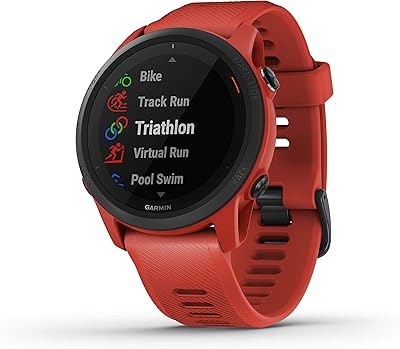
Garmin Fenix Enduro GPS Watch
85%
96%
Battery Life
92%
Build Quality & Durability
89%
Solar Charging Efficiency
88%
Activity Tracking Accuracy
75%
Ease of Use
More
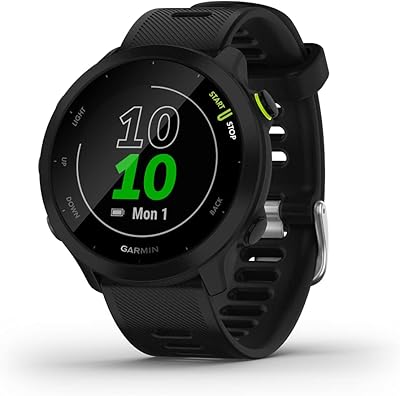
Garmin Forerunner 745 GPS Running Watch
85%
91%
GPS Accuracy
88%
Battery Life
85%
Sports Tracking Versatility
84%
Music Storage & Streaming
89%
Build Quality
More
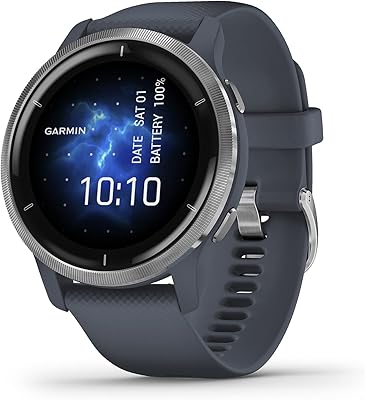
Garmin Forerunner 55 GPS Running Watch
79%
91%
GPS Accuracy
88%
Battery Life
78%
Heart Rate Monitoring
93%
Ease of Setup & Use
84%
Training Features
More
Garmin Venu 2 GPS Smartwatch
87%
94%
Battery Life
88%
Health Tracking Accuracy
91%
Display Quality
80%
Ease of Use
86%
Fitness Features
More
Garmin Forerunner 245 GPS Running Smartwatch
75%
92%
GPS Accuracy
89%
Battery Life
88%
Training Plan Quality
71%
Running Dynamics
91%
Comfort and Wearability
More
COROS APEX 2 Outdoor GPS Watch
83%
96%
Battery Life
92%
Build Quality
88%
GPS Accuracy
84%
Navigation & Maps
89%
Comfort & Wearability
More
Garmin Approach S62 Golf GPS Watch
87%
91%
Battery Life
85%
Ease of Use
89%
Display Quality
92%
Feature Set
88%
Build Quality
More
Garmin Forerunner 955 GPS Running Smartwatch
88%
93%
GPS Accuracy
91%
Battery Life
88%
Build Quality
90%
Training Metrics
87%
Health Tracking Features
More
Garmin Swim 2 GPS Swimming Smartwatch
86%
92%
Swim Tracking Accuracy
89%
Battery Life
88%
Heart Rate Monitoring
85%
Comfort and Fit
83%
Ease of Use
More
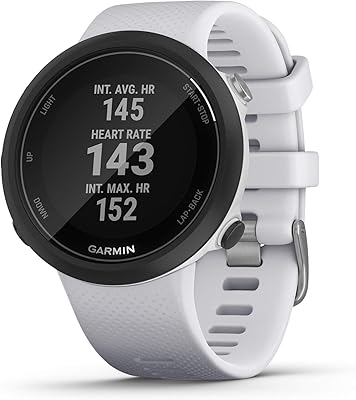
Garmin Enduro 3 GPS Smartwatch
83%
96%
Battery Life
91%
GPS Accuracy
93%
Build Quality
88%
Comfort & Wearability
89%
Navigation & Mapping
More

FAQ

In GPS mode without solar contribution, you can expect well over 30 hours of continuous tracking. With adequate sunlight exposure — think open alpine terrain or a desert race — solar input extends that meaningfully, with some users reporting effectively indefinite runtime during long sunny days. In dense forest or overcast conditions, count on the base battery figure rather than the solar maximum.

Honest answer: for most daily training runs, the solar contribution is modest unless you are spending multiple hours in direct sunlight. It is most impactful during long outdoor events where total sun exposure accumulates over many hours. If your typical training runs are under two hours or happen indoors, it will not make a dramatic difference to your charging habits.

Yes, fully. The preloaded TopoActive maps and GPS run entirely on the watch itself — no phone needed. You can plan routes on Garmin Connect on your phone and sync them, but once transferred, the watch navigates independently. This is one of its genuine strengths for remote trail and mountain running.

The 240x240 resolution is noticeably lower than some rivals in this price bracket, including the Apple Watch Ultra. Map detail looks coarser, and text-heavy screens can feel a bit cramped. That said, the display is bright and readable in direct sunlight, which matters far more on a trail than pixel density does.

The 1.4-inch case is on the larger side, and some athletes with slimmer wrists find it sits a bit high or shifts during fast movement. The UltraFit nylon band helps by distributing contact more evenly than silicone, but if you have a wrist under about 150mm circumference, it is worth trying it on in person before committing.

Yes, the Enduro 2 has 32GB of onboard storage, and you can sync music from supported streaming services like Spotify or Deezer directly to the watch for phone-free playback via Bluetooth headphones. It is a useful feature for long solo training runs when carrying a phone is inconvenient.

The flashlight has multiple brightness levels, a strobe mode that pulses in sync with your running cadence, and a red safety light for night visibility. It does draw additional power, so running it on high brightness for extended periods will reduce your overall battery runtime. For short nighttime segments, the impact is manageable, but it is worth factoring in if you are racing overnight.

Yes, the built-in adventure racing app is officially approved by the Adventure Racing World Series, which makes the Enduro 2 one of a small number of GPS watches cleared for use in ARWS-sanctioned events. If you are competing at that level, this is a meaningful practical consideration.

It takes some time investment, especially if you are new to Garmin devices. Downloading maps, setting up your preferred data screens, and connecting to Garmin Connect all require working through menus that can feel overwhelming initially. Most users report getting comfortable within a week of regular use, but plan for a learning curve if you are coming from a simpler GPS watch.

Absolutely — the Enduro 2 includes a broad range of built-in sports apps beyond running, including cycling, swimming, skiing, hiking, and more. The preloaded ski resort maps make it genuinely useful on the mountain. It is designed as a multi-sport endurance device, so while running is its primary identity, it handles other activities competently.

Where to Buy