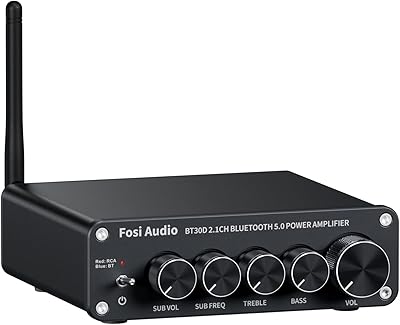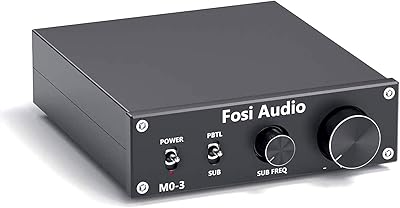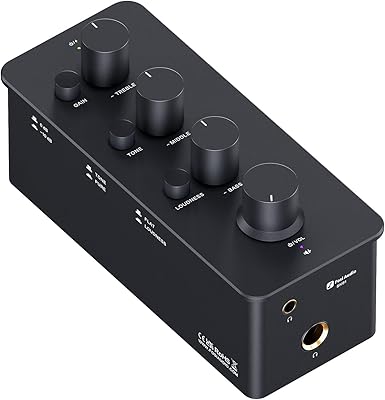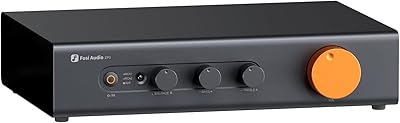


Overview

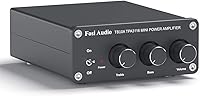
The Fosi Audio TB10A is a compact, no-frills stereo amplifier that earns its place in a crowded budget hi-fi market. Fosi Audio has built a solid reputation for delivering capable audio gear without inflated price tags, and this mini amp continues that trend. At the heart of the design are two Texas Instruments TPA3116D2 chips — a well-regarded pair of Class D ICs that keep heat low and efficiency high. The aluminum enclosure is genuinely small, sitting easily on a desk without dominating the space. A power supply is included, so setup is immediate. Set expectations right: this is an entry-level amp, but it is a confident one.

Features & Benefits

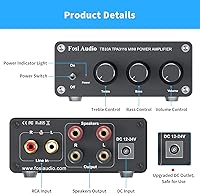
The TB10A is rated at 100W x 2 into 4 ohms — worth noting that this is a peak figure rather than a continuous RMS rating, so real-world usable power is more modest. Still, it drives most bookshelf speakers in a typical room without straining. The bass and treble knobs are straightforward, but they handle everyday listening adjustments well enough without needing a separate equalizer. A single RCA stereo input covers most common sources — a phone, TV, computer, or DAC. Built-in protections guard against overheating, short circuits, and voltage issues, and the unit runs noticeably cool during normal use.

Best For

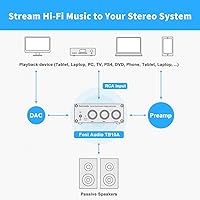
This compact stereo amplifier makes the most sense for anyone building a small desktop or home office speaker system on a sensible budget. If you are new to passive speakers and want a low-fuss amp to drive a pair of bookshelf speakers, this is a natural starting point. DIY audio hobbyists also tend to gravitate toward it, since the TPA3116D2 platform is well-documented and easy to modify or experiment with. It is not suited for large rooms or demanding listening sessions, but for a tidy desk setup or a secondary listening spot, it fits the bill without overcomplicating things.

User Feedback

Across a large pool of reviews, the consistent theme is that this mini amp sounds cleaner than most people expect, particularly at low to moderate volumes. The aluminum shell earns regular praise for feeling more substantial than typical budget electronics. On the downside, a handful of users with sensitive speakers report a faint background hiss at higher gain settings — worth knowing if you plan to pair it with high-efficiency drivers. The tone controls split opinion: casual listeners appreciate having them, while more critical ears prefer a flat signal chain. Long-term reliability reports are encouraging, with very few complaints about failures over extended use.

Pros

  • Solid aluminum enclosure feels far more premium than the price suggests.
  • Texas Instruments TPA3116D2 chipset delivers genuinely clean audio at normal listening volumes.
  • Power supply is included in the box — no immediate extra purchase required.
  • Runs noticeably cool even during extended listening sessions, thanks to efficient Class D design.
  • Bass and treble controls offer useful flexibility for casual listeners without needing separate gear.
  • Compact footprint fits easily behind a monitor or on a crowded shelf.
  • Built-in protections guard against overheating, short circuits, and voltage irregularities.
  • Long-term reliability reports across hundreds of reviews are consistently encouraging.
  • Compatible with a wide range of 4 to 8 ohm passive speakers straight out of the box.

Cons

  • The advertised watt rating is a peak figure — continuous real-world output is considerably lower.
  • Only one RCA input means swapping sources requires manually changing cables every time.
  • No Bluetooth, optical, or 3.5mm input — connectivity is strictly wired and limited.
  • Audible background hiss is a recurring complaint when paired with high-sensitivity speakers.
  • Tone controls cannot be fully bypassed, which bothers listeners who prefer a flat signal.
  • Some units show loose rear input jacks or wear on front panel labeling over time.
  • No meaningful warranty support experience reported — failed units often leave buyers without recourse.
  • Not suitable for larger rooms or speakers that demand sustained high current output.

Ratings

The Fosi Audio TB10A has accumulated thousands of verified purchase reviews across global markets, and the scores below reflect what real buyers actually experienced — not marketing claims. Our AI rating engine analyzed that feedback while actively filtering out incentivized, bot-generated, and outlier submissions, so the numbers here represent a genuinely balanced picture. Strengths are credited where earned, and recurring frustrations are reflected honestly.

Sound Quality
83%
At everyday listening volumes, most users describe the sound as surprisingly clean and open for the price tier. The Class D topology keeps distortion low, and paired with a decent set of bookshelf speakers, the audio comes across as composed rather than harsh or thin.
At higher volumes, some listeners notice a slight edge or compression that reminds you this is a budget amplifier. It rewards good source material and efficient speakers — push mediocre speakers hard and the limitations become more audible.
Build Quality
86%
The aluminum alloy enclosure is the first thing buyers comment on positively — it feels dense and solid in hand, far more so than the price would suggest. Knobs have a reassuring resistance and the overall fit is tight with no rattles or flex.
The rear input jacks feel slightly loose on some units, and a few users noted that the lettering on the face can wear with cleaning. It is well-built for its tier, but it is not going to feel like premium gear from a specialist audio brand.
Value for Money
91%
For a budget-conscious buyer stepping into passive speaker territory, the price-to-performance ratio is one of the strongest arguments in this amp's favor. Getting Texas Instruments silicon, an aluminum chassis, and a bundled power supply at this price point is genuinely hard to beat.
The value equation depends heavily on your speaker pairing. If you invest in more demanding or inefficient speakers expecting this amp to scale with them, you will hit its ceiling and likely want to upgrade sooner than expected.
Power Output
71%
29%
The amp handles typical desktop and small-room listening without breaking a sweat. For 85–90dB sensitivity bookshelf speakers in a medium-sized room, usable headroom is more than sufficient for comfortable listening levels throughout the day.
The 100W x 2 figure is a peak rating at 4 ohms, not a continuous RMS figure — real-world continuous output is considerably lower. Buyers expecting concert-level dynamics or planning to fill a large living room will be disappointed.
Setup & Ease of Use
93%
Plug in the included power adapter, connect an RCA cable from your source, attach your speaker wire, and you are playing music within minutes. There are no menus, no pairing processes, and no learning curve whatsoever.
The single RCA input means you can only connect one source at a time. Switching between a TV and a computer requires physically swapping cables, which becomes tedious if you regularly use multiple sources.
Tone Controls
74%
26%
Having bass and treble knobs on an amp at this price is a practical convenience many users genuinely appreciate. For listeners who want a warmer low end from thinner-sounding speakers, the bass boost gives enough flexibility without needing a separate equalizer.
The tone controls are functional but coarse — they are a broad sweep, not surgical adjustments. Purists who prefer a flat signal chain find them best left centered, and there is no bypass switch to take them fully out of the circuit.
Noise Floor & Background Hiss
62%
38%
With standard efficiency speakers in the 85–88dB range, most users report a clean, quiet background even at idle. The SNR rating holds up well in real-world conditions under normal desktop use.
Users pairing this amp with high-sensitivity speakers — anything above 92dB — frequently report an audible background hiss, especially noticeable in quiet passages or at high gain settings. It is a known limitation of the TPA3116 chipset in this implementation.
Thermal Performance
89%
Running cool is one of the genuine practical advantages of Class D design, and this amp delivers on that promise. Even after hours of continuous use, the enclosure stays barely warm to the touch, which matters on a cluttered desk.
Under sustained high-volume use with low-impedance speakers, the unit can get noticeably warmer, though thermal protection kicks in before any damage occurs. Ventilation around the unit is still advisable.
Input Flexibility
58%
42%
The RCA input is universal enough to connect practically any consumer audio source — a laptop headphone jack with an adapter, a TV audio output, a DAC, or a phone. It covers the most common use cases without requiring special cables.
One input is the hard limit. There is no Bluetooth, no optical input, no 3.5mm jack, and no input selector switch. For anyone with more than one source, this is a genuine constraint that adds cable management friction to daily use.
Long-Term Reliability
81%
19%
The volume of long-term reviews skews positive, with many buyers reporting stable, failure-free operation across one to three years of regular use. The built-in protection circuits appear to do their job in preventing damage from common electrical events.
A small but consistent minority of reviews describe units failing after six to eighteen months, typically with no warning. It is a low failure rate by budget electronics standards, but the absence of a strong warranty response process leaves some buyers without recourse.
Packaging & Included Accessories
77%
23%
Including a power adapter in the box is a meaningful decision — it removes an immediate extra purchase and ensures the amp works with a compatible power source from day one. Packaging is compact and protective without being excessive.
The included power adapter is adequate but not exceptional, and some users prefer to swap it for a higher-quality aftermarket supply to squeeze cleaner performance. No speaker wire is included, which is a minor but noted omission for first-time buyers.
Size & Form Factor
92%
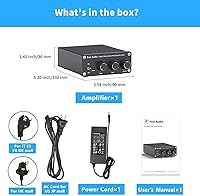
At just over five inches wide and barely an inch and a half tall, this amp disappears behind a monitor or tucks onto a shelf without demanding real estate. For small-space setups, the compact footprint is a practical asset rather than a compromise.
The compact size does limit connectivity options and internal component headroom. If your setup requires multiple inputs or you want rack-mount capability, you will need something physically larger regardless of budget.
Speaker Compatibility
73%
27%
The amp handles a wide range of 4 to 8 ohm passive speakers confidently, making it compatible with the majority of consumer bookshelf and satellite speakers on the market. Most entry-level and mid-range passive speakers pair with it without issue.
Very low-impedance speakers or high-current-hungry designs will push this amp beyond its comfort zone. Highly sensitive speakers can also expose the noise floor issue. Speaker matching genuinely matters here more than it does with higher-powered amplifiers.

Suitable for:

The Fosi Audio TB10A is a strong fit for anyone building a compact desktop listening setup without wanting to spend serious money on amplification. If you have a pair of passive bookshelf speakers sitting unused because you lack a receiver, this mini amp solves that problem immediately and affordably. Home office workers who want background music or focused listening through proper speakers — rather than a Bluetooth puck — will find it more than capable for that role. Beginners stepping into hi-fi for the first time will appreciate how little friction is involved: plug in the power adapter, connect an RCA cable from your source, attach your speakers, and you are done. DIY audio enthusiasts also have good reason to consider it, since the TPA3116D2 chipset is well-documented and the platform is commonly used as a starting point for modifications and experiments. Anyone prioritizing a low-heat, low-footprint amplifier that stays quiet and unobtrusive on a crowded shelf will find the form factor genuinely practical.

Not suitable for:

The Fosi Audio TB10A is not the right tool if you are trying to fill a large living room with sound or drive power-hungry floor-standing speakers — the usable continuous output, which is lower than the peak figures suggest, simply is not built for that kind of demand. Buyers who regularly switch between multiple audio sources will quickly find the single RCA input frustrating, since there is no input selector and swapping cables manually gets old fast. If you own high-sensitivity speakers rated above 90dB, be aware that a faint background hiss is a documented issue with this amp at higher gain settings, and that may be unacceptable in a quiet listening environment. Anyone expecting Bluetooth connectivity, optical input, or any form of wireless integration will need to look elsewhere — this compact stereo amplifier is a wired-only, one-source device by design. Finally, critical listeners who want a flat, uncolored signal path may find the tone controls an unwanted variable, since there is no hard bypass switch to remove them from the circuit entirely.

Specifications

  • Amplifier Type: Class D stereo integrated amplifier using two Texas Instruments TPA3116D2 chips in a 2.0 channel configuration.
  • Max Power Output: Rated at 100W x 2 into 4 ohms at peak conditions (20Hz–20kHz, 0.04% THD); continuous RMS output is lower under real-world conditions.
  • THD: Total harmonic distortion is rated at or below 0.04% under standard test conditions.
  • SNR: Signal-to-noise ratio is rated at 98dB or greater, indicating a reasonably clean background under normal operating conditions.
  • Input: Single stereo RCA input pair; compatible with standard consumer audio sources including DACs, TVs, computers, and smartphones via adapter.
  • Speaker Impedance: Compatible with passive speakers rated between 2 and 8 ohms; works with speakers rated up to 200W at 8 ohms or 300W at 4 ohms.
  • Tone Controls: Dedicated bass and treble rotary knobs allow basic sound shaping; no hard bypass switch is included.
  • Supply Voltage: Accepts 12V to 24V DC input; the included power adapter supplies 19V DC for standard operation.
  • Power Adapter: A 19V power adapter and AC power cord are included in the box, enabling immediate use without additional purchases.
  • Enclosure Material: Full aluminum alloy construction provides a rigid, low-resonance chassis that also aids passive heat dissipation.
  • Dimensions: Measures 5.2 x 3.54 x 1.42 inches (L x W x H), making it one of the more compact stereo amplifiers available at this output level.
  • Weight: Unit weighs 1.2 pounds, light enough for easy repositioning on a desk or shelf without additional mounting hardware.
  • Protection Circuits: Built-in protections include under-voltage lockout, over-temperature warning and shutdown, short-circuit protection, overload protection, and DC protection.
  • Mounting Type: Designed for surface mount use on a desk, shelf, or audio rack; no rack ears or wall-mount hardware is included.
  • Channels: Two-channel stereo output (2.0); no subwoofer output or pre-out is available on this model.
  • Certifications: Listed as Energy Star compliant, reflecting the efficient power consumption characteristic of Class D amplifier design.
  • Manufacturer: Made by Fosi Audio, a consumer electronics brand focused on compact, budget-friendly hi-fi amplification products.
  • Availability Date: First made available for purchase in October 2017 and remains an active, non-discontinued product in the Fosi Audio lineup.

Related Reviews
Fosi Audio TDA7498E
Fosi Audio TDA7498E
83%
88%
Sound Quality
93%
Value for Money
71%
Build Quality
74%
Power Output & Headroom
66%
Noise Floor & Background Hiss
More
Fosi Audio BT10A
Fosi Audio BT10A
81%
93%
Value for Money
82%
Sound Quality
91%
Noise Floor
84%
Bluetooth Performance
67%
Power Output
More
Fosi Audio BT30D
Fosi Audio BT30D
78%
83%
Sound Quality
88%
Subwoofer Performance
81%
Bluetooth Connectivity
91%
Value for Money
62%
Build Quality
More
Fosi Audio ZP3 Balanced Preamp
88%
94%
Sound Quality
88%
Ease of Use
90%
Build Quality
87%
Customization Options
75%
Memory Function
More
Fosi Audio M03
Fosi Audio M03
81%
91%
Audio Clarity & Distortion
74%
Power Output & Headroom
88%
Versatility & Operating Modes
93%
Value for Money
72%
Build Quality & Enclosure
More
Fosi Audio SK01 Headphone Amplifier
83%
88%
Sound Quality
72%
Battery Life
91%
Build Quality
85%
Tone Control Flexibility
80%
Portability
More
Fosi Audio M04 Subwoofer Amplifier
89%
94%
Bass Performance
91%
Sound Clarity
88%
Build Quality
90%
Ease of Setup
87%
Thermal Management
More
Fosi Audio P4
Fosi Audio P4
81%
88%
Build Quality
84%
Sound Quality
91%
Motorized Volume Control
79%
Remote Control
86%
Input Flexibility
More
Fosi Audio V3 Stereo Amplifier
81%
93%
Value for Money
91%
Audio Clarity & Noise Floor
67%
Real-World Power Output
74%
Build Quality & Finish
88%
Thermal Management
More
Fosi Audio HT4S
Fosi Audio HT4S
80%
88%
Build Quality
84%
Value for Money
76%
Sound Quality
82%
Multi-Channel Versatility
63%
Bluetooth Performance
More

FAQ

Yes, it handles 8 ohm speakers without any issues. In fact, most standard bookshelf speakers fall right in the 4 to 8 ohm range this amp is designed for, so compatibility is rarely a concern for typical home setups.

It comes in the box — a 19V power adapter and AC cord are both included. You can plug it in and connect your speakers right away without hunting for a compatible supply.

Yes, as long as your TV has an RCA audio output. Many modern TVs do, though some only have optical or HDMI ARC outputs, in which case you would need an external converter before the signal reaches this amp.

No, it does not. This is a strictly wired amplifier with a single RCA input. If you need wireless connectivity, you would either need a separate Bluetooth receiver feeding into the RCA input, or a different amplifier model altogether.

Possibly, yes. High-sensitivity speakers are more likely to expose the noise floor of this amp, and several owners with similar setups have reported an audible hiss at higher gain settings. It is worth knowing before you buy, especially if you listen in a quiet room.

Barely warm, in most cases. Class D amplifiers are inherently efficient, and the aluminum casing helps dissipate what little heat is generated. Even after a few hours of continuous listening at moderate volume, the unit typically stays comfortable to the touch.

Not directly — there is only one RCA input, so you would need to physically swap cables when changing sources. If you frequently switch between, say, a computer and a TV, an external RCA switch box would solve this without any damage to the amp.

It works best with standard bookshelf speakers in a small to medium room. It can technically drive larger speakers, but its usable continuous power has limits, so floor-standers or power-hungry designs in bigger spaces may not get the volume or dynamic range you expect.

They are genuinely useful for casual listening adjustments — nudging the bass up a touch with thinner-sounding speakers, for example, makes a noticeable difference. Purists tend to leave them centered since there is no bypass switch, but for everyday listening they work fine.

Most buyers report trouble-free use across one to three years of regular listening, and the built-in protection circuits help prevent damage from common electrical issues. A small number of users have experienced failures around the one-year mark, but based on the overall review volume, that appears to be the exception rather than the norm.