
Overview

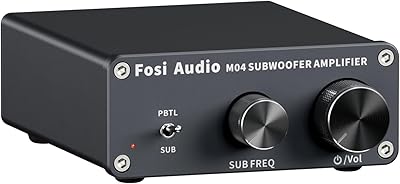
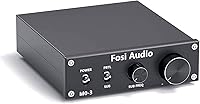
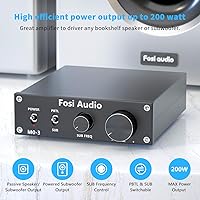
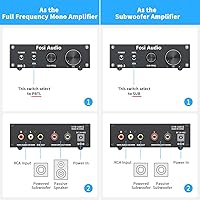
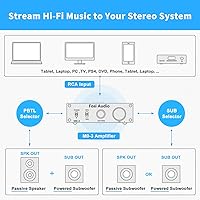
The Fosi Audio M03 is a surprisingly capable compact mono amplifier that punches well above its size in the budget subwoofer space. Built on Texas Instruments' TPA3255D2 chip — a class-D design respected for its efficiency and low distortion — this mini sub amp offers something rare at this price: genuine flexibility. A simple toggle switches it between PBTL mode for full-frequency mono duties and SUB mode for dedicated bass work. It ships with a 32V/5A power adapter, which handles everyday listening without trouble, though squeezing out peak wattage requires a heftier external supply. For home bass amplification on a tight budget, it is a serious contender.

Features & Benefits

The heart of the M03 is the TPA3255D2 chip, and it shows in the numbers. A THD rating of 0.03% or lower means distortion is essentially inaudible — bass stays tight and clean rather than muddy or strained. The signal-to-noise ratio clears 106dB, which translates to a quiet background even at higher volumes. The built-in low-pass filter spans 20–300Hz and is adjustable via a front knob, sparing you from needing a separate crossover unit. Into a 4-ohm load, this mono amplifier can deliver 150 watts RMS — enough to drive most passive subwoofers in a small to medium room convincingly. The single RCA input keeps the signal chain simple.

Best For

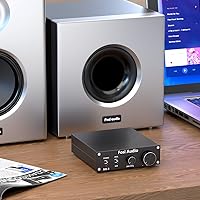
This mini sub amp fits neatly into several specific scenarios. Home theater builders adding a dedicated bass channel to an existing stereo or surround receiver will find it slots in without fuss. DIY audio hobbyists get a reliable, affordable option for driving a passive subwoofer cabinet without the bulk and cost of a traditional plate amp. It also works well on a desktop, where controlled, adjustable low-end can noticeably improve bookshelf speaker systems. And for anyone whose powered subwoofer's internal amp has given up, the M03 can serve as a direct replacement — often cheaper than a repair. Budget-conscious buyers wanting TI chipset performance without brand-name pricing will find it hard to beat.

User Feedback

Across well over 700 verified ratings, the M03 holds a 4.4-star average, and the breakdown reveals why. Most buyers are genuinely impressed by clean, distortion-free bass at this price, particularly those using it with passive subwoofer builds or as a drop-in replacement for failed plate amps. On the critical side, the included power supply comes up repeatedly — many users report that upgrading to a more powerful adapter unlocks noticeably better headroom and dynamics. The enclosure can also get warm during extended high-volume sessions, so leaving room for airflow is worth remembering. The mode switch, which some buyers expected to be a gimmick, consistently earns positive mentions as genuinely functional.

Pros

  • TPA3255D2 chip delivers clean, low-distortion bass that outperforms what the price suggests.
  • Switchable PBTL and SUB modes add real flexibility most competing boards at this tier lack.
  • Built-in low-pass filter means no external crossover is needed for most home subwoofer setups.
  • 150W RMS into 4 ohms is genuine usable power for small to medium rooms, not just a spec sheet number.
  • Compact enough to hide behind a TV stand or mount inside a cabinet without taking up shelf space.
  • Quiet noise floor makes the M03 suitable for use with sensitive drivers without audible hiss.
  • Works as a direct replacement for failed powered subwoofer amplifier boards, saving the cost of a full unit replacement.
  • Setup is minimal — one RCA in, speaker terminals out, and you are running within minutes.
  • Impedance range of 4–8 ohms covers the vast majority of consumer passive subwoofer drivers.

Cons

  • The included power supply limits output headroom; a more capable adapter is a near-mandatory upgrade for serious use.
  • No active cooling means the enclosure runs warm, and heat builds up fast in enclosed or poorly ventilated installs.
  • Closely spaced speaker terminals make terminating thick gauge wire awkward and time-consuming.
  • The low-pass filter knob lacks precise markings, so re-dialing your preferred crossover after a power cycle is trial and error.
  • Single RCA input leaves multi-source users needing an external switcher, adding cost and cable clutter.
  • No Bluetooth, optical, or any wireless input — sources must be hardwired.
  • The mode toggle has no status indicator, which makes confirming active mode difficult once the unit is hidden away.
  • Long-term reliability appears tied to user-managed heat and PSU quality, not just the hardware itself.

Ratings

The Fosi Audio M03 earns a strong overall standing based on AI-analyzed verified buyer reviews gathered from global sources — with spam, incentivized feedback, and bot activity actively filtered out before scoring. Across hundreds of real-world accounts from home theater builders, DIY audio enthusiasts, and budget-focused buyers, both genuine strengths and recurring frustrations are reflected transparently in every category below.

Audio Clarity & Distortion
91%
Buyers consistently describe the bass output as clean and controlled, with no audible muddiness even at moderate-to-high volumes. The TPA3255D2 chip keeps distortion impressively low for a budget-tier amp, and listeners using it with passive subwoofer cabinets report a noticeably tight, accurate low end.
A small number of users running the amp near its power ceiling — typically those using the stock power supply — noted occasional compression artifacts. Distortion performance is at its best with an upgraded PSU; the included adapter holds things back slightly.
Power Output & Headroom
74%
26%
Into a 4-ohm load, the M03 delivers genuine usable wattage that handles small to medium rooms without breaking a sweat. DIY subwoofer builders in particular report being pleasantly surprised by how much authority this compact board can push through a well-built cabinet.
The included 32V/5A adapter caps real-world headroom well below the theoretical maximum. Buyers expecting full-rated output straight out of the box will be disappointed — reaching that ceiling requires a separate, more powerful supply, which adds cost and setup complexity.
Versatility & Operating Modes
88%
The switchable PBTL and SUB modes are genuinely useful in practice, not just a spec sheet bullet point. Users who initially bought this as a subwoofer amp discovered the PBTL mode works well for driving a single full-range speaker, giving the board a second life in setups that evolve over time.
Switching between modes requires a physical toggle with no soft control or remote option, which can be inconvenient in enclosed rack or cabinet installations. There is also no visual indicator confirming which mode is active once the unit is tucked away.
Value for Money
93%
For buyers who understand what they are getting — a TI-chipset class-D mono amp at a mid-budget price — this mini sub amp represents outstanding value. Comparable performance from brand-name competitors typically costs significantly more, and the M03 holds its own in blind listening comparisons reported by experienced DIY builders.
The value calculation shifts slightly once you factor in the cost of a better power supply, which many users consider a near-mandatory upgrade. Budget-minded buyers should treat the total spend as slightly higher than the sticker price suggests.
Build Quality & Enclosure
72%
28%
The compact metal enclosure feels solid for its class, and the board layout is tidy with clearly labeled terminals. At 2.4 pounds it has enough heft to stay put on a shelf without feeling flimsy, and the input/output connectors feel reasonably well-fitted during installation.
The enclosure runs noticeably warm during extended high-volume sessions, and there is no active cooling or ventilation cutouts. Users who mount the unit in enclosed spaces — inside a subwoofer cabinet or media console — have reported thermal throttling concerns over long listening sessions.
Thermal Management
61%
39%
Under normal listening conditions — moderate volumes, well-ventilated placement — the M03 stays within acceptable temperature ranges. Buyers using it for background music or intermittent home theater sessions rarely flag heat as a problem in day-to-day use.
Extended high-output use in a confined space is where the lack of active cooling becomes a real concern. Several reviewers specifically advise against mounting it inside a sealed cabinet without planning for airflow, and at least a handful reported the unit shutting down briefly during long, loud sessions.
Ease of Setup
89%
Hookup is straightforward — one RCA input, speaker terminals out, power in. Most buyers report being up and running within minutes, even those with limited electronics experience. The included manual covers the mode-switching logic clearly enough that first-timers rarely get confused.
The single RCA input means users with multi-source setups need an external switcher or splitter, which adds a small layer of complexity. Those expecting Bluetooth or any wireless input will need to look elsewhere.
Low-Pass Filter Usability
84%
The onboard low-pass filter spanning 20–300Hz is a standout feature for this price tier. Being able to dial in the crossover point without an external processor is a genuine time-saver, and users integrating this mono amplifier into home theater systems appreciate having that flexibility built in.
The filter adjustment knob lacks detents or markings precise enough for repeatable settings, so if you power-cycle and nudge the knob accidentally, getting back to your preferred crossover point requires re-tuning by ear. A stepped or labeled control would improve the experience considerably.
Compatibility with Passive Subwoofers
87%
This is arguably the M03's strongest real-world use case. Buyers pairing it with passive subwoofer cabinets — including DIY builds and orphaned passive drivers from decommissioned systems — consistently report excellent matching. The 4–8 ohm impedance range covers most standard drivers without issue.
Users with 2-ohm subwoofer drivers fall outside the rated impedance range and have reported instability. Anyone working with non-standard driver configurations should verify compatibility carefully before assuming it will work.
Noise Floor & Background Hiss
86%
At idle and at low listening volumes, the M03 is impressively quiet. The SNR rating translates well to real-world use — buyers with sensitive drivers and in-room listening confirm that background hiss is not an issue during normal operation.
A few users with particularly sensitive full-range drivers in PBTL mode reported a faint hum traced back to ground loop issues rather than the amp itself. This is a system-level concern rather than a flaw in the unit, but worth noting for those running long unbalanced RCA runs.
Form Factor & Placement
92%
The footprint is small enough to hide almost anywhere — behind a TV stand, inside a media cabinet with the door cracked, or velcro-mounted to the back of a subwoofer cabinet. Buyers in tight apartment setups particularly appreciate that it delivers real bass power without occupying shelf space.
The compact size comes with a trade-off in connectivity — terminals are closely spaced, making thick gauge speaker wire somewhat awkward to terminate neatly. Users using 12AWG or heavier cable have flagged this as a minor but recurring annoyance.
Included Accessories
58%
42%
The box includes everything needed for a basic first-run — power adapter, the amp itself, and a user manual that covers the essentials. For buyers who just want to test the unit before committing to upgrades, the included supply gets the job done.
The 32V/5A power adapter is the single most-criticized item in buyer reviews. It consistently limits performance and is widely described as the first thing to replace. Including a more capable supply, or at minimum setting clearer expectations on the packaging, would reduce frustration significantly.
Long-Term Reliability
76%
24%
A meaningful number of buyers report using this mono amplifier for one to two years without incident, including some in continuous-duty setups like background music systems in small businesses. The TI chipset has a strong reliability track record in the audio community.
There is a modest subset of reviews describing early failures, typically traced to power supply issues or overheating in poorly ventilated installs rather than chip failure. Long-term reliability appears closely tied to whether the user manages heat and PSU quality responsibly.

Suitable for:

The Fosi Audio M03 is a strong fit for anyone who wants real bass amplification without spending a lot or taking up much space. Home theater enthusiasts who already have a receiver handling the main channels but want to add a dedicated powered bass source will find this mono amplifier integrates cleanly with minimal fuss. DIY speaker builders get arguably the best value here — this mini sub amp can drive a well-built passive subwoofer cabinet with enough authority to satisfy most living room or bedroom setups. It is also a smart rescue option for anyone whose powered subwoofer's internal amp has died; rather than replacing the whole unit, dropping this board in as a replacement is both cheaper and technically sound. Desktop audio users who want tuneable, controlled low-end from a compact device — without the footprint or cost of a full receiver — will find it fits that niche well too.

Not suitable for:

Buyers expecting a plug-and-play experience with full rated power straight out of the box should know upfront that the Fosi Audio M03 does not quite deliver that in its stock configuration. The included power adapter limits real-world headroom, and anyone planning to push the amp hard — filling a large room, running long listening sessions at high volumes — will need to budget for a better external power supply on top of the purchase price. This is a mono amplifier with a single RCA input, so it is not the right choice for anyone needing stereo output, multiple sources, or wireless connectivity; there is no Bluetooth, no optical input, and no remote control. Users with 2-ohm subwoofer drivers fall outside the supported impedance range and risk instability. If you run a sealed or poorly ventilated media cabinet and plan to leave it running for hours at volume, the thermal performance of this unit may also become a concern over time.

Specifications

  • Amplifier Chip: Powered by the Texas Instruments TPA3255D2, a high-performance class-D chip widely used in audiophile-grade budget amplifiers for its low distortion and efficient power delivery.
  • Topology: Single-channel (mono) class-D amplifier design, optimized for high efficiency and low heat generation compared to traditional class-AB amplifier circuits.
  • RMS Output: Delivers up to 150 watts RMS into a 4-ohm load, or 120 watts RMS into an 8-ohm load, under adequate power supply conditions.
  • THD Rating: Total harmonic distortion is rated at 0.03% or below, meaning audible coloration or distortion is effectively inaudible across the operating frequency range.
  • SNR: Signal-to-noise ratio is rated at 106dB or above, indicating a very quiet background noise floor suitable for use with sensitive drivers.
  • Operating Modes: Features two switchable modes: SUB mode for dedicated subwoofer amplification and PBTL mode for full-frequency mono speaker amplification.
  • Low-Pass Filter: Built-in adjustable low-pass filter covers 20Hz to 300Hz, allowing crossover tuning for subwoofer integration without requiring an external processor.
  • Input: Single RCA input for connecting to a receiver, preamp, or any line-level audio source with a standard analog output.
  • Impedance Range: Compatible with speaker loads rated between 4 and 8 ohms; use with 2-ohm loads is not supported and may cause instability.
  • Power Supply: Includes a 32V/5A DC power adapter in the box; the unit accepts input voltages between 24V and 32V DC for operation.
  • Peak Power: Maximum theoretical peak output is rated at 200 watts, though achieving this requires a higher-current external power supply beyond the included adapter.
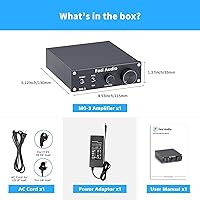
  • Dimensions: The unit measures 5.12 x 4.13 x 1.37 inches (L x W x H), making it compact enough for concealed placement in most media setups.
  • Weight: Weighs 2.4 pounds including the metal enclosure, giving it a solid feel without being bulky or difficult to position.
  • Mounting Type: Designed for surface mounting, with a flat base suitable for shelf placement or securing inside a cabinet using adhesive or bracket hardware.
  • Channels: Single mono channel output — this is not a stereo amplifier and is intended for driving one speaker or subwoofer driver at a time.
  • Voltage Range: Operates across a DC input range of 24V to 32V, giving users flexibility to use compatible third-party power supplies within that window.
  • Package Contents: Each unit ships with the amplifier board, a 32V/5A DC power adapter, and a printed user manual covering installation and mode selection.
  • Brand & Model: Manufactured by Fosi Audio, model designation M03, first available in August 2019 and ranked among the top audio component amplifiers on major retail platforms.

Related Reviews
Fosi Audio TDA7498E
Fosi Audio TDA7498E
83%
88%
Sound Quality
93%
Value for Money
71%
Build Quality
74%
Power Output & Headroom
66%
Noise Floor & Background Hiss
More
Fosi Audio BT10A
Fosi Audio BT10A
81%
93%
Value for Money
82%
Sound Quality
91%
Noise Floor
84%
Bluetooth Performance
67%
Power Output
More
Fosi Audio BT30D
Fosi Audio BT30D
78%
83%
Sound Quality
88%
Subwoofer Performance
81%
Bluetooth Connectivity
91%
Value for Money
62%
Build Quality
More
Fosi Audio SK01 Headphone Amplifier
83%
88%
Sound Quality
72%
Battery Life
91%
Build Quality
85%
Tone Control Flexibility
80%
Portability
More
Fosi Audio ZP3 Balanced Preamp
88%
94%
Sound Quality
88%
Ease of Use
90%
Build Quality
87%
Customization Options
75%
Memory Function
More
Fosi Audio M04 Subwoofer Amplifier
89%
94%
Bass Performance
91%
Sound Clarity
88%
Build Quality
90%
Ease of Setup
87%
Thermal Management
More
Fosi Audio P4
Fosi Audio P4
81%
88%
Build Quality
84%
Sound Quality
91%
Motorized Volume Control
79%
Remote Control
86%
Input Flexibility
More
Fosi Audio V3 Stereo Amplifier
81%
93%
Value for Money
91%
Audio Clarity & Noise Floor
67%
Real-World Power Output
74%
Build Quality & Finish
88%
Thermal Management
More
Fosi Audio HT4S
Fosi Audio HT4S
80%
88%
Build Quality
84%
Value for Money
76%
Sound Quality
82%
Multi-Channel Versatility
63%
Bluetooth Performance
More
Fosi Audio ZA3
Fosi Audio ZA3
83%
93%
Audio Clarity & Low Noise Floor
88%
Power Output & Headroom
91%
Build Quality & Chassis
94%
Connectivity & Input Options
82%
Op-Amp Rolling Experience
More

FAQ

For casual listening at moderate volumes, the included 32V/5A adapter works fine. But if you plan to push the amp hard — filling a larger room or running it at high volumes for extended periods — most experienced users recommend upgrading to a higher-current supply in the 32V/8A or 32V/10A range. Think of the included adapter as a starter supply rather than the final configuration.

Yes, you can. Switching to PBTL mode turns this into a full-frequency mono amplifier capable of driving a single passive bookshelf or full-range speaker. It will not give you stereo output, but for a desktop mono reference speaker or a single satellite in a custom setup, it works well.

The Fosi Audio M03 is rated for 4 to 8-ohm loads. Most consumer passive subwoofers and bookshelf speakers fall within this range, so compatibility is broad. Avoid pairing it with 2-ohm drivers — that falls outside the supported range and can cause instability or damage.

It does run warm, which is normal for a class-D amp working at higher output levels. In open-air or well-ventilated placement it is not a concern during typical listening sessions. Where it becomes worth watching is if you mount it inside a sealed cabinet with no airflow — in that case, leave some breathing room or add a small ventilation gap to keep temperatures manageable.

This is actually one of the most popular uses reported by buyers, and it works well. As long as the subwoofer's driver is a passive element in the 4 to 8-ohm range, this mono amplifier can drive it directly. You will need to wire it in and feed it a line-level signal from your receiver's subwoofer output.

The SUB mode engages the onboard low-pass filter and configures the amp for subwoofer-only duty — bass frequencies only, crossover adjustable via the front knob. PBTL mode bypasses the filter and lets the full audio frequency range pass through, making it suitable for full-range speaker use. If you are driving a subwoofer, use SUB mode. If you are driving a regular speaker, use PBTL mode.

In most setups, no. The signal-to-noise ratio is rated above 106dB, which translates to a genuinely quiet noise floor in practice. A small number of users with very sensitive drivers reported a faint hum, but this was typically traced to a ground loop in their specific system wiring rather than a flaw in the amp itself.

No. This is a wired-only amplifier with a single RCA input. If you need Bluetooth connectivity, you would need to add an external Bluetooth receiver feeding into the RCA input, or look at a different Fosi Audio model that has Bluetooth built in.

It covers the full 20–300Hz range, which gives you a lot of flexibility, but the knob itself is continuous with no click-stops or marked calibration points. That means you are setting it by ear each time. For most home theater integrations this is not a problem, but if you are doing precision speaker calibration work, you may want to supplement it with a measurement tool to confirm your crossover frequency.

It was designed with home use in mind. Several buyers report using it in semi-commercial settings like small cafes or retail background music systems with reasonable success, but Fosi Audio does not rate it for continuous-duty or outdoor use. For anything running all day in a warm environment, pay close attention to ventilation and consider a more robust power supply to reduce thermal stress on the unit.