

Overview

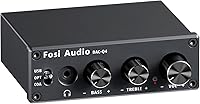
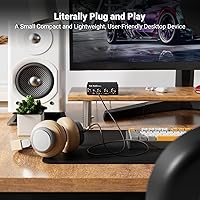
The Fosi Audio Q4 has been quietly sitting near the top of the budget DAC amp category since its 2019 launch, and there's a good reason it hasn't gone away. If your PC or laptop audio sounds thin, muddy, or plagued by background hiss, this DAC amp combo is the most direct fix you'll find at this price. It's built around a solid all-metal chassis that feels more substantial than you'd expect, and the whole thing sits comfortably on a desk without demanding much real estate. Plug it into a USB port and your computer recognizes it instantly — no drivers required.

Features & Benefits

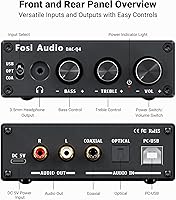
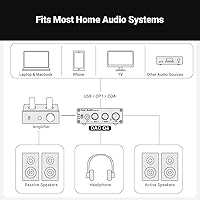
The Q4 covers the input bases well — USB from a computer, optical from a TV or disc player, and coaxial if your source calls for it. On the output side, you get both a headphone jack and RCA stereo outputs, which makes connecting powered speakers or a stereo receiver easy. It handles high-resolution audio cleanly, and the noise floor is impressively low for this tier — no audible hiss between tracks. The physical bass and treble knobs are a real practical bonus, letting you shape the sound without touching an equalizer app. It drives most everyday headphones comfortably.

Best For

This desktop audio upgrade makes the most sense for people whose computers are letting them down on audio. If you're running a gaming headset, studio headphones, or even just a solid pair of over-ears in the 80 to 150 ohm range, this is a natural fit. It also works well as a bridge between a TV or streaming device and a bookshelf speaker setup through a stereo receiver. For anyone just starting to explore better audio — no dedicated stack, no sprawling setup — it offers a clean entry point without a steep learning curve or complicated installation.

User Feedback

Buyers consistently mention the same thing: plugging this in and immediately noticing a clearer, fuller sound compared to onboard audio. The tone controls get a lot of appreciation too — people who never thought they'd want physical knobs end up using them more than expected. That said, the unit isn't without its weak spots. Those with harder-to-drive headphones — anything north of 150 ohms — may find the headphone output runs out of headroom too quickly. A handful of users have also noted some wobble in the volume knob after months of use, and a few wished for a proper wall adapter rather than relying on USB bus power alone.

Pros

  • Onboard audio hiss and distortion disappear immediately for most users after switching to this DAC amp combo.
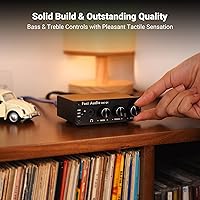
  • Physical bass and treble knobs let you shape your sound without opening any software.
  • Three input types — USB, optical, and coaxial — cover almost every common source device.
  • Works with both headphones and external speaker systems through its dual outputs.
  • Zero driver installation needed; recognized instantly by Windows and macOS.
  • The all-metal chassis feels noticeably more solid than competing plastic-bodied units at this price.
  • Included cables mean you can set up your preferred input path straight out of the box.
  • Small enough to sit beside a keyboard without disrupting a tidy desk layout.
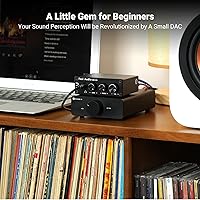
  • A reliable entry point for beginners who want better audio without a steep learning curve.

Cons

  • Users with high-impedance headphones above 150 ohms will likely find the output underpowered.
  • The volume knob has been reported to develop wobble after several months of regular use.
  • No dedicated wall adapter is included, and USB bus power can introduce noise on some host devices.
  • The included optical cable is short, limiting placement flexibility when the source device is farther away.
  • No RCA cable in the box despite RCA being a primary output option.
  • There is no balanced headphone output for users who need it.
  • Switching between multiple inputs requires manually pressing a physical selector — no auto-detection.
  • The tone controls adjust broad frequency bands rather than offering any precision EQ capability.
  • No microphone input, making it unsuitable for hybrid listening and communication setups.

Ratings

The scores below were generated by AI after analyzing thousands of verified buyer reviews for the Fosi Audio Q4 from global markets, with spam, bot-submitted, and incentivized feedback actively filtered out. Each category reflects the honest consensus of real users — the wins and the frustrations — so you can make a confident decision before buying.

Audio Quality Improvement
88%
The jump from onboard computer or laptop audio is immediately obvious to most buyers. Vocals come through with more clarity, bass feels more controlled, and the general muddiness that plagues integrated sound cards disappears. For a first DAC experience, this tends to genuinely surprise people.
It is worth setting expectations correctly — this is not a high-end audiophile unit, and trained ears comparing it to pricier DACs will notice the ceiling. Some buyers who upgraded from other dedicated DACs rather than onboard audio found the improvement more modest than expected.
Headphone Driving Power
67%
33%
For everyday headphones in the 16 to 150 ohm range — most consumer, gaming, and mid-level studio cans — the Q4 delivers plenty of clean volume without distortion. Users running popular models like the Audio-Technica ATH-M50x or Beyerdynamic DT 770 Pro 80-ohm report a satisfying, full-bodied listening experience.
Push beyond 150 ohms and things get noticeably thin. Owners of Sennheiser HD 600s or Beyerdynamic DT 990 Pro 250-ohm versions frequently mention the unit running out of steam before reaching comfortable listening levels, especially with dynamic music or film audio that demands more headroom.
Ease of Setup
94%
Plug-in-and-play is not marketing language here — Windows and Mac both recognize the unit almost instantly over USB, with no driver downloads or software configuration involved. Even buyers with little technical experience describe getting up and running in under two minutes, which is genuinely rare for audio hardware.
The optical and coaxial inputs, while straightforward for experienced users, occasionally cause confusion for complete beginners who aren't sure which input their TV or source device supports. The manual is minimal, and a clearer input-selection guide would prevent a lot of the early setup frustration seen in reviews.
Build Quality
79%
21%
The full metal shell sets this apart from competing plastic-bodied units at the same price. It sits solidly on a desk, doesn't slide around, and the knobs have a satisfying weighted feel when you first unbox it. For a budget piece of kit, it genuinely looks and feels more expensive than it is.
Long-term durability raises some questions. A recurring complaint after several months of use is the volume knob developing a slight wobble or looseness — not a dealbreaker, but noticeable enough that multiple reviewers specifically called it out. The knob feel at purchase is better than the knob feel a year later.
Input Versatility
91%
Having USB, optical, and coaxial inputs on a unit this small and affordable is genuinely useful. It means the Q4 can serve double duty — connected to a PC by day and switched over to a TV optical output in the evening without any rewiring. That kind of flexibility is hard to find at this price tier.
There is no automatic input switching, so users who frequently jump between sources need to manually toggle the selector. A minor inconvenience, but if you are constantly switching between a computer and a TV, the physical input button gets used more than you might like.
Tone Control (Bass & Treble)
86%
The physical bass and treble knobs are a legitimately useful feature that buyers consistently single out as a highlight. Being able to dial in a warmer low end for late-night listening or pull back a harsh treble without opening any software is a small quality-of-life win that adds up over time.
The controls are effective but not surgical — they affect a broad frequency range rather than offering precise adjustment, so you cannot target a narrow problem frequency. Buyers who want fine-grained EQ control will still need software alongside it. Think of them as rough tone shaping, not precision tuning.
Output Options
83%
The combination of a headphone jack and RCA stereo outputs means this unit can anchor two different listening setups without any adapters. Connecting a pair of powered bookshelf speakers via RCA while also having a headphone jack available is genuinely convenient for a hybrid home office and listening room setup.
There is no balanced output, which more serious headphone listeners will notice. The RCA output also does not carry enough signal strength for some passive speaker systems without an amplifier in the chain, which catches a few buyers off guard who expected it to drive speakers directly.
Noise Floor & Signal Clarity
85%
Users who switched from motherboard audio specifically to escape background hiss almost universally report success — the Q4 runs clean and quiet across a wide range of headphones and speakers. Sensitive in-ear monitors, which expose noise floors mercilessly, hold up reasonably well with this unit at moderate volumes.
At maximum volume with sensitive IEMs, a faint residual hiss can appear, though most users only encounter this under very specific conditions. It is not a chronic problem, but it does confirm that this is not a zero-noise-floor component in the strictest audiophile sense.
Power Solution
61%
39%
USB bus power keeps things simple — no wall adapter to lose, no extra cable to manage, and the unit draws power directly from the computer or any USB charger. For a minimal desktop setup, the absence of a power brick is actually appreciated by a meaningful share of buyers.
Relying on USB bus power means audio quality can be subtly affected by electrical noise from the host device, and several buyers specifically wished for an included wall adapter as an alternative. On certain laptops with noisy USB ports, a faint interference hum has been reported that disappears when powered from a cleaner USB source.
Value for Money
92%
Given what it delivers — multiple inputs, tone controls, a metal chassis, and a genuinely cleaner signal than most onboard audio — the price-to-performance ratio consistently impresses first-time buyers. It is one of the few budget audio products that earns repeat recommendations in online audio communities without heavy qualification.
As a stepping-stone product, it does have a clear ceiling, and buyers who catch the audio bug and start looking for more power or lower noise will likely outgrow it within a year or two. It is exceptional value for what it is, but it is not the last DAC most enthusiasts will buy.
Compatibility
89%
Across Windows 10, Windows 11, and macOS, the USB connection has proven consistently reliable in buyer reports. The unit also works with smart TVs, DVD and Blu-ray players via optical, and game consoles that support optical output — making it a genuinely versatile hub for a living room or home office.
There is no iOS or Android direct connection support, and buyers hoping to use it with a phone or tablet without a USB-A adapter will need additional hardware. Linux compatibility is generally fine but not officially confirmed, which leaves a small group of users in uncertain territory.
Compact Design & Footprint
87%
The Q4 is genuinely small — it fits comfortably beside a keyboard or tucked into a corner of a desk without demanding rearrangement. The clean, minimal front panel with just three knobs avoids the cluttered look of some competing units, and the metal body means it does not look out of place next to premium peripherals.
The compact size means limited internal space, which contributes to the modest headphone amplification power. A few users also note that the compact form factor makes the rear-panel connections feel a bit tight, especially when routing thicker optical cables — not a serious issue, but it can make cable management fiddly.
Included Accessories
76%
24%
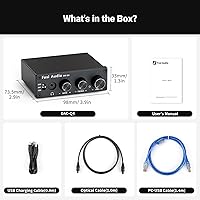
Fosi Audio includes a USB cable, an optical cable, and a PC-USB to Type-B cable in the box, which means most users can set up their preferred input path without a separate purchase. For an entry-level product, this is a more complete out-of-box package than many similarly priced competitors offer.
The included cables are functional but not premium — the optical cable in particular is on the short side, which limits placement flexibility if your source device is more than a few feet away. There is no RCA cable included, which is an omission that surprises buyers who plan to connect to a stereo system immediately.
Long-Term Reliability
71%
29%
The majority of buyers who have owned the Q4 for a year or more report no functional failures — the unit continues to power on and perform its core job without degradation. For an affordable piece of electronics used daily in a desktop environment, that baseline reliability is a meaningful positive.
The volume knob durability concern mentioned across multiple long-term reviews is the primary reliability flag. It is not a catastrophic failure, but a knob that develops wobble over months of regular use does affect the premium feel the unit initially projects, and it suggests the internals prioritize the DAC components over the physical controls.

Suitable for:

The Fosi Audio Q4 is a strong fit for anyone whose computer audio experience currently consists of hiss, distortion, or that flat, lifeless sound that integrated motherboard chips tend to produce. If you spend hours a day at a desk — working from home, gaming, editing video, or just listening to music — and you want a meaningful audio upgrade without building a complex or expensive setup, this DAC amp combo delivers exactly that. It works particularly well for headphone users running common consumer and semi-pro cans in the 16 to 150 ohm range, where it provides clean, well-controlled output without the need for a separate amplifier. People who want to connect a TV or media player to a stereo receiver or powered bookshelf speakers via an optical cable will also find it a practical and affordable bridge. It suits beginners curious about better audio who want something compact, simple to install, and easy to operate — no software menus, no configuration, just plug in and listen.

Not suitable for:

If you own headphones that demand serious driving power — think high-impedance studio cans in the 250 to 600 ohm range — the Q4 is likely to leave you underwhelmed, as it simply does not have the amplification headroom to bring those headphones to life. Experienced audiophiles who have already owned dedicated DAC and amp separates should also temper expectations; the improvement over a competent existing setup will be marginal at best, and the noise floor is not in the same league as higher-end components. Those who need balanced headphone outputs for noise rejection in a studio or recording environment will not find what they need here. If you are planning to drive passive speakers directly — without an amplifier in the chain — the RCA output alone will not be sufficient. And if you anticipate needing microphone input for calls or recording, this unit has none, so it is the wrong tool entirely for that job.

Specifications

  • Product Type: The Q4 is a combined DAC (Digital-to-Analog Converter) and headphone amplifier designed for desktop use.
  • Inputs: Three digital inputs are available: PC-USB, optical (TOSLINK), and coaxial, allowing connection from computers, TVs, disc players, and more.
  • Outputs: Two analog outputs are provided: a 3.5mm headphone jack on the front panel and a stereo RCA output on the rear for connecting to speakers or amplifiers.
  • Audio Resolution: The unit supports high-resolution audio playback up to 24-bit / 192kHz, which covers all standard streaming and lossless file formats.
  • Headphone Impedance: The headphone amplifier section is rated for headphones between 16 and 200 ohms, covering the majority of consumer and semi-professional headphone models.
  • THD Rating: Total harmonic distortion is specified at or below 0.01%, indicating a low level of signal coloration across the audible frequency range.
  • Signal-to-Noise Ratio: The SNR is rated at 105dB or above, meaning background noise is kept well below the music signal under normal listening conditions.
  • Power Supply: The unit is powered entirely via USB at 5V DC, drawing current from a connected computer port or any standard USB power source.
  • Dimensions: The chassis measures 3.9″ in length and 2.9″ in width, making it compact enough to sit beside a keyboard or in a tight desk corner.
  • Weight: The unit weighs 15.2 ounces, which is heavier than plastic alternatives at this price and contributes to its stable tabletop presence.
  • Chassis Material: The outer shell is constructed from full metal, providing better shielding against electromagnetic interference compared to plastic-bodied alternatives.
  • Controls: Three physical knobs are included on the front panel: a volume control, a bass adjustment dial, and a treble adjustment dial.
  • Driver Requirement: No driver installation is required on Windows or macOS; the unit is recognized as a standard USB audio device by both operating systems automatically.
  • Mounting Type: The unit is designed for tabletop placement and does not include rack-mount or wall-mount hardware.
  • In-Box Accessories: The package includes a USB charging cable, an optical (TOSLINK) cable, and a PC-USB to Type-B cable to cover the most common connection scenarios.
  • Microphone Input: There is no microphone input of any kind; the Q4 is strictly an audio output device and cannot be used for recording or voice communication.
  • Brand & Model: The unit is manufactured by Fosi Audio and sold under the model designation Q4, first listed for sale in July 2019.
  • Output Protection: An integrated output protection circuit is included to guard connected headphones and downstream equipment against DC offset or sudden signal spikes.

Related Reviews
Fosi Audio TDA7498E
Fosi Audio TDA7498E
83%
88%
Sound Quality
93%
Value for Money
71%
Build Quality
74%
Power Output & Headroom
66%
Noise Floor & Background Hiss
More
Fosi Audio BT10A
Fosi Audio BT10A
81%
93%
Value for Money
82%
Sound Quality
91%
Noise Floor
84%
Bluetooth Performance
67%
Power Output
More
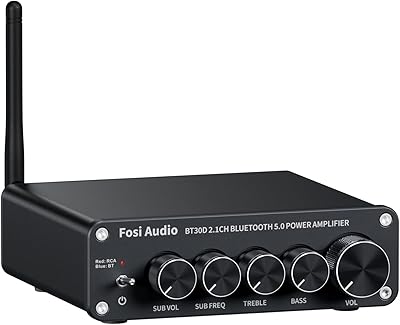
Fosi Audio BT30D
Fosi Audio BT30D
78%
83%
Sound Quality
88%
Subwoofer Performance
81%
Bluetooth Connectivity
91%
Value for Money
62%
Build Quality
More
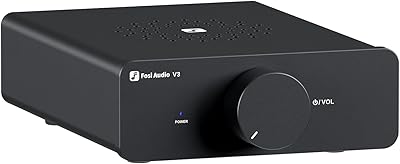
Fosi Audio V3 Stereo Amplifier
81%
93%
Value for Money
91%
Audio Clarity & Noise Floor
67%
Real-World Power Output
74%
Build Quality & Finish
88%
Thermal Management
More
Fosi Audio P4
Fosi Audio P4
81%
88%
Build Quality
84%
Sound Quality
91%
Motorized Volume Control
79%
Remote Control
86%
Input Flexibility
More
Fosi Audio M03
Fosi Audio M03
81%
91%
Audio Clarity & Distortion
74%
Power Output & Headroom
88%
Versatility & Operating Modes
93%
Value for Money
72%
Build Quality & Enclosure
More
Fosi Audio ZP3 Balanced Preamp
88%
94%
Sound Quality
88%
Ease of Use
90%
Build Quality
87%
Customization Options
75%
Memory Function
More
Fosi Audio SK01 Headphone Amplifier
83%
88%
Sound Quality
72%
Battery Life
91%
Build Quality
85%
Tone Control Flexibility
80%
Portability
More
Fosi Audio M04 Subwoofer Amplifier
89%
94%
Bass Performance
91%
Sound Clarity
88%
Build Quality
90%
Ease of Setup
87%
Thermal Management
More
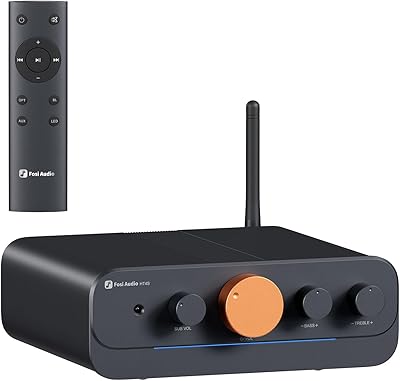
Fosi Audio HT4S
Fosi Audio HT4S
80%
88%
Build Quality
84%
Value for Money
76%
Sound Quality
82%
Multi-Channel Versatility
63%
Bluetooth Performance
More

FAQ

No — the Fosi Audio Q4 works completely plug-and-play on both Windows and macOS. Your computer recognizes it as a standard USB audio device the moment you plug it in, and you just need to set it as your default audio output in your system settings. No discs, no downloads, no configuration menus.

Technically the unit will drive them, but not ideally. At 250 ohms you may find yourself pushing the volume knob toward its upper limit just to reach a comfortable listening level, and the sound can feel thin or compressed at higher volumes. If the 250-ohm version of those headphones is your main driver, a more powerful dedicated amp would serve you better.

Yes, and this is actually one of its best use cases. If your TV has an optical (TOSLINK) output — which most modern TVs do — you can run an optical cable from the TV into the Q4, then connect the RCA outputs to a stereo amplifier or powered speakers. It is a clean, simple setup that requires no computer involvement at all.

It works on both. macOS recognizes the unit over USB without any driver installation, just like Windows does. Several buyers use it specifically with MacBooks and report no compatibility issues across recent macOS versions.

In most cases, yes. That hum is usually caused by electrical interference inside your computer — ground loops, noisy power circuits near the audio chip, or interference from the GPU and CPU. Moving your audio signal out of the computer entirely via USB and converting it externally is the standard fix, and this DAC amp combo handles that job well for most setups.

No — the RCA outputs carry a line-level signal, which is not strong enough to drive passive speakers on its own. You would need a stereo amplifier between this unit and any passive speakers. For powered or active speakers that have their own built-in amplifier, the RCA connection works fine.

There is a physical input selector button on the unit. You press it to cycle through the available inputs: PC-USB, optical, and coaxial. There is no automatic input switching, so if you want to change sources you will need to press the button manually.

It only runs off USB power — there is no wall adapter included or officially sold with it. For most desktop setups this is fine since the computer's USB port provides stable power, but if you notice any interference or hum, trying a cleaner USB source like a phone charger or a powered USB hub can sometimes help.

Not directly out of the box. The unit has a standard USB-A input intended for computers, so connecting a smartphone would require a compatible adapter — a USB-C to USB-A adapter for most modern Android phones, or a Lightning to USB adapter for iPhones. It is possible, but it is not the intended use case and results can vary depending on the phone and adapter combination.

It is genuinely small — roughly the footprint of a large deck of playing cards, at about 3.9″ long and 2.9″ wide. It sits flat on a desk and does not take up much room at all. Most buyers are pleasantly surprised by how compact it is when it arrives, especially given how solid and metal it feels.