Overview

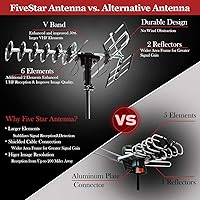
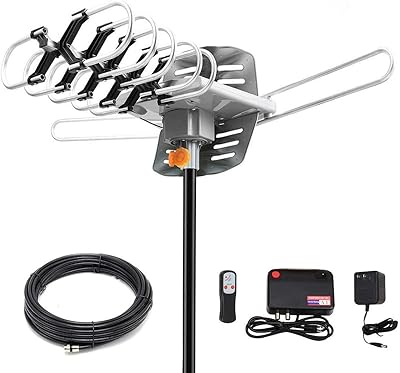
The Five Star FSA-3806-J Outdoor Motorized TV Antenna sits comfortably in the mid-range outdoor antenna category, targeting cord-cutters who want free over-the-air HD channels without paying for a monthly service. What separates it from basic passive rooftop antennas is its motorized 360-degree rotation, which lets you steer the antenna toward the strongest signal from inside your home. That said, real-world performance depends heavily on your distance from broadcast towers and local terrain — hills, trees, and buildings all take a toll. The package includes a full installation kit, which is a genuine plus for anyone tackling their first outdoor antenna setup.
Features & Benefits

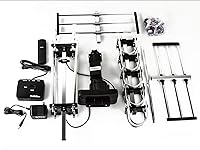
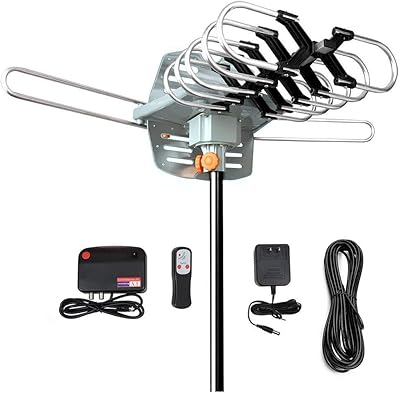
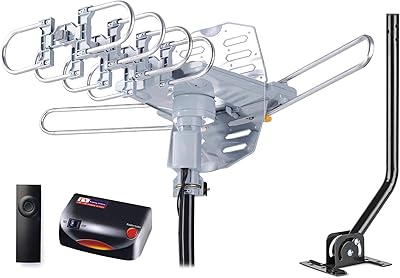
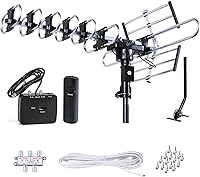
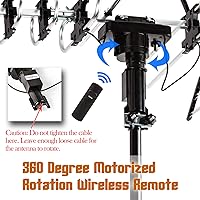
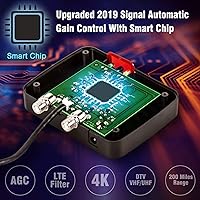
The motorized rotation is controlled via an infrared remote, so you can fine-tune signal direction without climbing on the roof every time reception drops. The built-in amplifier covers 45–860 MHz across UHF, VHF, and FM bands, and the Auto Gain Control adjusts signal strength dynamically rather than blasting everything at a fixed amplification level. A built-in LTE filter helps keep 4G interference out of your picture, which matters more than it used to in dense suburban areas. The kit also ships with 40 feet of RG6 coaxial cable, a 4-way splitter, cable clips, and a J-pole mount — covering most of what a standard installation actually requires.

Best For

This outdoor motorized antenna makes the most sense for rural and suburban households sitting well outside a city core, where broadcast towers are spread in multiple directions and a fixed-aim antenna simply can't cover them all. It's also a smart pick for anyone cutting the cable cord who wants to feed multiple TVs at once using the included splitter, rather than buying a separate unit. The all-in-one kit format suits buyers who don't want to piece together mounting hardware separately. FM radio listeners get a bonus here too — the antenna pulls in radio signals cleanly alongside television. If you live in a densely covered urban area, a simpler indoor antenna may honestly serve you better.

User Feedback

Owners consistently report a noticeable jump in channel count compared to indoor antennas, and most find the assembly process straightforward even without professional help. The remote motor function earns genuine praise — being able to rotate from the couch is a convenience people actually use. Where feedback turns mixed is around the advertised range figure, which many users in obstructed or hilly terrain find optimistic. A handful of longer-term owners mention the remote becoming less responsive over time, and some note the included splitter and cable feel slightly underbuilt relative to the antenna itself. Build quality in wet climates holds up reasonably well, though it isn't in the same class as higher-end weatherproof units.

Pros

  • Motorized 360-degree rotation lets you steer toward the strongest signal from inside your home — no more rooftop trips.
  • Covers UHF, VHF, and FM bands from a single outdoor installation, replacing multiple antennas at once.
  • Built-in LTE filter actively reduces 4G interference, a practical benefit in suburban areas with heavy cell traffic.
  • The all-in-one kit includes cable, splitter, mount, and clips — most standard installations need nothing extra.
  • Channel counts jump significantly over indoor antennas for users in flat terrain within a reasonable tower radius.
  • Auto Gain Control adjusts amplification dynamically, helping maintain cleaner signals across varying conditions.
  • Supports 4K and 1080p broadcast formats, so picture quality is not bottlenecked by the antenna itself.
  • The 4-way splitter makes it practical to serve multiple televisions throughout the house from a single antenna.
  • Assembly is straightforward enough for first-time installers with basic DIY comfort to complete in a couple of hours.

Cons

  • Real-world usable range for most buyers is well under 100 miles — the advertised figure is a consistent source of letdown.
  • The infrared remote requires a clear line of sight to the controller box, which limits where you can position the indoor unit.
  • Motor responsiveness tends to degrade noticeably for some owners after 18 months of outdoor exposure, especially in cold climates.
  • Splitting the signal four ways introduces enough loss that marginal channels often drop out on the third and fourth TV.
  • The included coaxial cable and splitter are functional but not high-grade — users with long cable runs may need upgrades.
  • Connector points and plastic housing show accelerated wear in freezing temperatures or high-humidity coastal environments.
  • Buyers in hilly or heavily wooded terrain frequently find that amplification cannot compensate for poor line-of-sight conditions.
  • Replacement remotes are not easy to source, leaving users with limited options if the original infrared unit fails.

Ratings

The Five Star FSA-3806-J Outdoor Motorized TV Antenna has been evaluated by our AI system after processing thousands of verified global buyer reviews, with spam, bot-generated, and incentivized submissions actively filtered out. Scores reflect a balanced picture of where this rotating TV antenna genuinely delivers and where real-world performance falls short of expectations. Both the strengths that keep buyers satisfied and the frustrations that generate returns are transparently represented below.
Signal Reception Quality
74%
26%
In flat, open suburban and rural areas with reasonable proximity to broadcast towers, users consistently pull in a solid range of HD channels they could never capture with an indoor antenna. Many report clean, stable pictures on major network affiliates with little to no pixelation under normal conditions.
Reception in hilly, wooded, or topographically complex areas is a persistent complaint. Users more than 50–60 miles from towers in obstructed environments often find signal quality disappointing, and the amplifier alone cannot compensate for poor line-of-sight conditions.
Motorized Rotation Performance
78%
22%
The ability to rotate the antenna from the couch rather than climbing on the roof is genuinely appreciated, especially for households where broadcast towers sit in different directions. Most users find the motor responsive enough in the first year of use, and the directional tuning does make a noticeable difference in finding the strongest signal.
Motor responsiveness tends to degrade for some users after 12–18 months of outdoor exposure, particularly in regions with harsh winters. A subset of buyers also note the motor turns more slowly than expected, making fine-tuned directional adjustments somewhat tedious.
Remote Control Reliability
67%
33%
The infrared remote works adequately at short to medium indoor distances, and first-time users generally find it simple to operate with minimal learning curve. Pairing the remote with the motor controller is straightforward out of the box.
Infrared remotes require a clear line of sight, which creates friction when the controller box is tucked behind a TV or in a cabinet. Several longer-term owners report reduced responsiveness over time and difficulty sourcing a reliable replacement remote if the original stops working.
Channel Count
79%
21%
Compared to indoor antennas, the jump in available channels is one of the most commonly celebrated outcomes. Users in well-covered markets regularly report picking up 40–70 or more free channels, covering major networks, PBS subchannels, and niche over-the-air broadcasters they didn't know existed.
Channel counts vary dramatically by location, and the marketing framing around 100-plus channels sets expectations that rural buyers in particular cannot realistically meet. In fringe reception areas, total usable channels can fall to single digits regardless of antenna quality.
Build Quality & Materials
62%
38%
The antenna frame feels reasonably sturdy for a mid-range outdoor unit, and the wind-resistant element design holds up adequately in moderate weather conditions. Buyers in mild climates generally report no structural issues over the first year or two of use.
The plastic housing and connector points show wear more quickly than expected in high-humidity or freezing climates. Several users in northern states and Canada report cracking or connector corrosion within two winters, raising concerns about longevity relative to the price paid.
Weather & Outdoor Durability
63%
37%
For buyers in temperate or dry climates, this outdoor motorized antenna holds up through rain and wind without major issues. The element design sheds moderate wind loads reasonably well, and UV degradation is not a widely reported problem in the first 12–18 months.
Extended exposure to ice loading, heavy snow accumulation, or coastal salt air accelerates deterioration noticeably. The motor housing in particular is a weak point in extreme cold, with several users reporting seizing or erratic behavior after hard freeze cycles.
Ease of Installation
81%
19%
The bundled kit — cable, splitter, clips, and J-pole mount — means most buyers can complete a basic rooftop or eave installation without a hardware store run. Assembly instructions are clear enough that first-time installers with basic DIY comfort report completing the job in under two hours.
Buyers with no prior experience mounting outdoor equipment may find rooftop work intimidating regardless of how straightforward the hardware is. The J-pole mount also assumes a specific installation surface, and users without a compatible mast or railing may need additional hardware not included in the kit.
Included Accessories Value
72%
28%
Shipping with 40 feet of RG6 coaxial cable, a 4-way splitter, and mounting hardware in a single box is a genuine convenience that saves buyers the time of sourcing compatible parts individually. For straightforward single-story or eave installations, the kit covers the full job.
The splitter and coaxial cable are adequate but not high-grade components, and users splitting the signal to three or four TVs often find the included splitter introduces noticeable signal degradation. Replacing the splitter with a quality amplified unit is a common recommendation among more experienced buyers.
Amplifier Effectiveness
69%
31%
The built-in amplifier with Auto Gain Control does a reasonable job of boosting weaker signals in suburban fringe areas, and the LTE filter meaningfully reduces interference from nearby 4G cell signals — a real benefit in densely populated areas where that interference is common.
Amplification cannot substitute for antenna placement and line-of-sight access to towers. In areas where the raw signal is simply too weak, the amplifier adds noise alongside the signal, occasionally worsening picture quality rather than improving it — a frustration users in deep rural areas frequently encounter.
FM Radio Reception
76%
24%
FM radio support is a legitimate bonus that buyers who use standalone tuners or AV receivers with FM inputs can actually use. In areas with strong FM broadcast infrastructure, reception through this rotating TV antenna is clean and stable across common station frequencies.
FM radio reception is dependent on the same directional alignment as TV signals, meaning rotating toward the best TV signal may compromise FM quality. Buyers expecting simultaneous optimized performance for both TV and FM from a fixed motor position may be disappointed.
Range Accuracy vs. Real-World Performance
44%
56%
In ideal flat-terrain conditions with unobstructed line of sight, the antenna does outperform compact indoor units by a meaningful margin, and some buyers in advantageous locations report pulling stations from impressive distances that lesser antennas cannot reach.
The advertised 200-mile range figure is widely regarded by real buyers as a marketing ceiling, not a practical expectation. Most users achieve reliable reception well within 70 miles under typical conditions, and treating the range claim at face value is the single most common source of buyer disappointment and returns.
Value for Money
71%
29%
For buyers who land in the right location — suburban, reasonably flat terrain, within 40–60 miles of towers — the combination of motorized rotation and an all-in-one kit genuinely justifies the mid-range price. The elimination of monthly cable fees makes the upfront cost pay off quickly for steady users.
Buyers in difficult reception environments who expected the range claims to hold up often feel the value proposition doesn't deliver. When the antenna underperforms due to terrain or distance, the mid-range price feels harder to justify against simpler passive alternatives that cost significantly less.
Multi-TV Splitting Performance
61%
39%
The 4-way splitter allows users to run signal to multiple rooms without purchasing additional hardware, which is a practical advantage for households wanting free OTA channels on more than one set simultaneously.
Splitting an already-amplified signal four ways introduces enough loss that marginal channels often drop out on the third and fourth television. Users in weaker signal areas are typically forced to choose between fewer splits or investing in a dedicated distribution amplifier to compensate.
Long-Term Reliability
59%
41%
A solid portion of buyers report trouble-free operation through two or more years of outdoor use, particularly those in moderate climates who completed a clean initial installation with proper weatherproofing on cable connections.
Long-term reliability is the category that generates the most divided feedback. Motor failures, connector corrosion, and remote responsiveness degradation cluster noticeably in the 18-to-36-month ownership window, suggesting the internal components are not rated for the full outdoor lifespan buyers expect.

Suitable for:

The Five Star FSA-3806-J Outdoor Motorized TV Antenna is built for cord-cutters in suburban and rural areas who are done paying monthly cable bills and want a practical, one-time solution for free over-the-air HD channels. It makes the most sense when your local broadcast towers are spread across different compass directions — that motorized rotation means you can pull in stations from multiple azimuths without ever touching the antenna again. Households that want to run signal to more than one TV simultaneously will appreciate the included 4-way splitter, which handles the basics without an extra purchase. First-time installers who dread sourcing compatible hardware will find the bundled kit — cable, mount, clips, and all — takes most of the guesswork out of a rooftop setup. Anyone who also uses an FM tuner gets a genuine bonus, since this rotating TV antenna handles radio frequencies alongside television without requiring a separate antenna.
Not suitable for:

The Five Star FSA-3806-J Outdoor Motorized TV Antenna is not the right call for buyers who live in heavily obstructed environments — think wooded hillsides, dense urban canyons, or locations more than 60–70 miles from the nearest cluster of broadcast towers in any direction. The advertised range figure is a theoretical ceiling under near-ideal conditions, not a realistic benchmark most buyers will hit, and purchasing based on that number alone leads to disappointment. Urban apartment dwellers who cannot legally or physically mount an outdoor antenna, or renters without landlord permission for rooftop installations, should look elsewhere entirely. If you are in a strong-signal urban market where towers are close and plentiful, a simpler and far less expensive passive indoor or outdoor antenna will likely serve you just as well without the added complexity of a motorized system. Buyers who need a truly weatherproof, heavy-duty antenna built to survive harsh northern winters or coastal salt environments for many years should consider stepping up to a purpose-built all-weather unit, as this one shows durability limitations over extended exposure to extreme conditions.
Specifications

  • Model Number: This antenna is manufactured by Five Star under the model designation FSA-3806-J.
  • Antenna Type: Outdoor motorized directional antenna designed for over-the-air UHF, VHF, and FM signal reception.
  • Dimensions: The antenna measures 17 x 8 x 7 inches and weighs 6.25 pounds, making it a mid-sized outdoor unit suitable for rooftop or eave mounting.
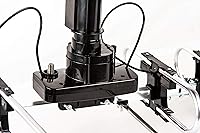
  • Rotation: The antenna head rotates a full 360 degrees via a built-in motor, controlled remotely without requiring manual repositioning.
  • Remote Control: An infrared remote is included for operating the motorized rotation from inside the home; line-of-sight to the controller unit is required.
  • Amplifier Gain: The built-in amplifier provides 15–35 dB of gain with Auto Gain Control technology that adjusts output based on incoming signal strength.
  • Frequency Range: The antenna and amplifier system operates across 45–860 MHz, covering the full UHF, VHF, and FM broadcast spectrum.
  • Impedance: Output impedance is 75 Ohm, which is the standard impedance for coaxial cable connections to televisions and splitters.
  • Broadcast Formats: Compatible with 4K Ultra HD, 1080p, 1080i, and 720p over-the-air broadcast formats, as well as FM radio reception.
  • LTE Filter: A built-in LTE filter is integrated into the amplifier circuit to reduce signal interference from nearby 4G cellular transmissions.
  • Included Cable: A 40-foot RG6 coaxial cable is included in the kit for connecting the outdoor antenna to the indoor signal controller and television.
  • Included Splitter: A 4-way passive splitter is included, allowing the antenna signal to be distributed to up to four televisions simultaneously.
  • Mounting Hardware: The kit includes a J-pole mounting bracket and 15 cable clips to support a standard rooftop, eave, or mast installation.
  • Signal Support: The antenna receives free over-the-air broadcast signals covering UHF channels, VHF channels, and FM radio frequencies in a single unit.
  • Noise Amplifier: A Super Low Noise Amplifier is built in to boost weaker signals while minimizing the additional noise introduced during amplification.
  • Number of Items: The package contains one antenna unit plus the full installation kit: cable, splitter, clips, J-pole mount, remote, and controller box.
  • Manufacturer: Five Star is the listed manufacturer and brand responsible for this antenna and its accessories.
  • Availability: This antenna model was first made available in January 2019 and is not listed as discontinued by the manufacturer as of the most recent product data.

Related Reviews

PIBIDI UHD-8903 Outdoor TV Antenna
77%
73%
Signal Range & Reception
67%
VHF Band Performance
84%
UHF Band Performance
78%
Build Quality & Durability
81%
Lightning & Grounding Protection
More
iGENJUN ANT-CS8218 Amplified Indoor Outdoor TV Antenna
72%
73%
Signal Reception Quality
67%
Amplifier Performance
88%
Ease of Installation
48%
Range Accuracy vs. Claimed Specs
71%
Build Quality & Materials
More
UltraPro Outdoor 70-Mile HD TV Antenna
76%
73%
Signal Reception
61%
Range Accuracy
82%
Installation Ease
78%
Build Quality
81%
Weather Resistance
More
PBD WA-2608 Motorized Outdoor TV Antenna
74%
82%
Signal Reception Quality
78%
Motorized Rotation
84%
Installation Experience
74%
Dual TV Output
71%
Build Quality & Durability
More
MATIS FBA08D Outdoor TV Antenna
73%
71%
Signal Reception
88%
Ease of Setup
84%
Dual TV Output
76%
Motorized Rotation
73%
Weather Resistance
More
GE 29884 Outdoor Long-Range TV Antenna
79%
83%
Signal Reception Strength
88%
Ease of Installation
86%
Build Quality & Durability
79%
Channel Count & Variety
84%
Value for Money
More
1byone 360° Omni-Directional Outdoor TV Antenna
73%
74%
Signal Reception
91%
Ease of Installation
72%
Build Quality
68%
Amplifier Performance
63%
4G LTE Filtering
More
Antop AT-414BG Omni-Directional Outdoor TV Antenna
85%
90%
Reception Quality
88%
Ease of Installation
86%
Durability in Outdoor Conditions
92%
Value for Money
87%
Signal Range
More
BEFORE 150-Mile Motorized Outdoor TV Antenna
70%
71%
Signal Reception
74%
Motorized Rotation
58%
Build Quality & Durability
66%
Ease of Installation
83%
Dual TV Output
More
Vragey HD012 Indoor/Outdoor TV Antenna
70%
71%
Signal Reception Quality
88%
Ease of Setup
63%
Amplifier Performance
34%
Range Accuracy vs. Marketing Claims
67%
Build Quality & Durability
More

FAQ

Most buyers in flat, open terrain report solid results within 40–60 miles of their nearest broadcast cluster. The advertised maximum range is a theoretical ceiling under near-ideal conditions, not a number most households will hit. If you are more than 70 miles out, or have significant hills or tree cover between you and the towers, temper your expectations accordingly and check a site like AntennaWeb or TVFool to map your specific situation before purchasing.

For a standard eave or J-pole mast installation, the included kit covers the essentials — mount, cable, clips, and hardware are all in the box. You will still need basic tools like a drill, screwdriver, and possibly a wrench depending on your mounting surface. If your roof has an unusual pitch or you want to attach to an existing mast with a different diameter, you may need an adapter not included in the kit.

Yes, the included 4-way splitter lets you run signal to up to four televisions from a single antenna. Keep in mind that splitting a signal always introduces some loss, so if you are already in a weaker reception area, adding more splits can cause marginal channels to drop out on the farthest TVs. In those cases, upgrading to an amplified distribution splitter is a common fix.

No, that is the whole point of the motorized design. The antenna connects to a small controller box that sits indoors, and the included infrared remote lets you rotate the antenna head in either direction from your couch. The remote does require a clear line of sight to the controller box, so make sure the box is not buried inside a cabinet or behind the TV.

In moderate climates — typical rain, wind, and mild frost — the Five Star FSA-3806-J Outdoor Motorized TV Antenna holds up reasonably well for a mid-range product. Where users run into trouble is in genuinely harsh conditions: sustained freezing temperatures, ice loading, or coastal salt air over multiple winters. The motor housing and connector points are the most vulnerable areas in extreme cold. If you are in a region with brutal winters, budget for potential maintenance or replacement sooner than you might with a premium-grade unit.

It genuinely receives FM radio — users who connect it to an AV receiver or tuner with an FM antenna input do report usable radio reception. The catch is that the optimal antenna direction for your favorite FM station may differ from the best position for TV channels, so you may have to choose a compromise rotation angle or rotate when switching between TV and radio use.

The antenna itself continues to receive signals fine without the remote; you just lose the ability to rotate it. The motor controller typically has manual direction buttons on the unit itself as a backup. Finding a replacement remote compatible with this controller is not always straightforward, so keep the original in good condition and replace the batteries before assuming the remote has failed.

Technically it can be mounted anywhere the J-pole bracket has a surface to attach to, including a sturdy balcony railing. The practical challenge in an apartment is that balconies often have obstructed sightlines — concrete walls, overhangs, neighboring buildings — that limit reception significantly. If your balcony has a clear open view toward broadcast towers, it is worth trying, but this rotating TV antenna is genuinely optimized for open rooftop or eave placement where signal access is unobstructed.

If you are comfortable with basic DIY tasks — drilling a pilot hole, running a cable through an exterior wall, connecting coax fittings — most people complete the installation in about two hours. The instructions are clear enough for a first-timer. What trips people up is the physical aspect of working at height on a roof, not the antenna assembly itself. If climbing on your roof is not something you are comfortable with, hiring a handyman or antenna installer for a couple of hours is a reasonable option.

In suburban and semi-urban areas where cell towers are dense, the LTE filter can make a real difference — some users report specific channels that were pixelated or missing entirely before the filter cleaned up the interference. In rural areas with sparse cell coverage, the filter is unlikely to have a dramatic visible impact, but it does not hurt performance either. It is a passive protective feature rather than an active one, so think of it as insurance rather than a signal booster.