Overview

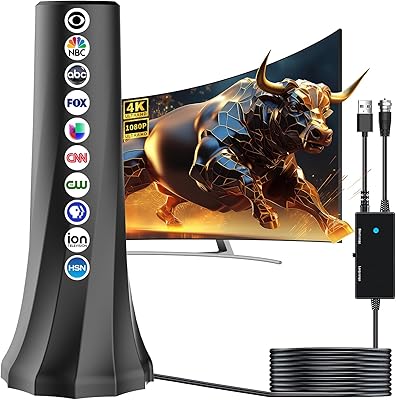
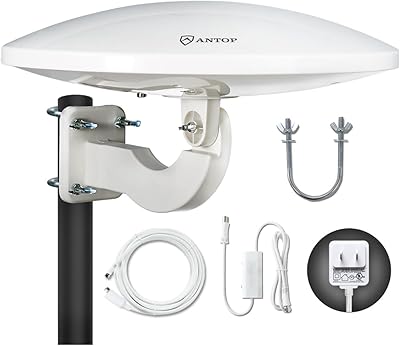
The Vragey HD012 Indoor/Outdoor TV Antenna is a mid-range cord-cutting option built for households that want free local channels — ABC, CBS, NBC, FOX, PBS — without a monthly bill. The dual indoor/outdoor design sets it apart from most flat, indoor-only alternatives, giving you real flexibility in where you install it. One thing worth stating upfront: the advertised range figures are wildly exaggerated. No terrestrial antenna picks up signals from hundreds of miles away; real-world reception depends on local terrain, tower proximity, and obstructions. Out of the box you get the antenna unit, a generous 38-foot coaxial cable, and several mounting options — and it works with both modern smart TVs and older sets.
Features & Benefits

What makes this antenna worth considering is the combination of omnidirectional coverage and practical installation flexibility. The 360-degree reception means you never have to aim it toward a specific tower — useful when your local broadcasts originate from different directions. Three mounting methods are included: adhesive backing, wall-mount holes, and a nylon cable tie, making it equally at home on a window frame or strapped to a roof vent. That 38-foot cable genuinely helps; it lets you park the antenna high or near a window while keeping the TV wherever you need it. The built-in amplifier assists in weak-signal areas, though users near broadcast towers may actually get cleaner results by reducing or bypassing the amplification entirely.

Best For

This indoor/outdoor antenna is a solid pick for cord-cutters in rural or suburban areas where streaming costs have gotten out of hand but over-the-air signals are still reachable. RV and caravan owners will find it particularly practical — it is light enough to pack and designed to mount on vehicle roofs. Households running a mix of newer smart TVs and older sets also benefit, since the Vragey HD012 does not require any smart features on the TV side to function. If you have been frustrated by flat panel antennas that need constant repositioning, the omnidirectional design is a genuine relief. The long cable also suits setups where the antenna lives near a window and the TV sits across the room.

User Feedback

Buyers generally respond well to how quickly this antenna goes up, and the multiple mounting options earn specific praise for accommodating different living situations. Picture quality feedback is positive for those within a reasonable distance of broadcast towers. That said, one complaint surfaces consistently: the range claims do not hold up in the real world, and buyers expecting miraculous reception many miles from any tower are often disappointed. Channel counts vary considerably — a dense metro user might pull in 50-plus channels while a rural household sees far fewer. A handful of users in strong-signal zones report the amplifier introduces interference rather than improving things, and some long-term owners note the connector durability deserves a closer look over extended use.

Pros

  • No aiming required — the 360-degree omnidirectional design picks up towers from any direction automatically.
  • Three mounting methods included in the box cover windows, walls, and vehicle roofs without extra purchases.
  • The 38-foot coaxial cable is longer than most competitors include, giving real flexibility in antenna placement.
  • Works with virtually any TV that has a coaxial input, from brand-new smart sets to older analog models.
  • Setup typically takes under 15 minutes, even for buyers with no prior antenna experience.
  • Useful for RV and caravan use — light enough to pack and practical to mount on a vehicle roof when stationary.
  • When locked onto a strong signal, picture quality is clean and stable across 1080i and 1080p broadcasts.
  • Eliminating a cable or streaming subscription pays back the purchase cost within the first month of use.

Cons

  • Advertised range figures are not grounded in real-world physics and set expectations that the hardware cannot meet.
  • The built-in amplifier can overload tuners in strong-signal areas, worsening reception rather than helping it.
  • Channel counts vary so widely by geography that performance is genuinely hard to predict before buying.
  • The adhesive mounting option loses grip in humid environments or on textured wall surfaces over time.
  • Connector durability becomes a concern for long-term users, with some reporting a loose fit developing at the F-connector end.
  • Not suitable for fully exposed outdoor installation in harsh climates — weather resistance is limited despite the outdoor marketing.
  • Users must manually re-scan channels after every repositioning, which catches some buyers off guard.
  • No gain adjustment option means strong-signal users have no simple way to reduce amplifier interference without a separate attenuator.

Ratings

The Vragey HD012 Indoor/Outdoor TV Antenna was put through a rigorous AI-driven analysis of verified global user reviews, with spam, incentivized, and bot-generated feedback actively filtered out before scoring. What follows reflects real buyer experiences across a wide range of locations — from dense urban apartments to rural properties far from broadcast towers — capturing both where this antenna genuinely delivers and where it falls short. Scores are intentionally candid, and the trade-offs are presented as honestly as the praise.
Signal Reception Quality
71%
29%
In suburban areas within 30 to 50 miles of broadcast towers, users consistently pull in the major networks — ABC, CBS, NBC, and FOX — with stable, artifact-free pictures. The omnidirectional design means towers in different compass directions are handled without repositioning, which is a real convenience for households in mixed-terrain zones.
Reception drops off noticeably beyond 50 miles, and rural users near hills or dense tree cover frequently report inconsistent lock on weaker stations. The signal can also fluctuate during bad weather, and channel counts vary so widely between zip codes that predicting performance before purchase is genuinely difficult.
Ease of Setup
88%
Most users report being up and running in under 15 minutes, with no tools required for the adhesive or cable-tie mounting options. The setup process is straightforward enough that households with no technical background — including older adults switching away from cable — consistently describe it as hassle-free.
The wall-mount hole option requires a drill and basic hardware knowledge, which a minority of buyers found unexpectedly involved for what they assumed would be a purely plug-and-play experience. A few users also noted the instruction sheet could be clearer on the channel re-scan step after repositioning.
Amplifier Performance
63%
37%
For users in genuinely weak-signal areas — think rural properties or basement apartments — the built-in amplifier makes a tangible difference, pulling in channels that a passive antenna would miss entirely. Several buyers in fringe-reception zones credited the amp for giving them a workable channel lineup where other antennas had failed.
Users living close to broadcast towers run into the opposite problem: the amplifier overloads the tuner, causing pixelation or dropped channels on stations that should be crystal clear. This is a known issue with amplified antennas generally, but the product offers no easy way to dial down the gain, leaving strong-signal users to improvise workarounds.
Range Accuracy vs. Marketing Claims
34%
66%
Setting aside the numbers printed on the box, this antenna does perform respectably within realistic distance limits. Users who calibrated their expectations around actual broadcast geography — using tools like antenna web maps before purchase — were generally satisfied with what the hardware delivered in practice.
The advertised range figures are not grounded in physics. No consumer antenna receives signals across hundreds of miles; the theoretical maximum under ideal conditions for any antenna is well under 200 miles, and real-world results are typically far lower. Buyers who took the marketing at face value were frequently and vocally disappointed.
Build Quality & Durability
67%
33%
The antenna housing feels reasonably solid for its price tier, and the connector joints are snug enough for standard indoor use. A number of users who mounted it under an eave or in a sheltered outdoor spot report no degradation after several months of exposure to mild weather.
Long-term outdoor use in harsher climates — heavy rain, sustained wind, or prolonged UV exposure — surfaces concerns about housing integrity and connector corrosion. Some buyers who used it in fully exposed rooftop or vehicle-roof applications noted the materials show wear faster than expected for the price paid.
Cable Quality & Length
79%
21%
The included 38-foot coaxial cable is one of the more generous accessory inclusions in this category, and buyers consistently appreciate having enough length to place the antenna near a window or outside while routing to a TV on the other side of a room. The cable feels thick and well-insulated compared to thinner alternatives bundled with competing units.
A minority of users noticed signal degradation when the cable was coiled tightly or routed through tight bends around door frames. A small number of long-term users also reported the F-connector end developing a loose fit over time, introducing intermittent signal drop that was frustrating to diagnose.
Mounting Versatility
83%
Having three distinct mounting methods in one package — adhesive pad, drilled wall mount, and nylon cable tie — covers a wide range of living situations without requiring the buyer to source additional hardware. RV and caravan owners in particular highlight how the cable tie method makes roof attachment practical and removable.
The adhesive backing, while convenient, loses grip in humid environments or on textured wall surfaces, and a few users found it detached within weeks when placed in a bathroom-adjacent wall or exterior-facing window frame. A more industrial-grade adhesive option would meaningfully improve the experience for those mounting scenarios.
Channel Count & Variety
66%
34%
In well-served metro and suburban markets, this antenna routinely surfaces 40 or more channels — including major networks, PBS subchannels, and local independent stations — giving cord-cutters a genuinely broad free-to-air lineup. Buyers in mid-sized cities often report being surprised by how many channels are available without a subscription.
Channel count is heavily geography-dependent, and rural users sometimes receive as few as five or six channels regardless of antenna placement. Subchannels and Spanish-language or religious broadcasters inflate the total count in ways that do not always reflect useful programming, and the discrepancy between urban and rural performance is stark.
Outdoor & Weather Resistance
58%
42%
For sheltered outdoor installations — under a roof overhang, inside an attic, or in a covered porch — this antenna holds up reasonably well and extends the signal advantage of being higher and further from indoor interference. Short-term vehicle use in fair weather also draws positive feedback.
It is not rated for fully exposed outdoor installation, and users who mounted it on open rooftops or vehicle exteriors in wet climates report premature wear. The product sits in an awkward middle ground: marketed for outdoor use but built to a standard that barely meets the demands of genuine outdoor exposure over a full year.
Device Compatibility
86%
One of the more consistently praised aspects is how broadly compatible this antenna is — it works with virtually any television that has a coaxial input, from flagship smart TVs to decades-old analog sets. Households running multiple TVs of different generations avoid the cost and complexity of needing separate solutions for each.
A small number of users with certain smart TV brands reported needing to run a full factory channel scan rather than a quick scan to populate their channel list correctly. This is a minor friction point, but buyers unaware of the re-scan requirement after repositioning can mistake a software issue for a hardware failure.
RV & Vehicle Usability
74%
26%
RV owners and frequent road-trippers represent a vocal positive segment among buyers, with many citing the lightweight build and cable tie attachment method as genuinely practical for roof mounting during stationary stays. Picking up local channels at campgrounds or rest stops without any subscription is a real value-add for that audience.
Performance while a vehicle is moving is essentially non-functional, and the antenna is only useful when parked. The lack of a dedicated vehicle mounting bracket also means buyers need to improvise or purchase additional hardware for a truly secure roof installation, which adds both cost and effort.
Value for Money
69%
31%
For buyers who approach this antenna with realistic signal expectations and live within a sensible broadcast range of local towers, the combination of included cable length, mounting flexibility, and broad device compatibility represents fair value. The elimination of a cable or streaming bill pays back the purchase price quickly for consistent free-to-air viewers.
Buyers who purchase based on the headline range claims and then find reception disappointing feel the price point is hard to justify — and that frustration is understandable. At this tier, a few well-reviewed competitors offer more honest specifications and more robust hardware, making the value proposition contingent almost entirely on setting correct expectations upfront.
Picture & Signal Stability
72%
28%
When locked onto a strong signal, the picture quality is clean and stable — the antenna passes through whatever resolution the broadcaster transmits, and users watching local news, sports, or network primetime in 1080i report a noticeably sharper image than they were getting through compressed cable or satellite feeds.
Signal stability becomes erratic in multi-path environments — near tall buildings, metal structures, or in valleys — where reflected signals compete with the direct broadcast path. This causes intermittent pixelation or brief freezes that are hard to solve through repositioning alone, and the omnidirectional design actually makes the antenna more susceptible to multi-path interference than a directional alternative.

Suitable for:

The Vragey HD012 Indoor/Outdoor TV Antenna is a genuinely practical choice for cord-cutters in suburban or mid-rural areas who live within a reasonable distance of local broadcast towers and simply want free access to the major networks without a recurring bill. It suits households running a mix of old and new televisions, since compatibility is broad and no smart features are required on the TV side. RV owners, caravan travelers, and people who spend weekends in a camper will find the lightweight build and cable-tie mounting method particularly useful for stationary use at campsites or rest stops. Anyone frustrated by flat, directional indoor antennas that need constant repositioning will appreciate the omnidirectional design — point it nowhere in particular and let it work. The long coaxial cable is also a genuine advantage for renters or homeowners who need to keep the antenna near a window or on an exterior wall while routing to a TV across the room.
Not suitable for:

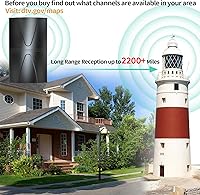
Buyers who take the advertised range figures at face value and expect to pull in stations from extreme distances will almost certainly be disappointed — the Vragey HD012 Indoor/Outdoor TV Antenna, like every consumer antenna on the market, operates within the laws of physics, and realistic performance depends entirely on proximity to local towers, terrain, and obstructions. People living in deep rural areas far from any broadcast infrastructure, or in valleys surrounded by hills, should temper expectations significantly or look into a larger directional antenna designed specifically for long-range fringe reception. Users situated very close to broadcast towers — inside a dense city center, for example — may find the built-in amplifier actually degrades performance rather than improving it, causing pixelation on channels that should otherwise be perfect. Those needing a fully weather-hardened outdoor installation exposed to year-round rain, wind, or UV intensity will likely find the build quality insufficient for that level of exposure over the long term. If your goal is receiving channels from distant metro areas while living in a rural county, this antenna will not solve that problem regardless of how it is positioned.

Specifications

  • Brand & Model: Manufactured by Vragey under the model designation HD012.
  • Antenna Type: Amplified omnidirectional antenna designed for both indoor and outdoor installation.
  • Signal Reception: Captures broadcast signals from all directions simultaneously across a full 360-degree horizontal arc.
  • Supported Formats: Passes through 720p, 1080i, 1080p, and 4K HDR signals depending on what local broadcasters transmit in your area.
  • Coaxial Cable: Includes a 38-foot thick copper coaxial cable designed to minimize signal interference across longer installation runs.
  • Impedance: Operates at 80 Ohm impedance, compatible with standard television coaxial inputs.
  • Antenna Dimensions: The antenna unit measures 5.1″ in length, 2.8″ in width, and 8.6″ in height.
  • Package Dimensions: The retail packaging measures approximately 8.78 x 5.2 x 2.76 inches.
  • Item Weight: The complete package weighs 1.19 pounds, making it light enough for portable or vehicle-mounted use.
  • Mounting Options: Three installation methods are included: adhesive backing, drilled wall-mount holes, and nylon cable tie for vehicle or pipe attachment.
  • Vehicle Compatibility: Designed to attach to the roof of trucks, cars, caravans, and motorhomes for stationary use during travel stops.
  • Device Compatibility: Works with any television equipped with a standard coaxial input, including smart TVs and older analog-ready sets.
  • Amplification: Built-in signal amplifier is intended to boost reception in weak-signal or fringe-coverage areas.
  • Color & Finish: Available in black with a matte finish suited to both interior and exterior installation environments.
  • Items in Package: Each package contains one antenna unit, one 38-foot coaxial cable, and the included mounting hardware.
  • Market Rank: Ranked #599 in the TV Antennas category on Amazon at the time of listing evaluation.
  • Availability Date: First made available for purchase on June 12, 2025.
  • Manufacturer: Produced and sold directly by Vragey, a brand specializing in digital television reception equipment.

Related Reviews

iGENJUN ANT-CS8218 Amplified Indoor Outdoor TV Antenna
72%
73%
Signal Reception Quality
67%
Amplifier Performance
88%
Ease of Installation
48%
Range Accuracy vs. Claimed Specs
71%
Build Quality & Materials
More
Antennas Direct ClearStream Eclipse Indoor TV Antenna
77%
74%
Signal Reception
67%
Amplifier Performance
93%
Design & Profile
91%
Ease of Setup
62%
Cable Length
More
Mohu Gateway Indoor TV Antenna
86%
87%
Signal Reception
92%
Setup and Installation
89%
Design and Aesthetics
90%
Value for Money
84%
Durability and Build Quality
More
ANTOP AT-211B Indoor TV Antenna
71%
72%
Signal Reception
67%
Amplifier Performance
91%
Ease of Setup
63%
Build Quality
58%
VHF Channel Support
More
Winegard FlatWave FL-5000 Indoor TV Antenna
79%
78%
Reception Quality
93%
Ease of Setup
72%
Signal Stability
84%
Build Quality
88%
Design & Aesthetics
More
UltraPro Outdoor 70-Mile HD TV Antenna
76%
73%
Signal Reception
61%
Range Accuracy
82%
Installation Ease
78%
Build Quality
81%
Weather Resistance
More
UltraPro 47331 Amplified Indoor TV Antenna
77%
74%
Signal Reception Quality
91%
Ease of Setup
88%
Design & Aesthetics
67%
Amplifier Performance
71%
Channel Count
More
YiziAifsion 2024 Upgraded Indoor TV Antenna
84%
88%
Signal Reception
85%
Picture Quality
91%
Setup & Installation
80%
Build Quality
87%
Range & Coverage
More
PIBIDI UHD-8903 Outdoor TV Antenna
77%
73%
Signal Range & Reception
67%
VHF Band Performance
84%
UHF Band Performance
78%
Build Quality & Durability
81%
Lightning & Grounding Protection
More
GE 29884 Outdoor Long-Range TV Antenna
79%
83%
Signal Reception Strength
88%
Ease of Installation
86%
Build Quality & Durability
79%
Channel Count & Variety
84%
Value for Money
More

FAQ

It depends heavily on terrain, obstructions, and how many towers serve your area. The Vragey HD012 Indoor/Outdoor TV Antenna can perform well within 30 to 50 miles under clear conditions, but performance drops off beyond that range — particularly if hills, dense trees, or buildings block the signal path. If you are on the fringe of reception, placing it as high as possible and near a window gives you the best shot. Use a free tool like antennaweb.org before purchasing to check what is realistically available at your address.

Probably not, or at least worth testing both ways. Amplifiers are designed for weak-signal situations, and if you are already close to towers, the extra gain can actually overload your TV tuner and cause pixelation or dropped channels. If picture quality seems worse than expected, try using the antenna without the amplifier engaged, or pick up an inexpensive inline attenuator to reduce the signal strength to a manageable level.

For most people, setup takes 10 to 15 minutes. If you use the adhesive backing or nylon cable tie mounting method, no tools are needed at all — just stick it up, run the cable to your TV, and do a channel scan. The wall-mount hole option requires a drill and appropriate screws or anchors, which adds some time but gives a more permanent and secure result.

This almost always comes down to a missed channel re-scan. After repositioning the antenna, your TV needs to search for channels again from its new location — the previously saved list does not update automatically. Go into your TV settings, find the channel or antenna setup menu, and run a fresh scan. It only takes a couple of minutes and typically resolves the issue completely.

Not effectively, no. The antenna is designed for stationary use and works best when parked at a campsite, rest stop, or any fixed location. Trying to receive over-the-air signals while in motion results in dropped signals and constant re-scanning. Once you are stopped and set up, it performs well for picking up local broadcast channels wherever you happen to be.

Yes, fully. Any television with a standard coaxial input — regardless of age — will work with this antenna. As long as your TV has a built-in digital tuner (which most sets manufactured after 2007 do), you can connect the cable and start scanning for channels. If your TV is older and lacks a digital tuner, you would need a separate digital converter box, but that is a TV limitation, not an antenna one.

For most standard room layouts, yes. Thirty-eight feet gives you enough slack to route through a window frame, along a baseboard, and across a typical living room or bedroom without running short. If you need to go through walls or across a larger space, you may need a coaxial cable extension, which is inexpensive and widely available.

It holds up reasonably well in dry, stable indoor environments, but humidity and heat are its weak points. If you are mounting near a kitchen window, bathroom wall, or any exterior-facing surface that sees temperature swings, the adhesive can lose grip within weeks. In those situations, the wall-mount hole method or a nylon cable tie gives a far more reliable long-term hold.

Not directly out of the box, but you can with a simple coaxial splitter. Keep in mind that splitting the signal reduces signal strength to each TV, which can be an issue if your reception is already marginal. If you are in a strong-signal area this usually works fine; in weaker areas you may need a powered distribution amplifier to compensate for the split.

Only if your local broadcasters are transmitting in 4K, which very few do as of now. The antenna itself is capable of passing through a 4K signal, but the broadcast infrastructure in most markets still transmits at 1080i. The 4K capability is real in a technical sense, but in practice, the programming you receive will almost certainly be in 1080i or lower for the foreseeable future.