Dayton Audio MA1240A
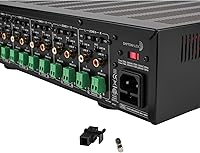
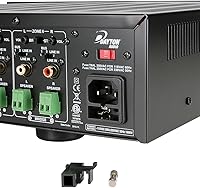
Overview
The Dayton Audio MA1240A has been a fixture in distributed audio installations since 2010 — that kind of staying power says something in a market where products come and go. This multi-zone amplifier sits in an interesting space: engineered for professional installers and serious DIYers, yet priced to make sense for ambitious residential projects. Dayton Audio has built its reputation on delivering real performance without unnecessary markup, and this 12-channel amp is a solid example of that philosophy. It is not a flashy product, but for anyone who needs reliable, scalable multi-room audio from a single rack unit, it has proven itself a dependable workhorse across well over a decade.
Features & Benefits
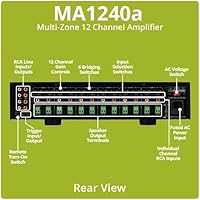
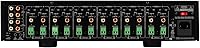
Power output of 60 watts per channel into 4 ohms gives you real headroom for both background listening and more demanding foreground zones. What makes this multi-zone amplifier genuinely practical day-to-day is the independent gain control on each channel — you can balance a quiet bedroom against a busy kitchen without touching an external processor. The input layout is equally well thought out: twelve individual inputs alongside two stereo bus inputs cover most real-world signal routing scenarios. Bus output passthrough means the system can grow without replacing the amp — just add another unit downstream. Bridgeable channel pairs let you consolidate power for any zone that needs a stronger push.
Best For
This multi-zone amplifier is built for anyone managing four to six zones of distributed audio — residential installers doing a whole-home project, or commercial integrators fitting out a restaurant, retail space, or office. In those environments, per-zone independence is not a luxury, it is a requirement. Home automation enthusiasts pairing this with a matrix switcher or a control platform like Control4 will find it integrates without friction. Pure DIYers are also well served, though a little pre-planning around cable runs and source routing goes a long way. If covering an entire property from one rack-mounted amp appeals to you, this 12-channel amp is a proven way to get there.
User Feedback
Long-term owners consistently describe this 12-channel amp as a set-it-and-forget-it unit — stable, quiet, and reliable across years of continuous use. Professional installers specifically call out the clear terminal labeling as a genuine time-saver during complex wiring jobs. That said, there is one thing worth flagging before you buy: the unit runs warm under full load, and rack ventilation is not optional — plan for it before installation, not after. A handful of first-time multi-zone builders have also found the included documentation a bit thin. Neither issue is a dealbreaker, and buyers consistently note that channel separation and the noise floor both punch well above expectations for this price tier.
Pros
- Twelve independent channels cover whole-home or commercial audio from a single rack unit, no daisy-chain headaches.
- Per-channel gain controls let you balance every zone precisely without external attenuators or volume controls.
- Bus input and passthrough architecture makes future system expansion straightforward — just add another amp downstream.
- Long production history since 2010 provides genuine confidence in parts availability and long-term reliability.
- 110 dB signal-to-noise ratio delivers genuinely quiet backgrounds even with sensitive ceiling speakers installed.
- Bridgeable channel outputs give you a practical power boost for larger or outdoor zones when needed.
- Clear terminal labeling reduces wiring errors and speeds up commissioning time for professional installers significantly.
- Multi-stage protection circuitry helps diagnose faults quickly rather than leaving you chasing phantom audio issues.
- Wide 8Hz to 48kHz frequency response ensures clean, neutral audio reproduction across all connected zones.
- Rack-standard dimensions integrate cleanly into any existing AV equipment rack without modification or adapter hardware.
Cons
- Runs noticeably warm under full multi-zone load — dedicated rack ventilation is a must, not optional.
- Included documentation is thin and will leave first-time multi-zone builders searching for external installation guidance.
- At 40 lbs, single-person rack installation is awkward and genuinely benefits from a second pair of hands.
- Bridging channel pairs for extra power directly reduces available zone count, requiring careful upfront planning.
- Unbalanced inputs make long cable runs in electrically noisy environments more susceptible to interference pickup.
- No built-in source switching — this amp moves audio, it does not manage it, so a matrix switcher is often required.
- The utilitarian industrial finish looks out of place in a visible, aesthetically considered equipment rack or listening room.
- Per-channel gain pots are functional but lack the stepped precision found on higher-end commercial installation amplifiers.
Ratings
Our scores for the Dayton Audio MA1240A were generated by AI after systematically analyzing verified buyer reviews from across the globe, with spam, bot-submitted, and incentivized feedback actively filtered out before any score was calculated. The result is an honest snapshot of what real installers, integrators, and home audio enthusiasts experienced — strengths and frustrations included, nothing glossed over.
Channel Count & Zone Flexibility
Power Output & Headroom
Signal Flexibility & Input Options
Independent Gain Control
Build Quality & Chassis Durability
Thermal Management
Noise Floor & Channel Separation
Ease of Installation
Value for Money
Reliability & Longevity
Bridgeability & Power Scalability
Rack Integration
Documentation & Setup Guidance
Frequency Response & Audio Fidelity
Suitable for:
The Dayton Audio MA1240A is purpose-built for anyone who needs to distribute audio across multiple independent zones from a single, reliable rack unit — and it excels in that role. Professional AV installers wiring a five or six zone whole-home audio system will find the channel count, input flexibility, and per-zone gain control align almost perfectly with real-world project requirements. Commercial operators — restaurant owners, retail managers, office facilities teams — who need background music running independently in different areas without complex external processors will appreciate how self-contained this 12-channel amp is. Home automation enthusiasts integrating a distributed audio backbone into a Control4, Savant, or similar smart home platform will find it pairs cleanly without requiring proprietary workarounds. DIY builders who have done their homework, planned their cable runs, and want a proven, long-tenured product rather than an unproven newcomer will feel confident in its track record spanning well over a decade of continuous production.
Not suitable for:
Buyers looking for an amplifier to power a single dedicated listening room or a simple two-zone setup should look elsewhere — the Dayton Audio MA1240A is engineered for scale, and its price reflects that scope. If your entire audio ambition is a living room and a back patio, you will be paying for ten channels you will never use, and a more focused four-channel or stereo amplifier will serve you better at a lower cost. Audiophiles who intend to use this as a primary amplifier for critical listening will likely find it technically competent but not deeply satisfying compared to dedicated stereo power amplifiers in a similar or higher price bracket. Anyone planning to mount this in a sealed, unventilated cabinet without planning for heat dissipation is setting themselves up for a frustrating experience — the unit genuinely needs airflow under sustained multi-zone loads. First-time buyers who have never tackled a multi-room audio installation and expect the included documentation to guide them through the process from scratch may find the learning curve steeper than anticipated without supplementary resources.
Specifications
- Channels: The amplifier provides 12 independent channels, enabling simultaneous audio distribution across up to six stereo zones or twelve mono zones.
- Power at 4 Ohms: Each channel delivers 60 watts RMS into a 4-ohm load, suitable for most standard ceiling and in-wall speaker installations.
- Power at 8 Ohms: Each channel delivers 40 watts RMS into an 8-ohm load, covering a wide range of passive speaker configurations.
- Frequency Response: Audio reproduction spans 8Hz to 48kHz, providing a wider range than human hearing and ensuring no audible content is rolled off at the extremes.
- Signal-to-Noise Ratio: The A-weighted SNR measures 110 dB, resulting in an effectively silent background even when used with sensitive speakers in quiet rooms.
- Distortion: Total harmonic distortion is rated at 0.08%, indicating clean, low-coloration amplification across the full operating range.
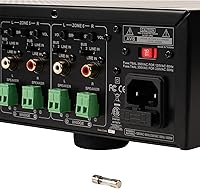
- Individual Inputs: Twelve independent RCA-style inputs allow each channel to receive a completely separate audio source for fully isolated zone control.
- Bus Inputs: Two stereo bus inputs accept a shared audio signal that can be distributed across multiple channels simultaneously for whole-property broadcast scenarios.
- Bus Outputs: Two stereo bus outputs pass the bus signal to an additional downstream amplifier, enabling system expansion without signal splitting hardware.
- Bridged Operation: Adjacent channel pairs can be bridged to combine their output into a single higher-power mono channel for zones requiring greater acoustic headroom.
- Gain Controls: Each of the twelve channels has an independent analog gain control knob, allowing per-zone volume trimming at the amplifier level.
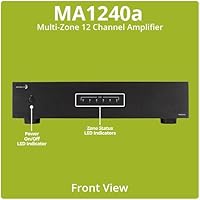
- Protection Circuitry: Multi-stage protection circuitry guards against short circuits, overloads, DC faults, and thermal events, with status indicators to assist in fault diagnosis.
- Power Requirements: The unit operates on a universal supply accepting 115 to 230 VAC, making it compatible with both North American and international mains voltages.
- Standby Consumption: Standby power draw is 0.46 watts, meaning the unit consumes negligible energy when active but idle between audio sessions.
- Dimensions: The chassis measures 16.7″ wide by 14.25″ deep by 4″ tall, occupying a standard 2U rack space in a 19-inch rack enclosure.
- Weight: The unit weighs 40 lbs, which is substantial and typically requires two people for safe and comfortable rack installation.
- Form Factor: The amplifier is designed as a rack-mount unit, compatible with standard 19-inch EIA equipment racks used in residential and commercial AV installations.
- Input Sensitivity: Input sensitivity is rated at 450 mV, aligning with standard consumer and prosumer line-level output levels from preamplifiers and source devices.
Related Reviews
Dayton Audio DSP-408
Dayton Audio Classic T65 Floorstanding Tower Speakers
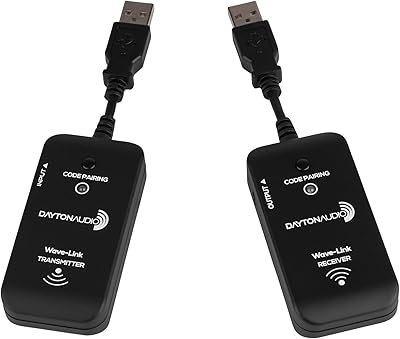
Dayton Audio Wave-Link WLS Wireless Audio System
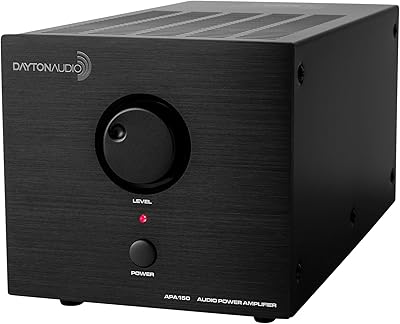
Dayton Audio APA150
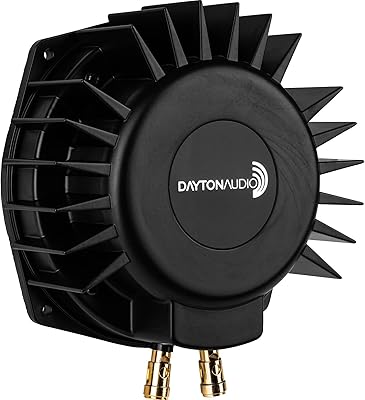
Dayton Audio BST-300EX Tactile Bass Shaker
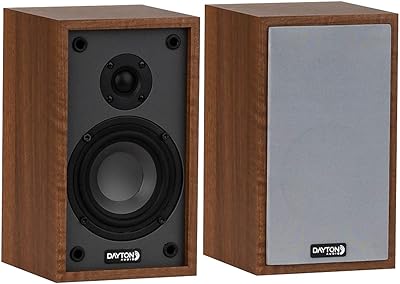
Dayton Audio Classic B40
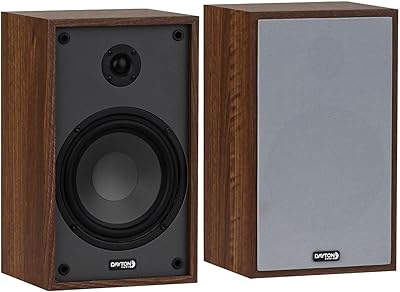
Dayton Audio Classic B65
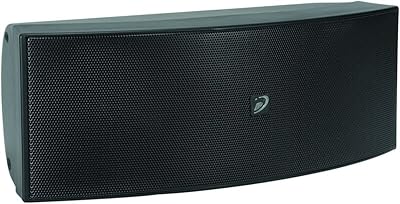
Dayton Audio CCS-33B 3-Way Center Channel Speaker
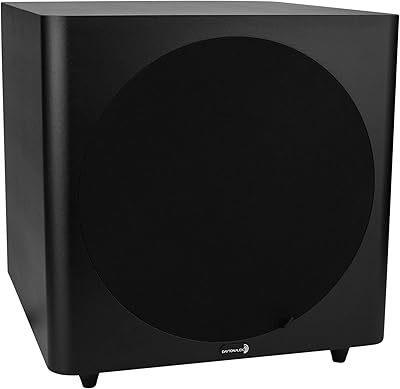
Dayton Audio SUB-1200 12″ Powered Subwoofer