Overview

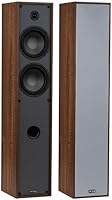
The Dayton Audio Classic T65 Floorstanding Tower Speakers represent one of the more compelling options for buyers looking to step into full-size speakers without spending a fortune. Dayton Audio has long been a trusted name in the DIY audio community — think Parts Express regulars — though the brand is less visible in mainstream retail circles. At nearly 39 inches tall, the cabinet places the tweeter at natural ear level, which matters more than many buyers realize. The wood finish looks appropriate in a living room without screaming budget gear. One important note upfront: these are passive speakers, so a separate amplifier or receiver is required before anything plays.
Features & Benefits

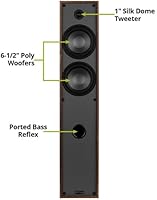
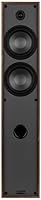
The T65 pair runs a dual 6.5-inch woofer configuration housed in a ported bass reflex cabinet, which means the low end extends further than a sealed box of similar size would allow — real bass weight rather than just warmth. The 1-inch silk dome tweeter crosses over at 3 kHz and handles the top end with composure; long listening sessions don't fatigue the ears the way cheaper metal dome tweeters can. The crossover is a genuine passive network rather than a cut-rate single capacitor, which keeps tonal balance between drivers coherent. At 87 dB sensitivity, this floorstanding set rewards a capable amp — a 50 to 100-watt receiver pulls the most out of them.

Best For

This floorstanding set is a strong match for listeners in apartments or medium-sized living rooms who want genuine low-end presence without adding a subwoofer to the setup. People building a budget stereo system or expanding into a front-channel pair for a 5.1 home theater will find the specs align well with common entry-level receivers from Denon, Yamaha, or Sony. If you've been running bookshelf speakers and feel like you're missing something in the bass register, these tower speakers address that gap directly. Large rooms or dedicated home theaters may still benefit from a dedicated subwoofer, but for most everyday listening environments, the T65 pair holds its own confidently.

User Feedback

Based on 75 ratings — a modest but meaningful sample — the picture is generally positive, with a 4.5-star average. The clearest consensus is around bass output: buyers are repeatedly surprised by how much low end these tower speakers produce relative to their price bracket. Treble character also gets consistent praise; the silk dome keeps things smooth at louder volumes. On the critical side, some owners find the speaker grilles feel flimsy, and a few note that the cabinet walls could use more internal damping to reduce coloration — an easy DIY fix, but worth knowing. Imaging and soundstage are described as competent rather than exceptional, which is honest and expected in this segment.

Pros

  • Dual 6.5-inch woofers deliver surprising bass weight for the cabinet size and price bracket.
  • The silk dome tweeter stays smooth and fatigue-free even during extended listening sessions at higher volumes.
  • A real passive crossover network keeps tonal balance coherent between the drivers — not a budget shortcut.
  • These tower speakers pair easily with common entry-level receivers from Denon, Yamaha, and similar brands.
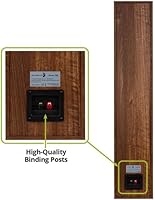
  • Gold-plated binding posts support banana plugs or bare wire, a practical quality touch at this price.
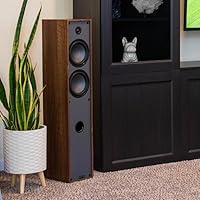
  • The wood veneer finish looks considerably more expensive than the actual cost suggests.
  • At nearly 39 inches tall, the tweeter sits at natural ear level without any stand or riser needed.
  • Power handling headroom is generous enough to handle dynamic peaks without audible stress or compression.
  • The T65 pair can cover most small-to-medium room listening needs without adding a dedicated subwoofer.
  • Sold as a matched pair with speaker wire included, making it an accessible starting point for a stereo setup.

Cons

  • Soundstage imaging is competent but not particularly wide or precise compared to pricier competitors.
  • The speaker grilles feel noticeably lightweight and cheap relative to the cabinet itself.
  • Cabinet walls could benefit from additional internal damping; some coloration is audible on certain frequencies.
  • At 87 dB sensitivity, these tower speakers underperform noticeably when paired with a weak or underpowered amplifier.
  • Large rooms and open-plan spaces may still require a subwoofer to achieve satisfying bass weight.
  • The sample size of 75 reviews is relatively small, so edge-case reliability issues may not yet be fully documented.
  • No wireless or powered option exists — buyers need a separate amplifier, adding to the total system cost.
  • Bass texture, while punchy, lacks the control and definition found in more expensive ported designs.

Ratings

The Dayton Audio Classic T65 Floorstanding Tower Speakers have been scored by our AI review engine after analyzing verified global buyer feedback, with spam, bot-submitted, and incentivized reviews actively filtered out. Scores reflect the real distribution of user sentiment — strong points are credited honestly, and recurring frustrations are not glossed over. The result is a transparent picture of where these tower speakers genuinely punch above their weight and where buyers consistently run into limitations.

Bass Performance
83%
The most consistently praised aspect across buyer reviews — users moving up from bookshelf speakers describe the low-end as a noticeable and satisfying upgrade. The ported cabinet does real work in small to mid-sized rooms, producing bass weight that feels substantial during both music playback and movie sound effects without requiring a dedicated subwoofer.
In larger rooms or open-plan spaces, the bass starts to feel lean and less impactful. A handful of more experienced listeners note that while the quantity of bass is impressive for the price, the tightness and definition at the low end don't match what pricier tower designs deliver.
Treble Clarity
81%
19%
The 1″ silk dome tweeter earns consistent praise for staying smooth and controlled even at higher listening volumes. Users who stream music for hours at a stretch report no listening fatigue, which is a real-world win compared to budget metal dome alternatives that can become harsh and tiring over time.
A small number of audiophile-leaning buyers describe the top end as slightly soft or lacking air above 15 kHz. It is not a flaw for most listeners, but those accustomed to more revealing tweeters may find the treble just a touch polite for critical listening.
Value for Money
88%
Buyers repeatedly note that the T65 pair delivers a level of sound and visual presence that looks and feels like it should cost significantly more. The wood veneer finish, gold-plated binding posts, and full passive crossover are design choices rarely seen at this price tier, and reviewers acknowledge them openly.
The overall value calculus changes if you don't already own a receiver — these are passive speakers that need an external amplifier, which adds meaningfully to total system cost. Budget-first buyers who factor in a new AVR may find the true out-of-pocket spend less impressive than the speaker price alone suggests.
Build Quality
71%
29%
The cabinet itself feels reasonably solid and the wood veneer finish is a genuine step above the printed plastic wraps found on competing budget towers. The binding posts have a quality feel and accept banana plugs cleanly, which buyers setting up a proper wired system appreciate.
The speaker grilles are a clear weak point — multiple reviewers independently describe them as thin, lightweight, and cheap-feeling relative to the cabinet quality. Some buyers also note that the internal cabinet damping feels insufficient, with a slightly hollow knock when tapping the walls suggesting room for improvement.
Soundstage & Imaging
66%
34%
For casual listening and home theater use, the stereo image produced by this floorstanding set is wide enough to create a convincing sense of space between left and right channels. In a typical living room at normal listening distances, most buyers describe the experience as engaging and enjoyable.
Audiophiles and more critical listeners consistently flag this as the T65 pair's most obvious limitation. Precise instrument placement and front-to-back depth feel vague compared to more carefully engineered two-way designs, and this is a recurring observation from buyers who have previously owned or auditioned speakers in higher price brackets.
Amp Compatibility
78%
22%
The 6-ohm impedance is standard enough that most receivers and integrated amplifiers handle these tower speakers without complaint. Buyers pairing them with mainstream AVRs from Denon or Yamaha in the 50 to 80-watt-per-channel range consistently report an easy, stable setup with no impedance-related issues.
At 87 dB sensitivity, the T65 pair is not particularly efficient — weak or very low-budget amplifiers will leave them sounding flat and underpowered. Buyers who pick up a bargain-bin amplifier to save money may feel the speakers underperform, when the real bottleneck is the source of power, not the speakers themselves.
Aesthetic Design
82%
18%
The wood veneer finish is one of the more frequently mentioned positives among buyers who care about how their audio gear looks in a living space. At nearly 39 inches tall, the towers have a presence that reads as intentional and furniture-adjacent rather than cheap and utilitarian.
The finish, while attractive, is veneer rather than real wood, and close inspection reveals this. Buyers who have owned premium cabinets in solid or thick real-wood enclosures will notice the difference in both appearance and resonance characteristics.
Ease of Setup
86%
Unboxing and connecting the T65 pair is a genuinely uncomplicated process for anyone who has used a stereo receiver before. Included speaker wire covers the initial hookup, and the clearly labeled binding posts make polarity mistakes unlikely even for first-time passive speaker owners.
Buyers completely new to passive speaker systems occasionally report confusion about why the speakers produce no sound without a receiver — the passive-only nature of the product is not prominently communicated in the packaging. For true beginners, this creates an unexpected extra purchase.
High-Volume Performance
79%
21%
The 150-watt peak power handling gives these speakers genuine headroom when a well-matched amplifier pushes the volume. Buyers who use them for parties or louder home theater sessions note that the sound stays composed and undistorted at levels that smaller bookshelf speakers would struggle to maintain cleanly.
At very high volumes, some buyers report that the cabinet resonates slightly and the bass loses some of its punch and control. This is consistent with the lighter internal damping that several users have independently flagged, and it's most noticeable when playing bass-heavy content at near-maximum levels.
Midrange Accuracy
74%
26%
Vocals and acoustic instruments sit at a natural, well-balanced level in the mix, and listeners who primarily stream vocal-focused music report a pleasant and involving mid presentation. The crossover handoff at 3 kHz is clean enough that there is no obvious honk or coloration in the upper midrange.
The midrange is competent rather than expressive — detail retrieval in complex mixes can feel slightly blurred compared to more focused single-driver mid designs. Buyers coming from higher-resolution speakers may find the midrange presentation a little congested when the music gets dense.
Low-Frequency Extension
77%
23%
The ported bass reflex design pushes usable bass response down to around 35 Hz on paper, and in practice buyers describe real low-end reach that goes deeper than the cabinet size implies. For music with prominent bass lines or action movie soundtracks, the extension is genuinely impressive in context.
Below 40 Hz the output rolls off and the bass starts losing impact, which means the deepest organ notes or LFE movie content requires a subwoofer to reproduce properly. This is expected behavior for a tower of this size, but buyers hoping to skip a sub entirely for dedicated home theater use may be disappointed.
Packaging & Delivery
76%
24%
Most buyers report the speakers arriving well-protected and in good cosmetic condition, with adequate foam padding around both cabinets. The included speaker wire, while not audiophile grade, is a practical inclusion that means buyers can get sound from the system the same day without an extra purchase.
A small number of buyers report cosmetic damage to the veneer corners upon arrival, suggesting the outer box could benefit from more robust protection for the more fragile edge areas. The packaging is functional but not confidence-inspiring if the speakers are subjected to rough handling during shipping.
Driver Quality
80%
20%
The poly cone woofer material is a sensible choice for this type of speaker — it balances stiffness, damping, and weight in a way that produces punchy, dynamic bass without the breakup issues sometimes found on cheaper paper cone alternatives. Buyers notice the bass has texture, not just volume.
The drivers are custom-spec components manufactured for this cabinet, which means replacement availability could be a concern in the long run if a driver fails out of warranty. There is limited independent third-party data on long-term cone durability in this specific unit.

Suitable for:

The Dayton Audio Classic T65 Floorstanding Tower Speakers are a smart pick for anyone who wants genuine full-range sound from a standing speaker without committing to a high-end audio budget. They're particularly well-suited to listeners in apartments or medium-sized living rooms where the ported cabinet's bass extension will fill the space naturally without needing a separate subwoofer. If you're currently running a pair of bookshelf speakers and feel like the bottom end is always missing something, this floorstanding set closes that gap in a meaningful way. Home theater builders putting together a front stereo pair or a budget 5.1 system will find these tower speakers compatible with most mainstream receivers — a 50 to 100-watt Denon, Yamaha, or Onkyo AVR pairs well without breaking the bank further. The wood veneer finish is also a genuine plus for anyone who wants speakers that don't look like they came out of a big-box electronics clearance bin.
Not suitable for:

The Dayton Audio Classic T65 Floorstanding Tower Speakers are not the right call for buyers expecting audiophile-grade imaging or a deep, precise soundstage. If pinpoint instrument separation and wide stereo depth are priorities — the kind of performance you'd expect from more expensive two-way designs — this floorstanding set will leave you wanting more. Large dedicated home theater rooms or open-plan living spaces are also a tougher fit; in those environments, bass output can feel thin and a subwoofer becomes less optional. These are passive speakers with a 6-ohm impedance and 87 dB sensitivity, which means a weak or budget amplifier will leave them sounding flat and constrained — buyers without an existing receiver need to factor that additional cost into the equation. Listeners who want plug-and-play convenience should look elsewhere entirely, since there are no built-in amplification or wireless options here.
Specifications

  • Speaker Type: 2-way floorstanding tower speaker with a ported bass reflex enclosure, sold as a matched pair.
  • Woofers: Each cabinet houses two 6.5″ poly cone dynamic drivers responsible for midrange and bass reproduction.
  • Tweeter: A 1″ silk dome tweeter handles high-frequency output, crossed over at 3 kHz from the woofers.
  • Crossover: A true passive crossover network — not a single capacitor — distributes the audio signal accurately between the woofers and tweeter.
  • Frequency Response: Rated from 35 Hz to 20,000 Hz, covering deep bass through the upper limit of human hearing.
  • Sensitivity: Sensitivity is rated at 87 dB, meaning a reasonably capable amplifier is needed to reach satisfying listening volumes.
  • Impedance: Nominal impedance is 6 ohms, compatible with the vast majority of stereo receivers and AV amplifiers on the market.
  • Power Handling: Each speaker handles up to 150W peak and 80W RMS, with a recommended amplifier range of 15 to 100 watts.
  • Enclosure Type: Ported bass reflex design allows low frequencies to extend further than a sealed cabinet of equivalent size would permit.
  • Dimensions: Each speaker measures 7.8″ deep by 7.25″ wide by 39.4″ tall, placing the tweeter at natural seated ear level.
  • Weight: Each speaker weighs approximately 18.5 lbs (8.38 kg), making one-person placement manageable with some care.
  • Finish: Exterior is finished in a wood veneer that gives the cabinets a more traditional, furniture-grade appearance.
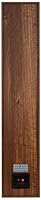
  • Connections: Equipped with gold-plated binding posts that accept banana plugs, spade connectors, or bare speaker wire.
  • Included Items: The package includes one matched pair of speakers and a length of speaker wire to get started.
  • Warranty: Covered by a full manufacturer warranty from Dayton Audio; buyers should confirm current warranty terms at point of purchase.
  • Surround Config: Designed for 2.0 stereo use but equally functional as front left and right channels in a multi-channel home theater system.
  • Cabinet Height: Standing at 39.4 inches tall, the cabinet naturally positions the tweeter at ear level for a seated listener without any riser.
  • Waterproofing: These are indoor speakers only and carry no waterproof or weather-resistant rating whatsoever.

Related Reviews
Dayton Audio Classic B65
78%
83%
Sound Quality
71%
Bass Performance
86%
Treble Clarity
78%
Build Quality
91%
Value for Money
More
Dayton Audio Classic B40
77%
88%
Sound Clarity
91%
Treble Performance
54%
Bass Extension
83%
Build Quality
93%
Value for Money
More
Polk Audio Reserve R700 Tower Speaker
86%
93%
Sound Quality
90%
Bass Performance
88%
Build Quality
82%
Ease of Setup
87%
Design and Aesthetics
More
Dayton Audio CCS-33B 3-Way Center Channel Speaker
76%
88%
Dialogue Clarity
91%
Value for Money
52%
Bass Performance
63%
Build Quality
71%
Outdoor Durability
More
Polk Audio T50 Floor Standing Tower Speaker
80%
84%
Bass Performance
69%
Treble Clarity
77%
Midrange Quality
82%
Volume & Dynamics
91%
Value for Money
More
Fluance Signature HFF Floorstanding Tower Speakers
79%
88%
Sound Quality
84%
Bass Performance
91%
Build Quality
86%
Soundstage & Imaging
83%
High-Frequency Clarity
More
BOSS Audio MRWT40RGB Marine Wake Tower Speakers
73%
74%
Sound Clarity
51%
Bass Response
77%
Weather Resistance
88%
RGB Lighting
83%
Ease of Installation
More
Dayton Audio DC160-8 6.5-Inch Woofer
80%
93%
Value for Money
78%
Bass Extension
84%
Midbass Clarity
81%
Build Quality & Materials
76%
Unit-to-Unit Consistency
More
Dayton Audio SAT-BK Satellite Speaker Pair
75%
86%
Sound Clarity
47%
Bass Response
91%
Value for Money
62%
Build Quality
88%
Magnetic Shielding
More
Cerwin-Vega XLS-12 12″ 3-Way Home Audio Floor Tower Speaker
85%
92%
Sound Quality
94%
Bass Performance
89%
Build Quality
85%
Value for Money
80%
Ease of Setup
More

FAQ

No — these are passive speakers, which means they need an external amplifier or AV receiver to produce any sound. If you don't already own one, factor that into your budget before buying. A standard entry-level stereo receiver from Denon, Yamaha, or Sony works well with the T65 pair.

They perform best in small to medium-sized rooms — think a typical apartment living room, bedroom, or a dedicated listening space up to around 300 to 400 square feet. In larger open-plan areas, the bass can feel a little thin and you may want to add a subwoofer to compensate.

For most everyday listening setups, the dual 6.5-inch woofers and ported cabinet deliver enough low-end presence to skip a subwoofer entirely. That said, if you're building a proper home theater or your room is large, a sub will fill in the lowest frequencies more convincingly. It's not required, but it's a reasonable upgrade path later.

Dayton Audio recommends pairing them with an amplifier putting out between 15 and 100 watts per channel. At 87 dB sensitivity, they're not particularly easy to drive, so a weak or cheap amplifier will leave them sounding flat. A mid-range AVR in the 50 to 80 watt per channel range is the sweet spot for most listeners.

Yes — the gold-plated binding posts are compatible with banana plugs, spade connectors, or bare wire. The posts feel solid and are a noticeable step above the plastic push-pin terminals you'd find on budget competitors.

Mostly yes. Unboxing, connecting speaker wire, and positioning them is straightforward even if this is your first pair of passive speakers. The included speaker wire gets you started, though upgrading to a thicker gauge cable is worth considering for longer runs. The main learning curve is on the amplifier or receiver side if you're new to home audio.

The most obvious difference is in the bass register — these tower speakers produce noticeably more low-end weight and body than a typical bookshelf speaker without a sub. Treble and midrange are comparable in quality. You're not gaining a dramatically wider soundstage, but for listeners who feel like their bookshelf setup is always missing something in the lower frequencies, this floorstanding set is a meaningful upgrade.

They feature a wood veneer finish, not a printed paper wrap or all-plastic shell. It looks reasonably natural in person and holds up well aesthetically in a living room setting, though it's not the same as solid hardwood cabinet construction found on much more expensive speakers.

Technically you can run a single speaker from a mono output, but they're designed and sold as a stereo pair and will sound best used together as intended. Running a single speaker won't damage anything, but it defeats the purpose of the two-channel setup these are built around.

Yes, the grilles are removable. Some listeners prefer the look with grilles off and find the sound is very slightly more open without the fabric in front of the drivers, though the difference is subtle in normal listening conditions. The grilles themselves are on the lightweight side — a minor build quality criticism from several owners — but they do their job of protecting the drivers.

Where to Buy