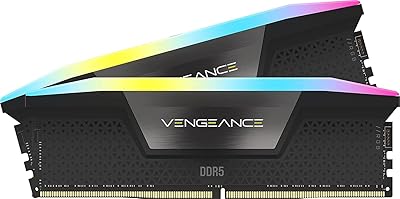
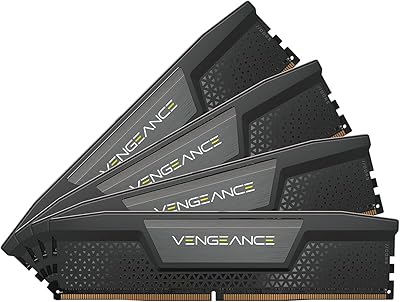
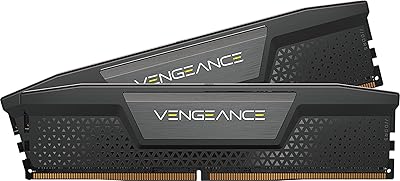
Overview

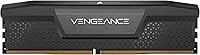
The Corsair Vengeance DDR5 32GB 7200MHz RAM is a high-frequency kit designed for enthusiast desktop builders who aren't content with run-of-the-mill DDR5 speeds. Most DDR5 kits ship at 4800 or 5600MHz out of the box; this DDR5 kit blows past that ceiling, landing at 7200MHz — firmly in the top tier of what the platform currently supports. The dual-channel 2x16GB configuration ensures modern multi-core CPUs stay fed with bandwidth during demanding workloads. Intel XMP 3.0 support and Corsair iCUE integration add meaningful tuning flexibility, though the premium price tag is the honest cost of binning chips capable of running reliably at these frequencies.
Features & Benefits

At 7200MHz with CL34 timings, there's a real tradeoff worth understanding. Higher frequency means more bandwidth, but CL34 is looser than what you'd see on a slower DDR5 kit — in practice, the net bandwidth gain still favors the faster clock for most workloads. What really distinguishes the Vengeance 7200MHz modules is onboard voltage regulation: a dedicated power management chip handles voltage delivery on the module itself, rather than leaving it to motherboard circuitry. This makes high-frequency operation noticeably more stable. Add XMP 3.0 profiles through iCUE, and you can fine-tune behavior per application without ever opening the BIOS. The plain black heatspreader keeps things tidy if RGB isn't your priority.

Best For

This high-frequency memory kit is a strong match for Intel 12th and 13th gen builders — XMP is an Intel-native standard, so AMD users should look for EXPO-certified kits instead. Content creators doing video rendering, 3D work, or handling large datasets will notice real gains from the extra memory bandwidth. Gamers who plan to hold onto their build for several years will appreciate the headroom as more titles start leveraging DDR5 throughput. If you're already running Corsair peripherals or cooling with iCUE, integrating this DDR5 kit into that ecosystem is a natural extension. And if you prefer a clean build with no lighting distractions, the no-RGB heatspreader delivers exactly that.

User Feedback

With a 4.6-star average across more than 200 ratings, most buyers are satisfied — but the picture is nuanced. The most common praise centers on easy XMP activation, consistent stability at the advertised speed, and solid build quality. Where opinions split is around iCUE: some users find the software genuinely useful for monitoring and tuning, while others consider it overhead they'd rather skip — and for basic use, you can absolutely run this high-frequency memory kit without it. A few buyers raise the honest question of whether the step up from 6000MHz justifies the cost; in gaming, the gains are measurable but modest in practice. AMD users occasionally report compatibility friction, and RGB fans note the plain aesthetic as a limitation.

Pros

  • Stable operation at the full 7200MHz XMP speed straight out of a simple BIOS toggle, with no manual tuning required for most Intel boards.
  • Onboard voltage regulation makes high-frequency stability noticeably more reliable than kits that depend entirely on motherboard power delivery.
  • Intel XMP 3.0 support allows saving custom per-application memory profiles, a genuinely useful feature for mixed workloads.
  • The 2x16GB dual-channel configuration leaves two slots free for future capacity upgrades without scrapping the kit.
  • iCUE provides real-time frequency and voltage readouts without needing to reboot into BIOS, which is handy during tuning sessions.
  • No-RGB heatspreader is a practical choice for airflow-sensitive builds and users who want a professional, clutter-free look.
  • Strong 4.6-star average across a meaningful number of real-world buyers reflects consistent quality control and reliable out-of-box performance.
  • DDR5 as a platform offers better long-term scalability than DDR4, making this high-frequency memory kit a reasonable investment for a multi-year build.

Cons

  • The price premium over comparable 6000MHz DDR5 kits is hard to justify purely on gaming benchmark gains, which are real but incremental.
  • CL34 timings are relatively loose for a kit at this price point — tighter-latency alternatives exist at lower frequencies for latency-sensitive workloads.
  • No AMD EXPO certification means AMD platform builders cannot reliably use this kit at its rated speed.
  • iCUE is required to unlock advanced tuning features; users who prefer lean systems will find it an unwanted software dependency.
  • 32GB total capacity may feel limiting for professional workstation users who work with very large project files or virtual machines.
  • Some motherboard and BIOS combinations require manual intervention or firmware updates before the XMP profile loads correctly.
  • The kit is desktop-only, ruling it out entirely for anyone building in a mini-ITX system with SO-DIMM requirements.
  • No RGB is a deliberate design choice, but buyers who expected lighting options and did not check specs carefully may feel caught off guard.

Ratings

Our AI-generated scores for the Corsair Vengeance DDR5 32GB 7200MHz RAM were produced by analyzing verified global buyer reviews, with spam, bot submissions, and incentivized feedback actively filtered out before scoring. Each category reflects the honest distribution of real user experiences — strengths and frustrations weighted equally — so you get a picture that is useful for making an actual purchase decision, not just a confidence boost.
Rated Speed Accuracy
93%
The overwhelming majority of buyers confirmed that these modules reached the advertised 7200MHz after a straightforward XMP activation in the BIOS, with no manual timing adjustments needed. For enthusiast builders who pay a premium specifically for a rated frequency, arriving at that number without drama is the core expectation — and this kit delivers on it consistently.
A smaller subset of users reported needing a BIOS update before the XMP profile would apply correctly, which adds an unexpected step for builders who assumed it would simply work out of the box. This is partly a motherboard ecosystem issue, but it does introduce friction for less experienced builders.
Stability & Reliability
89%
Long-term stability at 7200MHz is one of the most praised aspects in user feedback, with buyers reporting clean, crash-free performance across extended rendering sessions, gaming marathons, and sustained workstation tasks. The onboard voltage regulation appears to meaningfully contribute here, keeping power delivery consistent even under sustained load.
A handful of users encountered intermittent instability on specific motherboard and BIOS combinations, particularly on some B660 and Z690 boards running older firmware. These cases appear to be edge situations rather than systematic failures, but they are real and worth flagging for anyone building on older Intel board revisions.
Value for Money
61%
39%
For content creators and prosumer workstation builders, the bandwidth gains at 7200MHz over a 6000MHz kit are tangible in rendering and encoding workloads, making the price delta feel earned in a professional context. Buyers in those use cases tend to rate value positively because they can directly observe the throughput improvement.
For gaming-focused buyers, the real-world frame rate differences versus a well-tuned 6000MHz kit are modest enough that the premium is difficult to rationalize. Multiple reviewers explicitly noted that they would choose a lower-frequency kit in hindsight if gaming were their sole workload, which pulls this score down considerably.
XMP & Overclocking Support
91%
Intel XMP 3.0 support with iCUE integration gives enthusiasts the ability to create and save custom memory profiles tied to specific applications or tasks, which is a genuinely useful feature rather than a marketing checkbox. Builders already tuning their systems through iCUE found this to be a smooth, practical extension of their existing workflow.
XMP 3.0 is strictly Intel-native, and AMD platform users who purchased this kit without fully understanding that distinction have reported frustration when the profile fails to apply correctly or causes boot failures. This is not a product defect, but it is a real source of negative feedback in the review pool.
Build Quality & Feel
88%
The aluminum heatspreader feels solid and well-fitted, and buyers consistently noted that the modules look premium in person — the matte black finish reads as deliberately understated rather than budget. For builders who care about what their open-side case looks like, this kit holds up visually without demanding attention.
The absence of RGB is a genuine limitation for a segment of buyers who expected lighting options at this price point and did not verify the spec before purchasing. While the plain design is intentional, it is worth noting that disappointed RGB users do exist in the review pool and have marked the kit down for it.
Software Experience (iCUE)
67%
33%
For users already running the Corsair iCUE ecosystem across peripherals, fans, and cooling, having memory frequency and voltage data visible in the same dashboard is a genuinely convenient addition. The real-time readings and profile-saving features work as described and add meaningful utility for people who actively tune their systems.
Users who installed iCUE solely for memory management found it resource-heavy relative to what they needed, with background CPU and memory usage noticeable on some systems. The software also has a history of update-related instability that surfaces in reviews — enough that several buyers recommend running the kit without it unless you specifically need the advanced features.
Compatibility (Intel Platforms)
86%
On verified compatible Intel 12th and 13th gen boards with up-to-date BIOS versions, installation and XMP activation is smooth and reliable. Builders who checked the motherboard QVL list before purchasing reported a consistently positive plug-and-play experience.
Not all Intel boards behave identically, and there is enough variability in BIOS maturity across Z690, Z790, and B-series boards that some users had to troubleshoot before achieving stable operation at full speed. This is a nuance of the high-frequency DDR5 ecosystem rather than a flaw unique to this kit.
Thermal Performance
84%
The low-profile aluminum heatspreader keeps temperatures manageable under sustained load, and the lack of RGB eliminates the minor additional heat that LED arrays can introduce in tight builds. Builders using compact mid-tower cases with limited airflow reported no thermal throttling during extended sessions.
Without active cooling or significant airflow directed at the DIMMs, temperatures can climb noticeably during prolonged heavy workloads like overnight rendering jobs. This is not unique to this kit among high-frequency DDR5 modules, but buyers running fanless or passively cooled cases should factor it in.
Installation Experience
87%
Physical installation is standard and straightforward — the modules seat firmly, and the slot locking mechanism is consistent with what builders expect from quality DDR5 sticks. Most users reported the entire hardware installation taking only a few minutes with no issues.
The multi-step process of updating BIOS firmware before enabling XMP, which some users encountered, added unexpected time and technical complexity to what they assumed would be a simple memory swap. For first-time builders, this learning curve is worth anticipating.
Low-Profile Clearance
82%
18%
At 1.38″ tall, the Vengeance 7200MHz modules clear the vast majority of popular tower CPU coolers without any conflict, which was a genuine concern for buyers pairing these with large air coolers like the Noctua NH-D15 or be quiet! Dark Rock Pro. Most users reported a comfortable margin of clearance.
A small number of users with particularly large coolers or unusual mounting configurations reported a tighter fit than expected, and a few had to reposition their cooler's fan bracket to avoid contact. The margin is comfortable for most setups but not quite universal.
AMD Platform Compatibility
29%
71%
There is very little positive to say here from an AMD perspective — this kit was never designed for that platform, and the few AMD users who report success at near-rated speeds are outliers relying on their board's unofficial XMP tolerance rather than supported functionality.
AMD builders who purchased this kit based on the frequency spec alone and assumed cross-platform compatibility have repeatedly reported boot failures, forced fallback to JEDEC speeds, and instability. XMP 3.0 is Intel-native, this kit has no EXPO certification, and the review pool contains enough AMD-related frustration to make this score accurately reflect the reality for that audience.
Packaging & Presentation
79%
21%
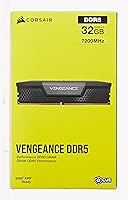
The kit arrives in clean, protective packaging appropriate for the price tier, and buyers report that modules are well-secured and show no signs of shipping damage in the vast majority of cases. The unboxing experience feels consistent with Corsair's premium product positioning.
A minor but recurring observation is that the packaging itself is not particularly memorable or premium-feeling compared to what some buyers expect at this price point. It functions well as protective packaging but does not contribute to the perceived value the way some competing brands' presentation does.
Future Platform Scalability
83%
DDR5 as a memory standard is clearly positioned for the next several years of desktop platforms, and buying at 7200MHz today means this high-frequency memory kit is unlikely to become a bottleneck as future CPUs and workloads demand more bandwidth. Buyers with a long upgrade horizon find this reassuring.
There is a reasonable concern that future Intel or AMD platforms optimized for DDR5 may ship with their own preferred frequency profiles or new standards that leave XMP 3.0 kits in a compatibility gray area. This is speculative, but it is worth noting for buyers planning five-plus year build cycles.

Suitable for:

The Corsair Vengeance DDR5 32GB 7200MHz RAM is purpose-built for enthusiast desktop builders who want to extract maximum performance from Intel 12th or 13th gen platforms — it is not a kit you buy because it was on sale, but because you've decided to build something seriously fast. Content creators who spend hours in video editing timelines, 3D rendering queues, or large-dataset workflows will find the high memory bandwidth genuinely useful, not just a spec-sheet talking point. Gamers building a rig they plan to keep for five or more years will appreciate having headroom as future titles and engines continue to push DDR5 harder. If you are already running Corsair peripherals, coolers, or fans through iCUE, folding this DDR5 kit into that same software environment is a natural and convenient extension of your existing setup. Anyone who prefers a clean, minimal build aesthetic without RGB lighting will also find the understated black heatspreader a welcome change from the usual glow-in-the-dark arms race.

Not suitable for:

The Corsair Vengeance DDR5 32GB 7200MHz RAM is a poor fit for AMD platform builds — XMP 3.0 is an Intel-native specification, and while some AMD boards may attempt compatibility, AMD's own EXPO standard is the correct tool for that job, and this kit does not carry EXPO certification. Budget-conscious builders or anyone upgrading a mainstream gaming PC will likely find the performance delta over a well-tuned 6000MHz DDR5 kit too small to justify the meaningful price premium, especially in everyday gaming workloads where the gains are measurable but not transformative. Laptop or small-form-factor mini-PC users are simply out of scope — these are full-size desktop DIMMs. Users who are sensitive to background software and prefer a lightweight system footprint may also find iCUE's resource usage a recurring frustration, particularly if they have no other Corsair hardware to justify keeping it installed. Finally, anyone who wants RGB lighting as part of their build aesthetic will need to look elsewhere in Corsair's own lineup.
Specifications

  • Capacity: This kit provides 32GB of total memory across two 16GB DDR5 modules in a dual-channel configuration.
  • Memory Type: Both modules use DDR5 technology, the current generation standard offering improved bandwidth and energy efficiency over DDR4.
  • Clock Speed: The rated operating speed is 7200MHz, achievable via Intel XMP 3.0 profile activation in a compatible motherboard BIOS.
  • CAS Latency: The kit runs at CL34 primary timings, which is expected for DDR5 at this frequency tier and represents a reasonable latency-to-bandwidth balance.
  • Voltage: Operating voltage is 1.45V, delivered via an onboard power management integrated circuit rather than solely through motherboard VCC rails.
  • Form Factor: Both sticks are standard full-size DIMMs designed exclusively for desktop motherboards; they are not compatible with laptops or mini-ITX SO-DIMM slots.
  • XMP Support: Intel XMP 3.0 is supported, allowing one-click speed activation and the ability to save custom frequency and timing profiles through Corsair iCUE software.
  • Voltage Regulation: An onboard PMIC handles voltage regulation at the module level, reducing dependence on motherboard power delivery quality during high-frequency operation.
  • Software: Full integration with Corsair iCUE software enables real-time monitoring of frequency, voltage, and temperature, as well as custom XMP profile management.
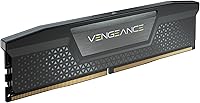
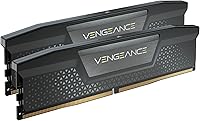
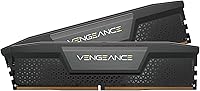
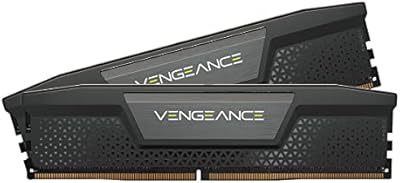
  • Heatspreader: Each module features a low-profile aluminum heatspreader finished in matte black with no RGB lighting elements.
  • Dimensions: Each module measures 5.31″ in length, 1.38″ in height, and 0.28″ in width, making it compatible with most CPU coolers that respect standard DIMM clearance.
  • Weight: Each individual module weighs 1.28 oz, which is typical for a DDR5 stick with an aluminum heatspreader.
  • AMD Compatibility: This kit carries Intel XMP 3.0 certification only and does not hold AMD EXPO certification, meaning reliable high-speed operation on AMD platforms is not guaranteed.
  • Model Number: The official Corsair part number for this kit is CMK32GX5M2X7200C34, useful for cross-referencing compatibility lists and warranty claims.
  • Release Date: This kit was first made available in November 2022, positioning it among the early high-frequency DDR5 offerings for Intel 12th and 13th gen platforms.
  • Warranty: Corsair provides a limited lifetime warranty on Vengeance DDR5 memory, covering defects in materials and workmanship under normal use conditions.
  • Amazon Rating: The kit holds a 4.6 out of 5 star rating based on over 200 verified customer ratings on Amazon.
  • Best Sellers Rank: It ranks at approximately #1,263 in the Amazon Computer Memory category, reflecting steady demand within the enthusiast segment.

Related Reviews
Corsair Vengeance DDR5 32GB (2x16GB) 6800MHz RAM
88%
91%
Overall Performance
94%
Gaming Performance
88%
Ease of Overclocking
89%
Software Integration (iCUE)
92%
Compatibility with Intel Systems
More
Corsair Vengeance SODIMM DDR5 32GB Laptop RAM
80%
93%
Installation Ease
89%
Speed Detection & XMP
84%
Real-World Performance
76%
Platform Compatibility
67%
Latency & Timings
More
Corsair Vengeance 32GB DDR5 SODIMM RAM
84%
93%
Overall Reliability
91%
Installation Experience
88%
Speed & Auto-Configuration
84%
Real-World Performance Gain
79%
Compatibility Range
More
Corsair Vengeance DDR5 32GB 5200MHz RAM
84%
91%
Installation & Setup
89%
Motherboard Compatibility
76%
Rated Speed Performance
61%
Overclocking Headroom
88%
Build Quality & Heatspreader
More
Corsair Vengeance RGB DDR5 32GB (2x16GB) 6200MHz
86%
92%
Performance
88%
RGB Lighting Customization
89%
Overclocking Support
85%
Build Quality
90%
Compatibility with Desktop PCs
More
Corsair Vengeance RGB 32GB DDR5 Desktop RAM
82%
93%
Performance at Rated Speed
89%
Ease of Setup
91%
RGB Lighting Quality
67%
iCUE Software Experience
82%
Compatibility Range
More
Corsair Vengeance DDR5 64GB 6000MHz Desktop RAM
83%
93%
Performance at Rated Speed
91%
XMP Setup & Ease of Use
94%
Stability & Reliability
67%
Platform Compatibility
62%
Value for Money
More
Corsair Vengeance 32GB DDR5 Desktop RAM
81%
91%
XMP Stability
52%
AMD Compatibility
83%
Value for Money
94%
Cooler Clearance
86%
Build & Physical Quality
More
Corsair Vengeance RGB DDR5 32GB (2x16GB) 6400MHz
88%
91%
Performance for Gaming
94%
Overclocking Stability
88%
Ease of Setup
85%
RGB Lighting Customization
90%
Compatibility with Intel Systems
More
Corsair Vengeance DDR5 32GB 6600MHz Desktop RAM
81%
88%
Out-of-Box Performance
84%
XMP Stability
71%
Value for Money
77%
Software Integration
91%
Build Quality
More

FAQ

Not reliably at its rated speed. XMP 3.0 is an Intel-native overclocking standard, and while some AMD boards will attempt to apply the profile, AMD's own EXPO standard is the correct specification for that platform. If you are building on AMD, look for a kit that carries EXPO certification instead.

No, iCUE is not required for basic operation. The memory will run at its default DDR5 speed without any software installed, and you can also activate the XMP 3.0 profile directly through your motherboard BIOS. iCUE becomes useful if you want real-time monitoring, voltage readouts, or the ability to create and save custom XMP profiles without repeatedly entering the BIOS.

It depends on what you are doing. For most gaming workloads, the performance difference between 6000MHz and 7200MHz DDR5 is measurable in benchmarks but rarely transformative in practice. Where the higher frequency earns its keep is in bandwidth-heavy tasks like video rendering, 3D work, or large dataset processing. If gaming is your primary use case, a well-tuned 6000MHz kit offers stronger value; if you do creative workloads, the extra headroom is more justifiable.

Most likely yes. At 1.38″ tall, the Vengeance 7200MHz modules use a relatively low-profile heatspreader by enthusiast standards. The majority of popular tower coolers clear this height comfortably, but it is always worth checking your specific cooler's DIMM clearance spec before buying.

Restart your system and enter the BIOS, then look for an XMP or Extreme Memory Profile option — on most Intel boards it is labeled XMP or Intel XMP. Select the XMP 3.0 profile, save, and reboot. The system will then run the memory at its rated 7200MHz speed. If your board does not post after enabling XMP, try updating the BIOS firmware first.

Corsair recommends using matched pairs from the same kit for best stability, especially at high frequencies like 7200MHz. Mixing this kit with sticks from a different manufacturer or speed bin can cause instability or force the system to fall back to a lower, safe speed. If you need more than 32GB, purchasing a second identical kit is safer than mixing.

No, the Vengeance 7200MHz modules have no RGB lighting at all. The heatspreader is a plain matte black finish. If you want RGB, Corsair does offer other Vengeance DDR5 variants with lighting, but this particular model is intentionally designed without it.

This DDR5 kit is designed for Intel 12th gen (Alder Lake) and 13th gen (Raptor Lake) platforms, both of which use the LGA1700 socket and DDR5-capable motherboards. It should also be compatible with Intel 14th gen boards using the same socket and chipset family, though it is always worth verifying compatibility on your specific motherboard's QVL list.

It is genuinely useful, particularly at high frequencies. Standard DDR4 and many lower-end DDR5 kits rely on the motherboard to regulate module voltage, which introduces variability depending on your board quality. Having a dedicated power management chip directly on the memory module means cleaner, more consistent voltage delivery, which contributes to stable operation at speeds like 7200MHz that push the limits of what DDR5 chips can reliably handle.

Start by checking whether your motherboard BIOS is up to date — manufacturers frequently release updates that improve high-frequency DDR5 compatibility. If updating the BIOS doesn't resolve it, try seating only one stick in the primary recommended slot and testing again. You can also manually enter slightly looser timings or drop to a lower XMP sub-profile as a fallback. Corsair's support team is responsive and can walk you through troubleshooting specific to your board combination.