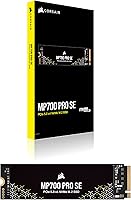
Overview

The Corsair MP700 PRO SE 4TB NVMe SSD sits at the very top of the consumer storage market, built for users who genuinely push their systems to the limit. PCIe Gen5 x4 doubles the available bandwidth over Gen4, but that only matters if your workload can actually use it — and most everyday tasks cannot. What sets this Gen5 SSD apart from most of the competition is the 4TB capacity; large single-drive configurations at this speed tier remain rare. There is one critical caveat worth flagging upfront: active cooling is required. Without a heatsink or sufficient airflow over the M.2 slot, thermal throttling will undercut those headline numbers. This is a premium purchase for a specific type of buyer.

Features & Benefits

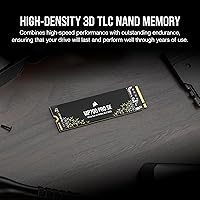
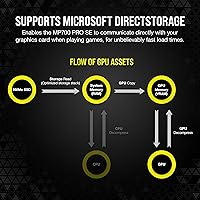
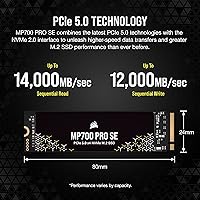
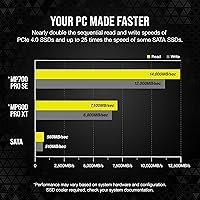
At the core of the MP700 PRO SE's performance story are sequential read speeds reaching 14,000MB/s and writes up to 12,000MB/s — numbers that translate into tangible time savings when handling massive video files, virtual machine images, or large game asset compilations. The NVMe 2.0 protocol brings tighter queue management and reduced latency compared to its predecessor, which matters more in sustained workloads than synthetic benchmarks suggest. High-density 3D TLC NAND is a sound choice here — more durable and consistent under heavy write loads than QLC alternatives. DirectStorage support enables direct GPU asset streaming in compatible titles, though the game library supporting it is still growing. Hardware-level encryption rounds out the feature set for security-conscious users.

Best For

This high-capacity NVMe drive is purpose-built for a narrow but well-defined audience. Video editors and VFX artists working with 4K or 8K footage will feel the difference immediately — fast sustained transfers mean less time waiting on renders, proxies, and cache writes. Serious PC gamers on Intel Z790 or AMD X670 platforms who want every possible edge from DirectStorage-compatible titles will also find this a worthy fit. For anyone building a future-proof storage setup and tired of juggling multiple smaller drives, 4TB at this speed tier is a compelling consolidation. That said, if your motherboard tops out at PCIe 4.0, or you lack proper M.2 cooling, the value proposition weakens considerably.

User Feedback

Across 68 ratings, the MP700 PRO SE holds a strong 4.6-star average, and the pattern in buyer comments reflects that well-earned score. Most praise centers on benchmark performance and the sheer relief of having 4TB in a single M.2 slot — a common theme among buyers who previously ran two or three drives. On the critical side, heat is the recurring concern. Several users note that without a quality heatsink or active case airflow, temperatures climb quickly and throttling follows. A handful of buyers on PCIe 4.0 systems report satisfaction but acknowledge they are not extracting full value. The consensus: for the right Gen5-ready platform, this drive delivers on its promises — but it punishes underprepared systems.

Pros

  • Sequential read speeds of up to 14,000MB/s make a real difference for large file workflows like video editing and data migration.
  • 4TB capacity in a single M.2 slot is genuinely rare at this performance level — a major convenience for storage-hungry builds.
  • High-density 3D TLC NAND offers better long-term endurance than QLC drives, which matters under sustained heavy writes.
  • NVMe 2.0 protocol delivers lower latency and improved queue handling compared to the previous generation.
  • Hardware encryption support is a practical bonus for professionals handling sensitive client data.
  • DirectStorage compatibility positions this high-capacity NVMe drive well for next-generation gaming workflows as the supported title library grows.
  • Strong 4.6-star rating across real buyer reviews reflects consistent satisfaction among users on compatible platforms.
  • Backward compatibility with PCIe 4.0 and 3.0 slots provides some flexibility for incremental platform upgrades.

Cons

  • Active cooling is required but not included — an easy oversight that can lead to immediate thermal throttling out of the box.
  • Gen5 platform requirement means a large portion of existing PC builds simply cannot take advantage of the top-end speeds.
  • The premium price tier puts this drive out of reach for anyone whose workload would not realistically benefit from Gen5 bandwidth.
  • DirectStorage game support is still limited, so gaming-focused buyers may find the practical benefit smaller than expected right now.
  • Buyers on PCIe 4.0 systems report feeling they overpaid once they realize the speed ceiling their platform imposes.
  • No heatsink in the box is a notable omission given how aggressively this drive can heat up under sustained loads.
  • At this price point, a mistake in compatibility research — wrong platform, inadequate cooling — is a costly one to walk back.

Ratings

Our AI-generated scores for the Corsair MP700 PRO SE 4TB NVMe SSD were produced by analyzing verified global buyer reviews, with spam, bot activity, and incentivized feedback actively filtered out before scoring. The ratings reflect an honest cross-section of real-world experiences — covering both the areas where this Gen5 SSD genuinely impresses and the friction points that have frustrated buyers. Strengths and shortcomings are weighted equally so you get a clear, unvarnished picture before committing.
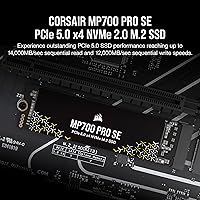
Sequential Read Performance
96%
Users on Gen5-ready platforms consistently report benchmark results at or near the advertised 14,000MB/s ceiling, with video editors and data pipeline professionals noting tangible reductions in large file transfer times. For anyone moving multi-gigabyte assets regularly, the throughput advantage over Gen4 drives is not just theoretical.
The headline speeds require a perfectly cooled, Gen5-compatible system to materialize — buyers on older platforms or with marginal airflow rarely see numbers that justify the premium over a well-specced Gen4 alternative.
Sequential Write Performance
93%
Sustained write speeds hold up impressively under demanding workloads, with content creators noting that writing large 8K project caches or database snapshots rarely causes the kind of stuttering seen on QLC-based competitors. The TLC NAND architecture clearly helps here.
Write performance, like read, is highly sensitive to thermal conditions — prolonged heavy writes in a poorly ventilated case will trigger throttling that pulls real-world speeds well below the 12,000MB/s rating.
Thermal Management
52%
48%
When paired with a quality aftermarket heatsink or a motherboard cover with active airflow, the MP700 PRO SE maintains stable temperatures and holds performance over extended sessions without complaint from most users.
Without dedicated cooling, this high-capacity NVMe drive runs hot enough to throttle quickly, and that is a recurring frustration in user reviews — especially since no heatsink ships in the box. It is a real gotcha for buyers who did not read the fine print.
Value for Money
61%
39%
For the specific buyer who needs 4TB at Gen5 speeds in a single M.2 slot, the pricing is broadly in line with what the market asks for this tier of performance and capacity, and most of those buyers report feeling the cost was justified.
For anyone whose platform tops out at Gen4, or whose workloads do not stress storage bandwidth, the premium feels steep against far cheaper alternatives that would perform identically in practice. The value case is narrow and platform-dependent.
Installation Experience
78%
22%
Physical installation is as straightforward as any standard M.2 2280 drive — it slots into a compatible motherboard in minutes, and firmware is handled automatically by most systems without any manual intervention needed.
The cooling requirement adds a setup step that can catch buyers off guard, and sourcing a compatible heatsink separately adds both cost and effort that should ideally have been included in the retail package.
Platform Compatibility
74%
26%
Backward compatibility with PCIe 4.0 and 3.0 slots means the drive will physically function in a wide range of systems, and users on older platforms do report reliable operation with no stability issues.
Running this Gen5 SSD on a Gen4 or Gen3 board wastes the majority of what you paid for — speed drops dramatically, and the drive becomes an expensive way to get performance a budget Gen4 model could have delivered.
Build & Reliability
88%
The 3D TLC NAND foundation gives this drive a more durable write endurance rating than QLC alternatives at comparable capacities, and early adopter reports show no unusual failure rates or reliability concerns after months of use.
It is still too early in the product lifecycle to make strong long-term reliability statements, and the thermal stress that comes with inadequate cooling could accelerate wear in systems that run the drive hot regularly.
DirectStorage Support
69%
31%
The MP700 PRO SE is fully equipped to take advantage of Microsoft DirectStorage where supported, and users on capable systems with compatible games report noticeably snappier asset loading compared to older drives.
The library of DirectStorage-optimized titles remains limited, which means this feature does not yet deliver on its full promise for most gamers — it is a future-facing benefit rather than an immediate daily driver advantage.
Capacity Offering
94%
Having 4TB in a single M.2 slot is a genuine differentiator — power users who previously juggled multiple drives for project storage appreciate the simplicity and the performance consistency of a single unified volume.
The 4TB tier carries a significant cost premium over the 2TB variant, and buyers who do not actually need that much fast storage would be better served financially by the smaller sibling.
Hardware Encryption
81%
19%
Controller-level encryption adds a meaningful layer of data security for professionals handling client files or sensitive data, with no measurable hit to read or write performance since it operates independently of the CPU.
The feature requires deliberate setup through BIOS or security tools and offers little benefit to casual users — it is well-implemented but will go untouched by the majority of buyers who purchase this drive purely for speed.
NVMe 2.0 Protocol Benefits
83%
NVMe 2.0 brings genuine improvements to queue depth handling and command latency that are felt in sustained mixed workloads — database operations, virtualization, and professional applications that issue many simultaneous read and write commands benefit measurably.
For gaming and consumer media workloads, the NVMe 2.0 advantage over NVMe 1.4 is largely invisible — it is a meaningful spec for enterprise-adjacent use cases but rarely something mainstream buyers will notice day to day.
Out-of-Box Experience
63%
37%
The drive itself is compact and well-finished, and setup on a compatible Gen5 system with proper cooling in place is quick and painless, with detection and initialization handled automatically by current operating systems.
The absence of a heatsink or even a basic thermal pad in the box feels like an oversight at this price tier — several buyers mention this as their first and most immediate disappointment upon unboxing.
Gaming Performance
72%
28%
On a fully equipped Gen5 gaming rig, boot times and game load screens are genuinely fast, and buyers who game on Intel Z790 or AMD X670 platforms report a snappy, responsive experience across installed titles.
The honest reality is that most games are not storage-bandwidth-limited, and the gap between this drive and a solid Gen4 alternative is marginal in game load tests — the premium is harder to justify on gaming alone.

Suitable for:

The Corsair MP700 PRO SE 4TB NVMe SSD was built for a specific kind of power user, and if you fall into that category, it is genuinely hard to beat. Video editors and colorists working with 4K or 8K RAW footage will notice the difference in scrubbing timelines, writing cache files, and transferring project archives — these are workloads where 14,000MB/s sequential reads stop being a marketing number and start being real time saved. System builders running Intel Z790 or AMD X670 platforms who want to consolidate multiple drives into a single fast volume will appreciate the 4TB capacity, which remains uncommon at this performance tier. PC enthusiasts who keep up with DirectStorage-compatible game releases and want every advantage their Gen5 platform can offer will also find this drive a strong fit. For anyone who has hit the ceiling on a 2TB drive and refuses to compromise on speed, this high-capacity NVMe drive is one of very few options that genuinely checks both boxes at once.
Not suitable for:

The Corsair MP700 PRO SE 4TB NVMe SSD is a poor fit for a surprisingly large segment of buyers who might be tempted by its headline specs. If your motherboard predates PCIe Gen5 — meaning most systems built before late 2022 — you will not come close to the advertised speeds, and you would be paying a steep premium for performance your platform physically cannot deliver. The mandatory active cooling requirement is also a real barrier: if your case lacks strong M.2 airflow or you plan to skip a heatsink, thermal throttling will pull speeds back significantly, undermining the entire value proposition. Casual users who primarily browse, stream, or run productivity software will never stress a drive anywhere near these limits — a well-priced Gen4 SSD would serve them just as well at a fraction of the cost. Budget-conscious builders and anyone upgrading a secondary or NAS-adjacent system should look elsewhere; this Gen5 SSD demands a system worthy of it.
Specifications

  • Interface: Uses a PCIe Gen5 x4 NVMe 2.0 interface, delivering double the bandwidth ceiling of the previous Gen4 standard.
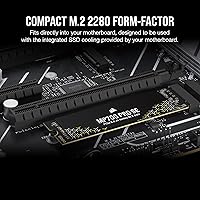
  • Form Factor: Follows the M.2 2280 standard, measuring 3.17 x 0.87 x 0.09 inches and fitting most modern desktop M.2 slots.
  • Capacity: Available in this configuration at 4TB of usable digital storage on a single M.2 module.
  • Sequential Read: Rated for sequential read speeds of up to 14,000MB/s under optimal conditions with proper cooling in place.
  • Sequential Write: Rated for sequential write speeds of up to 12,000MB/s, sustaining high throughput during large file transfers and saves.
  • NAND Type: Built on high-density 3D TLC NAND, which offers a more reliable endurance profile over time compared to QLC-based drives.
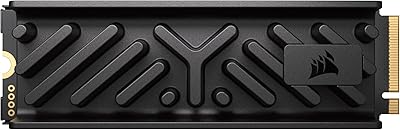
  • Cooling: Requires active cooling to maintain peak performance — no heatsink is included in the box.
  • Platform Support: Natively compatible with Intel Z790 and AMD X670 platforms and any newer chipsets supporting PCIe Gen5 x4.
  • Backward Compat.: Will operate in PCIe 4.0 and PCIe 3.0 slots, though at significantly reduced speeds relative to its Gen5 ceiling.
  • DirectStorage: Supports Microsoft DirectStorage, enabling direct asset streaming to a compatible GPU in supported titles (requires DirectX12 GPU with Shader Model 6.0).
  • Encryption: Supports hardware-level encryption, providing a built-in layer of data security without relying solely on software solutions.
  • Weight: Weighs 0.264 ounces, consistent with standard M.2 2280 drives and adding negligible mass to any build.
  • Color: Ships in a black finish with no integrated heatsink or thermal pad included in the retail package.
  • Protocol: Runs the NVMe 2.0 protocol, which improves command queue handling and reduces latency compared to NVMe 1.x implementations.
  • Installation: Designed for internal installation in desktop systems; not intended for laptop or external enclosure use without specific compatibility verification.

Related Reviews
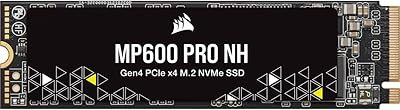
Corsair MP600 PRO NH 4TB NVMe SSD
88%
93%
Performance
91%
Speed
89%
Capacity for Heavy Workloads
85%
Build Quality
87%
Ease of Installation
More
Corsair MP700 PRO 1TB NVMe SSD
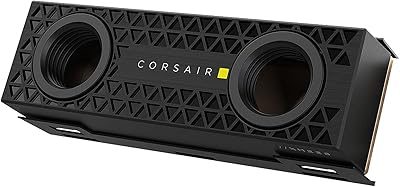
76%
94%
Raw Read Performance
88%
Write Performance
61%
Thermal Management
69%
Value for Money
91%
Installation & Setup
More
Corsair MP600 PRO XT 2TB NVMe SSD
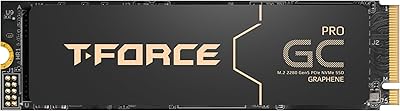
83%
94%
Sequential Read Speed
91%
Sustained Write Performance
93%
Thermal Management
88%
Build & Installation Quality
92%
Endurance & Longevity
More
TEAMGROUP T-Force GC PRO 4TB Gen5 NVMe SSD
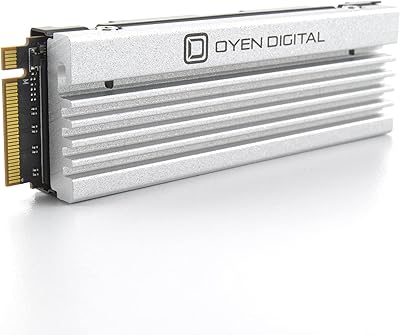
80%
88%
Sequential Speed Performance
83%
Thermal Management
81%
Sustained Write Consistency
67%
Compatibility & Setup Experience
74%
Value for Money
More
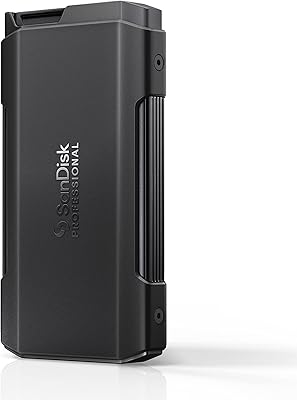
SanDisk Professional PRO-Blade Transport 4TB NVMe SSD
85%
92%
Performance
89%
Durability
90%
Modularity
88%
Portability
91%
Data Transfer Speed
More
Oyen Digital Dash Pro 4TB NVMe SSD for PS5
88%
91%
Performance
88%
Installation Ease
94%
Speed & Load Times
83%
Thermal Management
90%
Build Quality
More
Corsair MP600 Elite 4TB M.2 PCIe Gen4 NVMe SSD
89%
94%
Performance
93%
Speed for Gaming
96%
PS5 Compatibility
89%
Thermals (Cooling Performance)
91%
Durability
More
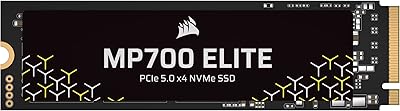
Corsair MP700 Elite 2TB PCIe 5.0 NVMe M.2 SSD
89%
94%
Performance
93%
Speed & Load Times
90%
Thermal Management
88%
Build Quality
85%
Ease of Installation
More
Corsair MP700 Elite 1TB PCIe 5.0 NVMe M.2 SSD
87%
94%
Performance for Gaming
92%
Speed and Data Transfer
88%
Reliability & Durability
91%
Ease of Installation
90%
Load Time Improvement
More
Corsair MP600 PRO NH 2TB PCIe Gen4 x4 NVMe M.2 SSD
88%
94%
Performance for Gaming
92%
Write Speed
94%
Read Speed
88%
Ease of Installation
89%
Compatibility with Desktops
More

FAQ

Yes, you need a motherboard with a PCIe Gen5 x4 M.2 slot — typically found on Intel Z790 or AMD X670 boards and newer. If your board only supports Gen4 or Gen3, the drive will still work, but you will not come close to the advertised 14,000MB/s read speeds. Always check your motherboard specs before buying.

No, it does not. This is one of the most important things to know before purchasing. The MP700 PRO SE runs hot under sustained loads, and without active cooling or at minimum a good aftermarket heatsink over the M.2 slot, thermal throttling will kick in and pull performance down. Many buyers pick up a compatible heatsink separately or rely on their motherboard's built-in M.2 cover if it has active airflow.

Absolutely. It is well-suited as a primary boot drive, and Windows 10 and 11 both support NVMe 2.0 natively. Boot times will be very fast on a compatible Gen5 system, though the difference from a good Gen4 drive on daily boots is incremental rather than dramatic.

It depends on how you define worth it. For raw load times in most current games, a quality Gen4 drive gets you most of the way there. Where this drive starts to pull ahead is with Microsoft DirectStorage — but supported titles are still a relatively short list. If you are building a forward-looking Gen5 rig and plan to game on it for several years, the investment makes more sense than if you just want faster load screens today.

Most laptops do not have PCIe Gen5 M.2 slots, and the ones that do are rare high-end workstation models. Even if the physical slot fits, your laptop likely caps out at Gen4. It is technically backward compatible, but this high-capacity NVMe drive is really designed and optimized for desktop use.

TLC stores three bits per cell versus QLC's four, which generally means better write endurance and more consistent performance over the drive's lifetime. For users who write large amounts of data regularly — video editors, for example — TLC holds up better under sustained pressure than QLC alternatives at similar capacities.

The drive will still function, but it will throttle its performance once it hits thermal limits, which on a Gen5 drive under load can happen faster than you might expect. In a well-ventilated case with airflow passing over the M.2 slot, many users get by without a dedicated heatsink — but for sustained workloads, proper cooling is strongly recommended.

The formatted usable capacity will be slightly less than 4TB, as is standard with all flash storage — manufacturers calculate capacity in decimal gigabytes while operating systems report in binary. You can realistically expect around 3.6 to 3.7TB of accessible space once formatted and installed.

Hardware encryption on this Gen5 SSD is handled at the controller level, which means it adds essentially no performance overhead — unlike software-based encryption which taxes the CPU. Setup typically involves enabling it through the drive's security settings or via your BIOS. For professionals handling sensitive files, it is a genuinely useful feature rather than just a checkbox.

A single drive like this is far simpler to manage — no RAID controller overhead, no risk of array failure if one drive dies, and a cleaner system overall. In terms of raw sequential throughput, it comfortably outpaces a typical Gen4 RAID-0 pair while being less of a headache to configure and maintain. For most users, consolidating into one fast drive is the better practical choice.

Where to Buy

Grooves-Inc.com
In stock $884.81