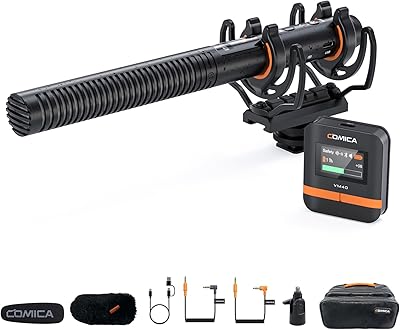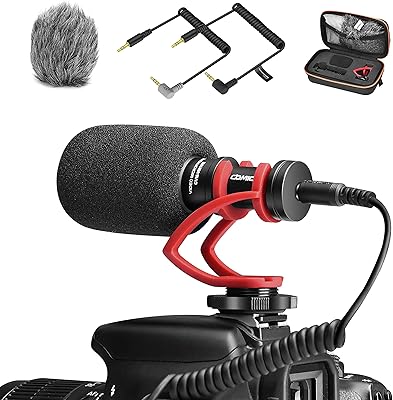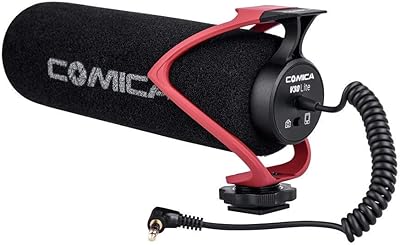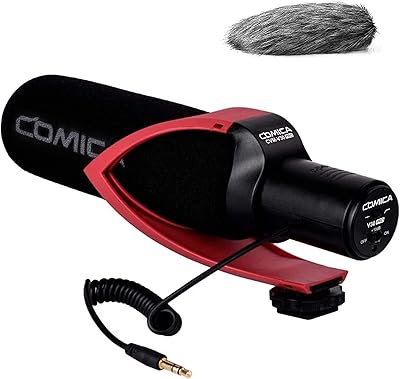

Overview

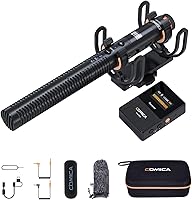
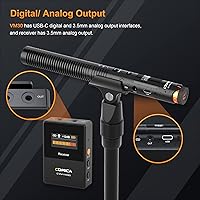
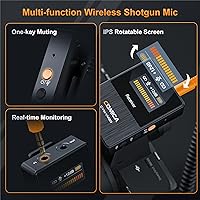
The Comica VM30 is a mid-range wireless shotgun microphone that occupies a genuinely useful middle ground — built sturdier than budget clip-ons, yet priced well below professional broadcast gear. Its full metal body signals that this is a tool made for real-world use, not a plastic shelf piece. What sets it apart from most on-camera mics at this tier is the combination of both wired and wireless modes in a single unit, plus dual output options: analog 3.5mm for cameras and USB-C digital output for smartphones and laptops. That kind of flexibility is rare, and it is the core reason this camera microphone has earned a firm spot in a crowded market.

Features & Benefits

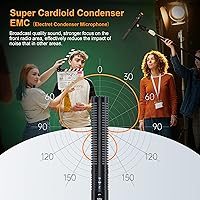
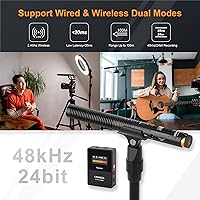
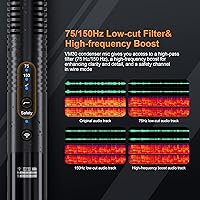
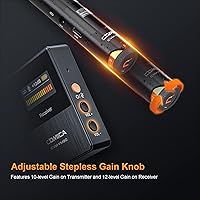
The wireless mode is probably what draws most buyers in first. Operating on the 2.4GHz band, it delivers under 20ms latency and reaches up to 100 meters in open conditions — though real-world range in congested environments will often be shorter. The supercardioid pickup pattern at 48kHz/24bit keeps focus tight on whatever is in front of the mic, which makes a noticeable difference when recording outdoors or in untreated rooms. Two low-cut filter options at 75Hz and 150Hz help tame rumble and wind noise, while the 12-level gain control means you are not stuck fighting a camera preamp to get clean audio.

Best For

This wireless shotgun mic makes the most sense for solo video creators who need one tool to cover multiple recording scenarios. A YouTuber shooting at a desk can plug in via USB-C for clean digital audio on a laptop, then take the same mic out on a camera using the 3.5mm output. Journalists and documentary shooters will appreciate not needing a separate transmitter pack — the transmitter is built directly into the mic body. Android smartphone users get a real benefit from the digital output, which bypasses the analog noise floor entirely. It is also a logical step up for anyone still relying on a basic hot-shoe mic.

User Feedback

Buyers generally come away impressed with the build quality and the convenience of switching between wired and wireless without swapping gear. The USB-C digital connection draws particular praise from smartphone and laptop users who report noticeably cleaner results than analog alternatives. The main recurring criticism is battery life in wireless mode — seven hours is workable for short shoots but falls short on a long event day. A handful of users also note occasional dropout in 2.4GHz-congested spaces like trade shows. A few mention that dialing in gain staging and filters takes some experimentation upfront. Overall, this camera microphone earns broadly positive marks with honest, predictable limitations.

Pros

  • Wired and wireless recording modes built into one unit — no need to buy separate gear.
  • USB-C digital output delivers cleaner audio on Android phones and laptops by bypassing analog conversion.
  • Full metal build handles real-world travel and on-location shooting without feeling fragile.
  • Supercardioid pickup pattern keeps focus tight and cuts room noise in untreated spaces.
  • 12-level gain control reduces dependence on camera preamps, which is useful with noisier bodies.
  • Two low-cut filter options give practical flexibility for both indoor and outdoor shooting conditions.
  • 50-hour wired battery life means weeks of typical use between charges.
  • Sub-20ms wireless latency keeps audio and video in sync without manual offsetting in post.
  • Includes both TRS and TRRS cables plus windscreen and wind muff straight out of the box.
  • Ranked in the top 50 of its category, with a 4.3-star average across a meaningful number of verified buyers.

Cons

  • Seven hours of wireless battery life is a hard ceiling that creates real problems on full-day shoots.
  • Wireless range claims are best-case figures; crowded 2.4GHz environments can cause noticeable dropouts.
  • Gain staging and filter settings have a learning curve that first-time mic users will need to work through.
  • At 1.37 pounds, the combined weight can feel top-heavy on compact mirrorless camera bodies.
  • The mic clip included in the box feels less durable than the microphone itself.
  • No visual gain readout means finding the right level requires monitoring by ear rather than by sight.
  • The 150Hz low-cut filter softens vocal warmth slightly, requiring compensation with the high-frequency boost.
  • In-box documentation does not adequately explain the difference between analog and digital output behavior.

Ratings

Our AI rating system analyzed verified buyer reviews for the Comica VM30 from across global markets, actively filtering out incentivized, bot-generated, and low-quality feedback to surface what real users consistently experience. Scores reflect both the genuine strengths and the honest friction points that show up repeatedly in real-world use. Nothing has been softened — where buyers run into walls, the numbers show it.

Audio Clarity
83%
Most users describe voice capture as noticeably cleaner than what they were getting from built-in camera mics or basic hot-shoe options. The supercardioid pattern does a solid job rejecting off-axis noise, which matters when recording outdoors or in rooms that are not acoustically treated.
At higher gain settings, some users pick up a faint noise floor, particularly in wired mode. It is not a dealbreaker, but buyers expecting broadcast-grade silence in every condition will find the occasional limitation.
Wireless Performance
78%
22%
In open outdoor environments, the 2.4GHz wireless link holds up reliably and the sub-20ms latency is genuinely undetectable in normal video work. Documentary and event shooters praise the freedom of moving without a cable tether while keeping audio in sync.
In environments packed with competing 2.4GHz signals — busy conference halls, trade shows, urban interiors — a handful of users report intermittent dropouts. The claimed 100-meter range is a best-case figure that most real-world settings will not replicate.
Build Quality
91%
The full metal chassis feels substantially more durable than the plastic-bodied competitors sitting in the same price bracket. Users who travel frequently or shoot on location consistently mention that the mic survives bag-tossing and rough handling without any creaking or damage.
The added weight from the metal body is minor but noticeable if mounted on a mirrorless camera for extended handheld shooting. A small number of users also note the metal surface picks up handling noise if touched during a take.
Battery Life
63%
37%
In wired mode, the 50-hour battery life is exceptional and largely a non-issue — you can go weeks between charges depending on usage. Pass-through charging is a practical touch that keeps things running during longer desk recording sessions.
Seven hours in wireless mode is the number that keeps coming up in critical reviews. For a full wedding day, a long documentary shoot, or a day-long conference, that ceiling is genuinely limiting and requires planning around charging breaks.
Connectivity & Compatibility
88%
Having both a 3.5mm analog output and a USB-C digital output in one mic solves a real problem for creators who switch between cameras, Android phones, and laptops. The USB-C path in particular delivers cleaner results on smartphones by bypassing the analog input stage entirely.
Some users initially find the output selection confusing — the analog and digital paths behave differently in terms of gain staging, and there is a learning curve to understanding which cable and setting to use for each device. The included documentation could explain this more clearly.
Noise Rejection
79%
21%
The two low-cut filter settings give useful flexibility. The 75Hz cut handles general rumble and HVAC hum, while the 150Hz option works well for windy outdoor conditions. Users shooting near busy streets or in breezy environments particularly appreciate having both available.
The included windscreen helps but has limits in stronger gusts. A few outdoor shooters note that the 150Hz filter also slightly softens vocal warmth, which requires compensating with the high-frequency boost — a trade-off that takes some trial and error to dial in.
Ease of Use
71%
29%
Pairing the transmitter and receiver is quick once you understand the process, and the automatic on/off feature is a genuinely useful detail that prevents accidental battery drain. Experienced shooters will feel at home almost immediately.
For first-time users unfamiliar with gain staging, the 12-level gain control and dual filter options create a real learning curve. Several reviewers mention spending significant time experimenting before landing on their preferred settings, with limited in-box guidance to help.
Value for Money
81%
19%
At its price point, bundling wireless transmission, dual analog and digital outputs, and a solid metal build into one package represents genuinely strong value. Users upgrading from entry-level mics report a clear, immediate improvement that justifies the cost.
At the higher end of the prosumer price range, buyers with slightly larger budgets may find purpose-built wireless systems with longer battery life and more stable RF performance. The VM30 asks you to accept certain trade-offs in exchange for its all-in-one convenience.
Gain Control
74%
26%
Having 12 discrete gain levels is a practical advantage over mics that rely entirely on the camera body for input level management. Users recording with cameras that have noisy preamps find this especially helpful for keeping the signal clean without heavy post-processing.
The gain adjustment interface is functional but not intuitive — there is no visual readout, and users must rely on audio monitoring to find the right level. A small number of buyers report accidental gain changes when handling the mic during a shoot.
Low Latency
86%
Sub-20ms wireless delay is the kind of figure that translates to real-world usability — lip sync stays accurate in standard video work without any manual offset needed in editing. Live streamers and event videographers consistently highlight this as one of the mic's strongest practical attributes.
While the latency spec is excellent, a few users note that in fringe reception conditions the occasional audio hiccup creates brief sync inconsistencies. This is rare but worth noting for anyone shooting in signal-dense venues.
Polar Pattern Precision
82%
18%
The supercardioid pattern does what it is supposed to — keeps the capture zone tight and reduces the amount of room ambience that bleeds into recordings. For run-and-gun video work in public spaces, this helps deliver cleaner raw audio that needs less noise reduction in post.
The tighter pickup angle means that slightly off-axis subjects can sound noticeably thinner. Interviewers working with two people seated at an angle, for example, may find that one subject consistently sounds less present than the other if positioning is not carefully managed.
Portability
77%
23%
The compact shotgun form factor mounts cleanly onto a camera hot shoe without unbalancing smaller mirrorless bodies significantly. It packs neatly in a camera bag alongside standard gear, and the included accessories fit without needing a dedicated case.
At 1.37 pounds including the receiver, this is not featherweight. Users shooting with ultra-compact cameras or action-oriented rigs report that the combined weight feels top-heavy over extended handheld sessions.
Included Accessories
72%
28%
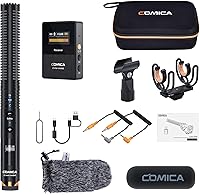
The kit includes both TRS and TRRS cables, a windscreen, a wind muff, and a mic clip — enough to get started without a separate accessory purchase. Covering both cable types out of the box is a considerate touch that most competitors skip.
The wind muff provides only moderate protection in genuinely blustery conditions. A few users also note that the mic clip feels slightly less robust than the mic itself, and some replaced it with a third-party shock mount to reduce handling vibration in the recording.

Suitable for:

The Comica VM30 is a strong match for solo content creators who need one microphone to cover multiple scenarios without buying separate gear for each. A YouTuber who records voiceovers at a desk in the morning and shoots outdoor B-roll in the afternoon will genuinely get value from having both USB-C digital output and wireless capability in a single unit. Android smartphone videographers in particular will notice a real improvement by plugging in digitally rather than routing through a noisy analog headphone jack. Journalists and documentary shooters doing run-and-gun work will appreciate the built-in wireless transmitter — no rigging a separate body pack under a shirt or managing an extra battery. It also makes practical sense for podcasters who occasionally take their setup on location and want one mic that can handle both environments without compromise. Anyone stepping up from a basic on-camera microphone will likely find the jump in audio quality immediate and worth the investment.

Not suitable for:

Buyers planning to run wireless for full-day events should think carefully before committing — the seven-hour wireless battery ceiling is a real operational constraint that the Comica VM30 cannot talk its way around, and if you are covering a ten-hour wedding or a multi-day conference, you will need to plan charging breaks into your schedule. Professional broadcast journalists or film productions with dedicated sound departments will find the audio specs adequate but not at the level of purpose-built dual-channel wireless systems that cost significantly more. Users working frequently in dense urban environments, crowded convention halls, or any space saturated with competing 2.4GHz signals should be cautious — the wireless link can show its limits exactly when reliability matters most. Buyers who want a pure plug-and-play experience with no learning curve may also find the gain staging and filter system more involved than expected, especially if they are coming from a simple plug-in microphone with no controls. Finally, those shooting with ultra-lightweight mirrorless or action cameras may find the combined weight of the mic and receiver noticeably unbalancing for extended handheld work.

Specifications

  • Polar Pattern: Supercardioid directional pickup pattern focused on capturing sound directly in front of the microphone while rejecting off-axis and ambient noise.
  • Frequency Response: Full frequency response spans 20Hz to 20kHz, covering the complete range of human speech and musical content.
  • Digital Output: USB-C digital output delivers 48kHz/24bit audio resolution for use with smartphones, laptops, and other devices with a USB-C port.
  • Analog Output: 3.5mm TRS and TRRS analog outputs allow direct connection to cameras, camcorders, and smartphones with a standard headphone jack.
  • Low-Cut Filters: Two switchable low-cut filter settings at 75Hz and 150Hz reduce low-frequency rumble, wind noise, and handling vibration.
  • High-Freq Boost: A 10kHz high-frequency enhancement function adds presence and clarity to voice recordings without requiring post-processing EQ.
  • Wireless Range: Wireless transmission operates up to a maximum of 100 meters in open, unobstructed conditions on the 2.4GHz band (2400–2483.5MHz).
  • Wireless Latency: Audio latency in wireless mode is rated at under 20ms, which is within the threshold for frame-accurate lip sync in standard video production.
  • Transmit Power: Wireless transmitter output power is rated at +10dBm with a receiving sensitivity of -86dBm.
  • Battery Life: Internal rechargeable lithium polymer batteries provide up to 50 hours in wired mode and up to 7 hours in wireless mode, with pass-through charging supported.
  • Dynamic Range: Dynamic range is rated at 111dB SPL (A-weighted, per IEC651), suitable for capturing both quiet speech and louder sound sources without distortion.
  • Max SPL: Maximum sound pressure level handling is 130dB SPL at 1% THD, allowing the microphone to record loud environments without clipping.
  • Signal-to-Noise: Signal-to-noise ratio is rated at 75dB SPL (A-weighted, per IEC651), indicating clean audio reproduction under typical recording conditions.
  • Equiv. Noise: Equivalent self-noise is 19dB SPL (A-weighted, per IEC651), a respectable figure for a prosumer shotgun microphone at this price tier.
  • Sensitivity: Microphone sensitivity ranges from -38dB to -18dB re 1V/Pa (12mV to 125mV at 94dB SPL) with a tolerance of plus or minus 2dB at 1kHz.
  • Gain Adjustment: A 12-level discrete gain adjustment control allows precise input level management independent of the connected camera or device preamp.
  • Output Impedance: Output impedance is rated at 50 ohms, compatible with standard microphone inputs on cameras and audio interfaces.
  • Body Material: The microphone housing is constructed from full metal material, providing structural durability for field and travel use.
  • Weight: The complete package weighs 1.37 pounds, inclusive of the microphone body and wireless receiver unit.
  • In the Box: Package includes the VM30 microphone and receiver, 3.5mm TRS and TRRS audio cables, a USB-C charging cable, a microphone clip, a foam windscreen, and a wind muff.

Related Reviews
Comica VM40
Comica VM40
83%
88%
Audio Quality
93%
32-Bit Float Recording
82%
Wireless Performance
91%
Onboard Backup Recording
89%
Build Quality
More
Comica VM20
Comica VM20
81%
83%
Audio Clarity
78%
Noise Rejection
88%
Build Quality
81%
Low-Cut Filter Performance
76%
Gain Control
More
Comica CVM-VM10II
Comica CVM-VM10II
83%
92%
Build Quality
88%
Value for Money
79%
Audio Clarity
94%
Portability
84%
Wind Noise Reduction
More
Comica CVM-V30 LITE
Comica CVM-V30 LITE
79%
78%
Audio Clarity
81%
Directional Performance
61%
Build Quality
93%
Ease of Use
84%
Camera & Phone Compatibility
More
Comica VM10 Pro
Comica VM10 Pro
87%
93%
Build Quality
96%
Portability
88%
Digital Audio Performance
91%
Gain Control Functionality
84%
Real-Time Monitoring
More
COMICA CVM-V30 PRO Shotgun Microphone
85%
87%
Sound Quality
89%
Noise Reduction
91%
Ease of Use
68%
Battery Life
85%
Build Quality
More
Comica CVM-WM200A Wireless Lavalier Microphone System
84%
88%
Audio Quality
67%
Battery Life
91%
Setup Ease
85%
Transmission Range
80%
Build Quality
More
COMICA Ejoy Uni PRO(A)
80%
93%
Ease of Setup
78%
Audio Clarity
74%
Noise Cancellation
71%
Wireless Performance
63%
Build Quality
More
Comica CVM-WM100 PLUS
83%
92%
Signal Stability
86%
Audio Quality & Clarity
94%
Post-Production Flexibility
61%
Portability & Form Factor
68%
Power Management & Battery Life
More
Comica EJoy D10 PRO Wireless Gaming Microphone
83%
88%
Sound Quality
94%
Battery Life
83%
RGB Lighting
90%
Connectivity Options
79%
Build Quality
More

FAQ

It depends on the connection you use. The 3.5mm analog output works with older iPhones that have a headphone jack, but for current Lightning or USB-C iPhones, you would need an appropriate adapter. The USB-C digital output is designed specifically for USB-C Android devices and computers, not for Apple Lightning ports. If you are shooting primarily on an iPhone, check compatibility with your specific model before purchasing.

Yes, the VM30 supports pass-through charging, so you can keep it plugged into a power source via USB-C while recording wirelessly. This is helpful for desk setups or any situation where you have access to a power bank or wall outlet during a shoot.

The 3.5mm analog output connects to cameras, camcorders, and devices with a standard mic input — the signal goes through the camera's own preamp, which affects the final sound quality depending on your camera. The USB-C digital output bypasses analog conversion entirely and sends a clean 48kHz/24bit digital signal directly to the connected device, which typically results in lower noise when used with a smartphone or laptop.

Possibly, but with some caveats. The 2.4GHz band is heavily used in environments packed with Wi-Fi routers, wireless cameras, and other devices, and some users do report occasional dropouts in these conditions. For mission-critical indoor event recording, it is worth doing a test run in the venue first rather than discovering interference issues mid-shoot.

For most half-day shoots, interviews, or YouTube filming sessions, 7 hours is workable. For full-day events like weddings, conferences, or documentary shoots, it will require a planned charging break. The pass-through charging feature helps, but you will need to manage battery planning more actively than with wired-only mics.

Yes, the 3.5mm TRS output is compatible with the standard microphone inputs found on most Sony, Canon, Nikon, and Fujifilm cameras. Both TRS and TRRS cables are included in the box, so you should be able to connect to your camera without buying additional cables.

The 75Hz filter cuts low-end rumble like air conditioning hum, traffic noise, and floor vibrations while leaving vocal warmth mostly intact — it is a good general-purpose setting for indoor recording. The 150Hz filter is more aggressive and works better for wind noise outdoors, though it does roll off some of the lower warmth in voices, which you may want to compensate for with the built-in high-frequency boost.

Yes, the USB-C digital output connects directly to a laptop or desktop computer and the mic will appear as an audio input device. This makes it usable for recording podcasts, voiceovers, or video calls without needing an external audio interface.

The 100-meter spec is measured in open, unobstructed outdoor conditions. Indoors, with walls, furniture, and competing wireless devices reducing the signal, most users find reliable performance up to roughly 20 to 30 meters. Do not plan a shoot around the maximum spec figure — treat it as a ceiling, not a typical working range.

It takes a bit of experimentation, especially if you are not familiar with gain staging. The 12 gain levels have no visual display, so you will need to monitor audio by headphone or check levels on your camera to find the right setting. Most users find a comfortable working setup after a session or two, but the included documentation is minimal, so watching a tutorial video before your first shoot is worth the time.