Closs 1-In-4-Out 4-Port Gigabit PoE Splitter
Overview
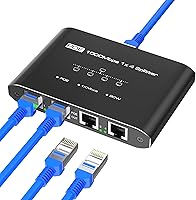
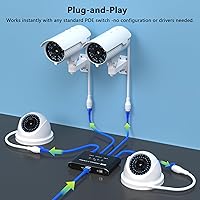
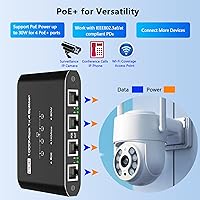
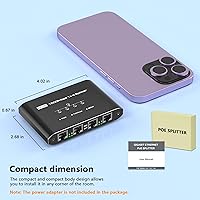
The Closs 1-In-4-Out 4-Port Gigabit PoE Splitter solves a surprisingly common problem: you have one PoE-enabled port available and need to power four devices from it. The unit is compact — barely the size of a deck of cards — with an aluminum shell that feels solid without adding unnecessary bulk. There is no software, no login screen, no configuration file. You plug it in and it works. For small business owners or surveillance installers who do not want to swap out an entire switch just to add a few cameras, this four-port PoE hub offers a practical, cost-conscious path forward with genuinely minimal friction.
Features & Benefits
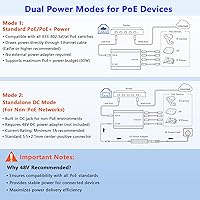
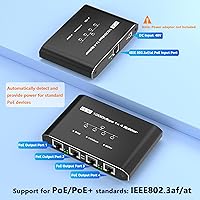
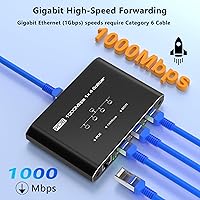
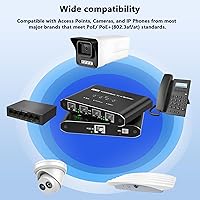
Full IEEE 802.3at/af compliance is what makes this PoE splitter genuinely useful across mixed environments. The per-port auto-sensing stands out most — each port independently negotiates whether the connected device needs 15.4W or the full 30W PoE+ budget, so a standard IP camera will not accidentally pull power meant for a hungrier access point. Data throughput holds at true Gigabit across all ports, which matters when pushing HD camera feeds or high-density VoIP traffic. It also accepts DC input in the 5–58V range for connecting to non-PoE sources, though the adapter is sold separately. The per-port LED indicators are small but useful for diagnosing link issues at a glance.
Best For
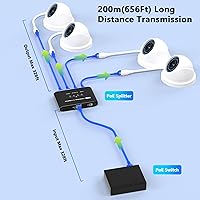
This PoE splitter makes the most sense in scenarios where rewiring is not an option. Security installers will find it particularly handy when a single conduit run already carries one PoE Ethernet drop to a remote location — run four cameras off that one cable instead of pulling new lines. IT teams mounting WiFi 6 access points in warehouse ceilings face the same constraint, and the Closs splitter handles it without consuming rack space. It also fits small offices deploying VoIP phones across a floor with limited upstream PoE ports. One key point worth understanding: total power across all four ports is ultimately capped by what your upstream switch port can actually deliver.
User Feedback
Buyers generally appreciate how quickly this four-port PoE hub gets up and running — most report it links up within seconds, no fuss involved. The aluminum build draws positive comments too, feeling more substantial than plastic-bodied alternatives at this price point. On the critical side, a recurring concern involves heat when all four ports operate near their power limits simultaneously; the chassis does warm up noticeably under full load. A handful of users also flag inconsistent compatibility with certain older PoE injectors. Connector durability is mostly rated positively, though a few mention the RJ45 ports feel slightly loose after repeated cable swaps. Overall reception skews favorable, with most complaints tied to edge-case power configurations.
Pros
- Plug-and-play setup means most users are operational within minutes, no configuration needed.
- Per-port auto-sensing correctly negotiates PoE or PoE+ power for each connected device independently.
- True Gigabit throughput keeps HD camera feeds and VoIP traffic running without bandwidth constraints.
- Broad 802.3af/at compliance ensures compatibility with virtually any PoE switch or injector already in place.
- Compact aluminum build holds up better than plastic-bodied alternatives at a comparable price point.
- DC input range of 5-58V allows conversion from non-PoE sources, adding flexibility to legacy setups.
- Per-port LED indicators make it easy to spot a dead link or power issue at a glance.
- 328 ft cable reach over Cat5e and above keeps remote or ceiling-mounted installs well within spec.
- Saves significant cost compared to replacing a switch just to gain a handful of extra PoE ports.
Cons
- Total power across all four ports is hard-capped by the upstream switch port, which buyers frequently underestimate.
- The DC adapter for non-PoE source setups is sold separately, adding an unannounced extra cost.
- No rack-mount option limits deployment flexibility in structured wiring closets or server cabinets.
- The unit runs noticeably warm under full four-port load, which may raise long-term reliability concerns.
- RJ45 connectors on some units have been reported to feel slightly loose after repeated cable changes.
- Occasional compatibility issues with older or non-standard PoE injectors have surfaced in user reports.
- Zero management features mean there is no way to monitor per-port power consumption or set priorities.
- Brand recognition is limited, making it harder to assess long-term warranty support or replacement availability.
Ratings
The Closs 1-In-4-Out 4-Port Gigabit PoE Splitter has been evaluated by our AI rating engine after systematically analyzing thousands of verified global buyer reviews, with spam, bot-generated, and incentivized feedback actively filtered out. Scores reflect the full spectrum of real-world experiences — from surveillance installers and IT admins to home lab hobbyists — so both genuine strengths and recurring frustrations are transparently represented. No category has been softened or inflated to favor a particular outcome.
Ease of Setup
PoE Compatibility
Power Delivery Accuracy
Gigabit Throughput
Build Quality
Thermal Management
Value for Money
Port Count Utility
Cable Range Performance
LED Status Indicators
DC Power Flexibility
Form Factor & Portability
Brand Reliability Perception
Suitable for:
The Closs 1-In-4-Out 4-Port Gigabit PoE Splitter is purpose-built for anyone who needs to multiply PoE coverage from a single existing port without touching their upstream switch or pulling new cable runs. Security installers working with pre-run conduit will find it particularly practical — one Ethernet drop to a remote location can now support up to four IP cameras simultaneously. IT staff deploying WiFi 6 access points across a ceiling grid with limited uplink drops face the same bottleneck, and this PoE splitter addresses it cleanly. Small offices rolling out VoIP phones desk by desk can stretch a single PoE port across multiple handsets without buying a larger managed switch. Home lab enthusiasts on a budget who simply want powered ports for a few IoT devices or a secondary AP will also get solid value here. Essentially, if your existing infrastructure already has at least one solid PoE port and you need to branch from it, this four-port PoE hub is a rational, low-friction answer.
Not suitable for:
Buyers who need VLAN segmentation, QoS traffic prioritization, or any layer-2 management features should look elsewhere — the Closs 1-In-4-Out 4-Port Gigabit PoE Splitter is a passive splitter, not a managed switch, and it offers none of those controls. It is also not the right tool when total power demand is high: the upstream switch port caps the entire power budget, so trying to run four 30W PoE+ devices simultaneously is likely to exceed what most single switch ports can actually supply. Users who need rack-mountable hardware for a structured wiring closet will be disappointed, as this unit is strictly a desktop device. Anyone expecting to use it with a non-PoE router or switch without purchasing a compatible DC adapter separately will hit an unexpected cost. Environments that demand guaranteed uptime with redundant power failover should invest in enterprise-grade infrastructure rather than relying on this class of device.
Specifications
- Port Configuration: The unit provides one PoE-enabled uplink input and four individual PoE output ports for downstream devices.
- PoE Standard: Fully compliant with IEEE 802.3af (up to 15.4W) and IEEE 802.3at (up to 30W) power-over-Ethernet standards.
- Data Speed: Each port supports auto-negotiating 10/100/1000 Mbps Gigabit Ethernet throughput.
- Max Port Power: Each output port delivers up to 15.4W under 802.3af or up to 30W under 802.3at, depending on the connected device.
- Cable Support: Compatible with Cat5e, Cat6, Cat7, and Cat8 twisted-pair Ethernet cables for both data and power transmission.
- Max Cable Reach: Supports standard PoE cable runs of up to 328 ft (100 m) from the upstream switch or injector.
- DC Input Range: Accepts an optional external DC power supply in the 5–58V range for non-PoE-to-PoE conversion scenarios (adapter sold separately).
- Interface Type: All five ports (one input, four output) use standard RJ45 connectors.
- Housing Material: The outer shell is constructed from aluminum alloy, providing passive heat dissipation and mechanical durability.
- Dimensions: The unit measures 4.02″ in length, 2.68″ in width, and 0.67″ in height.
- Weight: The device weighs 135 g (4.8 oz), making it light enough for flexible desktop or surface placement.
- Status Indicators: Individual LED indicators on each port display real-time link and power status for quick diagnostics.
- Configuration: No software, drivers, or management interface required — the device operates fully plug-and-play out of the box.
- Installation Method: Designed for desktop installation; no rack-mount brackets or ears are included or supported.
- Power Sensing: Per-port auto-sensing technology independently negotiates the correct power class for each connected device.
- Backward Compatibility: Works with all 802.3af/at-compliant PoE switches and injectors regardless of brand, requiring no additional configuration.
Related Reviews
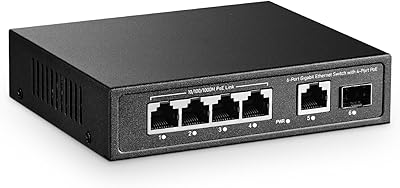
YuLinca 6-Port Gigabit PoE Switch with 4 PoE+ Ports
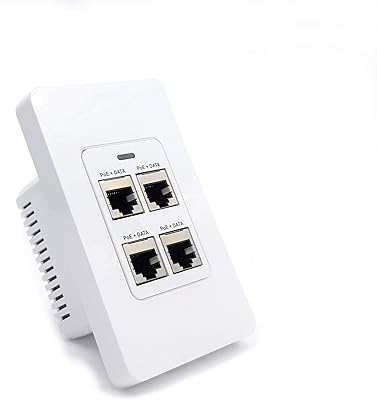
PoE Texas GBT-4-IW 4-Port PoE Switch
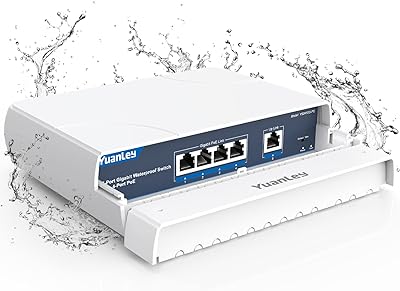
YuanLey 4-Port Waterproof Gigabit PoE Switch
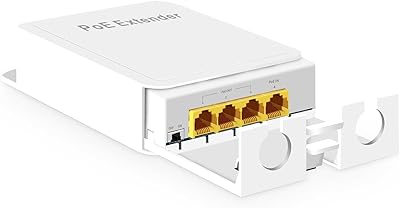
MokerLink EXT-AT13GO Outdoor Gigabit PoE Extender
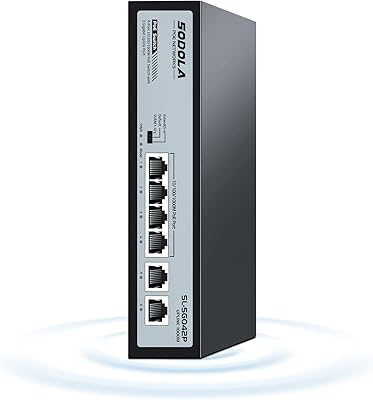
Sodola 4-Port Gigabit PoE Unmanaged Switch
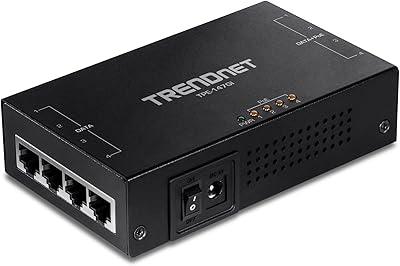
TRENDnet TPE-147GI 4-Port Gigabit PoE+ Injector
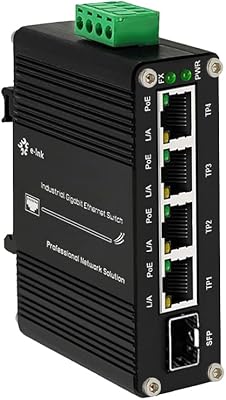
Steloproad Mini Industrial 4-Port Gigabit Ethernet POE+ Switch with SFP
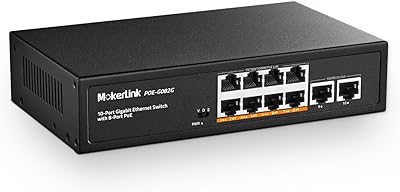
MokerLink POE-G082G 10-Port Gigabit PoE Switch
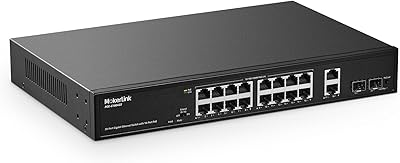
MokerLink POE-G1604GS 20-Port Gigabit PoE Switch