Overview

The Celestron SkyMaster 25x100 Binoculars sit at a genuinely interesting intersection: affordable enough for an enthusiastic beginner, yet capable enough to satisfy an intermediate observer. Celestron has been making optics since 1960, and that long track record carries real weight — this is not a brand that slaps a label on someone else's glass. That said, the first thing a prospective buyer must accept is that these giant binoculars are not handheld instruments. At 8.6 pounds and 25x magnification, any tremor becomes a blur. Owning them properly means owning a stable tripod too, and that cost should be factored in from day one.
Features & Benefits

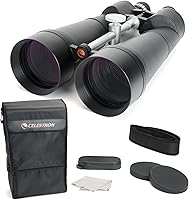
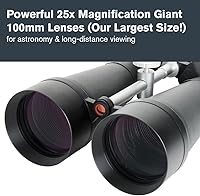
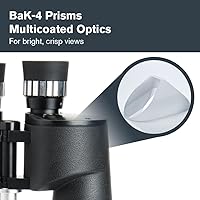
The 100mm objective lenses are the core reason to consider this instrument. At night, that aperture gathers enough light to resolve individual stars in globular clusters, trace the Milky Way's structure, and reveal lunar detail that smaller binoculars simply cannot show. The 25x magnification is powerful but unforgiving of any wobble, which is why a heavy-duty tripod is genuinely non-negotiable. BaK-4 prisms and multi-coated glass keep images bright and contrasty even around twilight. A built-in 1/4-inch-20 adapter connects cleanly to most photo tripods with no extra hardware. Folding eyecups and 15mm of eye relief make long observing sessions manageable, even for those who wear glasses.

Best For

The SkyMaster 25x100 makes the most sense for amateur astronomers who want serious aperture without committing to a full telescope setup. If you already own a solid photo tripod, you are most of the way there. Rural observers with access to dark sky locations will get the most out of the large lenses — light pollution significantly limits what 100mm of aperture can pull in. Beyond astronomy, these giant binoculars work well for stationary nature watching: birdwatchers in a hide, coastal spotters tracking ships, or anyone scanning wide landscapes from a fixed position. They are not suited to handheld use, hiking, or situations that demand quick movement.

User Feedback

Owners of this astronomy bino consistently praise image brightness on the Moon and star clusters as a genuine highlight, particularly given the price tier. The collimation issue is the elephant in the room, though — a notable share of buyers receive units with misaligned optics that produce a frustrating double image. Some can be adjusted at home; others need to be returned. On the more positive side, the carrying case and tripod adapter earn consistent appreciation as genuinely useful inclusions rather than filler. A smaller but recurring complaint involves chromatic aberration on high-contrast daytime targets — color fringing on bright edges is visible, though it rarely matters during nighttime astronomy.

Pros

  • The 100mm aperture gathers far more light than standard binoculars, revealing faint star clusters and lunar detail with genuine clarity.
  • BaK-4 prisms and multi-coated lenses keep images bright and contrasty even during low-light twilight sessions.
  • A built-in 1/4-inch-20 adapter connects to most standard photo tripods quickly and without extra hardware.
  • The rubber-armored, water-resistant housing holds up well to outdoor nighttime conditions and accidental knocks.
  • Folding eyecups and 15mm of eye relief make these reasonably comfortable for eyeglass wearers during extended sessions.
  • The included carrying case is a genuinely useful accessory, not a throwaway afterthought — it fits well and protects properly.
  • Celestron backs the product with a Limited Lifetime Warranty and US-based technical support, which adds real peace of mind.
  • For observers in dark-sky locations, the wide, immersive binocular view of the Milky Way is something a narrow telescope eyepiece cannot replicate.

Cons

  • A significant number of units arrive with misaligned optics, requiring collimation work or a return before the binoculars are usable.
  • The mandatory tripod is not included, and a model sturdy enough to handle 8.6 pounds adds meaningfully to the total cost.
  • Chromatic aberration — color fringing on bright, high-contrast edges — is noticeable during daytime terrestrial use.
  • Light pollution severely limits performance; buyers in urban or suburban areas will not see most of the targets these were designed for.
  • Edge-of-field sharpness falls off noticeably, which bothers observers who expect consistent clarity across the full image circle.
  • The close focus distance of nearly 148 feet makes these useless for anything nearby, limiting their versatility.
  • High-elevation or near-zenith viewing on a standard photo tripod is physically awkward and uncomfortable over a full observing session.
  • Replacement units after a return are not guaranteed to be better-collimated than the original, which frustrates buyers hoping for a quick resolution.

Ratings

The scores below for the Celestron SkyMaster 25x100 Binoculars were generated by AI after analyzing thousands of verified owner reviews worldwide, with spam, bot-submitted, and incentivized feedback actively filtered out. The result is an honest, balanced snapshot that captures both what these giant binoculars genuinely excel at and where real buyers have run into frustration. Strengths and pain points are weighted equally so you get the full picture before committing.
Optical Brightness
88%
The 100mm lenses are the headline act, and owners consistently report that light-gathering performance lives up to the promise. On clear nights, star clusters resolve into individual pinpoints and the Moon reveals crater detail that feels almost telescopic. For the price tier, this level of brightness is genuinely hard to match.
Brightness alone does not guarantee a perfect view. A small but vocal group of buyers report that poorly collimated units undermine the optical potential entirely, turning what should be a crisp image into a frustrating double or blurred mess that requires adjustment or return.
Image Sharpness & Clarity
79%
21%
When properly aligned, the SkyMaster 25x100 delivers sharp, detailed views at the center of the field. Deep-sky targets like the Orion Nebula or the Pleiades cluster show noticeably more structure than observers are used to seeing through smaller binoculars, which is a meaningful reward for the setup effort.
Edge sharpness drops off more than some buyers expect, with softness becoming visible toward the outer third of the field of view. This is a known characteristic of large Porro-prism binoculars at this price point, but it can still disappoint observers who assumed center sharpness extended across the whole image.
Optical Alignment Out of Box
53%
47%
When units arrive correctly collimated, the experience is excellent and owners report zero issues with eye strain or double imaging across extended observing sessions. A well-aligned pair straight from the box makes setup straightforward and builds immediate confidence in the purchase.
Collimation inconsistency is the single most-discussed flaw across owner reviews. A significant portion of buyers receive units that are visibly misaligned, producing double images that cause eye fatigue within minutes. Some can self-correct with patience; others face the hassle of returns, and replacement units are not guaranteed to arrive any better.
Chromatic Aberration
67%
33%
During nighttime astronomy, which is the primary use case, chromatic aberration is largely a non-issue. Stars remain tight and color fringing rarely distracts from the experience, meaning the core audience gets clean-enough views for what they actually bought these for.
Switch to daytime terrestrial targets and color fringing around high-contrast edges becomes clearly visible — tree branches against a bright sky, distant boat rigging, or birds in direct sunlight will all show a purple or green halo. It is minor enough to accept for astronomy use but annoying for dedicated daytime spotting.
Build Quality & Durability
82%
18%
The rubber-armored body feels reassuringly solid, not hollow or cheap. Owners who use these outdoors regularly report that the housing holds up well to bumps, moisture, and the general roughness of nighttime field sessions where you are not always handling gear with perfect care.
At this price point, a few buyers note that the focuser feels slightly stiff or gritty compared to higher-end optics, and the mechanical action does not inspire the same confidence as the optical performance does. Nothing that breaks, but a small reminder that corners were cut somewhere.
Tripod Compatibility & Mounting
84%
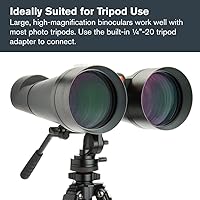
The built-in 1/4-inch-20 adapter works cleanly with the vast majority of standard photo tripods, and owners appreciate not needing an additional bracket or adapter plate. Mounting takes under a minute once you have a tripod ready, which makes getting set up at a dark-sky site genuinely quick.
The operative phrase is heavy-duty tripod. Users who pair these with lightweight travel tripods quickly discover that 8.6 pounds of binoculars demand a stable platform or every slight breeze produces an unusable image. Buyers who assumed their existing flimsy tripod would work have been consistently disappointed.
Comfort & Ergonomics
71%
29%
The folding eyecups work reliably and the 15mm of eye relief is workable for eyeglass wearers during shorter sessions. Diopter adjustment is smooth and holds its setting well, so once you have dialed the focus in for your eyes, it stays put across an evening.
Extended sessions reveal the ergonomic limits. Because these must be tripod-mounted, your neck and back posture depend entirely on the tripod head angle and height, which is not always comfortable for zenith or high-elevation viewing. There is no way around the fact that looking near-straight up through big binoculars on a tripod is physically awkward.
Value for Money
83%
Comparable aperture in a dedicated telescope would cost considerably more, and these giant binoculars offer a genuinely wide, immersive view that many observers find more enjoyable than a narrow eyepiece. For buyers who go in with the right expectations, the cost-to-performance ratio is hard to argue with.
The sticker price does not include the tripod, and a tripod capable of handling 8.6 pounds without wobble is not cheap. The true all-in cost is meaningfully higher than the binoculars alone, and first-time buyers who overlook this sometimes feel misled when they realize a proper mount is effectively mandatory.
Low-Light Performance
86%
Twilight and pre-dawn observing are where the SkyMaster 25x100 earns consistent praise. The large objective diameter pulls in enough light to make targets visible that smaller instruments lose in the murk around dusk, and comet hunters in particular have noted its usefulness in marginal sky conditions.
Light pollution significantly cuts into the advantage that 100mm of aperture provides. Urban and suburban buyers frequently report that their night skies wash out most of the faint objects these lenses are designed to reveal, leaving them with bright but largely featureless views that undersell the instrument's actual capability.
Accessories & Packaging
77%
23%
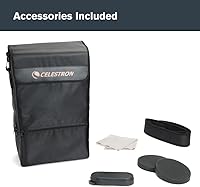
The included carrying case is consistently called out as a genuine quality inclusion rather than a token gesture — it actually fits the binoculars well and provides reasonable protection for storage and transport. The tripod adapter being pre-installed rather than loose in a bag is a small but appreciated detail.
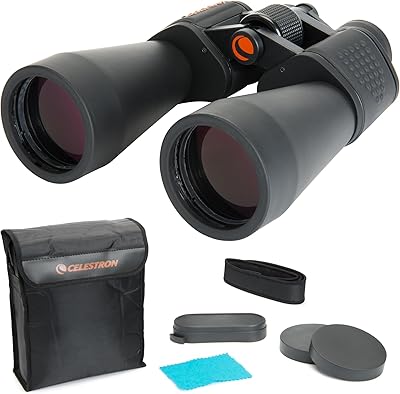
Lens caps, while present, draw some complaints about fit — a few owners report they pop off too easily during handling or transport. A neck strap is included but largely impractical given the weight, and buyers should not expect it to serve any real purpose beyond cosmetic completeness.
Daytime Terrestrial Performance
69%
31%
For stationary daytime use — scanning a harbor, watching wildlife from a fixed blind, or observing sporting events from a distance — the magnification and aperture combination produces impressively detailed images. Distant subjects that would be tiny specks through 8x or 10x binoculars become properly identifiable.
The close focus distance of nearly 148 feet makes these useless for anything nearby, and the chromatic aberration that is forgivable at night becomes more apparent on bright daytime subjects. Combined with the mandatory tripod, spontaneous daytime use is simply not practical.
Ease of Setup
74%
26%
Once you have a suitable tripod, physical setup is genuinely straightforward. The adapter threads in quickly, balance is predictable given the size, and the controls are simple enough that there is very little learning curve for someone who has used binoculars before.
The setup process is still multi-step compared to just picking up a pair of standard binoculars. Carrying the instrument, assembling the tripod, attaching and balancing the binoculars, then adjusting diopter and focus adds up to five or ten minutes before you are actually observing — not a deal-breaker, but worth knowing.
Warranty & Brand Support
81%
19%
Celestron's Limited Lifetime Warranty is a meaningful differentiator and owners who have needed to use it generally report a positive experience with the US-based support team. Knowing a brand with 60-plus years in the optics market stands behind the product adds genuine peace of mind.
Warranty coverage does not make the collimation lottery less frustrating in the short term — shipping a heavy instrument back and forth takes time and effort. A handful of reviewers also note that warranty service response times can vary, which matters when you are waiting to get back out under the stars.

Suitable for:

The Celestron SkyMaster 25x100 Binoculars are built for a specific kind of observer, and when they land in the right hands, the match is excellent. Amateur astronomers who want to explore the night sky with more aperture than a typical handheld instrument can deliver — but are not yet ready to commit to a full telescope setup — will find these a compelling entry point into high-aperture observation. Rural observers with access to genuinely dark skies stand to gain the most, since the 100mm lenses can pull in faint nebulae, star clusters, and even hints of galaxy structure that smaller binoculars simply cannot touch. Stationary daytime users also fit naturally into this category: birdwatchers observing from a fixed hide, coastal spotters tracking distant boats, or anyone scanning a wide landscape from a tripod-mounted position. Critically, buyers who already own a heavy-duty photo tripod are well-positioned to get up and running without a significant additional outlay, making the total cost of ownership considerably more palatable.
Not suitable for:

Anyone expecting to pick these up and use them handheld will be disappointed almost immediately — at 8.6 pounds and 25x magnification, the image shakes uncontrollably without a solid, heavy-duty tripod beneath them, and that tripod is not included. Urban and suburban buyers should also think carefully before purchasing, because light pollution substantially reduces what 100mm of aperture can actually reveal; the faint deep-sky objects these lenses are designed to show simply wash out under a bright sky. The Celestron SkyMaster 25x100 Binoculars are not suited for travel, hiking, casual outdoor use, or any scenario that requires quick, spontaneous viewing — the setup process alone takes several minutes. Buyers who need to observe targets closer than roughly 148 feet will find the minimum focus distance a hard limitation. Those who want clean, fringe-free daytime optics should also look elsewhere, as chromatic aberration on bright high-contrast subjects is a known characteristic of this instrument.
Specifications

  • Objective Diameter: Each objective lens measures 100mm, providing exceptional light-gathering capability for low-light and nighttime observation.
  • Magnification: The fixed magnification is 25x, bringing distant targets significantly closer while requiring a stable tripod to maintain a usable image.
  • Prism Type: BaK-4 Porro prisms are used, a high-density glass formulation that maximizes light throughput and minimizes internal reflection loss.
  • Lens Coating: Optics are multi-coated to reduce glare and surface reflections, improving contrast and image brightness across the full field of view.
  • Field of View: The angular field of view is 3.0 degrees, translating to 156 feet of observable width at a distance of 1,000 yards.
  • Eye Relief: Eye relief measures 15mm, which is sufficient for most eyeglass wearers to see the full field without removing their glasses.
  • Eyecup Style: Folding rubber eyecups are fitted as standard, allowing eyeglass wearers to fold them down and non-eyeglass users to fold them up for a comfortable fit.
  • Diopter Range: The diopter adjustment range spans -5 to +5, allowing fine-tuning to compensate for differences in vision between the observer's two eyes.
  • Close Focus: The minimum focus distance is 147.6 feet, meaning the binoculars cannot focus on subjects closer than approximately 49 meters.
  • Tripod Adapter: A 1/4-inch-20 threaded tripod adapter is built directly into the binocular body, compatible with the standard mount found on most photo tripods.
  • Housing Material: The exterior is rubber-armored over a hard inner chassis, providing impact resistance and a secure grip surface in wet or cold conditions.
  • Weather Resistance: The housing is water-resistant, offering protection against rain splashes and moisture encountered during outdoor nighttime sessions, though it is not fully waterproof.
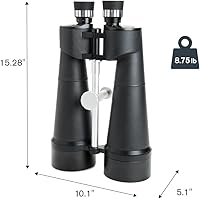
  • Weight: The binoculars weigh 8.6 pounds without a tripod, requiring a heavy-duty mount rated well above this figure for vibration-free viewing.
  • Dimensions: Physical dimensions are 10.1 x 5.1 x 15.28 inches, making this a large instrument that requires dedicated storage space and a proper carrying solution.
  • Included Accessories: The package includes a fitted carrying case and a tripod adapter; no tripod, no eyepiece filters, and no smartphone adapter are included.
  • Warranty: Celestron provides a Limited Lifetime Warranty for US buyers, supported by a US-based technical support team for troubleshooting and service queries.
  • Model Number: The official model number is 71017, which should be referenced when contacting Celestron support or searching for compatible accessories.
  • Country of Brand: Celestron is headquartered in Torrance, California, and has been producing optical instruments since 1960.

Related Reviews
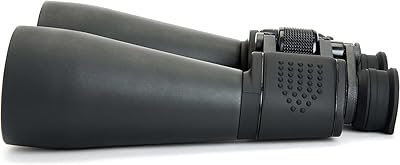
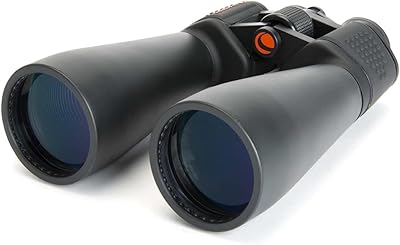
Celestron SkyMaster 25x70 Binoculars
75%
84%
Optical Clarity
91%
Light Gathering
79%
Magnification Performance
72%
Build Quality
58%
Collimation Consistency
More
Celestron SkyMaster 15x70 Astronomy Binoculars
83%
92%
Optical Performance
88%
Build Quality
91%
Value for Money
78%
Ease of Use
75%
Weight & Portability
More
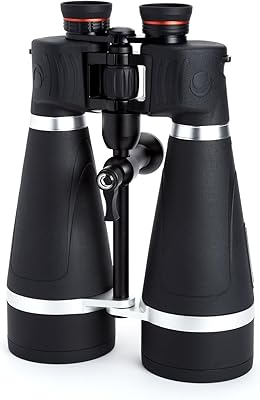
Celestron SkyMaster Pro 20x80 Binocular
83%
91%
Optical Performance
89%
Build Quality & Durability
75%
Ease of Use
94%
Magnification & Clarity
85%
Waterproof & Weather Resistance
More
Celestron SkyMaster 12x60
87%
95%
Optical Clarity
92%
Low-Light Performance
90%
Magnification Accuracy
88%
Build Quality
87%
Durability
More
Celestron TrailSeeker 8x42 Binoculars
82%
91%
Optical Clarity
93%
Field of View
88%
Build Quality
74%
Focusing Mechanism
78%
Eyecup Comfort & Usability
More
Celestron Cometron 7x50 Binoculars
81%
73%
Optical Clarity
84%
Light Gathering
89%
Field of View
71%
Build Quality
91%
Value for Money
More
Celestron Outland X 8x42 Binoculars
82%
88%
Optical Clarity
83%
Low-Light Performance
91%
Field of View
86%
Build Quality
89%
Weather Resistance
More
Celestron Nature DX 10x42 Binoculars
82%
86%
Optical Clarity
83%
Build Quality
89%
Weather Resistance
91%
Value for Money
88%
Ease of Focus
More
Celestron Nature DX 8x32 Binoculars
80%
83%
Optical Clarity
81%
Build Quality
86%
Weather Resistance
88%
Field of View
67%
Low-Light Performance
More
Celestron Outland X 10x42 Binoculars
81%
88%
Optical Clarity
91%
Build Quality & Durability
93%
Weatherproofing
89%
Value for Money
61%
Eye Relief & Eyeglass Compatibility
More

FAQ

You really do need a tripod — this is not a matter of preference. At 25x magnification and 8.6 pounds, even a steady hand produces an image that shakes too much to be useful. A heavy-duty photo tripod rated for at least 10 to 15 pounds is the practical minimum, and a fluid head makes tracking objects considerably easier.

A sturdy photo tripod with a 1/4-inch-20 threaded head connects directly to the built-in adapter without any extra bracket. The key word is sturdy — a lightweight travel tripod will wobble constantly. Look for something with thick aluminum or carbon fiber legs and a rated load capacity comfortably above 10 pounds. A pan-tilt head or fluid video head gives you smooth movement when tracking objects across the sky.

They can be a great entry point, provided you go in with realistic expectations. You will need to learn how to polar-align a view, navigate the night sky to find targets, and deal with the setup process each session. If you are brand new to astronomy, spending some time learning basic star-hopping first will make the experience far more rewarding than pointing these at a random patch of sky and hoping for the best.

Collimation issues are more common with these than you would hope — a meaningful percentage of buyers do receive units that show a double image or noticeable misalignment. If this happens, first check Celestron's support resources, as some users are able to make minor adjustments at home using the collimation screws. If the misalignment is severe, contacting Celestron directly under the warranty is the right path; just be aware that the return and replacement process takes time.

Yes, with some caveats. The magnification and aperture produce impressive detail on distant subjects, making them genuinely useful from a fixed hide or a vehicle window. The main limitations are the close focus distance of nearly 148 feet — anything nearer simply will not focus — and some chromatic aberration (color fringing) that becomes noticeable on bright, high-contrast targets like birds against a bright sky. For stationary daytime use at distance, they perform well enough.

Under a dark sky, quite a lot. Globular clusters like M13 resolve into a ball of individual stars rather than a fuzzy patch. Open clusters are stunning. The Orion Nebula shows real structure and texture. You can pick up several Messier galaxies as faint smudges, trace the arms of the Milky Way, and observe lunar surface detail in extraordinary depth. In a light-polluted suburban sky, however, faint nebulae and galaxies largely wash out, and you are mostly limited to the Moon, planets, and bright clusters.

At 15mm, it is workable for most eyeglass wearers. Fold the eyecups down so your glasses sit as close to the lens as possible, and you should be able to see the majority of the field of view without significant vignetting. That said, observers with particularly strong prescriptions or unusual facial geometry may still see some image cutoff at the edges. It is worth trying the setup before committing to a long session.

Use the included lens caps every time, and store the binoculars in the provided carrying case in a dry environment. If moisture gets on the glass, let it evaporate naturally before capping — trapping moisture under a cap can encourage fungal growth over time. For cleaning, use a soft brush to remove dust first, then a proper lens cloth or optical tissue with a drop of lens cleaning fluid. Never use paper towels, tissues, or your shirt, as these scratch multi-coated surfaces.

There is no dedicated camera or smartphone adapter included, and the eyepiece design is not specifically optimized for digiscoping. That said, some users do achieve basic afocal photography by holding a phone camera up to the eyepiece by hand or with a universal digiscoping clamp. Results vary considerably and depend heavily on your phone's camera. For serious astrophotography, dedicated telescope setups are a better foundation.

The water-resistant rating covers splashes and light rain — the kind of moisture you encounter when a brief shower passes through during an observing session. It is not the same as waterproof, so you should not submerge them or use them continuously in a downpour. If rain picks up seriously, putting them back in the case is the sensible move. The rubber-armored housing does add a practical layer of protection against accidental drops and general outdoor roughness.