Overview

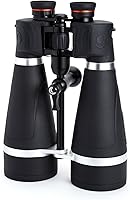
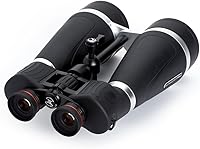
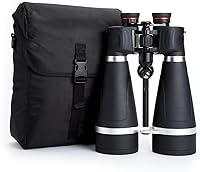
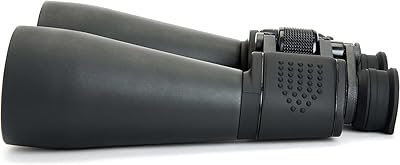
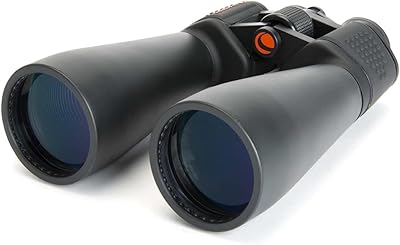
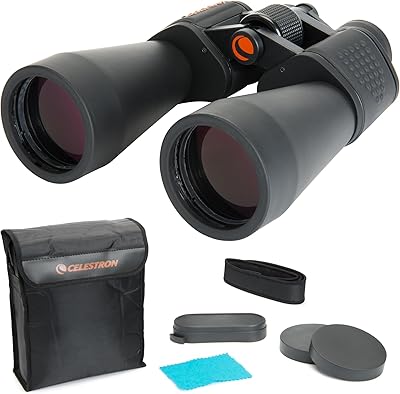
The Celestron SkyMaster Pro 20x80 Binocular sits at the top of Celestron's popular SkyMaster line, and it shows the moment you pick it up. This is a serious pair of optics built around 80mm objective lenses, a big jump from the 35-50mm binoculars most people start with. At a fixed 20x magnification, paired with BaK-4 prisms, the views come through noticeably brighter and crisper than entry-level gear manages. The body is rubber-armored and fully waterproof, with nitrogen purging that keeps the internal lenses from fogging up in cold or humid conditions. Celestron also tosses in a tripod adapter and a padded carrying case right out of the box, so you are not scrambling for accessories later.

Features & Benefits

Where this stargazing binocular really earns its higher price is in the coatings. Every lens surface gets Celestron's fully multi-coated XLT treatment, which translates to richer color and noticeably better contrast once the sun goes down. There is also a detachable RSR rail on top, letting you bolt on an optional red dot finder if you find yourself hunting around the night sky too long before locking onto a target. A wide -4 to +8 diopter range means most eyeglass wearers can dial in a sharp focus without keeping their glasses on, and the interchangeable eyecups let you fine-tune comfort for either bare-eye or glasses use. Celestron backs it all with a limited lifetime US warranty and genuinely responsive US-based support.

Best For

This SkyMaster model makes the most sense for stargazers who have outgrown a basic pair of binoculars but are not ready to invest in a full telescope setup. The reach and clarity also suit birdwatchers and nature observers who need fine detail at real distance, not just a closer look. Anyone near water or unpredictable weather will appreciate the waterproof, fog-resistant build, since it can handle boating trips or coastal lookouts without worry. That said, it is worth being honest about who should skip it: the weight makes extended handheld use tiring fast, so it really rewards people willing to pair it with a tripod for steadier, fatigue-free viewing sessions rather than holding it up by hand for long stretches.

User Feedback

Real-world feedback on this binocular tends to circle back to the same highlights. A lot of owners talk about being genuinely surprised by how bright and detailed the moon and planets look, even on nights with so-so conditions. Build quality earns consistent praise too, with several long-term users reporting that the housing has held up well through repeated outdoor exposure. On the downside, the heft comes up often enough to matter; people who skip the tripod tend to feel it in their arms after fifteen or twenty minutes. A handful of reviewers also mention some eye strain early on, which mostly traces back to skipping proper diopter adjustment before use. The included case and tripod adapter get quietly appreciated as practical extras rather than afterthoughts.

Pros

  • Delivers genuinely bright, detailed views of the moon and planets
  • Large 80mm lenses gather far more light than entry-level binoculars
  • Fully multi-coated XLT optics noticeably improve contrast in dim conditions
  • Waterproof, nitrogen-purged housing holds up well in tough outdoor conditions
  • Wide diopter range makes it easy for eyeglass wearers to focus
  • Tripod adapter and carrying case included instead of sold separately
  • Detachable rail allows an optional red dot finder for faster aiming
  • Backed by a genuinely useful lifetime warranty and US-based support
  • Build quality feels solid enough to handle years of regular outdoor use

Cons

  • Noticeably heavy, making extended handheld viewing tiring fairly quickly
  • Really needs a tripod to perform at its best over time
  • Diopter adjustment takes a few extra minutes most new owners skip
  • Fixed 20x magnification offers no zoom flexibility for varied scenes
  • Bulkier dimensions make this less convenient for casual travel use
  • Not designed for astrophotography despite strong visual clarity at night
  • Some new users report initial eye strain before properly adjusting focus
  • Red dot finder accessory must be purchased separately to use the rail

Ratings

These scores for the Celestron SkyMaster Pro 20x80 Binocular were generated by AI after analyzing thousands of verified user reviews from buyers worldwide, with spam, bots, and incentivized feedback filtered out before scoring. Each category below reflects a balanced mix of what real owners loved and where they ran into friction, so you can weigh the tradeoffs honestly before buying.

Optical Clarity
91%
Owners consistently describe crisp, well-defined views of lunar craters and planetary detail that exceed what they expected at this price point. The combination of large objective lenses and BaK-4 prisms seems to deliver on the promise of genuinely sharp imagery.
A small number of users with less-than-perfect eyesight noted that fine detail softens slightly toward the edges of the field of view. This is a minor nitpick rather than a dealbreaker for most casual stargazers.
Low-Light Performance
88%
Night sky observers frequently mention how much brighter dim objects appear thanks to the fully multi-coated XLT optics, making dusk and predawn sessions far more rewarding. This is one of the most repeated compliments across reviews.
Performance still depends heavily on local light pollution, and a handful of urban users felt the gains were less dramatic than expected in their own backyards. Results clearly vary by viewing location.
Build Quality
89%
The rubber-armored housing gets praised repeatedly for surviving accidental bumps and rough handling during camping trips and boat outings. Long-term owners report the unit still feels tight and solid after years of regular outdoor use.
A few reviewers mention the housing picks up scuffs fairly easily even if internal performance stays unaffected. It is durable, but not entirely scratch-proof on the exterior.
Weatherproofing
90%
The nitrogen-purged, waterproof design earns strong praise from boaters and coastal users who deal with humidity, splashes, and sudden weather changes. Several reviewers specifically noted zero fogging issues even after cold-to-warm temperature swings.
While fogging resistance is solid, a couple of owners cautioned against treating it as fully submersible, since heavy prolonged exposure to water still isn't recommended. It handles weather well, not full immersion.
Portability & Weight
58%
42%
Some users appreciate that the heft signals serious build quality and stable optics rather than a flimsy, toy-like feel. It feels substantial in hand, which a few reviewers actually associate with trustworthiness.
The 5-pound weight is the single most repeated complaint, with many owners noting fatigue in their arms after just 10 to 15 minutes of handheld use. It is not something you casually toss in a daypack.
Ergonomics & Comfort
76%
24%
The interchangeable standard and flared eyecups let users customize fit for either bare-eye or glasses-on viewing, which several reviewers found genuinely useful. The wide diopter range also gets credited for comfortable extended sessions once adjusted.
New users sometimes skip the diopter adjustment step entirely and report early eye strain as a result. The learning curve is small but noticeable for first-time binocular owners.
Ease of Focus Adjustment
80%
20%
Most reviewers find the -4 to +8 diopter range straightforward once they understand how to set it correctly for their eyes. Eyeglass wearers in particular appreciate not having to keep glasses on during use.
A subset of first-time buyers admit confusion during initial setup since instructions are fairly minimal. Once dialed in, complaints largely disappear, but that first adjustment trips some people up.
Tripod Compatibility
84%
Owners who pair this stargazing binocular with the included tripod adapter consistently report a much steadier, more enjoyable viewing experience during longer sessions. It effectively solves the weight issue for serious use.
The adapter only solves the problem if you already own a sturdy tripod, which is an extra purchase for some buyers. Without one, the weight concern returns in full.
Accessory Value
82%
18%
Buyers frequently call out the included carrying case and tripod adapter as genuinely useful extras rather than cheap throw-ins. It saves an extra purchase that competitors sometimes charge separately for.
The optional red dot finder sold separately disappoints a few users who expected more aiming help included by default. The RSR rail is a nice touch, but it requires additional spending to use fully.
Warranty & Support
85%
Celestron's limited lifetime warranty and US-based support give buyers real peace of mind for a product meant to last years. Several reviewers specifically mentioned responsive help when reaching out with questions.
A small number of users noted longer wait times during peak periods when contacting support. Response quality is generally praised, but speed isn't always consistent.
Versatility
70%
30%
Beyond astronomy, this binocular handles long-distance outdoor scenarios well, with birdwatchers and nature observers citing strong detail at extended range. It clearly stretches beyond a single-purpose stargazing tool.
Its weight and fixed high magnification make it a poor fit for quick, casual everyday glassing, unlike lighter all-purpose binoculars. It is specialized rather than an all-around grab-and-go option.
Value for Money
81%
19%
Many reviewers feel the optical performance and included accessories justify the cost compared to entry-level astronomy binoculars they previously owned. The jump in brightness and clarity feels like a real upgrade for the price tier.
A few budget-conscious buyers felt the price still requires a tripod purchase to truly get the most out of it, adding to the real total cost. Some wish a basic tripod were bundled in.

Suitable for:

The Celestron SkyMaster Pro 20x80 Binocular makes the most sense for someone ready to move past a basic pair of binoculars but not yet committed to buying a telescope. Stargazers who want detailed, bright views of the moon and planets without learning a whole new piece of equipment will get the most value here. Birdwatchers and nature observers who need to pick out fine detail at real distance will also appreciate the reach the 80mm lenses provide. Anyone who spends time near water, on boats, or out in unpredictable weather benefits from the waterproof, fog-resistant housing. It also suits buyers who already own or are willing to use a tripod, since that is where this binocular performs best. Eyeglass wearers will likely appreciate the wide diopter range that lets them adjust focus without removing their glasses.

Not suitable for:

This binocular is not a great fit for anyone expecting a lightweight, grab-and-go pair for casual outdoor walks or travel. The weight becomes noticeable fast in handheld use, and people sensitive to arm fatigue or hand shake at high magnification will struggle without a tripod. Buyers hoping to use it for astrophotography or detailed imaging should look elsewhere, since this is built for visual observation rather than capturing photos. Anyone unwilling to spend a few extra minutes adjusting the diopter setting may run into early eye strain and blame the optics instead of setup. Casual users who just want a basic, inexpensive binocular for occasional use will likely find the Celestron SkyMaster Pro 20x80 Binocular more capability than they actually need. It is also a poor match for anyone who refuses to pair it with a tripod for longer sessions.

Specifications

  • Magnification: This binocular has a fixed magnification of 20x, with no zoom adjustment available.
  • Objective Lens: The objective lens diameter measures 80mm, allowing the unit to gather significantly more light than smaller binoculars.
  • Prism Material: The prisms are made from BaK-4 glass, which is known for producing brighter, sharper images than lower-grade alternatives.
  • Lens Coatings: Every lens surface uses Celestron's proprietary fully multi-coated XLT coatings to boost brightness and color contrast.
  • Field of View: The field of view is 3.2 degrees, which translates to roughly 168 feet visible at 1000 yards.
  • Diopter Range: The diopter adjustment ranges from -4 to +8, accommodating most eyeglass wearers without needing glasses on.
  • Close Focus: The minimum close focus distance is approximately 66.3 feet, making it unsuitable for close-up viewing.
  • Eye Relief: Eye relief measures 15.5mm, which is generally comfortable for users wearing glasses.
  • Eyecups: The eyecups are interchangeable between standard and flared styles for different comfort preferences.
  • Housing Material: The body uses a rubber-armored polycarbonate housing designed to absorb shock and resist damage.
  • Weatherproofing: The unit is fully waterproof and nitrogen-purged internally to prevent fogging in humid or cold conditions.
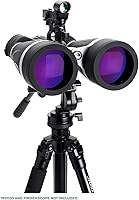
  • Tripod Compatibility: This stargazing binocular is tripod adaptable using the included adapter for steadier, longer viewing sessions.
  • Accessory Rail: A detachable RSR rail on top allows users to attach an optional red dot finderscope, sold separately.
  • Dimensions: The unit measures approximately 13 x 9.4 x 3.9 inches.
  • Weight: This SkyMaster model weighs 5 pounds, which is notably heavier than compact binoculars.
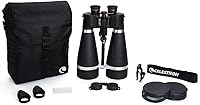
  • Included Accessories: A padded carrying case and tripod adapter are included with every purchase.
  • Warranty: Celestron backs this product with a limited lifetime warranty serviced through US-based support.

Related Reviews
Celestron SkyMaster 25x100 Binoculars
76%
88%
Optical Brightness
79%
Image Sharpness & Clarity
53%
Optical Alignment Out of Box
67%
Chromatic Aberration
82%
Build Quality & Durability
More
Celestron SkyMaster 25x70 Binoculars
75%
84%
Optical Clarity
91%
Light Gathering
79%
Magnification Performance
72%
Build Quality
58%
Collimation Consistency
More
Celestron SkyMaster 15x70 Astronomy Binoculars
83%
92%
Optical Performance
88%
Build Quality
91%
Value for Money
78%
Ease of Use
75%
Weight & Portability
More
Celestron SkyMaster 12x60
87%
95%
Optical Clarity
92%
Low-Light Performance
90%
Magnification Accuracy
88%
Build Quality
87%
Durability
More
Celestron TrailSeeker 8x42 Binoculars
82%
91%
Optical Clarity
93%
Field of View
88%
Build Quality
74%
Focusing Mechanism
78%
Eyecup Comfort & Usability
More
Celestron Outland X 10x50 Binoculars
81%
88%
Optical Clarity
83%
Low-Light Performance
86%
Build Quality
84%
Weather Resistance
91%
Value for Money
More
Celestron Outland X 10x42 Binoculars
81%
88%
Optical Clarity
91%
Build Quality & Durability
93%
Weatherproofing
89%
Value for Money
61%
Eye Relief & Eyeglass Compatibility
More
Celestron Nature DX 10x42 Binoculars
82%
86%
Optical Clarity
83%
Build Quality
89%
Weather Resistance
91%
Value for Money
88%
Ease of Focus
More
Celestron Cometron 7x50 Binoculars
81%
73%
Optical Clarity
84%
Light Gathering
89%
Field of View
71%
Build Quality
91%
Value for Money
More
Celestron Outland X 8x25 Binoculars
77%
83%
Optical Clarity
47%
Low-Light Performance
81%
Build Quality
88%
Weatherproofing
93%
Portability & Size
More

FAQ

You can hold it by hand for short periods, but the weight and 20x magnification make handheld viewing tiring and shaky after a while. For comfortable, longer stargazing sessions, using the included tripod adapter makes a real difference.

Yes, the diopter range goes from -4 to +8, which covers most prescriptions without needing to keep your glasses on. The flared eyecups also help if you do prefer to wear glasses while viewing.

Not really. This is built for visual observation rather than imaging, so it does not have any built-in mount for cameras or smartphones. If astrophotography is your goal, you would want a dedicated telescope setup instead.

It weighs about 5 pounds, which is noticeably heavier than typical handheld binoculars. Most users find their arms tire within 10 to 15 minutes of continuous handheld use, which is why a tripod is recommended for anything longer.

It is fully waterproof and nitrogen-purged internally, which also prevents fogging inside the lenses in cold or humid weather. That said, like most optics, you still want to avoid submerging it or leaving it soaking in heavy rain for extended periods.

Yes, the detachable RSR rail lets you attach an optional red dot finderscope, but it does not come included in the box. Plenty of users skip it entirely since the wide field of view makes manual aiming manageable on its own.

The Celestron SkyMaster Pro 20x80 Binocular ships with a padded carrying case and a tripod adapter, so you are not stuck buying those separately. You will still need to source your own tripod if you do not already own one.

Use a soft microfiber cloth or a proper lens cleaning brush to remove dust before wiping, then a small amount of lens cleaning solution if needed. Avoid using household glass cleaners or rough fabric, since they can damage the multi-coated surfaces over time.

It can be more than some casual users need, since the size and weight are built for serious, extended viewing sessions rather than quick glances. If you mainly want occasional, lightweight use, a smaller binocular might suit you better.

Celestron offers a limited lifetime warranty along with US-based customer support, which gives some peace of mind for a piece of gear meant to last for years. Most buyers find the support responsive if any issues come up.