Overview

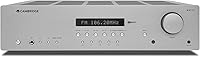
The Cambridge Audio AXR100 sits at the top of Cambridge's AX receiver lineup, and it earns that position with real substance. Cambridge Audio has been building respected hi-fi gear since 1968, and this hi-fi receiver reflects that legacy — a 100-watt per channel output, solid analogue controls, and a chassis that feels built to outlast a trend or two. Bluetooth is on board for wireless streaming, yet the design stays rooted in traditional two-channel audio. One thing worth stating plainly upfront: this is a stereo-only receiver. If Dolby Atmos or surround processing is on your checklist, look elsewhere. For anyone focused purely on music, this Cambridge stereo receiver is a serious contender at its tier.

Features & Benefits

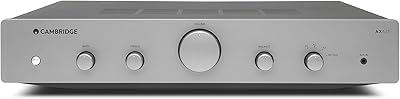
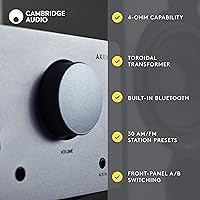
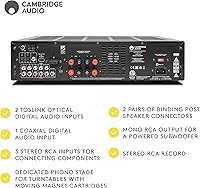
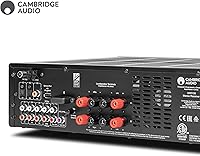
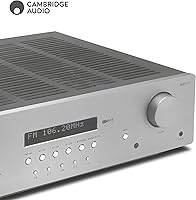
The built-in phono stage is one of the most practical highlights here — plug your turntable straight in without sourcing a separate preamp. Beyond vinyl, the AXR100 handles a wide range of sources: four analogue RCA inputs, optical and coaxial digital connections, a 3.5mm aux jack, and Bluetooth for wireless playback. The AM/FM tuner with RDS and 30 station presets is a welcome addition for anyone who still keeps radio in regular rotation. A dedicated subwoofer output lets you add low-end extension without extra signal routing, and the headphone output keeps late-night sessions private. The included remote control sounds like a small detail until your speakers are across the room.

Best For

This hi-fi receiver makes the most sense for people who are serious about music but want to avoid building a complicated component stack. If you own a turntable and have been running it through a budget preamp — or skipping one entirely — the integrated phono stage alone is a strong practical argument for this Cambridge stereo receiver. It pairs naturally with quality bookshelf or floorstanding speakers in a living room or a generous desktop setup. It is the wrong choice if home theater or surround sound is the goal. But for two-channel listening, whether sourced from vinyl, a phone, or an FM broadcast, this is a focused and capable machine.

User Feedback

Owners of the AXR100 consistently praise its sound clarity and warmth, with many noting it punches above its weight compared to similarly priced rivals like the Yamaha R-N303 or Denon DRA-800H. The physical build draws frequent compliments — the metal chassis and weighted knobs feel genuinely premium for daily handling. Where opinions get more mixed is Bluetooth: range is described as adequate rather than impressive, and a handful of users have flagged occasional dropout issues. The supplied remote is functional but uninspiring. Long-term owners report solid reliability overall, though a small number of early buyers noted slight channel imbalance at very low volumes — a minor caveat worth knowing for detail-focused listeners.

Pros

  • The built-in phono stage lets turntable owners skip a separate preamp entirely, saving money and desk space.
  • 100 watts per channel delivers real headroom for driving demanding speakers in medium to large rooms.
  • Sound quality consistently outperforms similarly priced rivals like the Yamaha R-N303 in pure sonic character.
  • The metal chassis and weighted knobs feel premium and built to last well beyond the warranty period.
  • A broad mix of inputs — RCA, optical, coaxial, 3.5mm — accommodates almost any source combination without adapters.
  • The AM/FM tuner with RDS and 30 presets is a genuinely useful inclusion that most modern receivers have dropped.
  • Long-term owners report strong reliability with very few hardware failures over years of daily use.
  • Setup is fast and intuitive — physical labeling and logical layout mean most users are up and running within minutes.
  • The subwoofer output makes adding a sub to a 2.1 setup straightforward without extra signal routing equipment.
  • Understated grey finish integrates cleanly into both modern and traditional room setups without visual clutter.

Cons

  • Bluetooth range is limited and prone to dropouts through walls or across larger open-plan rooms.
  • No Wi-Fi, AirPlay, or network streaming means the AXR100 cannot participate in multi-room audio setups.
  • The included remote feels noticeably cheap relative to the build quality of the receiver itself.
  • Very low volume levels can exhibit slight channel imbalance, which detail-focused listeners may find irritating.
  • No moving coil cartridge support limits the phono stage for serious vinyl purists with high-end turntables.
  • The top panel scratches and shows fingerprints more readily than the otherwise solid build quality would suggest.
  • Customer service response times have been described as slow by a subset of owners who needed warranty support.
  • Only available in grey, which creates a mismatch for buyers trying to match an all-black component setup.

Ratings

The Cambridge Audio AXR100 scores below are generated by AI after analyzing thousands of verified global user reviews, with spam, bot activity, and incentivized feedback actively filtered out. This hi-fi receiver earns strong marks in several core areas, though a few real-world pain points surfaced consistently enough to pull certain scores down. Both the strengths and the friction points are reflected transparently here.

Sound Quality
92%
Owners repeatedly describe the sound as warm, open, and well-defined — particularly with vinyl sources. At moderate to high volumes, the 100-watt output gives speakers room to breathe without the congestion or thinning that cheaper receivers often exhibit. Many users report it outperforming similarly priced Yamaha and Denon options on pure sonic character.
A small but consistent group of critical listeners notes the soundstage can feel slightly narrow compared to higher-end separates. At very low listening volumes, a few owners detected faint channel imbalance, which is more noticeable in quiet late-night sessions than during normal playback.
Build Quality
89%
The metal chassis and weighted rotary knobs make an immediately positive impression when unboxing. Daily users describe the controls as satisfyingly solid — nothing feels hollow or plasticky. For a receiver in this price tier, the physical construction consistently exceeds buyer expectations set by competitors.
Some buyers noted the top panel picks up fingerprints and light scratches more readily than expected. A handful of owners also flagged that the front panel lettering can wear slightly over months of heavy daily use, which is a minor but recurring cosmetic complaint.
Phono Stage Performance
86%
The integrated phono stage is one of the most praised practical features among vinyl enthusiasts. Users who previously ran separate budget phono preamps report a noticeable improvement in clarity and channel separation after switching to the built-in stage. It handles both moving magnet cartridges reliably across a range of turntable brands.
Serious vinyl purists with high-end turntables and moving coil cartridges may find the built-in stage limiting compared to a dedicated external preamp. A few experienced users describe the phono output as slightly thin in the low midrange when pushed with more demanding cartridges.
Bluetooth Reliability
67%
33%
For typical smartphone streaming from within the same room, Bluetooth performs adequately and connects quickly after initial pairing. Casual users streaming background music from a couch or desk report very few issues during normal daily use, and audio quality over Bluetooth is considered acceptable for non-critical listening.
Bluetooth range is a recurring complaint — walls and modest distances noticeably degrade the connection. Several owners documented dropouts during streaming sessions, particularly with older Android devices. This is one area where the AXR100 trails some competitors, and it is worth considering if wireless streaming is a primary use case.
AM/FM Tuner
78%
22%
The tuner receives consistent praise from users who still incorporate radio into their regular listening habits. RDS display and 30 presets make station management easy, and reception quality in urban areas is described as clean and stable. For a feature that many modern receivers omit entirely, it is a welcome inclusion.
In suburban or rural areas with weaker signals, sensitivity drops off more than some users expected. The lack of a digital or DAB tuner option is noted by European buyers in particular, though this is a market expectation gap rather than a performance flaw.
Connectivity & Inputs
83%
The range of inputs — RCA analogue, optical, coaxial, and 3.5mm — means most users can connect all their sources without a switcher or workaround. Having both digital and analogue options in a single receiver at this price point is genuinely useful for mixed setups combining a TV, turntable, and streaming device simultaneously.
There is no USB audio input or network streaming capability, which some buyers only realize after purchase. Users expecting a more modern digital feature set — Wi-Fi, AirPlay, or multi-room audio — will find this receiver deliberately old-school in its connectivity approach.
Power & Headroom
88%
The 100-watt-per-channel rating translates into real-world headroom that owners of larger rooms genuinely appreciate. Users pairing the receiver with demanding floorstanding speakers report it drives them confidently without audible strain, even at party-level volumes. Compared to the 50-watt AXR85, the jump in dynamics is described as meaningful rather than marginal.
For small desktop setups with efficient bookshelf speakers, the power on offer can be more than needed, and the volume control ends up living in the lower third of its range. This is not a flaw per se, but buyers with modest speaker setups may not extract the full value of the amplifier stage.
Value for Money
74%
26%
Buyers who prioritize pure two-channel audio performance consistently feel the price is justified when stacked against what separates would cost to match it. The phono stage, tuner, Bluetooth, and headphone output bundled together at this price point represent genuine all-in-one value for the target user.
At this price, some buyers expected a more refined Bluetooth implementation and a more capable remote. Compared to network-connected rivals at similar prices — such as the Yamaha R-N602 — the AXR100 can feel underfeatured to buyers who want streaming versatility alongside strong amplification.
Remote Control
58%
42%
The remote covers all primary functions and works reliably within normal room distances. Users appreciate that volume, input selection, and tuner presets are all accessible without getting up, which suits the relaxed listening sessions this receiver is designed around.
The remote feels thin and inexpensive relative to the receiver itself, and this contrast is frequently mentioned in user reviews. IR range is described as adequate but not impressive — pointing it off-axis or from across a larger room produces inconsistent results that several owners found frustrating.
Setup & Ease of Use
91%
Physical knobs and labeled inputs make initial setup intuitive even for buyers who have never owned a separate amplifier before. Most users report having music playing within minutes of unboxing, without needing to consult a manual. The logical layout of inputs on the rear panel is consistently praised.
The manual is considered basic by some buyers who wanted clearer guidance on optimizing the phono stage settings or configuring the subwoofer output crossover. Digital-native buyers occasionally find the entirely analogue control interface less immediate than app-controlled alternatives.
Headphone Performance
76%
24%
For late-night sessions or private listening, the headphone output is a genuinely useful addition. Owners using mid-tier headphones report a clean, full-bodied sound that holds up well for extended listening without fatigue. It is a step above what most budget receivers offer from their headphone stages.
With high-impedance or audiophile-grade headphones, some users notice the output lacks the drive needed to fully control demanding cans. The headphone stage is best treated as a practical convenience rather than a dedicated high-performance output, which may disappoint headphone-focused listeners.
Design & Aesthetics
85%
The understated grey finish and symmetrical front panel fit cleanly into both modern and traditional room setups. Users frequently note that it looks more expensive than its price suggests, and that it does not dominate a shelf or media unit the way bulkier AV receivers tend to do.
Color options are limited to grey, which is a minor frustration for buyers who prefer black components to match existing equipment. The display is functional but minimal — those accustomed to receivers with larger, backlit information screens may find it underwhelming for at-a-glance feedback.
Long-Term Reliability
81%
19%
Multi-year owners describe the AXR100 as dependable in daily use, with very few hardware failures reported in the broader owner community. Cambridge Audio's reputation for longevity in their mid-range products is a frequently cited reason buyers chose this over less established alternatives.
A small number of owners reported relay clicking issues or channel dropout after extended ownership, though these appear to be outlier cases rather than a systemic problem. Warranty support experiences have been mixed, with some users noting slow response times from customer service.

Suitable for:

The Cambridge Audio AXR100 is purpose-built for music lovers who want a single, well-engineered receiver to anchor a proper two-channel system without assembling a shelf full of separate components. It is an especially strong fit for vinyl enthusiasts, since the integrated phono stage means you can plug a turntable straight in and start listening without budgeting for a separate preamp. Buyers upgrading from a soundbar, a cheap shelf system, or a budget receiver in the sub-300 range will notice a meaningful step up in clarity, warmth, and dynamic range. It also suits people who still have FM radio as part of their daily routine alongside casual Bluetooth streaming from a phone or laptop. A living room or bedroom setup with quality passive bookshelf or floorstanding speakers is the natural home for this hi-fi receiver, and its clean, understated aesthetic means it blends into most spaces without demanding attention.

Not suitable for:

Buyers looking for a home theater hub should look elsewhere — the Cambridge Audio AXR100 is a stereo-only receiver, and there is no Dolby, DTS, or surround decoding of any kind. If your primary need is driving a 5.1 or 7.1 speaker system for movies and TV, something like the Denon AVR-X1700H or a similar AV receiver is a more appropriate choice. Network streaming enthusiasts who want built-in Wi-Fi, AirPlay 2, Spotify Connect, or multi-room audio will also find this receiver frustratingly limited — the wireless capability starts and ends with Bluetooth. Headphone-focused listeners who plan to use high-impedance or audiophile-grade headphones as their main output should also temper expectations, as the headphone stage is a convenience feature rather than a dedicated high-performance circuit. Finally, buyers in areas with weak FM signals may find the tuner underwhelming, and anyone who wants app-based control or a color display will find the entirely physical, analogue interface feels deliberately old-fashioned.

Specifications

  • Power Output: Delivers 100 watts per channel into 8 ohms, providing substantial headroom for driving a wide range of passive speakers in small to medium-sized rooms.
  • Frequency Response: Covers 5Hz to 50kHz at -1dB, meaning the amplifier handles the full audible spectrum and well beyond without significant roll-off.
  • Signal-to-Noise Ratio: Rated above 82dB unweighted, which translates to a clean, quiet background during playback with minimal audible hiss at normal listening volumes.
  • Input Impedance: Fixed at 47k ohms across analogue inputs, a standard hi-fi specification that ensures compatibility with the vast majority of consumer and prosumer source components.
  • Subwoofer Output: Provides a dedicated subwoofer output with a 200Hz second-order crossover, with output level that tracks the main volume control automatically.
  • Max Consumption: Peak power draw reaches 550W under full load, so a standard household outlet is sufficient without any special wiring considerations.
  • Analogue Inputs: Includes four RCA stereo analogue inputs for connecting CD players, streamers, cassette decks, or any line-level source.
  • Digital Inputs: Accepts both optical (TOSlink) and coaxial (S/PDIF) digital inputs, enabling direct connection to televisions, disc players, and digital audio converters.
  • Aux Input: A 3.5mm stereo jack on the front or rear panel allows quick connection of portable devices without needing an RCA adapter.
  • Phono Stage: The built-in moving magnet phono stage supports direct turntable connection, eliminating the need for a standalone external preamp for standard cartridge types.
  • Bluetooth: Integrated Bluetooth receiver enables wireless audio streaming from smartphones, tablets, and computers within typical short-range distances.
  • Tuner: Built-in AM/FM tuner supports RDS text display and stores up to 30 station presets for quick access to favorite broadcasts.
  • Headphone Output: A front-panel headphone jack accommodates standard 6.35mm (quarter-inch) plugs for private listening without interrupting the speaker outputs.
  • Remote Control: An infrared remote control is included in the box and requires two AA batteries, covering volume, input selection, and tuner functions.
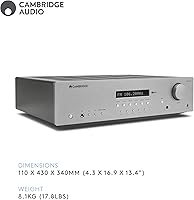
  • Dimensions: The unit measures 13.4 x 16.9 x 4.3 inches (depth x width x height), fitting standard hi-fi shelving and most media furniture.
  • Weight: At 17.82 pounds, the receiver has a solid, substantial feel consistent with its metal chassis construction.
  • Channel Config: Operates exclusively as a two-channel stereo amplifier with no surround sound decoding or multi-channel output capability.
  • Controls: All primary functions are operated via mechanical rotary knobs and push buttons on the front panel, with no touchscreen or app-based interface.
  • Color: Available in a single grey finish with a clean, minimalist front panel aesthetic designed to complement both traditional and contemporary room setups.
  • Batteries Required: Two AA batteries are required for the included remote control and are not included in the box.

Related Reviews
Cambridge Audio CXN100 Network Audio Player
86%
94%
Sound Quality
88%
Multiroom Compatibility
85%
Ease of Use
90%
Connectivity Options
92%
Build Quality
More
Cambridge Audio AXC35
80%
93%
Sound Quality
91%
Build Quality
89%
DAC Performance
78%
Value for Money
61%
Connectivity & Outputs
More
Cambridge Audio Alva Duo Phono Preamp
85%
91%
Sound Quality
88%
Noise Reduction
85%
Headphone Amplifier
90%
Build Quality
84%
Ease of Use
More
Cambridge Audio Melomania P100 SE Headphones
86%
96%
Battery Life
90%
Sound Quality
78%
Noise Cancellation
88%
Comfort & Fit
85%
Gaming Mode (Low Latency)
More
Cambridge Audio SX-50
78%
91%
Sound Clarity & Detail
63%
Bass Performance
88%
High-Frequency Smoothness
74%
Amplifier Compatibility
86%
Build Quality & Finish
More
Cambridge Audio SX-60
81%
91%
Sound Quality
88%
Bass Performance
79%
Treble & High-Frequency Clarity
86%
Midrange Accuracy
84%
Build Quality
More
Cambridge Audio AXA25
70%
91%
Sound Quality
88%
Build Quality
84%
Value for Money
86%
Ease of Setup
79%
Input Flexibility
More
Cambridge Audio Minx Min 22
79%
91%
Sound Clarity & Detail
47%
Bass & Low-End Performance
88%
Soundstage & Dispersion
83%
Build Quality & Materials
69%
Ease of Setup & Installation
More
M-Audio AIR 192|4
M-Audio AIR 192|4
85%
93%
Build Durability
91%
Tactile Control Experience
88%
Preamplifier Transparency
87%
Recording Latency
86%
Software Bundle Value
More
Universal Audio Arrow Thunderbolt 3 Audio Interface
88%
94%
Audio Quality
90%
Portability
89%
Real-Time Processing Performance
91%
Ease of Use
86%
Build Quality
More

FAQ

The built-in phono stage is designed for moving magnet cartridges, which covers the vast majority of turntables sold at consumer and mid-range prices. If your turntable already has a built-in preamp, just connect it to one of the standard line-level RCA inputs instead and bypass the phono stage entirely. Moving coil cartridges are not supported without an additional external step-up transformer or preamp.

Yes, and it is one of the more practical use cases for this hi-fi receiver. If your TV has an optical or coaxial digital audio output, connect it directly to one of those inputs on the back. Just keep in mind this is a stereo receiver, so you will get two-channel audio output — there is no surround processing of any kind.

For most users streaming from a phone or laptop within the same room, it works reliably enough. Where it starts to struggle is distance and obstructions — one or two walls between your device and the receiver can cause dropouts. It is solid for casual background listening but not something to depend on if wireless range is a priority in your setup.

It handles most floorstanding speakers comfortably. At 100 watts per channel, there is enough power for typical home listening levels with standard-impedance speakers. If you own particularly inefficient or low-impedance speakers — say, something that dips below 4 ohms — you may want to check compatibility with those specific models before committing.

The Bluetooth implementation supports standard SBC streaming. Higher-quality codecs like aptX or AAC are not confirmed as supported, which is worth knowing if audio fidelity over Bluetooth is important to you. For critical listening, using a wired optical or RCA connection will always deliver better results than Bluetooth on this receiver.

It works best with passive bookshelf or floorstanding speakers in the 6 to 8 ohm range — brands like KEF, Wharfedale, Monitor Audio, or ELAC are popular pairings among owners. The 100-watt output means you have room to grow if you want to upgrade speakers later without needing a new amplifier. Avoid powered or active speakers, as those have their own built-in amplifiers and only need a line-level signal, not a speaker-level output.

Yes, there is a dedicated subwoofer output on the rear panel. The crossover is fixed at 200Hz and the level tracks your main volume automatically, so setup is straightforward — just run an RCA cable from the sub output to your subwoofer and adjust the sub's own gain to taste.

It is about as simple as it gets. Each input has its own selector button or position on the front panel, and switching takes one press or one turn of the input knob. There is no software, no app, and no boot time — it behaves like a proper analogue component, which most owners consider a feature rather than a limitation.

It is a capable convenience feature — using mid-tier headphones like a Sennheiser HD 400 or Beyerdynamic DT 770 in standard 80-ohm versions, most users are satisfied with the output. Where it falls short is with high-impedance headphones above 250 ohms or very demanding planar magnetic designs, which may sound thin or underpowered. For serious headphone-only listening, a dedicated headphone amplifier would serve you better.

Like most amplifiers at this power level, the AXR100 does generate noticeable warmth during extended playback, especially at higher volumes. Cambridge Audio recommends leaving adequate clearance above and around the unit — do not stack components directly on top of it or enclose it in a tight cabinet without airflow. In normal open-shelf placement, heat is not a concern for most owners.