Overview

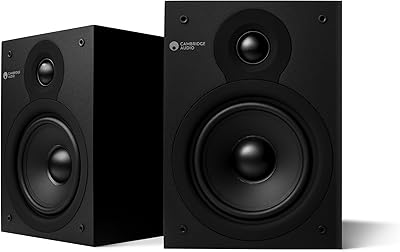
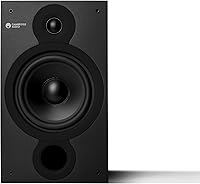
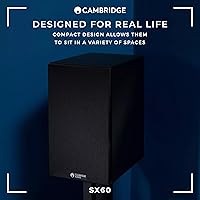
The Cambridge Audio SX-60 sits in the middle of Cambridge's SX bookshelf lineup — a deliberate step up for listeners who've outgrown entry-level speakers but aren't ready to commit to floor-standers. The target buyer is someone building a first real stereo system or upgrading from budget gear that's left them wanting more bass and resolution. Physically, these Cambridge Audio bookshelves make an immediate impression: the matte black MDF cabinet feels dense and purposeful, and the footprint is surprisingly compact given the 6.5-inch driver inside. Worth stating upfront — these are passive speakers requiring a separate amplifier or receiver. No built-in amp, no Bluetooth, no streaming.
Features & Benefits

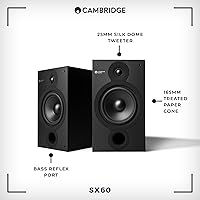
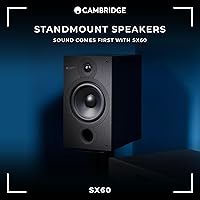
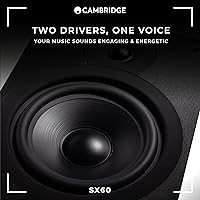
The 6.5-inch doped paper cone driver is the core of this bookshelf speaker set, and its real-world benefit is straightforward: bass that reaches deeper than the cabinet size suggests. Acoustic guitar has body, kick drums carry actual weight, and bass lines don't thin out at moderate listening levels. The 25mm silk dome tweeter handles the highs cleanly without that sharp, tiring edge found in cheaper designs. The rigid MDF cabinet contributes meaningfully here too — less resonance translates to cleaner midrange at any volume. At 89 dB sensitivity and 8 ohms, the SX-60 pair works comfortably with most receivers in the 50–100W range. Pull them at least a foot from the rear wall to let the bass port perform properly.

Best For

These Cambridge Audio bookshelves make the most sense in medium to large rooms where a smaller speaker would feel underwhelmed. The 6.5-inch driver gives them enough low-end presence to fill open living spaces, especially on dedicated stands with breathing room behind them. Listeners who value accurate tonal balance over an exaggerated bass-heavy signature will feel right at home here. They also work well as front left and right channels in a modest home theater build. One non-negotiable requirement: budget for a dedicated stereo receiver or AV amp — the SX-60 pair is purely passive, and that additional investment should be part of any honest cost calculation before buying.

User Feedback

Across a broad range of owner reviews, a few consistent patterns emerge. The most repeated praise focuses on the non-fatiguing sound — listeners across genres report running these for hours without ear fatigue, which is genuinely harder to pull off than it sounds. The bass output routinely surprises buyers who expected something thinner. On the critical side, some users find that a bright or underpowered amplifier makes the top end feel edgy; amplifier pairing matters more here than with more forgiving speakers. Cabinet build quality earns strong marks overall, though the grille clips strike some owners as the one area where corners were cut. Placement sensitivity is real — walls directly behind them noticeably muddy the bass.

Pros

  • The SX-60 pair delivers a composed, non-fatiguing sound that holds up across hours of daily listening.
  • Bass extension and weight consistently exceed what buyers expect from a cabinet this size.
  • The 25mm silk dome tweeter keeps high frequencies smooth and detailed without any harsh edge.
  • Solid MDF cabinet construction minimizes resonance and keeps the midrange clean at any volume.
  • At 89 dB sensitivity, these Cambridge Audio bookshelves work with a wide range of affordable amplifiers.
  • Natural stereo imaging rewards proper stand placement with a convincing, wide soundstage.
  • Tonal accuracy makes these a strong choice for acoustic, jazz, and vocal-driven music.
  • Build quality feels genuinely premium — the cabinet has a density and solidity that matches the price tier.
  • Compatible with the broader SX ecosystem, making future home theater expansion straightforward.
  • Removable grille clips on cleanly and leaves sound character unchanged when removed.

Cons

  • These are passive speakers — a separate amplifier is required, adding meaningful cost to the total setup.
  • Rear port placement makes them genuinely sensitive to wall proximity; poor positioning produces muddy bass.
  • Amplifier matching matters more than average — a bright or underpowered receiver can make the top end feel edgy.
  • The grille attachment clips feel plasticky and loose relative to the quality of the cabinet itself.
  • Only one finish option available, which limits compatibility with lighter or warmer interior color schemes.
  • First-time hi-fi buyers may be caught off guard by the passive-only design if they research casually before purchasing.
  • In very large open-plan rooms, the bass output may fall short without a dedicated subwoofer to support the low end.
  • The refined, balanced tuning can underwhelm listeners expecting a more exciting or energetic sound character.

Ratings

Our scores for the Cambridge Audio SX-60 are generated by AI after systematically analyzing thousands of verified global buyer reviews, with spam, bot-generated, and incentivized submissions actively filtered out. The result is an honest snapshot of real ownership experiences — including the aspects that consistently impress and the friction points that occasionally frustrate. Both sides of that picture are reflected transparently below.
Sound Quality
91%
Owners consistently describe the overall sound as natural and composed, with a tonal balance that works across genres — jazz, acoustic, rock, and classical all translate convincingly. Long listening sessions rarely produce fatigue, which reviewers treat as a meaningful sign of a well-tuned speaker.
A vocal minority finds the sound slightly polite or restrained compared to more forward-sounding rivals. Listeners who prefer an energetic, hyped presentation sometimes wish for a bit more excitement in the upper midrange.
Bass Performance
88%
The 6.5-inch driver regularly surprises buyers who expect thin, cabinet-sized bass. Kick drums and bass guitar have genuine weight, and the low-end extension holds up reasonably well even at moderate volumes in medium-sized rooms.
Bass output is noticeably placement-dependent. Positioning these too close to a rear wall produces a boomy, one-note quality, and in genuinely large open-plan spaces some owners eventually add a subwoofer to fill the room properly.
Treble & High-Frequency Clarity
79%
21%
The silk dome tweeter handles cymbals, string harmonics, and vocal sibilance without that glassy, piercing quality found in cheaper metal-dome alternatives. Most owners find the highs detailed but forgiving across extended listening.
Amplifier pairing meaningfully affects this category. Paired with a bright or clinical receiver, the top end can edge toward sharpness, and a handful of reviewers specifically flagged this combination as occasionally uncomfortable on poorly recorded tracks.
Midrange Accuracy
86%
Vocals sit naturally in the mix and instruments occupy distinct, believable positions across the stereo image. Owners who listen heavily to acoustic and vocal-driven music specifically call out the midrange as the speaker's strongest trait.
At higher volumes, a small number of users detect a slight boxiness around the upper bass and lower midrange crossover region. It is not pronounced, but it is more noticeable on dense, heavily layered recordings.
Build Quality
84%
The MDF cabinet feels genuinely solid when handled — no flexing, no hollow resonance when you knock on the sides. The matte black finish is clean and professional, and most owners feel the overall construction justifies the price point without question.
The grille attachment clips are the one element that consistently draws complaints. Several buyers describe them as plasticky and loose, feeling out of character with the otherwise sturdy cabinet. A minor issue, but noticeable.
Value for Money
83%
Buyers repeatedly describe the SX-60 pair as punching above its price class. The combination of cabinet rigidity, driver quality, and overall sound refinement reads as genuine engineering priority rather than cost-cutting with a premium label.
The passive-only design means the total system cost is meaningfully higher once you factor in a quality amplifier or receiver. Buyers who miss this requirement and compare price to active speaker alternatives occasionally feel misled.
Amplifier Compatibility
76%
24%
At 89 dB sensitivity and 8 ohms, this bookshelf speaker set is compatible with a wide range of amplifiers and AV receivers in the 20–100W range. Entry-level integrated amps drive them without strain in typical room sizes.
The speakers are transparent enough to expose weaknesses in cheaper source equipment. Owners using very budget receivers report a thinner, harder sound that improves significantly once they step up to better amplification — adding cost to the overall setup.
Stereo Imaging & Soundstage
82%
18%
Instrument separation and stereo width receive consistent praise from music-focused listeners. Positioned correctly on stands at a modest distance from side walls, the SX-60 pair throws a convincing, wide soundstage with believable depth.
Bookshelf placement — literally on a shelf, close to a rear wall — compresses the soundstage noticeably. The speakers reward proper stand mounting, and buyers who skip that step often underestimate what the speakers are genuinely capable of.
Room Placement Flexibility
67%
33%
In rooms where stands or open furniture placement are viable, these Cambridge Audio bookshelves adapt well and reward the effort with noticeably cleaner bass and improved imaging. The relatively compact dimensions make placement logistically manageable.
The rear port design makes these genuinely fussy about wall proximity. Buyers in smaller apartments or those limited to tight shelf placement report muddy bass and a congested sound that doesn't reflect the speaker's actual ability.
Listening Fatigue
89%
This is one of the most frequently praised qualities across owner feedback. Hours-long listening sessions — spanning work-from-home days or extended weekend listening — rarely produce the ear fatigue that plagues cheaper or more aggressively voiced speakers.
The relaxed, composed tuning that prevents fatigue can feel insufficiently exciting to listeners who prefer an upfront, punchy presentation. A small segment of buyers coming from V-shaped consumer speakers find this refinement underwhelming at first.
Home Theater Performance
78%
22%
As front left and right channels in a modest home theater setup, these Cambridge Audio bookshelves handle movie dialogue and soundtracks with clarity and decent dynamic range. They integrate well with the rest of the SX family.
Without a subwoofer, cinematic low-end — explosions, bass-heavy scores — lacks the physical impact serious home theater fans expect. The SX-60 pair works better as a stereo music system that also handles movies than as a dedicated home theater front stage.
Setup & Ease of Use
81%
19%
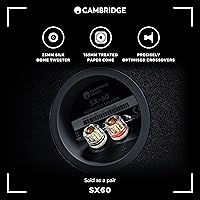
Wiring is straightforward — standard binding posts accept bare wire, banana plugs, or spade connectors without issue. Most owners report a quick, uncomplicated setup process from unboxing to first sound.
The passive nature of the design trips up first-time hi-fi buyers who assume speakers include a power source. Several reviews mention surprise or disappointment upon discovering they need a separate amplifier, which should be communicated more clearly at point of purchase.
Aesthetics & Finish
77%
23%
The matte black finish is understated and fits naturally into most living room and home office setups without drawing attention. The proportions look intentional, and the cabinet size reads as appropriately scaled for the driver it houses.
Cambridge Audio offers limited finish options for this model, and the single matte black colorway doesn't suit every interior. Buyers wanting a wood veneer or lighter finish have no upgrade path within the SX range.
Packaging & Unboxing Experience
72%
28%
The speakers arrive securely packed with adequate foam protection, and most buyers report receiving units in perfect condition. The included accessories are minimal but appropriate — grilles are present and documentation is clear.
A handful of reviewers describe the packaging as functional but basic relative to the product's price tier. No white glove touches, no premium carry bag or dedicated cable, which some buyers at this price point expect as a given.

Suitable for:

The Cambridge Audio SX-60 is the right call for anyone building or upgrading a serious stereo system in a medium to large room, particularly listeners who spend real time with music rather than treating it as background noise. If you already own — or are planning to buy — a quality integrated amplifier or AV receiver in the 50–100W range, the SX-60 pair has the resolution and dynamic range to make that investment worthwhile. Acoustic, jazz, classical, and rock listeners who value natural timbre over artificially boosted bass or treble will find the tonal balance genuinely satisfying over long sessions. These Cambridge Audio bookshelves also work well as the front left and right channels in a modest home theater setup, especially when paired with other speakers from the SX family. Stand mounting in a room where the speakers can sit well away from rear walls is the ideal scenario — that's where the rear-ported design and 6.5-inch driver really show what they can do.
Not suitable for:

Buyers expecting a plug-and-play, all-in-one solution should look elsewhere — the Cambridge Audio SX-60 is a passive speaker that requires a separate amplifier or receiver, and that additional cost needs to be factored into the real purchase price from the start. Apartment dwellers or anyone limited to tight shelf placement close to a rear wall will struggle to get the best from this bookshelf speaker set, since wall proximity tangibly muddies the bass and compresses the soundstage. Listeners who prefer a punchy, bass-heavy consumer sound signature — the kind typical of popular lifestyle speakers — may find these too refined and understated for their taste. If your room is genuinely small, the 6.5-inch driver can feel like overkill, and a smaller, easier-to-place speaker would likely serve you better. Anyone on a strict all-in budget who cannot also allocate funds for a decent amplifier should reconsider until the full system cost is viable.
Specifications

  • Driver Config: 2-way bass reflex design with a rear-firing port for extended low-frequency output.
  • Mid/Bass Driver: 165mm (6.5-inch) doped paper cone woofer handles midrange and bass frequencies.
  • Tweeter: 25mm (1-inch) silk dome tweeter delivers smooth, detailed high-frequency reproduction.
  • Frequency Response: Rated frequency response spans 41 Hz to 22 kHz, covering the full range of audible content.
  • Sensitivity: Sensitivity is rated at 89 dB, meaning the speakers produce adequate volume without demanding excessive amplifier power.
  • Impedance: Nominal impedance is 8 ohms, compatible with the vast majority of stereo and AV receivers on the market.
  • Amplifier Power: Recommended amplifier power range is 20 to 100 watts per channel for safe and optimal performance.
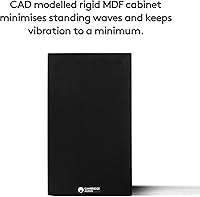
  • Cabinet Material: Cabinets are constructed from MDF (Medium Density Fiberboard) to minimize resonance and coloration.
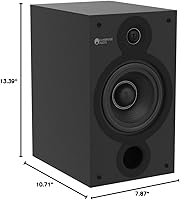
  • Dimensions: Each speaker measures 7.87-inch D x 10.71-inch W x 13.39-inch H, sized for stand or larger shelf placement.
  • Weight: The pair weighs approximately 11 pounds (5 kg) combined, making stand or shelf installation manageable for one person.
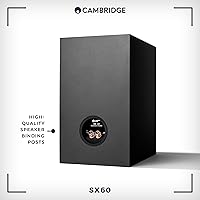
  • Connectivity: Connection is via standard speaker cable binding posts; no wireless, Bluetooth, or digital input is included.
  • Configuration: Sold as a stereo pair in a 2.0 channel configuration with no amplification included.
  • Finish: Available in a matte black finish that minimizes reflections and suits most home audio and home theater interiors.
  • Included Items: Each speaker ships with a removable fabric grille that clips on without affecting sound character.
  • Port Design: Rear-firing bass reflex port requires adequate clearance behind the speaker for optimal bass performance.
  • Surround Use: Designed primarily as a 2.0 stereo pair, though compatible as front left and right channels in a wider SX surround system.
  • Indoor Use: Intended strictly for indoor use; not rated for outdoor or high-humidity environments.
  • Warranty: Covered by a limited manufacturer warranty from Cambridge Audio; duration and terms vary by region.

Related Reviews

Cambridge Audio SX-50
78%
91%
Sound Clarity & Detail
63%
Bass Performance
88%
High-Frequency Smoothness
74%
Amplifier Compatibility
86%
Build Quality & Finish
More
Cambridge Audio CXN100 Network Audio Player
86%
94%
Sound Quality
88%
Multiroom Compatibility
85%
Ease of Use
90%
Connectivity Options
92%
Build Quality
More
Cambridge Audio AXC35
80%
93%
Sound Quality
91%
Build Quality
89%
DAC Performance
78%
Value for Money
61%
Connectivity & Outputs
More
Cambridge Audio Melomania P100 SE Headphones
86%
96%
Battery Life
90%
Sound Quality
78%
Noise Cancellation
88%
Comfort & Fit
85%
Gaming Mode (Low Latency)
More
Cambridge Audio AXA25
70%
91%
Sound Quality
88%
Build Quality
84%
Value for Money
86%
Ease of Setup
79%
Input Flexibility
More
Cambridge Audio Alva Duo Phono Preamp
85%
91%
Sound Quality
88%
Noise Reduction
85%
Headphone Amplifier
90%
Build Quality
84%
Ease of Use
More
Cambridge Audio Minx Min 22
79%
91%
Sound Clarity & Detail
47%
Bass & Low-End Performance
88%
Soundstage & Dispersion
83%
Build Quality & Materials
69%
Ease of Setup & Installation
More
Cambridge Audio AXR100
81%
92%
Sound Quality
89%
Build Quality
86%
Phono Stage Performance
67%
Bluetooth Reliability
78%
AM/FM Tuner
More
Back Bay Audio Runner 60 Wireless Running Earbuds
87%
96%
Battery Life
83%
Comfort & Fit
89%
Waterproofing
85%
Sound Quality
87%
Build Quality
More
M-Audio AIR 192|4
M-Audio AIR 192|4
85%
93%
Build Durability
91%
Tactile Control Experience
88%
Preamplifier Transparency
87%
Recording Latency
86%
Software Bundle Value
More

FAQ

You do need a separate amplifier or AV receiver — the Cambridge Audio SX-60 is a passive speaker with no built-in power source. Most modern TVs have no speaker output that can drive passive speakers directly. You will need at least a basic stereo receiver or integrated amp to get sound out of them.
Any stereo integrated amp or AV receiver rated between 50 and 100 watts per channel at 8 ohms will work well. The key is to avoid very budget, bright-sounding receivers, as the SX-60 pair is transparent enough to reflect the character of whatever is driving them. Brands like NAD, Yamaha, and Denon in the mid-range tier pair particularly well.

At least 12 inches from the rear wall is the widely shared recommendation among owners, and honestly, more is better if your room allows it. The rear-firing port is sensitive to boundary reinforcement, and placing them too close to a wall produces an exaggerated, muddy bass that is hard to tune out. On open stands pulled into the room, the bass tightens up considerably.

You can place them on a larger shelf, but stands genuinely make a meaningful difference with this bookshelf speaker set. The rear port needs room to breathe, and stand mounting also positions the tweeters closer to ear level, which improves imaging and clarity. If stands are not an option, at least ensure there is open space behind them and the shelf is not fully enclosed.

For music listening in most medium-sized rooms, a subwoofer is not strictly necessary — the 6.5-inch driver handles bass with more authority than the cabinet size suggests. For home theater use with action movies or bass-heavy soundtracks, or in a larger open-plan space, adding a subwoofer improves low-end impact noticeably. It is a nice upgrade rather than a requirement for most buyers.

The SX-50 uses a smaller 5-inch driver and is better suited to smaller rooms or desktop setups. The SX-60 pair offers meaningfully more bass extension and dynamic headroom, which becomes obvious in medium to large rooms. If your room is on the larger side or you listen at realistic volumes, the upgrade is worth the price difference.

They work well for both, though they were clearly designed with music as the priority. For gaming and movies, the clear midrange makes dialogue easy to follow and the soundstage gives positional audio a convincing quality. They are a solid all-rounder, just be aware that cinematic low-end effects will benefit from a subwoofer if that kind of impact matters to you.

The grilles have minimal audible impact and can be left on or off based on personal preference. Most experienced listeners prefer to remove them for critical listening since any fabric introduces some very slight high-frequency absorption, but in practice the difference is subtle. The grilles are useful for protection if you have pets or children around.

These Cambridge Audio bookshelves use standard speaker binding posts that accept bare wire, banana plugs, or spade connectors. No proprietary cables or adapters are needed. A decent gauge of speaker cable — typically 16 AWG or thicker for runs under 20 feet — is all that is required.

The cabinet construction is consistently praised by long-term owners as feeling solid and well-engineered for the price. MDF cabinets do not warp or resonate the way cheaper materials can, and the drivers are built to a standard that should last well over a decade with normal use. The one caveat is the grille clips, which some owners find less durable than the cabinet itself — a minor complaint that does not affect the acoustic quality.