Overview

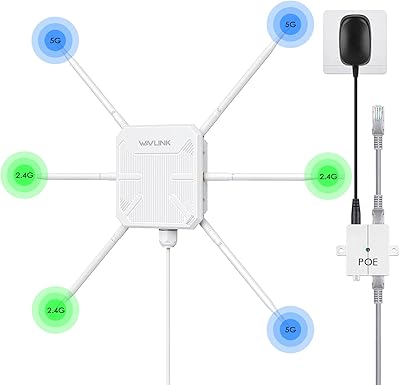
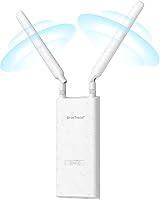
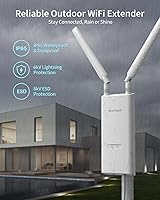
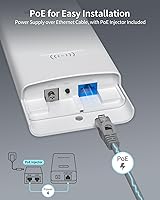
The BrosTrend AC1200 Outdoor WiFi Extender sits in an interesting middle ground — more capable than a cheap indoor repeater tossed near a window, but far less involved than deploying a full mesh network across your property. It connects wirelessly to your existing router and rebroadcasts that signal outdoors, so there is no rewiring your home network. What sets this weatherproof range booster apart from typical indoor units is the IP65-rated housing, combined with 6kV lightning and 8kV ESD protection — real durability that matters when a unit lives on an eave or fence post year-round. Power comes through a single Ethernet cable via PoE, which neatly sidesteps the headache of finding an outdoor outlet.

Features & Benefits

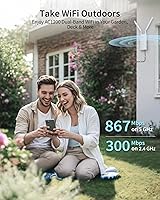
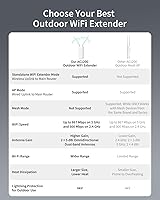
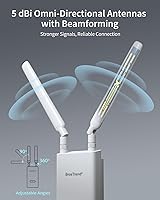
This outdoor extender runs dual-band AC1200, meaning you get up to 867 Mbps on the 5 GHz band for streaming or video calls, and 300 Mbps on 2.4 GHz for smart home devices that favor longer range. The PoE power delivery is genuinely one of the most practical aspects here — mount it on a pole or under a soffit, run a single Cat5e cable back to the included injector indoors, and you are done. Two detachable 5 dBi antennas combined with Beamforming help focus the signal rather than scattering it equally in every direction. The unit also carries a Gigabit Ethernet port, handy for directly wiring a camera or nearby device. Just temper expectations on range: 656 feet is a best-case, open-air figure.

Best For

This weatherproof range booster makes the most sense for people dealing with specific outdoor dead zones rather than whole-property coverage problems. Backyard patios, poolside areas, and garden workshops are classic use cases — places where your indoor router simply runs out of steam. Small farm owners trying to get connectivity to a barn or detached outbuilding will find the PoE setup especially appealing, since running power to those spots is often inconvenient. RV hosts and vacation rental owners benefit from the rugged build that holds up through seasons without babysitting. It is also a solid pick for anyone running outdoor security cameras or smart doorbells that need a consistent, reliable connection rather than a spotty one.

User Feedback

With a 4.2-star average across more than 200 ratings, this outdoor extender earns broadly favorable marks, and the pattern is consistent: buyers appreciate the straightforward PoE setup, the solid hardware construction, and the noticeable signal improvement around driveways and yards. The included cable and injector are generally viewed as a genuinely useful starting kit. Where criticism does appear, it centers on the inherent trade-off of wireless backhaul — latency is higher than you would get from a dedicated wired access point. Some buyers also note the 5 GHz band loses reach quickly once fencing or foliage appears, and a handful found the range claims overstated in their actual environment. Balanced overall, but worth understanding before you buy.

Pros

  • PoE power delivery means no outdoor outlet required — just run a single Ethernet cable to your chosen mounting spot.
  • IP65 weatherproofing keeps dust and rain out, making it genuinely suitable for permanent outdoor installation.
  • 6kV lightning protection and 8kV ESD protection offer a meaningful safety margin that indoor-only extenders skip entirely.
  • Dual-band coverage lets you assign bandwidth-hungry devices to 5 GHz while keeping smart home gadgets on the more reliable 2.4 GHz band.
  • The included PoE injector and outdoor Ethernet cable mean you can get up and running without buying extra accessories.
  • Beamforming focuses the signal toward your connected devices rather than broadcasting it equally in all directions, improving real-world reliability.
  • The onboard Gigabit Ethernet port lets you hardwire a nearby camera or device directly, skipping WiFi entirely for that connection.
  • Mounting hardware is included in the box, and the bracket accommodates both wall and pole installation without extra parts.
  • At 9.6 ounces, it is light enough to mount cleanly on an eave or fence rail without reinforcement.
  • A 4.2-star average across more than 200 buyers reflects consistent satisfaction with build quality and coverage improvement.

Cons

  • Wireless backhaul introduces extra latency compared to a true wired access point — noticeable if you care about ping times.
  • The 656-foot range claim assumes clear line of sight; fences, hedges, and walls can reduce that significantly in practice.
  • The 5 GHz band loses range outdoors faster than 2.4 GHz, so its speed advantage shrinks the farther you mount the unit from the router.
  • Some buyers report the web-based setup interface feels dated and less intuitive than app-driven competitors.
  • PoE cable runs are capped at 164 feet, which may not reach distant outbuildings without an additional switch or injector.
  • This is a wireless extender, not an access point — it cannot fix an already struggling or overloaded home router.
  • AC1200 throughput is adequate for most household tasks but will feel limiting if you later adopt Wi-Fi 6 devices expecting faster speeds.
  • No dedicated backhaul band means the unit shares the same radio for both its router connection and its client devices, which can constrain peak throughput.

Ratings

Our AI scoring for the BrosTrend AC1200 Outdoor WiFi Extender was built by analyzing verified global buyer reviews, with automated filters applied to remove incentivized, bot-generated, and duplicate submissions. The result reflects what real users actually experience once the unit is mounted and running — not just first impressions. Both the strengths that keep buyers satisfied and the frustrations that surface after weeks of use are transparently represented in each score below.

Weather Durability
91%
Buyers who have left this outdoor extender through full rain seasons, summer heat, and winter cold consistently report zero weather-related failures. The IP65 housing earns genuine trust — multiple reviewers note it still looks and performs like new after months of continuous outdoor exposure.
A small number of users in exceptionally humid or coastal environments mention minor corrosion around the antenna connection points over time. The housing itself holds up well, but the external metal components are not immune to salt-air conditions indefinitely.
Signal Coverage
74%
26%
In open residential yards and driveways, this weatherproof range booster delivers a noticeable and consistent improvement over a fading indoor router signal. Buyers covering patios, garden areas, and detached garages at moderate distances report strong real-world performance on the 2.4 GHz band.
The 656-foot range claim causes frustration when buyers discover it applies only to open, unobstructed conditions. Fencing, dense hedging, and building walls reduce effective range significantly, and the 5 GHz band in particular loses reach quickly once any obstruction enters the path.
Ease of Installation
82%
18%
The PoE power setup is a recurring highlight in buyer feedback — running a single Ethernet cable to the mounting point is far simpler than most users expect, and the included injector, cable, and mounting bracket mean the box contains everything needed to get started. Most buyers report completing the physical installation in under an hour.
The web-based configuration interface, accessed via a local browser rather than a dedicated app, feels dated to users accustomed to modern router setups. A handful of buyers report confusion locating the management IP address the first time, and the interface itself offers limited visual guidance during initial pairing.
Value for Money
78%
22%
Relative to the cost of running a dedicated outdoor power line or purchasing a professional-grade outdoor access point, the BrosTrend AC1200 sits at an accessible price point that buyers frequently describe as fair for what it delivers. The included accessories add genuine value rather than padding the box with items you would never use.
Buyers who later compare it to wired outdoor access points occasionally feel the performance trade-off — particularly the added latency from wireless backhaul — is not always worth the installation convenience. For users with more demanding outdoor connectivity needs, the price difference between this and a true access point setup narrows the value gap.
Build Quality
86%
The physical construction draws consistent praise — the housing feels dense and well-finished, not hollow or fragile. Buyers mounting it on exposed eaves and fence posts note that it does not flex, rattle, or show stress around the antenna mounts even after repeated weather cycles.
The wall-mounting bracket, while functional, is described by some buyers as feeling slightly less robust than the unit itself. A few users in high-wind installations recommend supplementing the provided screws with additional weatherproof fasteners for long-term confidence.
WiFi Speed Performance
69%
31%
For everyday outdoor tasks — streaming video to a patio speaker, keeping a smart doorbell online, or running a security camera — the throughput is more than adequate. The 5 GHz band handles bandwidth-heavy use cases well when the extender is mounted close enough to the source router to maintain a strong backhaul link.
As a wireless extender, the unit shares its radio for both the router-side connection and the client-side broadcast, which compresses real-world throughput under load. Heavy simultaneous use from multiple outdoor devices highlights this bottleneck, and buyers expecting router-equivalent speeds are routinely disappointed.
Latency & Reliability
63%
37%
For general browsing, streaming, and smart home device communication, the connection is described as stable and consistent during normal use. Buyers running outdoor security cameras report reliable uptime over extended periods without manual reconnection.
The wireless backhaul architecture introduces measurable latency compared to a wired access point, which several technically informed buyers flag explicitly. Users who attempted online gaming or real-time video calls over the extended network found the added lag noticeable and, in some cases, disruptive.
PoE Implementation
88%
The passive PoE setup is praised as elegantly practical — one cable does the job of both power and data, and the included injector is compact enough to tuck behind a shelf or outlet strip indoors. Buyers who were initially uncertain about PoE report that the process is simpler than it sounds once they follow the guide.
The 164-foot PoE cable run limit is a real constraint for buyers with larger properties trying to reach distant outbuildings. Those who need a longer run quickly discover they require additional powered network hardware, which adds cost and complexity beyond what the box implies.
Antenna Performance
77%
23%
The two detachable 5 dBi antennas with Beamforming are consistently credited with making outdoor signal feel more directional and purposeful than generic extenders. Buyers who adjusted antenna angle after initial mounting often report a measurable improvement in signal strength at their target device location.
Because the antennas are omni-directional, users hoping to concentrate signal tightly in one specific direction — such as a narrow side-yard camera run — find the coverage pattern less precise than a directional antenna would provide. Repositioning helps, but the physics of omni coverage mean some signal energy is always wasted in unwanted directions.
Compatibility
83%
The extender pairs cleanly with routers from all major brands, and buyers report no unusual handshake failures or brand-specific conflicts during setup. Legacy devices using older WiFi standards connect without issue thanks to broad backward compatibility across 802.11a through 802.11ac.
A small number of buyers using ISP-provided router-modem combo units report slightly more complex configuration steps when the source device has restricted management settings. It is not a widespread issue, but users with locked-down ISP hardware should verify their router settings before purchasing.
Mounting Flexibility
81%
19%
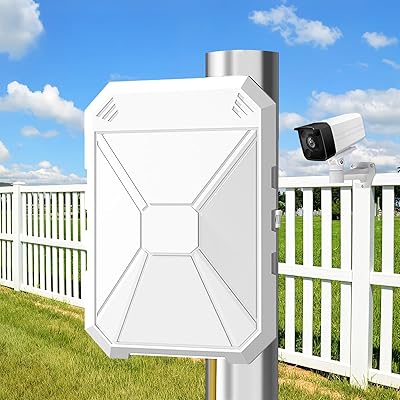
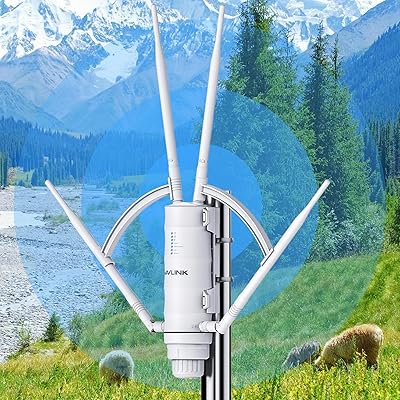
The pre-attached bracket handles both wall and pole mounting without requiring additional parts, which buyers appreciate given how many extenders ship with wall-only options. The slim, cylindrical form factor fits comfortably on a standard fence post or soffit without looking oversized or intrusive.
The mounting bracket does not accommodate all pole diameters equally well, and buyers with thicker fence rails or non-standard pipe diameters sometimes need to improvise with additional cable ties or clamps. A wider range of mounting collar options would broaden the installation scenarios meaningfully.
Range Consistency
66%
34%
At distances up to roughly 150 to 200 feet in typical residential settings with moderate obstructions, the signal holds reasonably steady without dramatic drop-offs. Buyers covering a backyard deck or a workshop at that kind of distance report a reliable and usable connection throughout the day.
Beyond 200 feet in obstructed environments, signal consistency becomes unpredictable and highly dependent on local conditions. Buyers who anchored purchase decisions to the maximum range claim express the most dissatisfaction, particularly when foliage or seasonal changes affect performance that seemed acceptable at first.
Surge & Lightning Protection
89%
The built-in 6kV lightning surge and 8kV ESD protection are mentioned appreciatively by buyers in storm-prone regions who previously lost outdoor equipment to voltage spikes. Several users specifically purchased this unit over competitors because of these protections, and none reported surge-related failures in their reviews.
While the integrated protection is reassuring, it does not substitute for a properly grounded installation — and the grounding screw in the box implies this is expected rather than optional. Buyers who skip grounding in favor of a quick install may not be getting the full protection the specs advertise.

Suitable for:

The BrosTrend AC1200 Outdoor WiFi Extender is a strong fit for homeowners who have a specific outdoor dead zone to solve — a backyard patio, a poolside deck, or a garden workspace where the indoor router signal simply does not reach. It is equally well-suited to small farm and rural property owners who need connectivity in a detached barn, workshop, or outbuilding, especially where running a dedicated power line would be costly or impractical. The PoE setup is a genuine advantage for anyone mounting a unit on a fence post, eave, or exterior wall, since the entire installation runs over a single Ethernet cable. RV owners and vacation rental hosts will also appreciate the weatherproof build, which holds up through rain, dust, and temperature swings without needing to bring the unit indoors seasonally. If you are already running a router you are happy with and just need to push its signal into an outdoor area, this weatherproof range booster slots into that gap cleanly and without demanding a full network redesign.

Not suitable for:

The BrosTrend AC1200 Outdoor WiFi Extender is not the right tool if you are trying to solve a whole-property coverage problem or replace a poorly performing router. Because it connects to your existing router wirelessly, it inherits whatever limitations that connection carries — including added latency that wired access points simply do not introduce. Users who need ultra-low latency for competitive gaming, real-time video production, or large file transfers will likely find the wireless backhaul a persistent frustration. This outdoor extender also is not ideal for anyone expecting to blanket a large rural property in all directions; the 656-foot range is a best-case, open-air figure, and dense foliage, fencing, or building walls can cut that considerably. Buyers who need Wi-Fi 6 speeds or who are managing a high-density device environment with dozens of simultaneous connections should look at a proper outdoor access point instead. Finally, if you do not already have a reliable router as a base, adding this unit will not fix a fundamentally weak network — it can only extend what is already working well.

Specifications

  • WiFi Standard: Supports 802.11ac Wave 2.0 and is backward compatible with 802.11a, 802.11b, 802.11g, and 802.11n devices.
  • Frequency Bands: Dual-band operation on both 2.4 GHz (up to 300 Mbps) and 5 GHz (up to 867 Mbps) simultaneously.
  • Dimensions: The unit measures 3.27 × 3.27 × 15.24 inches, making it a slim, pole-friendly form factor.
  • Weight: The extender body weighs 9.6 ounces, light enough for eave or fence-rail mounting without heavy-duty hardware.
  • Power Method: Powered entirely via a single Ethernet cable using passive PoE, with a PoE injector included in the box.
  • Max PoE Cable Run: Supports passive PoE delivery over Ethernet cable runs of up to 164 feet from the injector to the unit.
  • Weather Rating: IP65-rated housing protects against dust ingress and sustained water jets from any direction.
  • Lightning Protection: Built-in 6kV lightning surge protection and 8kV electrostatic discharge protection guard against voltage spikes.
  • Antennas: Two detachable, waterproof 5 dBi omni-directional antennas are included, with Beamforming technology to focus signal toward client devices.
  • Ethernet Port: One Gigabit Ethernet port on the unit supports direct wired connections to nearby devices or alternative backhaul configurations.
  • Claimed Range: Advertised maximum range is 656 feet under ideal, open line-of-sight conditions.
  • Wireless Streams: Uses a 2×2 MIMO stream configuration to support simultaneous data transmission and reception.
  • In the Box: Package includes the extender unit, a gigabit passive PoE injector, two antennas, waterproof rubber gaskets, a wall-mounting bracket, a power cord, an outdoor PoE Ethernet cable, cable ties, a grounding screw, an anti-theft screw, mounting screws, plastic anchors, and a quick installation guide.
  • Mounting Options: A detachable bracket pre-attached to the unit accommodates both wall and pole mounting configurations.
  • Housing Color: The unit ships in white to blend with typical exterior wall and soffit surfaces.
  • Manufacturer: Designed and sold by BrosTrend Technology LLC.

Related Reviews
INEAUTO AC1200 Outdoor WiFi Extender
85%
88%
Overall Performance
92%
Ease of Setup
85%
Range & Coverage
90%
Weatherproof Durability
87%
WiFi Speed & Stability
More
WAVLINK WN572HP3 AC1200 Outdoor WiFi Extender
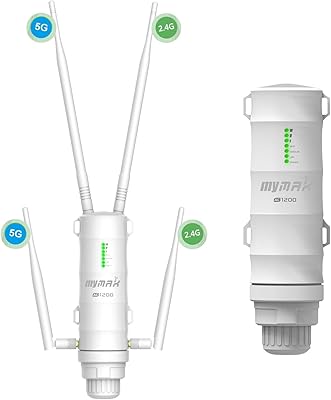
72%
78%
Outdoor Signal Range
71%
Ease of Setup
66%
PoE Implementation
73%
Build Quality & Weatherproofing
74%
Dual-Band Performance
More
MyMAX WN572HP3 AC1200 Outdoor WiFi Extender
86%
88%
Wi-Fi Performance
91%
Weatherproofing and Durability
83%
Ease of Installation
85%
Range Coverage
87%
Dual-Band Connectivity
More
WAVLINK WN588HX3 WiFi 6 Outdoor Access Point
75%
83%
Outdoor Signal Range
91%
Build Quality & Weatherproofing
78%
Installation & Mounting
61%
Setup & Configuration Experience
86%
WiFi 6 Performance
More
rockspace AC1200 WiFi Range Extender
83%
85%
Performance
92%
Ease of Setup
88%
Range Coverage
75%
Signal Stability
83%
Ethernet Port Functionality
More
TODAAIR AC1200 WiFi Range Extender
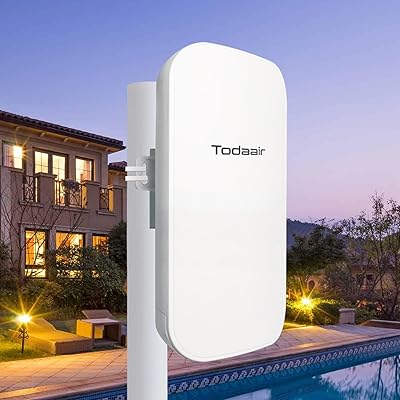
82%
88%
Wireless Coverage
85%
Dual-Band Performance
90%
Setup & Installation
82%
Device Capacity
80%
Speed Consistency
More
BrosTrend AC3L AC1200 Linux USB WiFi Adapter
75%
88%
Linux Compatibility
63%
Driver Installation Experience
83%
5GHz Signal Stability
81%
Antenna Range & Performance
71%
Windows Plug-and-Play
More
BrosTrend AX1500 WiFi 6 Extender
77%
72%
WiFi Coverage
78%
Wireless Speed
89%
Wired Connectivity
86%
Ease of Setup
81%
Build Quality
More
TODAAIR Outdoor N300 WiFi Extender
65%
78%
Weatherproof Durability
63%
Signal Range
74%
Ease of Setup
51%
Real-World Speed
67%
Build & Hardware Quality
More
WAVLINK AC600 Outdoor WiFi Extender
76%
86%
Build Quality
89%
Weather Resistance
91%
PoE Installation
72%
Signal Range
61%
Throughput & Speed
More

FAQ

No, and that is one of the more practical things about this outdoor extender. It draws all its power through the same Ethernet cable that carries your network data, using the included PoE injector. You plug the injector into a standard outlet indoors, run the Ethernet cable out to your mounting location, and the unit powers itself from there. No outdoor outlet required.

The 656-foot figure is a best-case, open-air number with no obstructions between the extender and your devices. In a typical backyard with fencing, hedges, or a structure in the way, expect meaningfully less. Most buyers in standard residential settings report solid coverage across a large yard or driveway, but do not count on that maximum figure if there are solid obstacles in the path.

It works with any standard WiFi router, regardless of brand. The BrosTrend AC1200 Outdoor WiFi Extender connects wirelessly to your existing network and rebroadcasts the signal outdoors — much like any other extender would. You just need a router that is already putting out a usable signal in the general direction of where you plan to mount the unit.

The IP65 rating means it is built to handle both sustained rain and dust without issue, and the housing is designed for permanent outdoor exposure. The 6kV lightning surge protection adds a meaningful safety layer during storms. That said, you should use outdoor-rated, UV-resistant Ethernet cable for the run, which is not always the same as standard indoor patch cable.

Yes. There is a Gigabit Ethernet port on the unit itself, so you can plug a wired camera or other device directly into it. That actually gives you a more stable, lower-latency connection for that one device than a wireless link would.

The passive PoE delivery is rated for cable runs up to 164 feet. Beyond that length, power delivery can become unreliable. If your mounting spot is farther than that from your indoor router or switch, you would need an additional powered switch or a different PoE approach rather than a longer passive run.

Most buyers find setup manageable. You connect the injector, run the cable, mount the unit, and then configure it through a web-based interface by accessing a local IP address from a browser. It is not an app-based setup, which feels old-fashioned to some people, but the process is straightforward if you follow the included quick installation guide step by step.

It extends your existing signal — it does not improve your base internet speed or fix a router that is already underperforming. If your indoor WiFi is slow or unstable, this weatherproof range booster will carry those same limitations outdoors. Think of it as a relay, not an upgrade to your connection.

By default, extenders like this typically broadcast under a separate network name so you can distinguish which signal you are connecting to. Some users prefer this for troubleshooting, while others find switching between networks mildly annoying. Check the web interface for any options to customize this behavior during setup.

Two hundred feet is well within the theoretical range, and a barn scenario with relatively open space between the structures is closer to ideal conditions than a dense suburban yard. The key variables are where exactly you mount the extender relative to your router and whether there are thick walls or metal roofing in the signal path. Mounting it as high as practical and pointing it toward the barn should give you a workable result, though your mileage may vary depending on local interference.