Overview

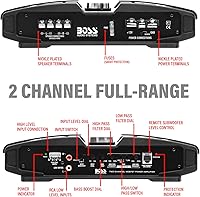
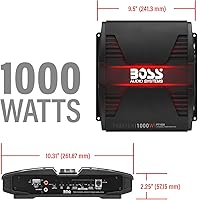
The BOSS Audio PT1000 2-Channel Car Amplifier is a practical, no-frills entry point for anyone wanting to leave factory sound behind without a big investment. One important thing to sort out early: that 1000W number is peak power only — continuous RMS output sits at roughly 250 watts per channel at 4 ohms, which is still a meaningful upgrade over a typical head unit. The amp is compact, measuring about 9.5 by 10 inches, so it fits reasonably well in a trunk corner or under a rear seat. BOSS Audio is widely available and genuinely accessible in price, though the brand draws mixed opinions from more experienced installers. Worth noting: this two-channel unit can be bridged to mono for dedicated subwoofer use.

Features & Benefits

Class A/B amplification is where the PT1000 lands, and that choice makes sense at this price point. Class A runs clean but wastes energy; Class B is efficient but can sound harsh at low levels. Class A/B splits the difference — you get reasonable audio fidelity without excessive heat under normal listening conditions. The MOSFET power supply helps maintain consistent current delivery even when the load fluctuates between speakers, which keeps output stable. Because this two-channel amplifier covers the full frequency range, you can run door speakers on one setup and swap to a subwoofer later without buying additional hardware. The variable gain control is worth understanding — it matches the amp's sensitivity to your receiver's output, not a substitute for the volume knob. The bass boost adds punch, but use it conservatively.

Best For

The PT1000 really clicks for a specific type of buyer. If you're putting together your first car audio setup and want something noticeably louder and more dynamic than what came from the factory, this BOSS amp delivers that at an accessible price. It also suits the casual driver upgrading a single subwoofer or a pair of component speakers — not someone chasing flat frequency response and studio-grade separation. The compact footprint means even a crowded trunk or a small hatchback can usually find room for it. DIY wiring is manageable here; the connections are clearly labeled and the learning curve is gentle. If you're an audiophile after precise imaging and clean headroom at high volume, look elsewhere. But for more presence and bass without a complex build, it holds up well.

User Feedback

Across more than 775 ratings, the PT1000 holds a 4.2-star average — which, for a budget amp, suggests it is meeting expectations for most buyers without dramatic letdowns. Buyers consistently praise easy installation and how much of a jump it provides over a bare head unit alone. On the critical side, several owners feel the wattage figures are optimistic — real-world output does not quite match what the box implies, especially at sustained volume. Heat is a recurring topic too: this two-channel amplifier can run warm during long sessions, so if you are mounting it in a sealed or low-airflow space, plan for ventilation. Long-term reliability reports are mixed; some units log years of trouble-free use, while others report issues after regular heavy use. Tempered expectations seem to be the key to satisfaction here.

Pros

  • Noticeably more volume and bass presence compared to running speakers off a head unit alone.
  • Full-range capability means it can power door speakers or a subwoofer from a single unit.
  • Bridgeable to mono, giving you 1000W peak output for a dedicated subwoofer build.
  • Compact dimensions make it easier to fit in tight or unconventional mounting spots.
  • MOSFET power supply helps maintain stable output across varying speaker impedance loads.
  • Variable gain control makes it easier to match the amp properly to different head units.
  • Straightforward wiring layout suits first-time installers with minimal experience.
  • Holds a 4.2-star average across 775-plus verified ratings, a solid signal of general satisfaction.
  • Class A/B design balances efficiency and sound quality better than pure Class B alternatives.
  • Accessible price makes it a low-risk way to test whether a car audio upgrade is worth pursuing further.

Cons

  • Advertised wattage is peak, not RMS — real continuous output is significantly lower than the headline number suggests.
  • The PT1000 runs warm during extended sessions, requiring good airflow around the mounting location.
  • Long-term reliability is inconsistent; some users report failure after sustained heavy use.
  • Bass boost can introduce distortion if pushed too far at this power tier.
  • Buyers expecting true 1000W performance will likely feel underwhelmed by actual output.
  • Not well-suited for enclosed or low-ventilation installs without additional heat management planning.
  • Mixed reception among experienced enthusiasts who view BOSS Audio as a budget-tier compromise.
  • Lacks the build precision and component quality found in similarly priced alternatives from more specialized audio brands.
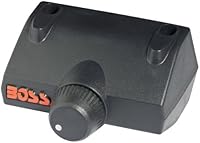
  • No remote subwoofer level control included, which limits fine-tuning convenience from the driver seat.
  • May struggle to drive demanding, low-sensitivity speakers cleanly at higher volume levels.

Ratings

The scores below were generated by AI after analyzing hundreds of verified global user reviews for the BOSS Audio PT1000 2-Channel Car Amplifier, with spam, incentivized, and bot-flagged submissions actively filtered out before scoring. Each category reflects the honest spread of buyer experience — where this BOSS amp earns genuine praise and where real frustrations surfaced. Nothing has been smoothed over to make the product look better than it is.

Value for Money
81%
19%
For buyers entering car audio on a limited budget, the PT1000 delivers a noticeable and immediate improvement over running speakers directly off a factory head unit. Most owners feel the purchase was justified given what comparable alternatives cost, and the bridgeable design adds flexibility that typically comes only at higher price points.
The sense of value takes a hit once buyers realize the advertised wattage is a peak figure, not a sustained one — some feel the spec sheet oversells what the amp actually delivers day to day. If expectations are anchored to the headline number rather than the RMS output, disappointment tends to follow.
Power Output Accuracy
47%
53%
In bridged mono mode, the PT1000 does provide enough output to drive a modest entry-level subwoofer with a clear, audible step up in bass presence. For casual listeners who are not measuring output with test equipment, the improvement over no amplification at all feels meaningful in real daily use.
The gap between the marketed 1000W peak figure and the actual continuous RMS delivery is large enough that experienced buyers flag it as misleading. Real-world output at 4 ohms per channel sits around 250W RMS, and multiple owners note the amp struggles to maintain clean output at higher volumes without audible compression or distortion creeping in.
Ease of Installation
83%
First-time installers consistently praise how approachable the wiring layout is — terminals are clearly labeled, the gain and bass boost controls are straightforward, and the overall process is manageable without prior experience. Buyers regularly report getting the amp running in an afternoon with basic hand tools and a factory head unit.
The included documentation does not always address edge cases like connecting to a factory stereo without RCA outputs, leaving some buyers to troubleshoot independently. A handful of users also found that the recommended wire gauges in the manual lean conservative, requiring research outside the box to avoid heat and voltage drop issues.
Thermal Management
51%
49%
Under moderate listening conditions with the amp mounted in an open, ventilated space — such as on a trunk board with airflow around it — thermal performance is acceptable for daily driving sessions. The amp rarely causes issues for buyers who keep volume at reasonable levels and allow adequate clearance on all sides.
Heat buildup is one of the most frequently mentioned complaints from owners who mounted the PT1000 in tight or sealed spaces. During sustained high-volume playback, the chassis gets hot enough to trigger concern, and several owners report thermal shutdowns or early failures they attribute directly to poor airflow in under-seat or enclosed installs.
Build Quality
58%
42%
The chassis feels reasonably solid for its price tier and does not rattle or flex noticeably during handling. Most owners who treat the amp gently and keep it within its thermal limits report no structural complaints during normal daily use, and the heatsink fins are adequately sized for moderate output levels.
Compared to amplifiers from more specialized audio brands in a similar or slightly higher price range, the internal component quality and casing finish feel budget-grade. Several long-term owners report failure of solder joints or internal components after extended heavy use, suggesting the build tolerances favor light-to-moderate duty rather than sustained demanding performance.
Sound Quality
66%
34%
Class A/B topology gives the PT1000 a cleaner signal than pure Class B designs, and at moderate listening levels the audio output is clear and full enough to satisfy casual listeners upgrading from a stock setup. Paired with decent aftermarket speakers, the improvement in clarity and warmth over a factory head unit is genuinely pleasant.
At higher volume levels, some softening of detail and occasional harshness creep in, particularly in the upper midrange. Audiophile-oriented buyers who prioritize flat frequency response, accurate staging, or low noise floor will find the sonic performance too rough around the edges for serious critical listening.
Bass Boost Control
62%
38%
The variable bass boost is a practical feature for subwoofer builds, giving owners the ability to dial in low-end emphasis without needing an external equalizer. At modest settings, it adds satisfying punch to kick drums and bass lines that makes everyday music listening more engaging.
Pushing the bass boost too aggressively introduces audible distortion at this power tier, which several owners learned the hard way during initial setup. The control lacks fine enough resolution to make subtle adjustments easy, and without a dedicated subsonic filter, some owners inadvertently stress their subwoofers with uncontrolled low-frequency content.
Gain Control Usability
71%
29%
Having a variable gain control is essential for proper amplifier setup, and the PT1000 includes one that covers enough range to work with both low-voltage factory head units and higher-output aftermarket decks. Buyers who understand its purpose — signal matching, not volume control — find it functional and easy to set by ear.
The gain knob lacks markings or detents, making it hard to return to a known setting after accidental adjustment. New installers who mistake it for a volume control sometimes set it too high, which clips the input signal and introduces distortion that they then incorrectly attribute to speaker or subwoofer problems.
Bridgeable Mono Performance
69%
31%
Bridging the two-channel amplifier to mono is a straightforward process and the resulting output does offer a real power increase for single-subwoofer builds. Entry-level 10-inch and 12-inch subwoofers in the 200W to 300W RMS range respond well to the bridged configuration during typical street-level listening.
Running bridged pushes the amp closer to its thermal limits more quickly, which compounds the heat concerns already noted by owners. The 4-ohm minimum impedance requirement in bridged mode also means buyers need to verify their subwoofer's specs carefully — mismatching can stress or damage the output stage over time.
Full-Range Flexibility
74%
26%
The ability to run the amp as a stereo unit for speakers or a mono bridged unit for a subwoofer from a single purchase is genuinely useful for budget builders who want flexibility without buying multiple components. This versatility is something buyers regularly cite as a deciding factor when comparing options at this price level.
While the amp handles the full frequency range, it does not include a built-in high-pass or low-pass crossover filter with sharp, adjustable slopes — meaning users who want to properly band-limit their speakers or subwoofer need an external processor or head unit with crossover capability to get the best results.
Long-Term Reliability
53%
47%
A meaningful segment of buyers report using the PT1000 without incident for a year or more, particularly those who run it at moderate levels with adequate ventilation. For casual daily drivers who are not pushing it hard, longevity tends to be acceptable relative to the price paid.
Reliability reports diverge sharply between light users and those who run the amp hard or in warm environments. A recurring pattern in negative reviews involves failure clusters around the six-to-eighteen month mark, with internal component issues cited more often than physical damage — suggesting the amp's long-term ceiling is lower than its initial performance implies.
Compact Footprint
78%
22%
At roughly 9.5 by 10 inches with a low 2.25-inch profile, the PT1000 fits comfortably on a trunk floor, under a rear seat shelf, or mounted to a custom board without dominating the available space. Owners with smaller vehicles or limited trunk real estate consistently mention the size as a practical advantage over bulkier alternatives.
The compact form factor does limit the size of the internal heatsink, which feeds directly into the thermal concerns noted elsewhere. Buyers who choose this amp specifically because it fits a tight space should be aware that tight spaces also tend to restrict the airflow the amp needs to run safely at higher output levels.
MOSFET Power Supply Stability
67%
33%
The MOSFET-based power supply does a reasonable job of maintaining consistent output as speaker load varies between 2 and 8 ohms, which matters when switching between different speaker types or configurations. In real-world use, this translates to fewer dropouts or voltage sags compared to older transformer-based designs in the same price bracket.
Under sustained demand — particularly in bridged mode driving a low-impedance load — some owners notice the power supply struggling to maintain clean regulation, which manifests as slight thinning of the bass or audible grain at high volumes. It performs best within its comfortable operating range rather than at the edges of its rated capability.
Documentation & Support
44%
56%
The included manual covers the basic wiring steps clearly enough for a straightforward installation, and BOSS Audio maintains an online presence with some downloadable support resources that more patient buyers have found useful for troubleshooting.
Customer support responsiveness from BOSS Audio gets a rough reception in owner feedback — warranty claims and technical queries are frequently described as slow or unresolved. The manual itself lacks depth on common edge cases like high-level input wiring, proper fusing, or thermal troubleshooting, which forces many first-time buyers to rely on YouTube tutorials rather than official guidance.

Suitable for:

The BOSS Audio PT1000 2-Channel Car Amplifier is a strong fit for first-time car audio builders who want a real, audible upgrade from their factory setup without spending a lot of money or tackling a complicated install. If you are the kind of person who just wants more volume, tighter bass, and a fuller sound on a daily commute, this BOSS amp delivers that without demanding much technical know-how. Casual listeners pairing it with a single aftermarket subwoofer or a set of component speakers will find the full-range flexibility particularly useful — one unit can serve both roles depending on how you wire it. The compact footprint makes it a reasonable choice for smaller vehicles or builds where mounting space is genuinely tight. DIY-friendly wiring, clear labeling, and a bridgeable design mean you can grow the setup slightly over time without needing to replace the amp right away.
Not suitable for:

Buyers who care deeply about accuracy, staging, and clean high-volume output will find the PT1000 frustrating fairly quickly — this is not the amp for that kind of listening. The real-world continuous output falls well short of what the peak wattage figure implies, so anyone building a system around honest power numbers should look at brands with independently verified RMS specs. This two-channel amplifier also runs warm, which makes it a poor choice for sealed or airflow-restricted mounting locations like deep under a seat or inside a packed trunk enclosure — heat management becomes a genuine concern during long listening sessions. Enthusiasts planning a multi-amp system with precise crossover tuning will likely outgrow it quickly. If long-term durability under heavy, sustained use is a priority, the mixed reliability reports from seasoned users suggest spending more upfront on a better-built unit is worth considering.

Specifications

  • Channels: The amp operates as a 2-channel unit and can be bridged down to a single mono channel for dedicated subwoofer use.
  • Peak Power: Maximum peak output reaches 1000W when bridged at 4 ohms, though this figure represents brief burst capacity rather than sustained performance.
  • RMS Power: Continuous RMS output is rated at 250W per channel at 4 ohms, or 500W per channel at 2 ohms under normal operating conditions.
  • Amplifier Class: Class A/B topology is used, balancing reasonable audio quality with acceptable thermal efficiency across a wide range of listening levels.
  • Power Supply: A MOSFET-based power supply regulates current delivery, helping maintain stable output voltage even as speaker load and demand fluctuate.
  • Impedance Range: The amp is stable across speaker loads from 2 to 8 ohms, giving flexibility when pairing with various speaker and subwoofer configurations.
  • Frequency Response: Full-range frequency response means the amp can handle both high-frequency speaker signals and low-frequency subwoofer signals without an external crossover requirement.
  • Bass Boost: A variable bass boost control is included, allowing the user to dial in additional low-frequency emphasis for subwoofer-focused installations.
  • Gain Control: Variable gain adjustment lets the installer match the amplifier's input sensitivity to the output voltage of the connected head unit.
  • Operating Voltage: Designed to operate at a standard automotive voltage of 14.4V, compatible with most 12V vehicle electrical systems.
  • Dimensions: The unit measures 9.5″ in length, 10.31″ in width, and 2.25″ in height, making it a compact option for trunk or under-seat mounting.
  • Weight: At 6.6 pounds, the amp is light enough for one-person installation without requiring special mounting hardware or reinforcement.
  • Mounting Type: Surface mount design is used, intended for flat installation on a board, shelf, or enclosure panel rather than a recessed bracket setup.
  • Bridgeable: The two channels can be bridged to deliver combined mono power output, useful when running a single subwoofer that benefits from more headroom.
  • Manufacturer: Made by BOSS Audio Systems, a US-based brand with a broad catalog of entry- to mid-tier car audio components widely distributed through major retailers.

Related Reviews
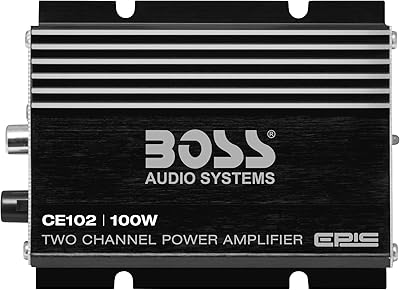
BOSS Audio CE102 2-Channel Car Amplifier
67%
83%
Value for Money
67%
Sound Quality
54%
Build Quality
81%
Ease of Installation
58%
Power Output
More
Planet Audio AC1200.2 2-Channel Car Amplifier

72%
84%
Value for Money
67%
Power Output
88%
Ease of Installation
71%
Sound Quality
58%
Thermal Performance
More
BOSS Audio R2504 4-Channel Car Amplifier
70%
82%
Value for Money
86%
Ease of Installation
51%
Power Output (Real-World)
58%
Thermal Management
62%
Build Quality
More
BOSS Audio PF1800 4-Channel Car Amplifier
71%
88%
Value for Money
84%
Ease of Installation
76%
Sound Quality
51%
Power Output Accuracy
58%
Thermal Management
More
Audiobank P1502 2-Channel Car Amplifier
69%
83%
Value for Money
81%
Ease of Installation
68%
Sound Quality
78%
Bass Performance
58%
Build Quality
More
BOSS Audio Systems OX4.400 4-Channel Car Amplifier
84%
90%
Power Output
85%
Sound Clarity & Performance
88%
Bass Enhancement
91%
Ease of Installation
80%
Build Quality
More
Stetsom HL 2000.4 2-Ohm 4-Channel Car Audio Amplifier
87%
93%
Power Output
85%
Cooling System Efficiency
88%
Sound Quality
91%
Ease of Installation
82%
Durability
More
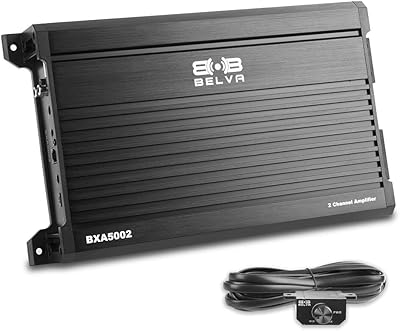
Belva BXA5002 2-Channel Car Amplifier
72%
83%
Value for Money
87%
Ease of Installation
76%
Sound Quality
58%
Power Output Accuracy
67%
Build Quality
More
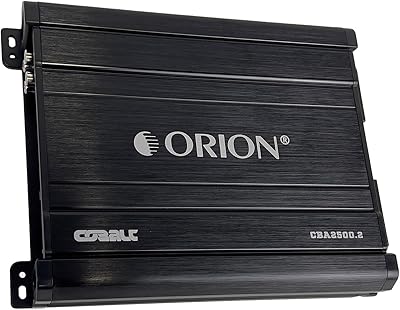
Orion Cobalt Series CBA2500.2 2-Channel Car Amplifier
88%
94%
Power Output
89%
Sound Quality
90%
Heat Management
85%
Ease of Installation
87%
Bass Boost Effectiveness
More
Stinger MT-1000.5 5-Channel Car Amplifier
75%
81%
Value for Money
84%
Ease of Installation
58%
Real-World Power Output
63%
Thermal Management
88%
Built-in Crossover Filters
More

FAQ

Not quite. That 1000W figure is a peak measurement, meaning it reflects a very brief maximum burst under ideal conditions. The real number you should plan around is the RMS rating — about 250W per channel at 4 ohms, or 500W per channel at 2 ohms. For most casual builds, that is still a meaningful step up from a standard head unit.

Not simultaneously in the traditional sense — you only have two channels to work with. However, the full-range design means you can run it as a stereo amp for speakers or bridge it to a single mono channel for a subwoofer. Some installers use it in bridged mode for a sub, then add a separate amp for speakers later as the budget allows.

Bridging combines both channels into one output with higher power. Typically, you connect the positive terminal from channel one and the negative terminal from channel two to your subwoofer, and send a mono signal to one of the inputs. Always check the wiring diagram included in the box since terminal labeling can vary — wiring it incorrectly can damage the amp or the speaker.

It does run warm, especially at higher volumes over long periods. If you are mounting it in an open trunk with airflow around it, that is usually manageable. If you are planning to tuck it under a seat or inside a sealed enclosure with no air circulation, you will want to think carefully about ventilation — several owners have flagged heat as a concern in confined spaces.

For an amp in this power class, an 8-gauge power and ground wire is generally considered the safe minimum, though some experienced installers recommend stepping up to 4-gauge for cleaner performance and lower resistance. A proper inline fuse on the power wire, close to the battery, is essential and should not be skipped.

Yes, it can work with a factory head unit. The variable gain control is specifically there to match the amp's sensitivity to the output level of whatever head unit you are using, including OEM units that output a lower voltage signal. If your stock stereo lacks dedicated RCA preamp outputs, you will also need a line output converter to step the speaker-level signal down.

It is not a volume knob. The gain control sets how sensitive the amp is to the incoming signal from your head unit. Setting it too high relative to your source signal introduces distortion; set it too low and you lose output potential. The goal is to match the two devices cleanly so the amp works from a strong, clean signal rather than amplifying noise.

For a first build aimed at noticeably better sound than factory, the PT1000 holds up well. It is straightforward to wire, the controls are not overwhelming, and the improvement over a bare head unit is real. Just go in knowing the power figures are optimistic, and do not expect it to compete with higher-end dedicated brands once your ear develops.

Reliability reports from owners are genuinely mixed. A good portion of buyers log months or even years of regular use without issues, particularly at moderate listening levels. Others report failures after sustained heavy use or when the amp is run hot consistently. It is not in the same durability league as premium brands, but for the price point, the risk is relatively low.

Any 2- to 8-ohm speaker or subwoofer within the amp's realistic continuous power output range is a reasonable match. Budget component speaker sets and entry-level 10-inch or 12-inch subwoofers in the 200W to 300W RMS range pair naturally with this BOSS amp without risking overpowering or underpowering the drivers. Avoid pairing it with high-sensitivity competition-grade subwoofers that need clean, high-headroom power to shine.

Where to Buy