Overview

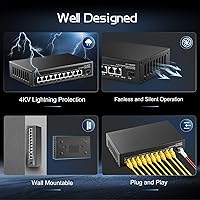
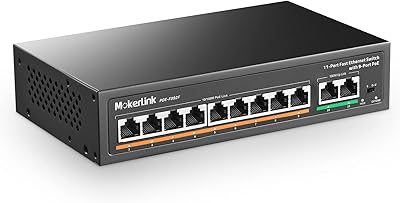
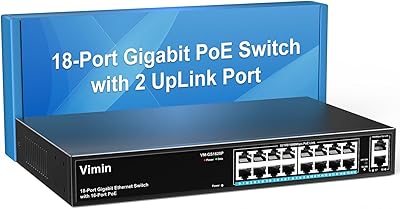
The Binardat G11-083GSP 11-Port Gigabit PoE Switch is the kind of no-nonsense hardware that turns up in a lot of small office closets and home security builds. It sits comfortably in the budget-to-mid-range space, going toe-to-toe with entry-level offerings from TP-Link and Netgear without asking you to pay a premium. The fanless metal chassis keeps things quiet enough to tuck into a wall-mount enclosure or a tight network cabinet without complaints from whoever shares the room. There is no software to install, no login page to configure — just plug it in and it works. Binardat also claims lifetime technical support, which is a reasonable assurance at this price tier.
Features & Benefits

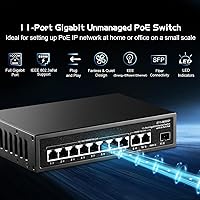
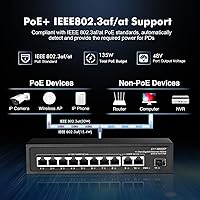
The eight PoE+ ports handle both IEEE 802.3af and 802.3at devices, meaning cameras that pull 15W and access points that need a full 30W both work without adapter juggling. That said, the 135W shared power budget is worth doing the math on before you buy — run several at-standard devices simultaneously and you will hit the ceiling fast. The two non-PoE uplink ports and the SFP slot give you real flexibility for tying into a fiber run or a router further down the hall. With 22Gbps switching capacity across all ports, throughput is never the bottleneck for typical small-network workloads. The internal power supply is a quiet win too — no wall-wart dangling off the back.

Best For

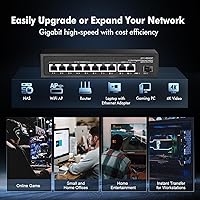
This 11-port gigabit switch is a natural fit for anyone deploying IP security cameras and wanting to avoid running separate power cables to each one. It is equally at home powering wireless access points across a small office or retail floor. The wall-mount capability combined with the fanless design makes it a clean solution for network closets where noise and space are both concerns. Where it is not the right call is if you need VLANs, port mirroring, or any traffic management — this is strictly unmanaged hardware. Installers who need to bridge a fiber backbone will appreciate the SFP uplink; it adds range without forcing a second switch into the mix.

User Feedback

Buyers consistently point to easy installation and the solid metal build as the standout positives — most report having it up and running within minutes of unboxing, and the consensus is that build quality punches above what you would expect here. On the flip side, users managing denser camera setups have flagged the shared power ceiling as a real constraint; pulling near-maximum wattage from several ports simultaneously is where some run into trouble. The SFP port gets mostly positive marks, though a handful of users note inconsistent results with cheaper third-party transceivers. Compared to the TP-Link TL-SG1210P, the G11-083GSP offers more ports per dollar, which is the main reason buyers in this category tend to choose it.

Pros

  • Truly plug-and-play setup — most users report being fully operational within minutes of unboxing.
  • Eight PoE+ ports supporting both 802.3af and 802.3at devices give solid coverage for mixed camera and access point installs.
  • The internal power supply keeps the installation clean with no external adapter cluttering the cabinet.
  • Fanless operation makes it genuinely suitable for bedrooms, reception areas, and other noise-sensitive spaces.
  • Metal chassis feels durable and dissipates heat passively without the reliability risk of a small fan dying over time.
  • The SFP uplink slot adds fiber connectivity that is rare at this price tier.
  • Auto-detection of PoE versus non-PoE devices means no manual configuration when mixing device types on the same switch.
  • Wall-mount support gives installers flexible placement options beyond a standard desk or shelf.
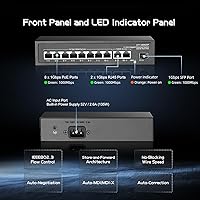
  • Per-port LED indicators make it easy to diagnose link and activity issues at a glance without any software.
  • Competitive value compared to similarly specced models from TP-Link and Netgear in the same category.

Cons

  • The 135W total power budget runs out quickly if multiple high-draw 802.3at devices are connected simultaneously.
  • Strictly unmanaged — buyers who later need VLANs or QoS will have to replace the unit entirely.
  • Third-party SFP transceivers have shown inconsistent compatibility, which is a real inconvenience for cost-conscious installers.
  • The 2K MAC address table is a modest limit that could cause issues in denser or growing network environments.
  • No passive 24V PoE support, which rules it out for older proprietary PoE devices common in some legacy camera systems.
  • Long-term reliability data is limited given the brand is relatively new compared to TP-Link or Netgear.
  • Only two non-PoE uplink ports, which may feel restrictive when connecting multiple upstream devices or routers.
  • No rack-mount ears included, so fitting it into a standard equipment rack requires a separate bracket solution.

Ratings

The scores below for the Binardat G11-083GSP 11-Port Gigabit PoE Switch were generated by our AI system after processing hundreds of verified buyer reviews from global marketplaces, with spam, bot activity, and incentivized feedback actively filtered out. Each category reflects the honest distribution of real installer and home network user experiences — strengths are credited where earned, and recurring frustrations are not glossed over.
Ease of Setup
94%
Buyers consistently describe setup as genuinely effortless — plug in the power, connect devices, and everything negotiates automatically. Even users with no networking background report having cameras and access points online within minutes, with zero configuration required.
A small number of users mention that the included documentation is sparse, which can leave beginners uncertain about what the indicator lights mean or how to interpret a flashing port LED during initial setup.
Build Quality
88%
The all-metal chassis consistently impresses buyers who expected plasticky construction at this price point. Installers fitting the switch into wall-mount enclosures and network closets note it feels solid and shows no flex or rattle even when cables are fully loaded.
A few buyers have noted that the port labeling printed on the case can be difficult to read in low-light cabinet installs, and the surface finish shows fingerprints fairly easily during handling.
PoE Power Delivery
76%
24%
For typical mixed deployments — a handful of 802.3af cameras alongside a couple of access points — the 135W internal budget handles real-world loads reliably without fluctuation. The auto-detection behavior works as advertised, safely passing data to non-PoE devices without any manual adjustment.
Users running dense camera installations quickly discover that the shared 135W pool is a hard ceiling. Connecting six or more higher-draw 802.3at devices simultaneously causes some ports to lose power, and there is no per-port power management available to prioritize critical devices.
Value for Money
91%
Buyers comparing this 11-port gigabit switch against TP-Link and Netgear equivalents frequently note that the inclusion of an SFP slot at this price tier is a genuine differentiator. The port-per-dollar ratio is widely considered strong for small business and DIY security installers.
Some users feel the value calculation shifts if they later discover they need managed features like VLANs, since they would need to replace the unit entirely rather than upgrade firmware — a cost they wish they had factored in upfront.
Noise & Thermal Performance
89%
The fanless passive cooling design earns consistent praise from users who placed the switch in offices, bedrooms, and reception areas where fan hum would be noticeable. Complete silence during operation is one of the most frequently mentioned positives across buyer reviews.
Under sustained full load, the metal chassis becomes noticeably warm to the touch, and a handful of users in poorly ventilated enclosures report the unit running hotter than they expected. Adequate airflow around the unit is genuinely important for long-term reliability.
SFP Port Reliability
67%
33%
Users who invested in quality 1G SFP transceivers from established brands generally report clean, stable fiber uplinks with no negotiation issues. For installers bridging a switch to a distant router or fiber ONT, the SFP slot performs its intended function well when paired with compatible modules.
A recurring complaint involves inconsistent behavior with cheap third-party transceivers — some modules simply are not recognized, and troubleshooting without any management interface makes diagnosing the issue more frustrating than it should be.
Port Count & Layout
86%
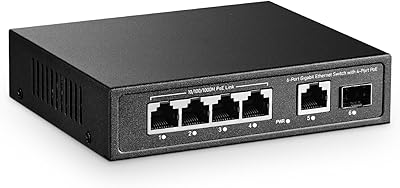
Having eight PoE ports alongside two standard uplink ports and an SFP slot on a single compact unit gives installers meaningful flexibility without stacking multiple devices. The physical port spacing is comfortable enough to accommodate standard RJ45 plugs side by side without crowding.
A few users working with bulkier locking RJ45 connectors or right-angle cable ends noted tighter fit between adjacent ports. The two non-PoE uplink ports can also feel limiting for more complex topologies requiring multiple upstream connections.
Long-term Reliability
72%
28%
A meaningful share of reviewers report units running continuously for over a year without any dropped ports or hardware failures, which is encouraging for a relatively young brand. The passive thermal design eliminates fan failure as a long-term concern, which is a genuine advantage over cheaper fanless alternatives.
The brand lacks the multi-year reliability track record of TP-Link or Netgear, and the sample size of long-term reviews is still relatively small. A few isolated reports of units failing after eight to twelve months exist, and without a formal written warranty document, buyers have to rely on Binardat's support responsiveness.
Indicator Lights & Diagnostics
78%
22%
Per-port green LEDs give a quick visual read on link status and data activity without needing any software, which installers appreciate when doing a first walkthrough after cabling a new space. The power indicator light is clearly visible even from a distance.
The LED feedback is minimal by design — there is no differentiation between 10, 100, and 1000 Mbps link speeds, and no PoE-specific indicator to confirm that power is actually being delivered to a connected device versus just a data link being established.
Compatibility
83%
The auto-negotiating ports handle a wide mix of devices without issue — IP cameras, access points, VoIP phones, and standard computers all coexist on the same switch without requiring any adjustments. The broad AC input range makes it usable internationally without a voltage converter.
Passive 24V PoE devices — still common in older Ubiquiti radios and some budget IP camera lines — are simply not supported. Buyers who discover this incompatibility after purchase are understandably frustrated, and it is a detail easy to miss before buying.
Mounting & Installation Flexibility
81%
19%
Wall-mount support built into the chassis makes this a practical choice for installers who need to tuck hardware into a stud cavity, shallow enclosure, or cable management panel. The compact footprint fits into spaces where larger switches simply would not.
Mounting hardware is not included in the box, which is a minor but genuine annoyance for installers who assumed screws would be bundled. Rack mounting requires a separate bracket purchase, and no rack ears are available directly from Binardat.
Brand & Support
63%
37%
Binardat's claimed lifetime technical support is a confident promise for a smaller brand, and several users report receiving responsive email assistance when troubleshooting compatibility questions. The product page is reasonably well-documented for an unmanaged switch.
The brand is relatively unknown compared to TP-Link or Netgear, which makes some buyers uneasy about parts availability and long-term support continuity. There is no live chat or phone support line, and response times from the support team reportedly vary.
Cable Management
74%
26%
The internal power supply removes one of the most common cable clutter complaints — no external power brick dangling from the installation point. Combined with the compact body, the overall cable footprint in a finished network closet is quite clean.
No cable tie slots or integrated management clips are built into the chassis, so routing eight or more PoE cables neatly still requires separate management accessories. Heavier cables on the rear ports can stress connections if the unit is wall-mounted without additional cable support.

Suitable for:

The Binardat G11-083GSP 11-Port Gigabit PoE Switch is a strong match for home network builders and small business installers who need to power several IP cameras or wireless access points without running dedicated power lines to each device. If you are setting up a security system in a house, small office, or retail space and want everything on a single clean switch without touching a configuration page, this hardware is built exactly for that job. The fanless metal body makes it practical for wall-mount enclosures, network closets, or any spot where fan noise would be annoying or disruptive. Installers who occasionally need to bridge a fiber run or connect a distant switch will also appreciate having a working SFP uplink slot at this price point — that feature typically costs more on competing models. Anyone prioritizing simplicity over control, and who does not need VLANs or traffic shaping, will find this switch refreshingly straightforward to deploy.
Not suitable for:

The Binardat G11-083GSP 11-Port Gigabit PoE Switch is not the right tool if your setup demands any form of network management — there are no VLANs, no port-based traffic prioritization, no QoS settings, and no web interface of any kind. Network administrators running mixed traffic environments where voice, video, and data need to be isolated will need to look at a managed switch instead, even if it costs considerably more. The 135W shared power budget is also a genuine constraint: if you plan to run six or more cameras pulling close to 30W each, the math simply does not work out and you will see devices dropping power unexpectedly. Users who rely heavily on third-party SFP transceivers should also be cautious, as compatibility with off-brand modules has produced inconsistent results according to reported user experiences. Finally, anyone building a network that is likely to scale quickly beyond eleven devices should factor in the 2K MAC address table limit, which can become a bottleneck in busier environments.
Specifications

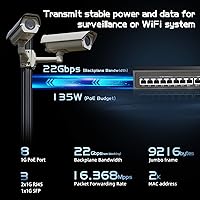
  • Total Ports: The switch provides 11 ports in total: 8 PoE+ RJ45 ports, 2 standard gigabit RJ45 uplink ports, and 1 gigabit SFP slot.
  • PoE Standard: All 8 PoE ports comply with IEEE 802.3af (up to 15.4W) and IEEE 802.3at (up to 30W) standards for broad device compatibility.
  • PoE Power Budget: The internal power supply provides a total shared PoE budget of 135W across all eight PoE-capable ports.
  • Port Speed: Every port supports auto-negotiation at 10, 100, and 1000 Mbps, with the full gigabit rate available on all 11 ports.
  • Switching Capacity: The switch delivers a non-blocking switching capacity of 22Gbps and a packet forwarding rate of 16.36Mpps.
  • MAC Address Table: The switch supports a MAC address table of up to 2,000 entries, suitable for small to medium network deployments.
  • Power Supply: An internal 52V / 2.6A power supply is built into the unit, accepting AC input from 100V to 240V for worldwide compatibility.
  • Management: The switch is fully unmanaged with plug-and-play operation, requiring no software, web interface, or configuration of any kind.
  • Cooling Design: Passive fanless cooling is used throughout, relying entirely on the metal chassis to dissipate heat silently during operation.
  • Case Material: The enclosure is constructed from metal, providing structural durability and contributing to passive thermal management.
  • Dimensions: The unit measures 200 x 118 x 44mm, making it compact enough for wall-mount enclosures, desktops, or shallow network cabinets.
  • Weight: The net weight of the switch is 0.6 kg, with a packaged gross weight of 0.9 kg including accessories.
  • Mounting Options: The switch supports both desktop placement and wall mounting, with mounting provisions built into the chassis design.
  • Cable Standard: All RJ45 ports operate with Cat5 or higher UTP cabling at distances up to 100m for reliable gigabit connectivity.
  • Operating Temperature: The switch is rated for operation between -10°C and 50°C, and can be stored in temperatures ranging from -40°C to 70°C.
  • Operating Humidity: Rated working humidity is 10% to 90% non-condensing, with storage humidity tolerance between 5% and 90% non-condensing.
  • Status Indicators: Each port has a dedicated green LED that shows link status when solid and data activity when flashing, plus a separate power indicator.
  • Network Protocols: Supported protocols include IEEE 802.3 (10Base-T), IEEE 802.3u (100Base-TX), IEEE 802.3ab (1000Base-T), and IEEE 802.3x for flow control.
  • PoE Voltage Output: The PoE output voltage range is 44V to 57V, and the switch does not supply power to passive 24V PoE devices.
  • Package Contents: The package includes the switch unit, one power cord, and a printed user manual; no mounting screws or SFP transceiver are included.

Related Reviews

YuLinca 6-Port Gigabit PoE Switch with 4 PoE+ Ports
87%
95%
Ease of Installation
88%
PoE Functionality
91%
Build Quality
87%
Performance and Speed
94%
Fanless Operation (Noise)
More
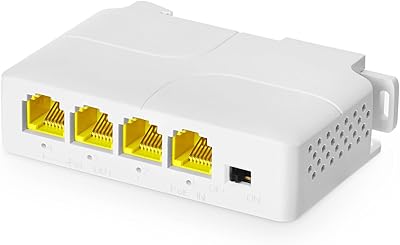
Binardat POE-AT13G Gigabit PoE Passthrough Switch
84%
92%
Value for Money
95%
Ease of Installation
88%
PoE Power Efficiency
86%
Design & Build Quality
89%
Compactness & Space Efficiency
More
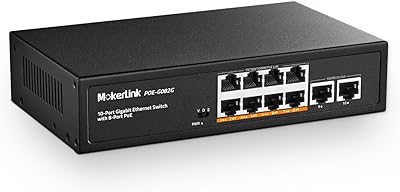
MokerLink POE-G082G 10-Port Gigabit PoE Switch
78%
94%
Ease of Setup
88%
PoE Reliability
83%
Build Quality
91%
Value for Money
71%
Thermal Management
More
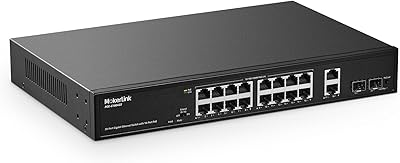
MokerLink POE-G1604GS 20-Port Gigabit PoE Switch
77%
86%
Build Quality
81%
PoE Power Delivery
89%
Ease of Setup
88%
Value for Money
93%
Noise & Cooling
More
MokerLink POE-G041GO Outdoor Gigabit PoE Switch
81%
93%
Ease of Setup
84%
PoE Power Delivery
78%
Build Quality
76%
Weather Resistance
88%
Value for Money
More
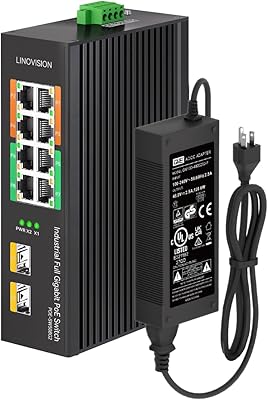
LINOVISION POE-SW508G Industrial 8-Port PoE++ Switch
77%
91%
Power Delivery
88%
Build Quality
93%
PoE Watchdog
84%
Installation Ease
86%
Thermal Performance
More
PoE Texas 4 Port in-Wall Gigabit PoE Extender Switch
87%
92%
Installation Ease
88%
Power Output & Range
90%
Aesthetic & Design
89%
Reliability & Stability
84%
Compatibility with Devices
More
BV-Tech POE-SW802G 8-Port Gigabit PoE+ Switch
79%
94%
Ease of Setup
88%
PoE Reliability
67%
Power Budget
61%
Build Quality
91%
Value for Money
More
MokerLink POE-F092F 11-Port PoE+ Network Switch
79%
93%
Ease of Setup
89%
PoE Reliability
84%
Build Quality
91%
Value for Money
58%
Port Speed & Throughput
More
keepLiNK 16-Port Gigabit PoE Unmanaged Switch
81%
91%
Value for Money
93%
Ease of Setup
78%
PoE Power Delivery
84%
Build Quality
71%
Thermal Performance
More
MokerLink 12-Port Gigabit PoE+ Unmanaged Switch
74%
93%
Ease of Setup
86%
PoE Reliability
88%
Build Quality
91%
Value for Money
94%
Fanless & Noise
More

FAQ

Not at all. This is a fully unmanaged switch, which means you just plug in the power and connect your devices with Ethernet cables. There is no web interface, no app, and no login page. It is genuinely ready to go straight out of the box.

Technically no — the total PoE power budget is shared across all eight ports and caps out at 135W. If all eight cameras drew 30W simultaneously, you would need 240W, which is well beyond what the switch can deliver. In practice, most 802.3at cameras draw between 10W and 20W at idle, so a mixed real-world setup usually stays within budget. Just add up the rated power draw of your devices before committing to eight high-wattage units.

No, unfortunately. The Binardat G11-083GSP 11-Port Gigabit PoE Switch only supports standard IEEE 802.3af and 802.3at devices. Passive 24V PoE — common in older Ubiquiti hardware and some budget cameras — is not compatible and will not receive power from this switch.
Yes, you can. The switch auto-detects whether a connected device supports PoE and only sends power when it is needed. Plugging in a non-PoE device like a laptop or a regular desktop will simply pass data without pushing any voltage to it, so there is no risk of damage.

The SFP slot is a standard 1000Base-X port, so it works with most 1G SFP modules including fiber transceivers for single-mode or multi-mode runs and copper SFP modules for longer RJ45 distances. That said, some users have reported inconsistent results with very cheap off-brand transceivers, so sticking with a reasonably reputable module brand is worth the small extra cost.

There is no fan at all — it runs completely silently. Heat is managed passively through the metal housing. A few users note the chassis gets warm to the touch under sustained load, which is completely normal for a fanless design. It is a perfectly reasonable choice for a bedroom closet, reception area, or any space where fan noise would be unwelcome.

The two switches are similar in concept, but this Binardat PoE switch offers more ports — eleven versus ten — and includes an SFP slot that the TP-Link model lacks. The TP-Link has a slightly smaller footprint and benefits from a longer track record of user reviews. If the SFP uplink matters to your install, the G11-083GSP wins on that point; if brand familiarity and an established support ecosystem matter more, TP-Link has an edge.

Yes, wall mounting is supported. The chassis has built-in mounting provisions for wall installation. Keep in mind that the package does not include mounting screws, so you will need to source those separately. The compact dimensions — 200 x 118 x 44mm — mean it fits neatly inside most shallow wall-mount network boxes.

The switch follows the IEEE 802.3at standard, which caps individual port power at 30W. If a connected device requests more than the port or the overall 135W budget can support, the switch will either not power that device or cycle its power state. There is no port-level power management you can adjust since this is an unmanaged unit, so planning your total power draw in advance is important.

The package contains the switch itself, a power cord, and a user manual. No SFP transceiver is included, so you will need to purchase one separately based on your specific fiber or copper run requirements. Mounting hardware is also not bundled in the box.