Overview

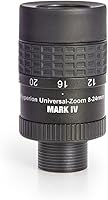
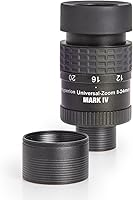
The Baader Hyperion Mark IV 8-24mm Zoom Eyepiece is the fourth iteration of a zoom design that Baader Planetarium has been steadily refining, and the changes are real. Unlike earlier generations, the Mark IV ships with both a 1.25″ and a 2″ barrel already included, so you won't need a separate adapter to fit most telescopes. That dual-barrel flexibility removes a common compatibility headache right out of the box. The 68° field of view is wider than most zoom eyepieces in this class manage, and it holds up well across the focal length range. There's also an M43 camera thread built in, which opens the door to afocal photography without needing a dedicated projection eyepiece.

Features & Benefits

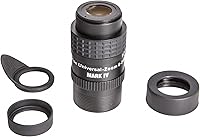
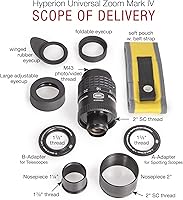
The five focal-length positions — 8, 12, 16, 20, and 24mm — each lock in with a satisfying tactile click. That might sound minor, but when you're tracking Saturn with cold hands or running two of these in a binoviewer, a detent you can feel without looking down genuinely changes the experience. The Phantom Coating Group multicoatings keep contrast high and internal reflections minimal; stars stay pinpoint and the background holds dark even near the field edge. Three eyecup styles are included, covering glasses wearers and those who prefer a closer or more relaxed eye position. At 16 ounces, the Baader Hyperion zoom sits on the heavier side — worth checking your focuser's load tolerance before committing.

Best For

This zoom eyepiece suits observers who want a wide observing range without hauling a full case of glass. Picture a typical session: you start at 24mm to star-hop to a galaxy cluster, click up to 12mm for a closer look, then push to 8mm when steady seeing lets you dig into Jupiter's cloud bands — all without touching your eyepiece case. Binoviewer users benefit especially, since matched clickstops lock both eyes to the same focal length reliably. Frequent travelers and star-party regulars will value the compact kit. Spotting-scope owners with a 1 3/8″ thread, particularly Celestron and Sky-Watcher users, get native compatibility without any additional hardware.

User Feedback

Buyer consensus leans positive, with consistent praise for edge-of-field sharpness — something not always guaranteed in a zoom at this tier. The clickstop mechanism earns repeated mentions as notably more refined than competing designs, and binoviewer owners specifically call it the feature that justified the purchase. That said, a recurring criticism surfaces at the 8mm position on fast focal-ratio scopes: field curvature becomes noticeable, and some buyers describe softness toward the edge at that magnification. It's a known zoom trade-off rather than a unique flaw. Several reviewers also note that this Baader optic compared favorably to assembling an equivalent set of fixed focal-length eyepieces at similar combined cost.

Pros

  • Five clickstop focal lengths let you change magnification one-handed without losing your dark adaptation.
  • Ships with both 1.25″ and 2″ barrels included, so nearly any telescope focuser is covered from day one.
  • The 68° apparent field of view is unusually wide for a zoom, making star-hopping feel genuinely comfortable.
  • Phantom Coating Group multicoatings deliver strong contrast and keep internal reflections to a minimum.
  • Binoviewer owners get reliable, matched focal-length clicks that freewheel zooms cannot replicate.
  • Three interchangeable eyecup styles mean glasses wearers are not an afterthought.
  • The built-in M43 thread opens up afocal and projection photography without extra hardware.
  • Replaces several fixed eyepieces in one package, which can simplify a travel kit significantly.
  • The clickstop action holds up well in cold temperatures, where stiff or vague zoom rings become a real annoyance.
  • A 4.3-star average across over 100 ratings reflects a consistently positive real-world ownership experience.

Cons

  • At 16 ounces, the Baader Hyperion zoom can upset balance on lightweight or older focusers not rated for the load.
  • Field curvature at the 8mm position becomes noticeable on fast focal-ratio scopes, limiting edge-to-edge sharpness.
  • No zoom eyepiece fully matches the optical performance of a premium fixed-focal-length eyepiece at the same magnification.
  • The clickstop positions are fixed at 8, 12, 16, 20, and 24mm — there is no in-between adjustment if your ideal magnification falls elsewhere.
  • The asking price is a significant investment that demands careful thought if casual observing is the primary use case.
  • Spotting-scope compatibility is limited to specific thread sizes; not all spotting scopes will accept this optic natively.
  • Users who rarely need the binoviewer or photography features are paying for capabilities they may never use.
  • Comparing it directly to a custom-matched set of fixed eyepieces at similar total cost, the fixed set will win on peak optical quality.

Ratings

The scores below reflect an AI-driven analysis of verified global buyer reviews for the Baader Hyperion Mark IV 8-24mm Zoom Eyepiece, with spam, bot-generated, and incentivized feedback actively filtered out before scoring. Each category is weighted against real observing scenarios reported by owners worldwide, from backyard planetary sessions to binoviewer setups at dark-sky sites. Both the genuine strengths and the recurring frustrations are represented transparently so you can make a genuinely informed decision.

Optical Clarity
86%
Reviewers consistently describe sharp, high-contrast views across the mid-range focal lengths, with stars holding their shape well toward the field edge. The Phantom Coating Group multicoatings draw specific praise for keeping backgrounds dark and reducing the washed-out look that cheaper zoom eyepieces often produce on bright targets like the Moon.
At the 8mm position, especially on scopes running at f/5 or faster, a noticeable softening appears toward the outer field — a limitation that several buyers flagged after expecting fixed-eyepiece-level performance at every zoom stop.
Clickstop Mechanism
93%
The tactile clickstops are arguably the most praised single feature across all reviews. Owners describe the detent action as firm, satisfying, and reliable even during cold-night sessions where gloved hands make fine motor control difficult. Binoviewer users specifically credit the clickstops for making matched focal-length positioning straightforward and repeatable.
A small number of users noted that the five fixed positions leave gaps — if your ideal magnification falls between 12mm and 16mm, for instance, there is simply no in-between stop, which can feel limiting on certain telescope and target combinations.
Barrel Compatibility
91%
Including both a 1.25″ and a 2″ barrel in the box is a practical decision that owners genuinely appreciate, removing the need to source a separate adapter after purchase. The fit is tight and secure in both sizes, with no wobble reported in either configuration across a wide range of telescopes.
A handful of buyers who own spotting scopes outside the Celestron and Sky-Watcher ecosystem found that the 1 3/8″ compatibility did not extend to their specific model, meaning the included barrels were still not a direct fit without further adapter work.
Value for Money
74%
26%
Owners who came from a background of swapping between multiple fixed eyepieces found the consolidated functionality genuinely cost-effective when measured against assembling an equivalent range in separate glass. The binoviewer use case in particular makes the price look more reasonable, since you would need two of any alternative.
Buyers who primarily do casual, single-target visual observing found it harder to justify the investment when a modest set of fixed eyepieces could serve their needs at lower total cost. The price point demands a clear and frequent use for the zoom range to feel fully earned.
Build Quality
88%
The physical construction draws consistent praise for feeling robust and well-machined rather than plasticky. The zoom ring moves smoothly without the gritty or stiff feel that some competing zoom designs develop after light use, and owners report no degradation in action quality after extended ownership.
At 16 oz, the eyepiece is heavier than many buyers anticipate, and a few noted that their lightweight refractor focusers struggled to hold it securely at certain angles without slippage, requiring drawtube tension adjustments they had never needed before.
Eyecup Versatility
82%
18%
Three interchangeable eyecup styles cover a genuine range of observing preferences, and glasses-wearing buyers specifically called out the winged foldable eyecup as well-designed for their needs rather than a token inclusion. Swapping between cups takes seconds and requires no tools.
A few users found that the large rubber cup, while comfortable for extended sessions, added enough height to make the eye placement feel awkward when the zoom was set to shorter focal lengths with tighter eye relief.
Eye Relief
71%
29%
Eye relief is workable across most of the zoom range, and owners observing without glasses generally report no discomfort during extended planetary sessions at 12mm to 20mm. The foldable eyecup helps manage the relief distance effectively for the majority of users.
At 8mm, eye relief tightens noticeably, which is a known trade-off for zoom designs at the high-magnification end. Glasses wearers in particular flagged this position as uncomfortable for more than brief use, sometimes forcing them to remove their glasses to see the full field.
Field of View Width
84%
A 68° apparent field of view stands out in the zoom eyepiece category, where most competitors offer 60° or less. Owners describe star-hopping at 24mm as genuinely comfortable rather than the narrowed, porthole-like experience common in cheaper zoom designs.
Some buyers noted that the full 68° field felt slightly harder to maintain at the 8mm position, where edge sharpness on faster scopes partially undercuts the benefit of the wide apparent angle.
Photography Utility
67%
33%
The built-in M43 thread is a genuine bonus for observers who occasionally want to attach a camera for afocal or projection shots of the Moon or bright planets. Owners who already had M43-compatible adapters in their kit found the integration straightforward and avoided buying a separate projection eyepiece.
Serious astrophotographers noted that afocal setups introduce optical limitations that make this a casual imaging tool rather than a production-grade one. The feature earns goodwill but is rarely the deciding purchase reason for buyers who need consistent imaging results.
Binoviewer Performance
89%
Binoviewer owners represent one of the most satisfied subgroups in the review pool, specifically because the clickstop design eliminates the tedious process of manually matching focal lengths between two eyepieces. Several buyers described purchasing a second unit after positive initial experience, which is a meaningful signal of satisfaction.
The weight of two units combined can challenge focusers on lighter telescopes, and a few binoviewer users noted that their optical train needed additional counterbalancing when running this configuration on smaller alt-az mounts.
Cold-Weather Usability
83%
The clickstop mechanism and smooth zoom ring function reliably in cold conditions, which real-world observers noted after sessions in sub-zero temperatures. Gloved operation is genuinely feasible, which is more than can be said for some competing zoom designs with stiff or poorly dampened rings.
A small number of buyers in very cold climates reported that the rubber eyecups became slightly stiffer in freezing temperatures, making the swapping process less comfortable mid-session than it is under moderate conditions.
Contrast & Coatings
87%
The multicoating performance draws genuine praise specifically in the context of lunar and planetary viewing, where internal reflections and ghost images can ruin fine detail. Owners describe backgrounds as reassuringly dark even when a bright object sits near the center of the field.
A few users comparing it directly against high-end fixed eyepieces with comparable coatings noted that the Baader Hyperion zoom’s additional internal elements create marginally more light scatter than a simpler fixed optical design would, though the difference is subtle in practical use.
Spotting Scope Fit
63%
37%
Celestron and Sky-Watcher spotting scope owners with the correct 1 3/8″ thread reported smooth, direct compatibility without hunting for third-party adapters. This makes the Baader Hyperion zoom a legitimate dual-purpose optic for terrestrial and astronomical use in those cases.
Compatibility outside Celestron and Sky-Watcher spotting scopes is inconsistent, and several buyers discovered only after purchase that their specific scope model required an additional adapter. The listing could be clearer about which spotting scope brands and models are genuinely supported.
Packaging & Included Accessories
79%
21%
Buyers were generally pleased to find both barrels and all three eyecup styles included in a single box, which reduced the typical accessory-hunting exercise that follows many premium eyepiece purchases. The protective case and caps received positive mentions for keeping the glass secure during transport.
A small number of buyers noted that the packaging, while functional, did not feel proportionate to the premium price tier — expectations around presentation tend to run higher at this investment level, and a few found the unboxing experience underwhelming compared to European optical competitors.

Suitable for:

The Baader Hyperion Mark IV 8-24mm Zoom Eyepiece is a strong match for visual astronomers who spend a typical night moving between wide-field browsing and high-magnification planetary work without wanting to fumble through an eyepiece case in the dark. Binoviewer users in particular get outsized value here, because the clickstop positions let you lock two copies to identical focal lengths reliably and repeatably — something freewheel zoom designs simply cannot offer. Frequent travelers and star-party regulars benefit from consolidating their observing range into a single piece of glass, reducing both bag weight and setup time. Spotting-scope owners using Celestron or Sky-Watcher models with a 1 3/8″ thread will find native compatibility without hunting for adapters. Anyone who dabbles in afocal or projection photography will appreciate the built-in M43 thread, which turns this optic into a flexible camera interface without buying a second eyepiece.
Not suitable for:

Observers who own fast focal-ratio telescopes — typically f/5 or shorter — and prioritize razor-sharp views to the very edge of the field at high magnification should think carefully before committing to the Baader Hyperion Mark IV 8-24mm Zoom Eyepiece. At the 8mm position on a fast scope, field curvature becomes noticeable, and edge sharpness trails what a dedicated, well-corrected fixed eyepiece in that focal length would deliver. If your primary interest is serious deep-sky imaging rather than visual observing, a purpose-built imaging train will outperform any afocal setup this optic enables. Budget-focused buyers equipping a first telescope will also find the asking price steep relative to a small set of decent fixed-focal-length eyepieces that could cover similar magnification range for less. Finally, those who already own a complete, well-matched set of fixed eyepieces spanning 8 to 24mm will struggle to justify the added expense for a marginal gain in convenience.

Specifications

  • Focal Length: The zoom range spans 8mm to 24mm, with five locked positions at 8, 12, 16, 20, and 24mm.
  • Field of View: Apparent field of view is 68° across the full zoom range, which is notably wide for this category.
  • Barrel Size: Ships with both a 1.25″ and a 2″ barrel included, covering the two most common focuser sizes without additional adapters.
  • Spotting Thread: A 1 3/8″ thread allows direct use with compatible Celestron and Sky-Watcher spotting scopes.
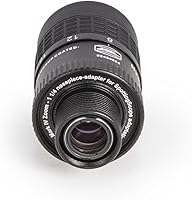
  • Camera Thread: An integrated M43 photo/video thread supports afocal and classical projection photography with optional camera adapters.
  • Lens Coating: All optical surfaces receive Baader’s Phantom Coating Group multicoatings for high contrast and minimal internal reflections.
  • Clickstops: Each of the five focal-length positions engages with a positive tactile detent, providing repeatable positioning without visual confirmation.
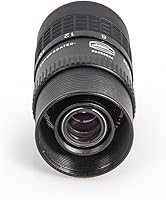
  • Eyecup Options: Three eyecup styles are included: a large adjustable rubber cup, a smaller straight rubber cup, and a winged foldable cup for eyeglass wearers.
  • Weight: The eyepiece weighs 16 oz (approximately 1 lb), which is on the heavier side and worth checking against focuser load ratings.
  • Dimensions: Overall dimensions measure 6.3″ in depth by 3.15″ in width by 3.15″ in height.
  • Generation: This is the Mark IV, the fourth major revision of Baader Planetarium’s Hyperion zoom eyepiece line.
  • Manufacturer: Designed and manufactured by Baader Planetarium, a German optics company with a long history in astronomical accessories.
  • Release Date: The Mark IV variant was first made available in February 2017.
  • Compatibility: Compatible with any telescope or spotting scope accepting 1.25″ or 2″ focusers, and select scopes with 1 3/8″ threaded eyepiece holders.
  • User Rating: Holds an average rating of 4.3 out of 5 stars based on over 100 verified buyer reviews on Amazon.
  • Market Rank: Ranked #97 in the Telescope Eyepieces category on Amazon at the time of this review.
  • Discontinuation: The product is currently active and has not been discontinued by the manufacturer.

Related Reviews

Canon EOS 5D Mark IV
82%
93%
Image Quality
89%
Autofocus Performance
94%
Build Quality & Durability
61%
Video Capabilities
88%
Low-Light Performance
More
K&F Concept 8-32X50 Zoom Monocular
75%
83%
Optical Clarity (Low-to-Mid Zoom)
57%
Optical Clarity (Max 32x Zoom)
81%
Build Quality & Durability
78%
Waterproofing & Weather Resistance
86%
Zoom Range & Flexibility
More
Billy Jealousy Marked IV Complete Tattoo Care Kit
87%
90%
Effectiveness in Healing
88%
Skin Sensitivity Compatibility
93%
Moisturization and Hydration
91%
Tattoo Vibrancy Maintenance
85%
Gentleness on Skin
More
7artisans 60mm F2.8 Mark II Macro Lens
77%
84%
Optical Sharpness
88%
Bokeh Quality
81%
Build Quality
91%
Value for Money
79%
Focus Ring Feel
More
Canon EF-S 24mm f/2.8 STM Lens
79%
88%
Image Sharpness
82%
Autofocus Performance
61%
Build Quality
96%
Portability & Size
74%
Low-Light Capability
More
SVPRO 1080P HD Webcam with 2.8-12mm Zoom Lens
87%
88%
Video Quality
91%
Zoom Lens & Manual Focus
85%
Ease of Setup
93%
Compatibility
80%
Build Quality
More
Viltrox AF 85mm F1.8 Mark II Lens
81%
86%
Autofocus Speed
91%
Autofocus Noise
88%
Center Sharpness
63%
Edge & Corner Sharpness
79%
Bokeh Quality
More
Sony FE 16-35mm F2.8 GM Zoom Lens
82%
94%
Optical Sharpness
91%
Aperture Consistency
89%
Autofocus Performance
88%
Build Quality & Weather Sealing
86%
Distortion Control
More
7artisans 7.5mm f2.8 Mark II Fisheye Lens for Canon RF
85%
88%
Image Quality
92%
Build Quality
65%
Ease of Use (Manual Focus)
90%
Portability
85%
Low-Light Performance
More
Canon EF 8-15mm f/4L Fisheye Zoom Lens
82%
93%
Optical Sharpness
91%
Zoom Versatility
88%
Autofocus Performance
94%
Build Quality
61%
Low-Light Capability
More

FAQ

In most cases, no. The Baader Hyperion Mark IV 8-24mm Zoom Eyepiece ships with both a 1.25″ and a 2″ barrel already included in the box, so it will fit directly into the focuser on virtually any modern telescope. The only exception would be older or non-standard focusers that fall outside those two sizes.
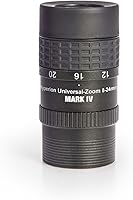
Clickstops are physical detents built into the zoom ring that lock the eyepiece at each of the five focal-length positions — 8, 12, 16, 20, and 24mm. Instead of a smooth, continuous wheel you can accidentally nudge, each position snaps in and holds firm. That matters most when you’re dark-adapted and don’t want to look away from the eyepiece, or when you’re running two of these in a binoviewer and need both sides at exactly the same focal length.

Yes, and this is one of the strongest use cases for the Baader Hyperion zoom. Because the focal-length positions click into fixed detents, you can set two of them to the same position reliably every time without measuring or guessing. Binoviewer users consistently rate this as one of the eyepiece’s standout advantages over freewheel zoom designs.

It handles both well in practice. At 24mm you get a wide, comfortable field for sweeping star fields and locating faint objects; click up to 8mm and you’re into useful planetary territory. The caveat is that on fast focal-ratio scopes — roughly f/5 or below — you may notice some edge softness at 8mm compared to a dedicated planetary eyepiece. On slower scopes, that issue largely disappears.

Yes. The package includes three different eyecup styles, one of which is a winged foldable design specifically suited to eyeglass wearers. You can swap between them depending on your setup or personal preference, which is a thoughtful inclusion that many competing eyepieces skip entirely.

The eyepiece has a built-in M43 thread, which is a standard video and photo mount size. With the right adapter for your specific camera system, you can set up afocal photography — where the camera shoots through the eyepiece as if it were your eye — or classical projection photography. It is not a substitute for a dedicated astrophotography rig, but it is a genuinely useful bonus for casual imaging.

Many Celestron and Sky-Watcher spotting scopes use a 1 3/8″ threaded eyepiece holder, and this Baader optic is designed to be compatible with that size. That said, spotting scope designs vary, so it is worth confirming your specific model’s eyepiece thread before purchasing.

It is a fair trade-off to think through. Fixed eyepieces at comparable individual quality will generally outperform any zoom at their specific focal length, particularly at the field edge. However, assembling a matched set covering 8mm through 24mm at equivalent optical quality adds up quickly in both cost and weight. The Baader Hyperion zoom sits at a point where the convenience and versatility genuinely justify the compromise for most visual observers.

For most mid-range and premium telescopes with rack-and-pinion or Crayford focusers, 16 oz is within acceptable limits but worth checking. Where it becomes an issue is on lightweight refractors or older focusers with limited clamping force, where the eyepiece can cause the focuser to slip or droop. Check your focuser’s specified load rating before committing, especially if you plan to use this in a 2″ configuration.

Use a soft lens brush or air blower to remove loose dust first — never wipe dry glass. If further cleaning is needed, use a lens tissue or a microfiber cloth specifically designed for optics, lightly moistened with a lens cleaning solution free of ammonia or alcohol. Avoid pressing hard, work from the center outward in small circles, and never use paper towels or clothing, which can scratch multicoated surfaces.

Where to Buy