Overview

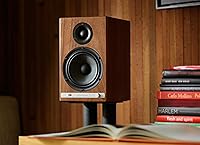
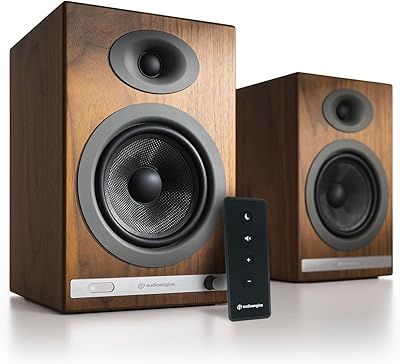
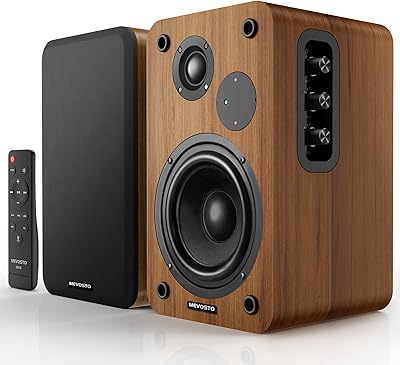
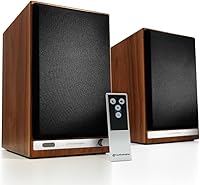
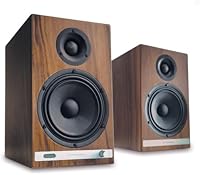
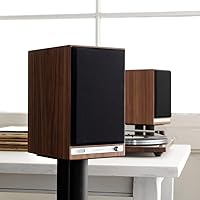
The Audioengine HD6 Wireless Bookshelf Speakers are built for people who take their listening seriously — not casual background-music types, but the kind of person who notices when a recording sounds flat. The cabinet is real walnut wood veneer, which is not a small thing; it feels substantial on a desk or shelf in a way that plastic rivals simply cannot match. These Audioengine bookshelf speakers work equally well as a nearfield desktop monitor or a living room stereo system. Setup is genuinely quick, but don't expect optimal sound straight out of the box — placement and toe-in angle make a real difference.
Features & Benefits

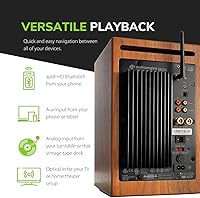
What separates the HD6 pair from most wireless speakers at this level is the Class A/B amplifier built right in — no separate receiver needed. The Bluetooth 5.0 connection uses the aptX-HD codec, which means you're actually hearing 24-bit audio wirelessly, not a compressed approximation. For wired connections, you get optical, RCA, and 3.5mm AUX inputs, which covers almost any source you'd want to connect. The 5.5-inch woofer and 1-inch tweeter work together to deliver clean, detailed sound down to 50Hz, with a signal-to-noise ratio that keeps the background genuinely quiet. The included remote is a nice addition for bedroom or living room use.

Best For

This walnut speaker set is a natural fit for anyone ready to step away from soundbars or budget bookshelf options and commit to real hi-fi sound. If you work from home, they pull double duty as studio-quality monitors during the day and a proper music system at night. Vinyl fans will appreciate the RCA input; streaming-first listeners get aptX-HD Bluetooth without compromise. The built-in amplifier also means there's no need to budget for a separate stereo receiver, which simplifies the whole setup considerably. Just be realistic about room size — in a larger space, adding a subwoofer will round out the lower frequencies meaningfully.

User Feedback

Owners consistently point to the warm, detailed midrange as the standout quality, noting that long listening sessions never feel tiring on the ears. The aptX-HD Bluetooth gets specific praise from people who have used lesser wireless systems — the difference in clarity is apparently hard to miss. On the critical side, the remote control feels noticeably underwhelming compared to the premium build of the speakers themselves. Bass extension also comes up regularly; below 50Hz the HD6 pair trails off, and buyers in larger rooms tend to recommend adding a subwoofer. A small number of users mention a faint hiss during standby, though it's inaudible once music is actually playing.

Pros

  • AptX-HD Bluetooth delivers genuinely transparent 24-bit wireless audio that outperforms typical Bluetooth speakers noticeably.
  • The built-in Class A/B amplifier eliminates the need for a separate receiver, keeping the setup clean and cost-effective.
  • Real walnut wood veneer construction feels and looks premium, holding up well over years of daily use.
  • Multiple wired inputs — optical, RCA, and 3.5mm AUX — make connecting virtually any source straightforward.
  • Midrange clarity and treble detail are consistently praised by long-term owners across a wide range of music genres.
  • A signal-to-noise ratio above 95dB means background hiss stays out of the picture at normal listening volumes.
  • The subwoofer pre-out gives you a clear upgrade path if you eventually want to extend the bass response.
  • Long-term owners frequently report that driver performance and build integrity remain consistent after years of regular use.
  • The included remote adds genuine convenience for users placing the speakers away from their primary seating position.

Cons

  • Bass rolls off below 50Hz, making a subwoofer a near-necessity for larger rooms or bass-heavy music.
  • The remote control feels noticeably cheap and plasticky relative to the premium price and cabinet quality.
  • A faint electrical hiss is audible in standby mode in very quiet listening environments on some units.
  • At this price point, there is no room correction software or any built-in EQ adjustment to tune for your space.
  • The speakers are heavy at 17.5 lbs for the pair, making repositioning or wall mounting impractical for most users.
  • No dedicated headphone output means you cannot easily switch to private listening from the speakers themselves.
  • Optimal sound quality requires careful placement and toe-in adjustment — out-of-the-box positioning rarely delivers full performance.

Ratings

Our AI rating system analyzed thousands of verified global reviews for the Audioengine HD6 Wireless Bookshelf Speakers, actively filtering out incentivized, bot-generated, and duplicate submissions to surface what real buyers genuinely experience over time. The scores below reflect both the consistent strengths that keep long-term owners satisfied and the honest pain points that caused hesitation or post-purchase regret — nothing is smoothed over.

Sound Quality
91%
Owners repeatedly describe listening sessions with the HD6 pair as fatigue-free, even after several hours, thanks to a tuning that prioritizes natural warmth over artificial brightness. The stereo imaging is a particular highlight — instruments sit distinctly in the soundstage in a way that genuinely surprises buyers coming from soundbars or budget shelf speakers.
A handful of listeners with a preference for a more analytical, clinical sound signature find the tuning slightly too warm for critical studio reference work. The bass roll-off below 50Hz also means you are not hearing the full picture on bass-heavy recordings without a subwoofer added to the chain.
Build Quality
93%
The real walnut wood veneer construction is the first thing buyers notice out of the box, and it remains a point of pride for long-term owners years later. Unlike plastic-cabinet competitors at lower price points, these Audioengine bookshelf speakers feel genuinely solid, with cabinet resonance that stays inaudible even at higher playback volumes.
The remote control is a notable exception to the otherwise high build standard — buyers consistently describe it as feeling cheap and lightweight, creating a jarring contrast with the premium cabinet. The veneer edges can also show minor wear over time if the speakers are placed in a high-contact area.
Bluetooth Performance
88%
When the source device supports aptX-HD, the wireless connection genuinely holds up against wired alternatives in day-to-day listening — streaming from a phone across the room sounds detailed and open, not compressed. The rated 100-foot range also holds stable in typical home layouts without the dropout issues that affect many Bluetooth speakers.
The aptX-HD advantage only activates when both the speaker and source device support the codec — users with iPhones or older Android devices often default to standard SBC Bluetooth, which noticeably narrows the quality gap. A small number of buyers also report occasional lag when switching between two paired Bluetooth sources.
Wired Connectivity
86%
Having optical, RCA, and 3.5mm AUX inputs on a single pair of powered speakers is genuinely useful — it covers a turntable with a preamp, a TV via optical, and a laptop headphone jack all at once without an adapter. Long-term owners frequently cite this wired input flexibility as one of the underrated practical strengths of the HD6 pair.
There is no USB audio input, so desktop users who prefer a direct digital connection must rely on optical or add an external DAC to get the cleanest signal path. The absence of balanced XLR inputs is also a real limitation for anyone wanting to integrate these into a professional studio routing setup.
Bass Performance
67%
33%
Within its operating range, the 5.5-inch woofer delivers punchy and controlled mid-bass that suits jazz, acoustic, and vocal-led music particularly well. In a small-to-medium room or on a desktop setup, the low-end feels appropriately full without the bloat and overhang that characterize cheaper ported enclosures at this size.
The 50Hz lower limit is a real and measurable constraint — listeners who regularly play electronic music, hip-hop, or orchestral content in a larger space will notice that sub-bass feels missing without an external subwoofer. Several buyers in bigger living rooms specifically flag this as the primary reason they would not repurchase without also budgeting for a dedicated sub.
Midrange Clarity
92%
The midrange reproduction is where this walnut speaker set genuinely distinguishes itself — vocals carry presence and body that is consistently praised by buyers who listen to acoustic, jazz, and classical recordings at length. Instruments in the mid-band are clearly separated and easy to follow even in dense, complex arrangements.
A few users who prefer a more forward, presence-heavy character — common among listeners accustomed to studio reference monitors — find the midrange slightly relaxed on fast, busy tracks. This is very much a matter of personal tuning preference rather than a measurable technical fault, and it is far from a universal criticism.
Treble Detail
85%
The 1-inch tweeter handles high-frequency detail cleanly without the harshness that makes some competing speakers tiring over a long afternoon of listening. Cymbal decay, string texture, and vocal sibilance all come through naturally, which is one consistent reason long-term owners report sustained satisfaction after years of daily use.
Buyers coming from a brighter-sounding speaker or headphone setup occasionally describe the treble as slightly rolled off in the upper registers, lacking the air and sparkle they were accustomed to. This is a deliberate tuning choice toward warmth rather than a defect, but it is worth knowing in advance if you prefer a more open, extended high end.
Amplifier Performance
89%
The Class A/B amplifier design keeps distortion below 0.05% across all volume levels, which means the sound stays clean and composed even when pushed well above typical listening levels. Buyers who have previously owned Class D-amplified speakers at this price point often single out the amplifier quality as a noticeable step forward in warmth and dynamic authority.
Class A/B amplification generates slightly more heat than Class D alternatives, which a small number of users notice in compact desk setups with limited ventilation around the cabinet. There is also no automatic power-off feature that fully eliminates standby draw, which is a minor but real consideration for energy-conscious buyers.
Setup & Installation
84%
Getting these Audioengine bookshelf speakers up and running is refreshingly straightforward — plug in, connect a source via Bluetooth or cable, and you have sound in minutes without any special configuration. Most buyers who have never owned powered speakers report that the included quick start guide covers everything needed for a working first session.
Achieving genuinely optimal sound requires considerably more effort — room placement, toe-in angle, and surface isolation all matter, and getting those details wrong leaves real performance on the table. Buyers who set the speakers up quickly on a cluttered desk or flush against a rear wall often underestimate what the HD6 pair can actually do until they invest time in proper positioning.
Value for Money
74%
26%
For buyers genuinely committed to hi-fi audio, the HD6 pair eliminates the separate amplifier purchase and offers a build quality that rivals speaker-plus-receiver setups costing considerably more in total. Long-term owners frequently cite value as a non-issue in hindsight — after two or three years of daily use, the system consistently feels like a sound financial decision.
For more casual listeners or buyers who primarily want reliable background music, the asking price is difficult to justify without a firm commitment to audio quality — there are capable wireless speakers available at a fraction of the cost. The bass limitation also means many buyers end up spending additional money on a subwoofer soon after purchase, which meaningfully increases the real total investment.
Remote Control
52%
48%
The remote handles the essential tasks — volume adjustment and input switching — reliably and without any technical issues. For users who place the speakers across the room in a bedroom or living room setup, having any remote at all is a genuine day-to-day convenience that desktop-only buyers tend to undervalue until they use it.
The remote is almost universally criticized for feeling cheap and plasticky — a stark disconnect from the walnut veneer cabinet it controls. There is no companion app, no smart home integration, and the remote provides no access to EQ or advanced settings, which feels particularly limiting given the premium tier this product occupies.
Long-term Durability
96%
Owners who have used the HD6 pair daily for three or more years consistently report that the drivers sound as good as when new, and the walnut veneer shows minimal wear under normal placement conditions. Audioengine's reputation for longevity is well supported by the volume of multi-year ownership reports that surface across global review platforms.
The limited warranty means buyers who experience hardware failures outside the covered period face potentially significant repair or replacement costs with no manufacturer recourse. The cable connecting the active and passive speakers is also a subtle long-term weak point, with a small but recurring number of owners reporting the need to replace it after extended continuous use.
Noise Floor
73%
27%
For the vast majority of users, the signal-to-noise ratio above 95dB keeps the listening experience genuinely quiet during normal playback — there is no perceivable hiss or hum once music is playing at any reasonable volume level. Most buyers never encounter a noise issue at all and consider the silent background one of the system's understated strengths.
A consistent minority of owners — particularly those with sensitive hearing or who listen in very quiet rooms — report a faint but audible hiss in standby mode that can be noticeable during silent gaps between tracks. This appears to be a unit-to-unit variation rather than a universal characteristic, but it surfaces often enough in owner reviews to represent a real quality-control concern.
Versatility
87%
The combination of aptX-HD Bluetooth, optical, RCA, and AUX inputs in a single powered system covers an unusually wide range of use cases — from a TV audio upgrade to a desktop nearfield monitor to a proper living room stereo, all without requiring any additional hardware beyond the speakers themselves. This adaptability is a core reason the HD6 pair appeals to such a wide range of buyer profiles.
The 2.0 stereo-only configuration limits use in home theater setups where surround channels or object-based audio processing are expected. Buyers who want these speakers as part of a multi-room audio network will also find no built-in Wi-Fi or network audio support — that capability requires a separate streaming device in the chain.
Aesthetics & Design
94%
The real walnut wood veneer finish is the single most commented-on physical attribute across owner reviews, with buyers consistently describing it as looking far more expensive than comparable speaker cabinets at this size. The compact rectangular form factor sits naturally on a bookshelf, a media console, or a standing desk without any visual awkwardness.
The inter-speaker cable connecting the active and passive cabinets is functional but plain, and routing it tidily in a carefully arranged setup requires cable management accessories that are not included. The speaker grilles, while present, are basic in design and contribute little to the overall visual appeal compared to the quality of the cabinet finish itself.

Suitable for:

The Audioengine HD6 Wireless Bookshelf Speakers are an excellent match for listeners who want genuinely high-fidelity audio without building a traditional separates system around a standalone amplifier and receiver. If you work from home and want speakers that handle both critical listening during focused work and relaxed music playback in the evening, the HD6 pair pulls that off without compromise. Vinyl enthusiasts who also stream will appreciate having RCA, optical, and aptX-HD Bluetooth all available at once, so switching between a turntable and a phone is painless. These Audioengine bookshelf speakers also suit anyone who places real value on build quality — the walnut wood veneer cabinet looks at home on a bookshelf or a premium desk setup in a way that generic plastic enclosures do not. Anyone upgrading from a soundbar or a budget shelf speaker will notice an immediate and substantial improvement in midrange clarity and overall stereo imaging.
Not suitable for:

The Audioengine HD6 Wireless Bookshelf Speakers are not the right call for buyers who need deep, room-filling bass without any additional hardware — the frequency response starts at 50Hz, and in larger rooms that limitation becomes noticeable on bass-heavy genres like electronic or hip-hop. If your budget is already stretched to cover the speakers alone, factor in the likely cost of a subwoofer before committing, particularly if your space is bigger than a small bedroom or a dedicated desk setup. Shoppers looking for a portable or battery-powered option will need to look elsewhere entirely, since the HD6 pair is corded and designed for permanent placement. Anyone who prioritizes surround sound for home theater use should also reconsider — this is a 2.0 stereo system and nothing more. Finally, buyers who are sensitive to any form of electrical hiss may want to audition the speakers first, as a small number of units produce a faint standby noise that, while inaudible during playback, can be noticeable in a very quiet room.
Specifications

  • Power Output: The built-in Class A/B amplifier delivers 150W of total power, providing clean headroom well beyond typical listening volumes.
  • Bluetooth Version: Bluetooth 5.0 with the aptX-HD codec supports 24-bit hi-res wireless audio streaming from compatible smartphones and computers.
  • Wireless Range: The Bluetooth connection is rated for up to 100 feet (approximately 30 meters) from the paired source device in open conditions.
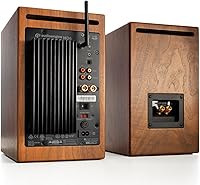
  • Wired Inputs: Three wired input options are available: optical (Toslink), RCA stereo, and a 3.5mm AUX jack for broad source compatibility.
  • Outputs: The rear panel includes an RCA line-out and a dedicated subwoofer pre-out for connecting an optional woofer to extend bass response.
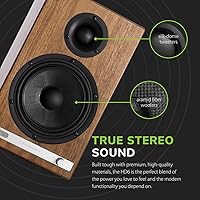
  • Tweeter Driver: Each cabinet houses a 1-inch tweeter responsible for reproducing high-frequency detail with low distortion.
  • Woofer Driver: A 5.5-inch dynamic woofer driver handles mid-bass and midrange frequencies in each enclosure.
  • Frequency Response: The speakers reproduce audio from 50Hz upward, covering the full midrange and high-frequency spectrum without the need for equalization.
  • Signal-to-Noise: The signal-to-noise ratio measures above 95dB (A-weighted), meaning amplifier noise remains inaudible under normal listening conditions.
  • Distortion: Total harmonic distortion plus noise (THD+N) is rated below 0.05% across all power settings, indicating very low coloration of the audio signal.
  • Bit Depth: The DAC supports 24-bit high-resolution audio playback for both wired digital and aptX-HD Bluetooth sources.
  • Dimensions: Each speaker cabinet measures 11.75″ high by 7.25″ wide by 10″ deep, making it a true bookshelf or desktop form factor.
  • Weight: The pair weighs 17.5 lbs combined, reflecting the solid wood veneer construction and internal amplifier hardware.
  • Cabinet Material: Enclosures are finished in real walnut wood veneer over an MDF core, providing both acoustic damping and a premium aesthetic.
  • Configuration: The system operates as a 2.0 stereo pair with a dedicated active (amplified) left speaker and a passive right speaker connected by an included cable.
  • Power Input: The power supply auto-switches between 100V and 240V at 50/60Hz, making the speakers compatible with wall outlets in most countries.
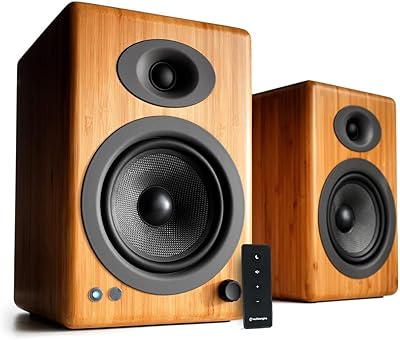
  • Included Accessories: The package includes a remote control, power cable, quick start guide, and warranty card as standard in the box.

Related Reviews

Audioengine HD4
Audioengine HD4
83%
91%
Sound Quality
88%
Bluetooth Performance
93%
Build Quality
89%
Amplifier Performance
86%
Input & Connectivity Flexibility
More
Audioengine P4 Passive Bookshelf Speakers
81%
88%
Sound Quality
61%
Bass Performance
91%
Build Quality
93%
Design & Aesthetics
84%
Amplifier Compatibility
More
Audioengine A5+ Powered Bookshelf Speakers
80%
91%
Sound Quality
93%
Build Quality
88%
Amplifier Performance
67%
Connectivity & Inputs
78%
Value for Money
More
Audioengine HD5
Audioengine HD5
86%
91%
Sound Quality
88%
Bluetooth Performance
89%
Amplifier & Power
86%
Build Quality
72%
Value for Money
More
KEF LS50 Wireless II Powered Bookshelf Speakers
84%
94%
Sound Quality
91%
Wireless Connectivity
85%
Ease of Setup
90%
Design & Build Quality
78%
Value for Money
More
Monster S200 Portable Bluetooth Speaker
73%
82%
Bass & Low-End Output
61%
Sound Clarity & Midrange
79%
Volume & Loudness
86%
Bluetooth Connectivity
84%
Waterproof Performance
More
KEF Q150 Bookshelf Speakers
77%
93%
Sound Staging
91%
Vocal & Midrange Clarity
62%
Bass Performance
67%
Amplifier Compatibility
84%
Treble Smoothness
More
Sanyun SW208 3″ Bookshelf Speakers
86%
88%
Build Quality
84%
High-Frequency Clarity
91%
Mid-Range Warmth
78%
Bass Performance
93%
Control Ergonomics
More
Orroplus OR-02 Powered Bookshelf Speakers
77%
83%
Sound Clarity & Midrange
61%
Bass Performance
91%
Connectivity & Input Range
78%
Bluetooth Performance
72%
Setup & Ease of Use
More
KEF Q350 Bookshelf Speakers
86%
93%
Sound Quality
80%
Bass Performance
88%
Build Quality
91%
Design and Aesthetics
85%
Ease of Setup
More

FAQ

No, the Audioengine HD6 Wireless Bookshelf Speakers have a 150W Class A/B amplifier built directly into the active speaker cabinet. You plug them into a wall outlet, connect your source, and you're ready to go — no additional amplification hardware required.
You can, but only if your turntable has a built-in phono preamp or if you use a separate phono stage between the turntable and the speakers. The HD6 pair accepts an RCA line-level signal but does not include its own phono preamp, so a standard moving-magnet cartridge turntable plugged in directly will sound very quiet and thin.

With the aptX-HD codec active, the difference is genuinely hard to detect in a casual listening session. That said, a direct optical or RCA connection will always be the reference quality baseline. If your source device does not support aptX-HD and falls back to standard SBC Bluetooth, you will notice a small but real drop in clarity at higher volumes.

They work in a medium-sized room without issue, but in a larger space the bass starts to feel a little thin below 50Hz. For a bigger room, pairing this walnut speaker set with a dedicated subwoofer is a common and worthwhile upgrade. On a desktop or in a small-to-medium room, they sound excellent without any additional hardware.

Yes, there is a dedicated subwoofer pre-out on the rear of the active speaker, so adding a sub down the line is straightforward. Just connect a subwoofer with an RCA input and adjust the crossover on the sub to blend with the speakers — most users find around 80Hz works well as a starting point.

There is no dedicated tone control or EQ on the speakers themselves. If you want to shape the sound, you would need to do it at the source — through a streaming app, a DAC with EQ, or audio software on your computer. Some users find the stock tuning slightly warm, which suits most genres well without adjustment.

Placement makes a bigger difference than most people expect. Try to position them at roughly ear height when seated, angled slightly inward (toed in) toward your listening position, and a few inches from the rear wall to reduce bass buildup. On a desk, foam isolation pads under each speaker also help by reducing vibration transfer from the surface.

The remote handles volume and input switching, which covers the basics well. The main complaint from owners is that it feels lightweight and inexpensive compared to the premium build of the speakers themselves — it gets the job done, but don't expect it to feel like a high-end accessory.

A small number of users have reported a faint hiss audible in standby or at very low volumes in a dead-quiet room. It is not a universal issue, and for most people it disappears entirely once music is playing at any reasonable level. If you are extremely sensitive to noise floors and listen in a very quiet environment, it is worth being aware of.

Long-term owners consistently report that the HD6 pair ages well — the drivers maintain their character and the walnut veneer stays looking good with minimal care. Audioengine has a solid reputation for building speakers that last, and the Class A/B amplifier design is inherently more reliable over time than Class D alternatives at this price point.

Where to Buy