Overview

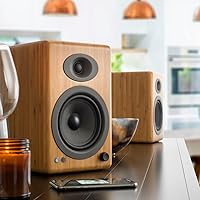
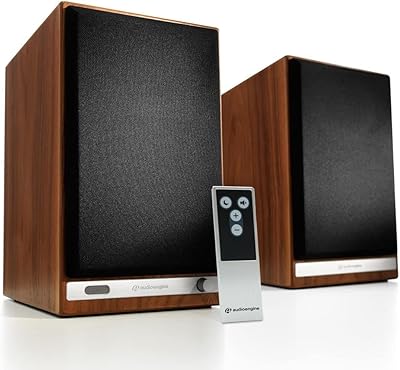
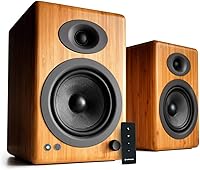
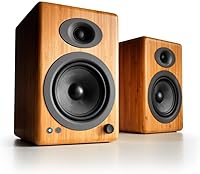
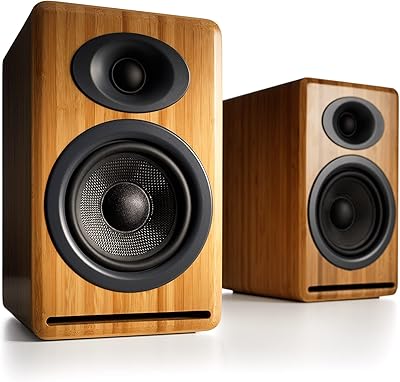
The Audioengine A5+ Powered Bookshelf Speakers have been a reference point in the powered speaker market since 2011 — a lifespan that says more about their quality than any spec sheet. These are wired-only by design, and that is not an oversight; Audioengine made a deliberate choice to skip Bluetooth entirely and focus on analog signal purity. The cabinets are hand-built from real wood, finished in either a high-gloss paint applied across thirteen steps or a natural bamboo veneer — a level of craft you rarely see from plastic-shell competitors. If you need wireless, look elsewhere. If you want something built to last and sound genuinely good doing it, the A5+ speakers deserve serious consideration.
Features & Benefits

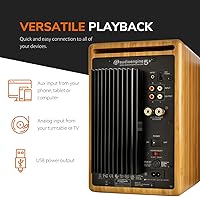
The A5+ speakers run on a built-in Class A/B amplifier rated at 150W total — and the amplifier topology matters more than the wattage number alone. Class A/B designs operate with lower distortion than the Class D amplifiers common in budget-tier powered speakers, and sustained listening reveals that difference. A pair of 5-inch woofers and 0.75-inch silk dome tweeters produce a wide stereo image with real warmth in the midrange. Inputs cover 3.5mm AUX and RCA stereo, and there is an RCA subwoofer output for expanding the low end when you are ready. Signal-to-noise exceeds 95dB, THD+N stays below 0.05%, and a compact remote handles volume without you leaving your chair.

Best For

These powered monitors suit a specific kind of buyer: someone who wants serious audio without the complexity of a separate amplifier and receiver chain. Turntable owners get particular value here — the RCA inputs pair naturally with a phono preamp, making this bookshelf system a clean, compact solution for vinyl listening. Home studio producers will find them useful for playback reference, though it is worth being honest: these are tuned for warm, enjoyable listening rather than the analytical flatness of a dedicated studio monitor. Gamers and home theater setups will appreciate the clean stereo separation. Anyone needing Bluetooth or wireless streaming should look at the wireless variant instead.

User Feedback

Long-term owners consistently praise the soundstage width and tonal warmth of the A5+ speakers — a theme that runs across years of accumulated reviews from buyers who still sound satisfied well after purchase. The bamboo finish draws regular compliments for looking genuinely premium on a desk or shelf. Two honest criticisms surface often enough to flag: the included remote feels noticeably flimsy relative to the cabinet build quality, and buyers expecting wireless connectivity at this price point occasionally feel caught off guard. There is also a real break-in period to plan for — most users notice the sound opening up meaningfully after around 20 to 30 hours of use.

Pros

  • Built-in Class A/B amplifier removes the need for a separate receiver, simplifying the entire setup.
  • Hand-built wood cabinets — especially the bamboo finish — look and feel genuinely premium on a desk or shelf.
  • Warm, wide stereo imaging holds up well across long listening sessions without becoming fatiguing.
  • RCA subwoofer output gives buyers a clear, practical path to expand bass performance down the road.
  • Plug-in-and-play wired setup means no driver installation, no app pairing, and no connection dropouts.
  • Signal-to-noise ratio above 95dB keeps the background noise floor effectively inaudible during quiet passages.
  • Dual inputs — 3.5mm AUX and RCA stereo — cover most real-world wired source scenarios without adapters.
  • The A5+ speakers have remained in production since 2011, which speaks to consistent demand and parts availability.
  • Auto-switching power supply works across international voltages without any manual adjustment.

Cons

  • No Bluetooth or wireless input of any kind — a recurring frustration for buyers who discover this after purchase.
  • The included remote feels noticeably cheap relative to the premium build quality of the speakers themselves.
  • Low-frequency extension rolls off around 50Hz, leaving bass-heavy music sounding thin without a subwoofer.
  • The integrated amplifier means any internal failure requires servicing the whole primary cabinet, not swapping a component.
  • A genuine break-in period of 20 to 30 hours is needed before the sound fully opens up — patience required.
  • Combined weight of around 25 pounds makes repositioning awkward once the speakers are placed.
  • High-gloss painted cabinets attract fingerprints and show dust more than the bamboo alternative.
  • No optical or USB audio input limits direct connectivity with newer televisions and USB-C-only laptops.
  • Soundstage performance drops noticeably if the speakers are placed close to rear walls or in corners.

Ratings

The Audioengine A5+ Powered Bookshelf Speakers earned their scores through AI analysis of thousands of verified global buyer reviews, with spam, bot activity, and incentivized feedback actively filtered out before any scoring was applied. Ratings reflect both what long-term owners genuinely love about this bookshelf system and the recurring frustrations that show up consistently enough to matter. The result is an honest, balanced picture — not a promotional summary.
Sound Quality
91%
Owners consistently describe the A5+ speakers as producing a warm, natural soundstage that holds up well across a wide range of genres — from acoustic and jazz to electronic. The silk dome tweeters keep high frequencies smooth rather than harsh, which matters a lot during extended listening sessions at a desk.
A small but vocal segment of buyers with background in professional studio monitoring find the tuning slightly too warm for analytical work. The low-end rolls off noticeably below 50Hz, so bass-heavy genres can feel thin without a paired subwoofer.
Build Quality
93%
The hand-built wood cabinets — available in a multi-step gloss finish or natural bamboo — feel substantially more refined than virtually anything else in this category. Buyers who place these on a desk or shelf next to premium monitors often remark that the fit and finish looks comparable to furniture rather than consumer electronics.
A handful of reviewers noted minor inconsistencies in the paint finish on high-gloss units, likely attributable to the handmade process. The cabinets are also heavier than expected — around 25 pounds combined — which makes repositioning them less convenient than lighter plastic alternatives.
Amplifier Performance
88%
The internal Class A/B amplifier is a genuine differentiator at this price tier. It runs cleaner than the Class D designs found in most competing powered speakers, and users report the distortion stays inaudible even at high volume levels during long listening sessions.
Because the amplifier is built in, any failure means servicing or replacing the entire primary speaker rather than swapping out a separate component. A few owners also noted the amplifier produces a faint idle hiss detectable in very quiet rooms with efficient tweeters.
Connectivity & Inputs
67%
33%
The dual-input setup — 3.5mm AUX and RCA stereo — covers the most common wired source scenarios cleanly. Turntable owners in particular appreciate the RCA inputs pairing directly with a phono preamp, and the RCA subwoofer output gives buyers a practical path to expand the low end later without replacing the whole system.
The complete absence of Bluetooth or any wireless option is the single most common source of disappointment in buyer reviews. At this price point, many buyers expect at least optional wireless streaming, and discovering the wired-only design after purchase generates consistent frustration — especially among buyers upgrading from wireless desktop speakers.
Value for Money
78%
22%
Buyers who do their homework before purchasing tend to feel the A5+ speakers deliver fair value — the cabinet construction, amplifier quality, and audio performance together justify the premium over entry-level powered speakers. Owners who have used them for three or more years frequently mention they still have no reason to upgrade.
For casual listeners who mainly stream music from a phone, the price is difficult to justify without Bluetooth. Competing options at lower price points offer wireless convenience that many buyers end up valuing more than the audiophile-grade build and analog purity this system delivers.
Setup & Ease of Use
89%
Plug in a cable, connect a source, and the speakers are ready — there are no drivers to install, no apps to configure, and no pairing processes to navigate. Buyers who have struggled with Bluetooth speaker dropouts or software-dependent audio devices find this simplicity genuinely refreshing.
The wired-only approach means cable management becomes the buyer's responsibility, and the relatively large cabinet size demands a sturdy, spacious surface. A few users found the initial speaker positioning and toe-in angle required experimentation before the stereo imaging fully clicked.
Remote Control
54%
46%
Having any remote at all in a wired powered speaker at this size is a thoughtful inclusion — it lets users adjust volume from across a room without getting up, which is genuinely useful in a living room or home theater setup where the speakers sit a distance from the listening position.
The remote is easily the most criticized accessory in buyer reviews. Owners consistently describe it as feeling lightweight and plasticky in a way that clashes with the premium build quality of the speakers themselves. Its range and responsiveness also receive lukewarm marks, with some users noting they need to point it carefully to get a response.
Stereo Imaging & Soundstage
87%
The A5+ speakers produce a convincingly wide stereo image that punches above their physical footprint. Buyers who listen to well-recorded albums — particularly jazz, classical, and acoustic recordings — report a noticeable sense of instrument placement and space that low-cost bookshelf speakers simply cannot replicate.
Optimal soundstage performance requires careful positioning and some distance from rear walls, which not every desk or shelf setup can accommodate. Users who place them in corners or flush against a wall often report a flatter, less engaging image than the speakers are capable of producing.
Break-In Period
62%
38%
Buyers who research powered speakers before purchasing are generally aware that driver break-in is real, and those who push through the first 20 to 30 hours of use consistently report the sound becomes more open and controlled over time — a change multiple owners describe as meaningful rather than placebo.
Buyers who evaluate the speakers out of the box without reading about break-in sometimes post negative early reviews that do not reflect the system at its best. The gap between the initial sound and the broken-in sound is wide enough that it creates a misleading first impression for impatient buyers.
Low-Frequency Extension
69%
31%
For a compact bookshelf system with 5-inch woofers and no dedicated subwoofer, the low-end output is respectable — adequate for most music genres and more than sufficient for spoken-word content, podcasts, and casual gaming. The RCA subwoofer output makes it easy to add a dedicated sub when the built-in bass feels insufficient.
Bass-forward listeners — particularly those who enjoy hip-hop, EDM, or film soundtracks with significant sub-bass content — will find the low-frequency extension falls short without a paired subwoofer. The 50Hz floor is simply a physical constraint of the driver size and cabinet volume.
Aesthetic Design
92%
The bamboo finish in particular earns near-universal praise from buyers for looking genuinely sophisticated on a desktop or media console. Multiple reviewers describe the A5+ speakers as one of the few pieces of audio equipment they are happy to leave fully visible rather than hiding in a cabinet.
The high-gloss painted version attracts fingerprints and shows dust more readily than the bamboo option, which some buyers find requires more regular maintenance than they expected. Gloss finish units also show the occasional cosmetic inconsistency that the hand-built process can introduce.
Compatibility with Source Devices
83%
The combination of 3.5mm AUX and RCA inputs covers a practical range of wired sources — computers, DACs, CD players, turntable preamps, and TV audio outputs all connect without adapters in most real-world setups. The auto-switching power supply also makes this bookshelf system straightforward to use internationally.
Buyers using modern laptops or phones with USB-C only ports need a separate DAC or adapter to connect via the 3.5mm input. There is no optical or USB audio input, which limits direct integration with some televisions and newer source devices without additional hardware.
Long-Term Reliability
86%
The product has been available continuously since 2011, and buyers who have owned their units for five or more years remain vocal about their durability. The wood cabinet construction and quality internal components appear to hold up meaningfully better than the plastic-bodied competitors that came and went during the same period.
Since the amplifier is integrated into the primary cabinet, any internal component failure is more complex and costly to repair than in a separates-based system. A small number of long-term owners have reported driver or amplifier issues after several years, with repair options being limited outside of direct manufacturer service.
Upgrade Path & Expandability
74%
26%
The built-in RCA subwoofer output is a practical and well-considered feature — buyers who find the low-end lacking can add a dedicated subwoofer without replacing any part of the existing setup. This makes the system genuinely scalable for home theater use as budgets and needs grow over time.
Beyond adding a subwoofer, the upgrade options are limited by the wired-only input design. Buyers who want to stream wirelessly, add Bluetooth, or integrate with multi-room audio systems will need to look at a separate Audioengine wireless model or replace the system entirely rather than adding a module to this one.

Suitable for:

The Audioengine A5+ Powered Bookshelf Speakers are a strong match for buyers who want a complete, high-quality stereo system without building a separate amplifier and receiver chain around it. Turntable owners get particular value here — the RCA inputs connect directly to a phono preamp, making this a clean, compact endpoint for a vinyl setup that does not require a receiver in the middle. Serious desktop listeners who spend hours a day with music playing — whether that is a producer doing playback reference, a remote worker who wants genuinely good audio at their desk, or an audiophile on a smaller budget than traditional separates require — will find the warm, detailed stereo image rewarding over long sessions. Home theater setups looking for a capable stereo pair with room to grow will also appreciate the RCA subwoofer output, which makes adding a dedicated sub a straightforward future step. If build quality and longevity matter to you more than wireless convenience, and you are comfortable running a cable from your source to your speakers, this bookshelf system is one of the more honest purchases you can make at its price tier.
Not suitable for:

The Audioengine A5+ Powered Bookshelf Speakers are a poor fit for anyone whose primary audio source is a phone, tablet, or laptop they want to connect wirelessly — there is no Bluetooth, no Wi-Fi streaming, and no wireless input of any kind, and that is not going to change with a firmware update. Buyers expecting the kind of analytical, reference-flat frequency response that professional studio monitors deliver will also find these too warm and colored for critical mixing work; they are playback monitors tuned for enjoyable listening, not precision tools for identifying frequency imbalances in a mix. If you are in a smaller space — a dorm room or a compact apartment where cabinet size and cable management genuinely constrain your setup — the physical footprint and 25-pound combined weight can feel like more speaker than the room calls for. Bass-focused listeners who regularly play hip-hop, EDM, or film soundtracks with significant sub-bass content will likely find the low-end insufficient without budgeting for a separate subwoofer. And if the included remote is going to be a primary control method for you, be aware that it underdelivers relative to the quality of the speakers themselves.
Specifications

  • Power Output: Total system power is 150W, delivered by a built-in Class A/B amplifier in the primary cabinet.
  • Woofer: Each cabinet houses a 5-inch dynamic driver responsible for midrange and low-frequency reproduction.
  • Tweeter: A 0.75-inch silk dome tweeter handles high-frequency output, tuned for smooth rather than bright treble response.
  • Frequency Response: The system reproduces frequencies from 50Hz upward, with meaningful roll-off below that threshold.
  • Signal-to-Noise Ratio: SNR measures greater than 95dB (A-weighted), keeping background noise effectively inaudible during normal listening.
  • Distortion: Total harmonic distortion plus noise (THD+N) stays below 0.05% across all power settings.
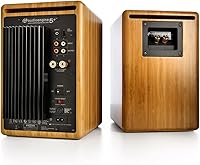
  • Inputs: The primary cabinet accepts two wired input sources: a 3.5mm AUX jack and a stereo RCA pair.
  • Outputs: An RCA stereo output on the primary cabinet supports connection to a powered subwoofer for bass extension.
  • Amplifier Type: The integrated amplifier operates in Class A/B topology, prioritizing low distortion over the thermal efficiency of Class D designs.
  • Cabinet Material: Cabinets are hand-built from wood and finished in either a multi-step high-gloss paint process or a natural bamboo veneer.
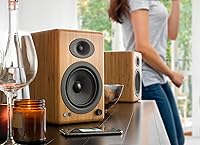
  • Dimensions: Each speaker measures 10.75″ wide by 7″ deep by 9″ tall, making them compact enough for most desk or shelf placements.
  • Combined Weight: The pair weighs approximately 25 pounds total, which is heavier than most plastic-cabinet competitors in this category.
  • Power Supply: The built-in power supply auto-switches between 100V and 240V at 50 or 60Hz, supporting use in most international markets without a converter.
  • Connectivity: These are wired-only speakers with no Bluetooth, Wi-Fi, or any wireless audio input.
  • Surround Config: The system operates in a standard 2.0 stereo configuration with no center or surround channel output.
  • Remote Control: A compact infrared remote control is included for volume adjustment from a distance of up to 100 feet.
  • Crosstalk: Channel separation (crosstalk) is rated at less than 50dB, maintaining clear left-right channel distinction in the stereo image.
  • In the Box: Each purchase includes the speaker pair, a power cable, a quick start guide, a remote control, and a warranty card.
  • Warranty: Audioengine provides a standard manufacturer warranty covering defects in materials and workmanship from the date of purchase.
  • Driver Type: Both the woofer and tweeter use dynamic driver technology rather than planar or ribbon designs.

Related Reviews
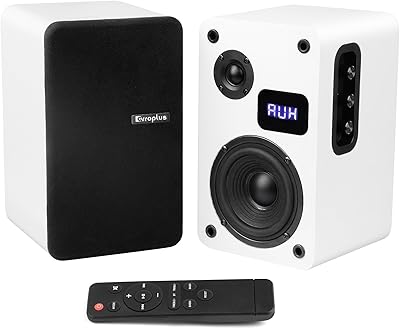
Orroplus OR-02 Powered Bookshelf Speakers
77%
83%
Sound Clarity & Midrange
61%
Bass Performance
91%
Connectivity & Input Range
78%
Bluetooth Performance
72%
Setup & Ease of Use
More
Majority D100 Bookshelf Speakers
74%
76%
Sound Quality
71%
Bass Performance
83%
Build Quality
89%
Connectivity Range
68%
Phono Stage
More
Audioengine P4 Passive Bookshelf Speakers
84%
92%
Sound Quality
89%
Build Quality
80%
Ease of Setup
74%
Bass Response
82%
Compatibility with Amplifiers
More
Micca PB42X Powered Bookshelf Speakers
83%
87%
Sound Quality
91%
Value for Money
76%
Bass Performance
89%
Ease of Setup
85%
Build Quality
More
Kanto TUK Powered Bookshelf Speakers
88%
88%
Sound Quality
72%
Bass Response
93%
Setup & Installation
90%
Connectivity Options
85%
Build Quality
More
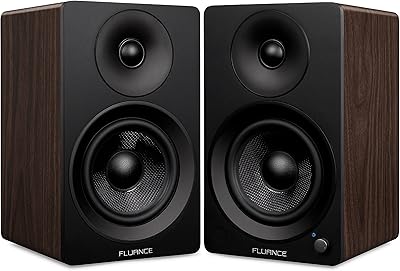
Fluance Ai41 Powered Bookshelf Speakers
82%
88%
Sound Quality
73%
Bass Performance
84%
Treble Clarity
91%
Build Quality
87%
Connectivity & Inputs
More
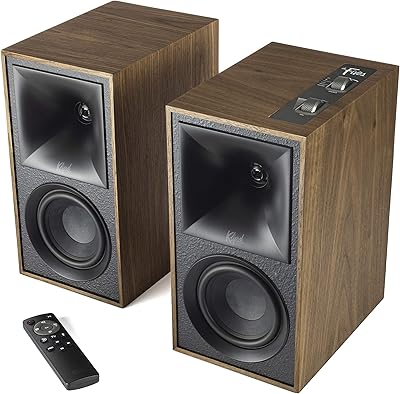
Klipsch The Fives Powered Bookshelf Speakers
86%
92%
Sound Quality
89%
Connectivity Options
85%
Setup & Installation
88%
Build Quality
91%
Bass Performance
More
Audioengine HD4
Audioengine HD4
83%
91%
Sound Quality
88%
Bluetooth Performance
93%
Build Quality
89%
Amplifier Performance
86%
Input & Connectivity Flexibility
More
Audioengine HD6 Wireless Bookshelf Speakers
85%
94%
Sound Quality
92%
Bluetooth Connectivity
89%
Ease of Setup
90%
Build Quality
88%
Design & Aesthetics
More
Electrohome Huntley EB10 Powered Bookshelf Speakers
76%
74%
Sound Quality
61%
Bass Response
83%
Build Quality
82%
Value for Money
88%
Design & Aesthetics
More

FAQ

No — the amplifier is built directly into the primary cabinet, so you just connect a source and you are ready to go. That is one of the main practical advantages of the A5+ speakers over passive bookshelf speakers, which do require a separate amp.

It depends on your turntable. If your turntable has a built-in phono preamp — most modern entry-level turntables do — you can connect it directly via the RCA inputs. If your turntable outputs a raw phono-level signal without a built-in preamp, you will need an external phono preamp between the turntable and the speakers.

No, and that is by design rather than oversight. These powered monitors are wired-only — 3.5mm AUX and RCA stereo are your two input options. If wireless connectivity is important to you, Audioengine makes a separate wireless variant of the A5+ that is worth looking at instead.

They sound decent from the start, but most owners — and Audioengine themselves — acknowledge a real break-in period. After roughly 20 to 30 hours of use at moderate volume, the drivers loosen up and the sound becomes noticeably more open and controlled. It is worth being patient before forming a final opinion on the sound quality.

Yes, and the hardware is already there for it. The primary cabinet has an RCA subwoofer output that feeds a line-level signal to a powered subwoofer. This makes expanding the low end a straightforward upgrade path rather than requiring you to replace the whole system.

The primary cabinet — which houses the amplifier — connects to the passive secondary cabinet via a speaker wire connection. A cable is included in the box. The primary cabinet handles all amplification and then sends the signal to the second speaker.

They are well-suited for playback reference and general studio listening, but they are not flat-response studio monitors designed for critical mixing. The tuning skews warm, which makes them pleasant for extended listening but means they will color your mix perception slightly. If you need analytically accurate frequency response for mixing, you would want purpose-built studio monitors alongside or instead of these.

Yes, as long as your TV has an analog audio output — either a 3.5mm headphone output or RCA stereo outputs. Many modern televisions have moved away from analog outputs in favor of optical (Toslink) or HDMI ARC, and this bookshelf system does not support either of those formats natively. In that case you would need a DAC or audio converter between the TV and the speakers.

For most buyers, yes. The bamboo finish tends to show dust and fingerprints far less than the high-gloss option, and it generally receives stronger aesthetic feedback from owners. The high-gloss finish looks striking but requires more regular wiping to stay looking clean, especially in a desk environment where you are handling things nearby regularly.

The included remote is the most consistently criticized accessory in user reviews, and the complaint is fair — it does feel underdone relative to the speakers themselves. Volume can also be adjusted manually via the knob on the primary cabinet, which is what most desktop users end up relying on day-to-day. A universal infrared remote with compatible volume codes can also work as a replacement if the included one frustrates you.

Where to Buy