Overview

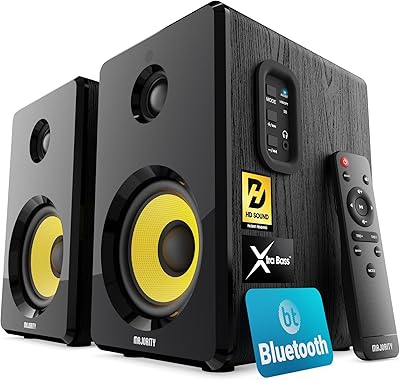
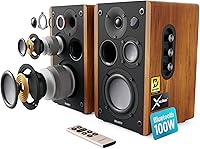
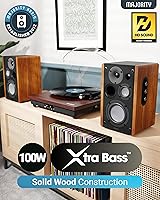
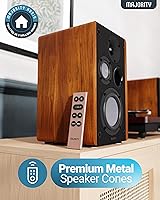
The Majority D100 Bookshelf Speakers are a powered speaker pair from a UK-based audio brand known for packing genuine features into accessible price points, targeting casual listeners and vinyl fans who want real connectivity without overspending. What sets them apart at this tier is the solid wood cabinet and triple-driver configuration — details more commonly found on pricier options. The 100W rating reflects peak headroom rather than continuous output; in a small or medium room, it translates to ample volume with room to spare. HDMI ARC, Optical, Phono, and Bluetooth 5.3 combine to create a versatile input lineup that few competing pairs at this price can match.

Features & Benefits

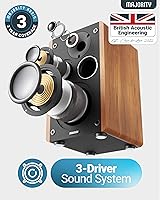
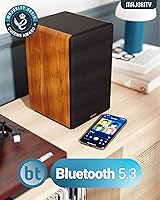
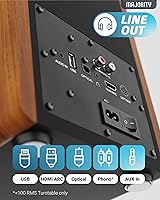
Bluetooth 5.3 handles wireless pairing reliably and with low latency, whether you are streaming from a phone or casting from a laptop. The HDMI ARC input is genuinely useful — plug these directly into a compatible TV and you have replaced mediocre built-in sound without needing a full soundbar. The built-in phono stage is arguably the standout feature for vinyl fans, enabling direct turntable connection without a separate preamp; however, it is rated for turntables outputting below 100 RMS amplitude, so higher-output decks should use the AUX input instead. The three-driver layout and Xtra Bass mode add body to the low end, while the wood enclosure helps keep resonance controlled at higher volumes.

Best For

These Majority bookshelf speakers hit a sweet spot for anyone juggling multiple audio sources from a single pair. Vinyl enthusiasts benefit most from the built-in phono stage — no extra preamp taking up shelf space. Anyone upgrading TV audio will value the HDMI ARC input for a cleaner, cable-light setup. Desktop users and small-room listeners will find the output headroom more than sufficient for daily use. This powered speaker pair works especially well as a central audio hub: turntable in the morning, television at night, Bluetooth whenever you just want to stream. If you want one pair that handles nearly every input without additional hardware, these fit that brief well.

User Feedback

With around 290 ratings and a 4.2-star average, the D100 speakers land in positive territory overall. Most satisfied buyers highlight the sound fullness for the cabinet size, the quality of the build, and how simple the initial setup is — even for first-time powered speaker owners. The picture gets more nuanced around the bass tuning: the boosted low-end earns fans among those who want impact, but some listeners find Xtra Bass mode overpowering in compact rooms and prefer running the speakers flat. A smaller group flagged quality-control inconsistencies such as minor channel imbalance or occasional Bluetooth drops. Input switching via the remote is functional but drew mixed reactions on intuitiveness, with a few buyers wishing for clearer feedback from the unit itself.

Pros

  • Built-in phono stage allows direct turntable connection with no extra preamp required.
  • HDMI ARC input handles TV audio cleanly without needing a soundbar or separate receiver.
  • Solid wood cabinet construction gives the D100 speakers a feel and look above their price tier.
  • Five input types in one pair — Bluetooth, HDMI ARC, Optical, Aux, and Phono — is genuinely rare at this price.
  • Bluetooth 5.3 connects quickly and holds a stable signal for everyday wireless streaming.
  • Triple-driver configuration delivers a noticeably layered sound compared to two-way speakers in the same range.
  • Setup is straightforward; most users are listening within minutes of unboxing.
  • Sound fullness in small to medium rooms consistently exceeds buyer expectations at first listen.
  • The included remote makes switching between sources convenient without touching the unit.
  • Wood finish gives this powered speaker pair a retro warmth that looks intentional on a record player shelf.

Cons

  • Xtra Bass mode is too aggressive for compact rooms and has no adjustment beyond on and off.
  • Phono input has an amplitude limitation that rules out higher-output turntables without additional hardware.
  • Remote control lacks visual or audible feedback when switching inputs, making it easy to lose track of the active source.
  • Unit-to-unit consistency is a known issue, with some buyers receiving speakers with channel imbalance straight out of the box.
  • The user manual does not clearly explain the phono amplitude restriction, leaving some turntable owners to discover it after purchase.
  • Bass tuning leans warm and boosted, which can make acoustic recordings and classical music sound muddy.
  • HDMI ARC compatibility with older televisions can require manual configuration that is not documented clearly.
  • Output starts to lose composure in larger rooms, limiting these to small and medium-sized spaces only.
  • Treble detail feels slightly recessed when any bass enhancement is active, reducing overall tonal balance.
  • Customer support experience has been inconsistent based on owner reports when resolving defective unit replacements.

Ratings

The Majority D100 Bookshelf Speakers were put through a rigorous AI-driven analysis of verified global buyer reviews, with spam, incentivized, and bot-generated feedback actively filtered out before scoring. The result is a balanced picture that captures both what genuinely impresses users and the friction points that real owners encounter day to day. Strengths and shortcomings are weighted equally, so every score reflects the honest consensus rather than a polished marketing version of it.

Sound Quality
76%
24%
Most buyers are pleasantly surprised by how full and room-filling the sound is for speakers this size. The three-driver setup delivers a layered presentation where vocals and mids come through with reasonable clarity, making them enjoyable for both background listening and more attentive sessions.
The tuning leans warm and bass-forward, which flatters pop and hip-hop but can make acoustic or classical recordings sound slightly muddled. Audiophiles used to flatter, more neutral speakers will notice the coloration fairly quickly.
Bass Performance
71%
29%
The low-end extension is a genuine talking point — for a bookshelf form factor, the D100 speakers produce a surprisingly substantial thump that works well for electronic music and film content. Xtra Bass mode adds an extra layer of punch that casual listeners tend to enjoy.
The bass boost is a blunt tool rather than a precise one, and Xtra Bass mode can overwhelm smaller rooms, turning what should be tight low-end into something boomy and one-dimensional. Users with rooms under roughly 120 square feet often report needing to dial it back entirely.
Build Quality
83%
The solid wood cabinet is one of the first things buyers comment on when unboxing — it feels noticeably more substantial than the plastic-wrapped MDF competitors at a similar price. The brown finish looks presentable on a shelf or desk without screaming budget electronics.
A handful of users noted that cabinet joins and internal bracing are not perfectly consistent unit to unit, and the front grille attachment feels less refined than the rest of the build. It is solid for the price, but up close the finishing details show where corners were cut.
Connectivity Range
89%
Few powered bookshelf speakers at this price point offer HDMI ARC, Optical, Phono, Aux, and Bluetooth 5.3 simultaneously. Buyers regularly highlight this as the reason they chose the D100 over alternatives — one pair handles the TV, turntable, and phone without any additional hardware.
The labeling on the rear inputs is small and can be difficult to read in low light, which causes initial confusion during setup. A couple of users also reported that the HDMI ARC handshake with older televisions required manual configuration to get working reliably.
Phono Stage
68%
32%
Having a built-in phono preamp removes a meaningful barrier for vinyl beginners — no separate box, no extra cables, just a direct turntable connection. For standard moving-magnet cartridges running below the 100 RMS amplitude threshold, users report clean, warm playback that suits casual vinyl listening well.
The amplitude limitation is a real constraint that the product description buries, and some turntable owners discovered it only after purchase. Users with higher-output decks or those expecting audiophile-grade phono accuracy found the built-in stage lacking in both gain headroom and overall transparency.
Bluetooth Performance
78%
22%
Bluetooth 5.3 delivers a stable, low-latency connection for most everyday use cases — streaming from a phone across a normal-sized room rarely produced dropouts in user reports. Pairing is quick, and the connection holds reliably when the source device is within a reasonable range.
A recurring minority complaint involves intermittent drops when other 2.4GHz devices are active nearby, particularly in apartment settings with dense wireless environments. A few users also noted that re-pairing after switching to another input and back can occasionally require a full Bluetooth reset.
Remote Control
62%
38%
The included remote does cover the essentials — volume adjustment and input switching from across the room — which is genuinely convenient when the speakers are part of a TV setup and you do not want to walk to the unit every time.
Feedback on the remote is consistently mixed: the input switching offers no visual confirmation on the remote itself, making it easy to lose track of which source is active. Button travel and responsiveness also drew criticism, with some users describing the feel as cheap relative to the rest of the product.
Setup & Ease of Use
81%
19%
Most buyers report having the D100 speakers up and running within fifteen minutes of opening the box, including the Bluetooth pairing and physical cable connections. The included speaker interconnect cable simplifies the wired link between the active and passive unit.
The user manual leaves some gaps, particularly around the input priority logic and the phono amplitude recommendation, which caught several first-time users off guard. A clearer quick-start guide covering common setup scenarios — TV via HDMI ARC, turntable via Phono, desktop via Aux — would reduce the initial confusion.
Value for Money
82%
18%
Taken as a bundle of features — wood cabinet, triple drivers, five input types including HDMI ARC and Phono, plus Bluetooth 5.3 and a remote — the D100 speakers represent a competitive package for the asking price. Buyers who compare this against similarly priced soundbars consistently feel they got the better deal on audio quality.
The value equation weakens slightly when you factor in quality-control inconsistency; some buyers received units with channel imbalance or minor cosmetic defects and faced support friction resolving them. The price is fair for a flawless unit, but less so if you land one requiring a replacement.
Volume & Power Headroom
74%
26%
In a typical bedroom or home office — roughly 100 to 180 square feet — the speakers hit genuinely loud levels with volume to spare before distortion becomes an issue. For desk use or near-field listening, most users never push past the midpoint of the volume range.
The 100W figure is a peak total for the pair rather than a per-channel continuous rating, so expectations around raw loudness should be calibrated accordingly. In larger living rooms or open-plan spaces, the output starts to feel strained at the high end, losing some composure under pressure.
Mid & Treble Clarity
69%
31%
Vocals and lead instruments sit at a comfortable level in the mix, and at moderate volumes the tweeter handles high-frequency detail without harshness. For spoken-word content, podcasts, and casual music listening, the clarity is more than acceptable.
The treble can feel slightly recessed when the bass boost is active, and at high volumes some users detected a hint of sibilance on brighter recordings. Those coming from dedicated studio monitors will notice the lack of accuracy in the upper frequencies fairly quickly.
Turntable Compatibility
65%
35%
For standard belt-drive turntables with a moving-magnet cartridge — the type most vinyl newcomers start with — the phono input works without fuss and delivers a warm, listenable result. It eliminates a whole category of accessory purchasing for entry-level vinyl setups.
The 100 RMS amplitude ceiling limits compatibility with certain turntables, and the product does not make this restriction prominent enough before purchase. Users with direct-drive tables or higher-output cartridges should plan to use the AUX input with a standalone preamp instead.
Aesthetic Design
77%
23%
The brown wood-finish cabinet has a retro warmth that looks intentional rather than accidental, and it pairs naturally with record players, wooden shelving, and mid-century style interiors. Buyers in this niche consistently mention that the speakers look more expensive than they are.
The brown finish is the only color option, which limits flexibility for buyers with modern minimalist or all-black setups. The front driver arrangement is functional but not particularly distinctive, and some users felt the overall visual design plays it too safe.
Quality Consistency
57%
43%
The majority of buyers receive units that perform exactly as described, and for those buyers the experience is straightforwardly positive from day one. When the build lands correctly, the fit and finish feel coherent and well-matched between the active and passive speaker.
A notable thread of reviews describes unit-to-unit inconsistency: channel imbalance, subtle hum from the active speaker, or cosmetic blemishes that suggest variable production tolerance. This is not universal, but it appears frequently enough to factor into the buying decision, particularly for gift purchases.

Suitable for:

The Majority D100 Bookshelf Speakers are a natural fit for anyone who wants a single powered pair to handle multiple audio sources without building out a full receiver-based system. Vinyl enthusiasts will appreciate the built-in phono stage most — it removes the need for a separate preamp and gets a standard moving-magnet turntable up and running with minimal fuss. Desktop users and home office listeners upgrading from tinny PC speakers or a basic soundbar will find the step up in sound fullness and cabinet quality immediately noticeable. The HDMI ARC input is a particular draw for cord-cutters who want clean, capable TV audio without routing cables through a receiver or buying a dedicated soundbar. Small to medium room listeners — a bedroom, study, or compact living room — will get the most out of the output headroom, where the speakers perform confidently without being pushed to their limits. If your priority is connectivity flexibility and a warm, engaging sound at a sensible price, this powered speaker pair delivers a compelling package.

Not suitable for:

Buyers with serious audiophile expectations will likely find the Majority D100 Bookshelf Speakers too colored and inconsistent for critical listening — the bass-forward tuning and less-than-precise treble response are engineering choices aimed at casual enjoyment rather than accuracy. Anyone planning to connect a turntable with a higher-output cartridge or a direct-drive deck should know upfront that the phono input has an amplitude ceiling; exceeding it means falling back to the AUX input with an external preamp, which negates one of the key selling points. Listeners in larger open-plan rooms will find the output starts to feel strained before it fills the space properly, making these a poor match for lounge or dining room use. Those who care deeply about consistent unit quality may also want to weigh the reported variability in build tolerances — channel imbalance and minor cosmetic issues appear often enough in owner feedback to be a genuine consideration. Finally, buyers who want a visually neutral speaker that blends into a modern all-black or minimalist setup will find the brown wood finish limiting, as it is the only option available.

Specifications

  • Model: The speaker pair carries the model designation D100, manufactured by Majority, a UK-based consumer audio brand.
  • Power Output: Total system power output is 100W peak, shared across the active and passive speaker in a stereo pair configuration.
  • Drivers: Each speaker houses three dynamic drivers — a woofer, a mid-range driver, and a tweeter — for a layered, three-way sound reproduction.
  • Frequency Response: The D100 speakers are rated down to 30 Hz, indicating extended low-frequency reach for a bookshelf cabinet of this size.
  • Connectivity: Available inputs include Bluetooth 5.3, HDMI ARC, Optical (Toslink), Aux (3.5mm), and a Phono (RCA) input with a built-in preamp stage.
  • Bluetooth Version: Bluetooth 5.3 is implemented for low-latency wireless audio streaming from phones, tablets, laptops, and compatible smart devices.
  • Cabinet Material: Both the active and passive enclosures are constructed from solid wood, finished in a brown tone suited to warm or retro-styled interiors.
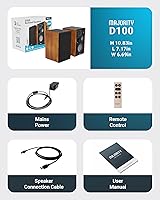
  • Dimensions: Each speaker measures 7.1″ wide by 6.6″ deep by 10.8″ tall, making them compact enough for most bookshelves, desks, or media units.
  • Weight: The combined weight of the pair is 15.71 lbs, reflecting the density of the solid wood cabinet construction.
  • Power Source: The speakers operate from a corded AC power connection; there is no battery or rechargeable option, so a wall outlet is required.
  • Remote Control: A remote control is included in the box, enabling volume adjustment and input source switching from across the room.
  • Phono Input: The built-in phono preamp is designed for moving-magnet turntables with an output amplitude below 100 RMS; higher-output sources should use the AUX input.
  • Compatible Devices: The D100 speakers are compatible with televisions, turntables, desktop computers, gaming consoles, tablets, and any Bluetooth-enabled audio source.
  • Audio Output Mode: The speakers operate in stereo output mode, with the active unit driving the passive speaker via the included speaker interconnect cable.
  • Included Accessories: The box contains the D100 speaker pair, one speaker interconnect cable, a power cable, the remote control, and a printed user manual.
  • Mounting Type: The speakers are designed for shelf mounting on a flat horizontal surface; no wall-mount bracket or stand hardware is included.
  • Bass Mode: An Xtra Bass mode is available via the remote, applying an additional low-frequency boost beyond the standard tuning of the drivers.
  • Warranty: Majority provides an extended warranty on the D100, though buyers are advised to confirm current terms directly with the brand at point of purchase.

Related Reviews
Majority D40 Active Bookshelf Speakers
85%
88%
Sound Quality
91%
Value for Money
85%
Connectivity Options
89%
Ease of Setup
84%
Build Quality
More
Majority D40X Powered Bluetooth Bookshelf Speakers
84%
88%
Sound Quality
90%
Ease of Setup
82%
Bass Performance
70%
Bluetooth Connectivity
85%
Build Quality
More
Probox BT16 Bookshelf Speakers
75%
78%
Sound Clarity
54%
Bass Performance
84%
Bluetooth Stability
82%
USB DAC Quality
63%
Build Quality
More
MEVOSTO DS19 Bookshelf Speakers
85%
89%
Sound Quality
91%
Bass Performance
85%
Treble Clarity
88%
Bluetooth Connectivity
90%
Design & Aesthetics
More
KEF Q150 Bookshelf Speakers
87%
88%
Sound Quality
75%
Bass Performance
93%
Build Quality
90%
Design & Aesthetics
85%
Treble Clarity
More
KEF Q350 Bookshelf Speakers
86%
93%
Sound Quality
80%
Bass Performance
88%
Build Quality
91%
Design and Aesthetics
85%
Ease of Setup
More
Micca MB42X Bookshelf Speakers
84%
89%
Sound Quality
92%
Value for Money
85%
Ease of Setup
77%
Bass Performance
91%
Design & Aesthetics
More
Riowois DS6800M Bookshelf Speakers
83%
85%
Sound Quality
90%
Ease of Installation
82%
Build Quality
88%
Space-Saving Design
78%
Bass Performance
More
Fluance XL8SW Bookshelf Speakers
87%
90%
Sound Quality
84%
Bass Response
91%
Clarity of Midrange
87%
Ease of Installation
88%
Design & Build Quality
More
Sanyun SW205
Sanyun SW205
78%
83%
Sound Quality
61%
Bass Performance
87%
Soundstage & Imaging
89%
Connectivity & Inputs
84%
Bluetooth Performance
More

FAQ

Yes, for most standard turntables you can. The D100 speakers include a built-in phono preamp, so a moving-magnet cartridge deck plugs straight into the Phono RCA input. The one thing to check is your turntable output amplitude — the phono stage is rated for sources below 100 RMS amplitude. If your deck outputs above that, you will get better results running it through an external preamp into the AUX input instead.

They work well for this purpose, particularly if your TV has an HDMI ARC port. That single HDMI cable handles both audio signal and volume control, so you can use the included remote to adjust the speaker volume in sync with your TV remote in many setups. The Optical input is there as a fallback for televisions without HDMI ARC.

It is essentially a toggle — Xtra Bass mode switches on or off via the remote, with no intermediate adjustment. If you find it too heavy for your room, the standard tuning without the mode active is noticeably more restrained, so most people end up leaving it off and relying on source-side EQ if they want fine control.

In a small to medium room — a bedroom, home office, or compact living space — these speakers get genuinely loud well before you hit the halfway point on the volume dial. They are not designed to fill a large open-plan lounge, but for typical near-field or bookshelf distances the output is more than sufficient for daily listening and occasional louder sessions.

Yes, a gaming console connects cleanly via HDMI ARC if your TV supports it, routing audio from the console through the TV and out via HDMI ARC to the speakers. Alternatively, if the console has an optical output, that works directly as well. Bluetooth pairing from a console is also possible depending on the platform.

The box includes the speaker pair, an interconnect cable to link the active and passive speaker, a power cable, the remote, and a user manual. For most common setups you will not need to buy anything extra. The one exception is if you want to use the HDMI ARC or Optical input, as those cables are not included and will need to be sourced separately.

They are well-suited to both. On a desk the near-field listening distance means you get a full, warm sound without needing high volume levels. In a small apartment room they perform comfortably as the primary audio setup. One practical note: the Xtra Bass mode is better left off in tight spaces, as the boost can make the low-end feel overwhelming at close range.

It covers the basics — volume and input switching — but owner feedback is mixed on the experience. The main frustration is that there is no clear indicator on the remote or the unit to confirm which input you have switched to, which gets confusing when cycling through multiple sources. It functions, but it is not the most polished remote you will come across.

The cabinet is described as solid wood construction, and owner feedback generally confirms it feels more substantial than the vinyl-wrapped MDF you find on competing speakers at this price. The brown finish has a warm, natural tone rather than a printed veneer look, which is part of why the speakers tend to photograph and present well alongside record players and wooden furniture.

The most consistently reported issue is unit-to-unit variability — a meaningful number of buyers have noted slight channel imbalance or minor cosmetic inconsistencies out of the box. Bluetooth connectivity in dense wireless environments can occasionally drop, and the HDMI ARC connection sometimes needs manual configuration with older televisions. None of these affect every unit, but they are worth knowing about, especially if you are buying as a gift and may not be able to test immediately.