
Overview

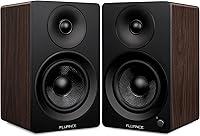
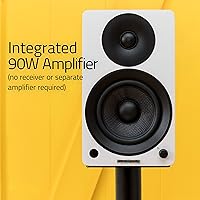
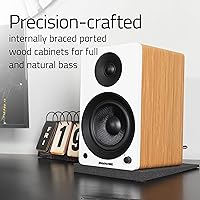
The Fluance Ai41 Powered Bookshelf Speakers occupy a sweet spot in the mid-range audio market — a self-contained stereo pair that skips the receiver entirely and still sounds genuinely good. The natural walnut cabinet sets the tone immediately; this isn't the glossy plastic finish you find on budget competition. Internally braced MDF keeps resonance controlled, while the built-in 90W Class D amplifier means you plug in and listen, nothing more. RCA, optical, and Bluetooth 5.0 are all on board, making these Fluance speakers equally at home on a living room shelf, a desktop, or beside a turntable.

Features & Benefits

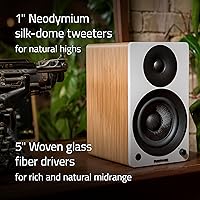
Pop on a well-recorded jazz album and the silk dome tweeter makes itself known immediately — detailed highs that don't fatigue your ears after an hour of listening. The 5-inch woven glass fiber woofer tracks bass lines with real accuracy, and the rear-ported MDF cabinet pushes the low-end response down to a respectable 35Hz without adding bloat. The Class D amplifier runs cool even at higher volumes, which matters during longer sessions. There's also a subwoofer pre-out if you ever want more low-end — a genuine expansion option, not just a spec bullet. Remote control and speaker wire are included straight out of the box.

Best For

The Ai41 pair is an obvious match for vinyl listeners — connect a turntable with a phono preamp and the RCA input handles it cleanly. Home office setups benefit just as much; optical in from a TV, Bluetooth from a laptop, and you have a capable desk system without the clutter of an amp stack. Upgrading from a soundbar or basic computer speakers? The step up in imaging and midrange clarity is immediately noticeable. Anyone wanting room to grow will appreciate the subwoofer output keeping future upgrades simple. Small to medium rooms are honestly where these Fluance speakers perform best.

User Feedback

With a 4.6-star rating across several hundred buyers, these powered bookshelves have earned genuine goodwill. The most consistent praise centers on stereo imaging and balance — people are genuinely surprised by the soundstage width at this price tier. The walnut finish also gets regular attention, frequently compared favorably to pricier options. On the critical side, the remote control is a common minor disappointment, feeling noticeably cheaper than the speakers themselves. Bass in larger rooms is another honest limitation; without a subwoofer, the low end can feel restrained. The two-year warranty and lifetime customer support appear repeatedly as real confidence builders, especially for first-time buyers.

Pros

  • Built-in 90W amplifier means no separate receiver, reducing cost and clutter significantly.
  • The natural walnut cabinet looks genuinely premium and holds up well in living room or office settings.
  • RCA, optical, and Bluetooth 5.0 inputs cover virtually every real-world source device in one package.
  • Stereo imaging consistently surprises buyers — the soundstage extends well beyond the cabinet width.
  • Silk dome tweeter keeps high frequencies detailed without becoming harsh during long listening sessions.
  • Subwoofer pre-out provides a clear upgrade path without replacing the speakers down the line.
  • Bluetooth pairing is reliable and the 15-meter range holds through typical apartment walls.
  • Includes speaker wire, remote, and a two-year warranty — genuinely useful out-of-the-box extras.
  • Warm, balanced midrange performs well on vocals, acoustic instruments, and spoken-word content alike.
  • Lifetime customer support from Fluance adds real confidence, especially for first-time powered speaker buyers.

Cons

  • Bass performance drops off noticeably in larger rooms without adding a separate subwoofer.
  • The remote control feels plasticky and cheap relative to the quality of the speaker cabinets themselves.
  • No USB-C input, which competing speakers and even Fluance's own step-up model now offer.
  • Input switching is fully manual — there is no automatic source detection when a new device connects.
  • Bluetooth audio quality is a step below what the wired inputs deliver for critical listening.
  • Amplifier headroom is limited at the top of the volume range, with audible compression when pushed hard.
  • Placement sensitivity is real — imaging suffers when the pair is tucked tightly into a shelf without breathing room.
  • No app-based EQ or tone control, so buyers with specific tuning preferences have no adjustment options onboard.

Ratings

The Fluance Ai41 Powered Bookshelf Speakers have been scored by our AI system after processing verified buyer reviews from global markets, with spam, bot activity, and incentivized feedback actively filtered out before any score was calculated. What you see below reflects the honest spread of real owner experiences — the genuine strengths that keep buyers recommending these Fluance speakers to friends, alongside the friction points that show up repeatedly enough to matter. Both sides of the picture are represented here, nothing softened.

Sound Quality
88%
The warm, balanced sound signature is the most frequently praised aspect across owner feedback. Buyers describe a wide stereo image that punches well above what the cabinet size suggests, with midrange clarity that holds up on everything from acoustic guitar to podcasts during a long work-from-home day.
A small but consistent group of listeners finds the overall tuning slightly warm, meaning certain recordings lack the crisp top-end air that more analytically voiced speakers provide. It is a matter of preference, but buyers coming from brighter-sounding systems may notice the difference immediately.
Bass Performance
73%
27%
The rear-ported cabinet does a credible job extending low-end response, and in a well-sized room — say, a home office or a 12 by 14 living space — kick drums and bass lines land with satisfying weight. The woven glass fiber driver tracks quickly enough that bass notes feel defined rather than loose.
In open-plan rooms or larger living areas, the bass thins out noticeably without a subwoofer attached. Several buyers specifically flag this as a limitation discovered after setup, noting that the low-end sounds satisfying at moderate volumes but loses authority when pushed harder in bigger spaces.
Treble Clarity
84%
The silk dome tweeter handles extended listening sessions well — users routinely mention being able to sit with these Fluance speakers for hours without fatigue, which is a real-world endorsement of how the high frequencies are voiced. Cymbal detail and vocal presence come through with genuine nuance.
At higher output levels, a handful of reviewers note a slight hardening in the upper frequencies, particularly on compressed streaming audio. It is not a dealbreaker, but listeners who regularly push the volume past two-thirds in a reflective room may catch occasional edginess on certain tracks.
Build Quality
91%
The natural walnut finish draws consistent compliments, with buyers describing the cabinets as looking far more expensive than the price tier suggests. The MDF construction feels solid and resonance-free when handled, and the front baffle has a clean, unfussy look that fits easily into living room or desktop aesthetics.
The back panel and input terminals, while functional, feel noticeably less refined than the front-facing woodwork. A few detail-oriented buyers have pointed out that the overall fit and finish is excellent from the listening position but loses some of that premium impression on closer inspection of the rear.
Connectivity & Inputs
87%
Having RCA, optical TOSLINK, and Bluetooth 5.0 all on one pair of speakers genuinely simplifies setup for most households. Switching between a turntable via RCA, a TV via optical, and a phone via Bluetooth covers the majority of real listening scenarios without any additional hardware sitting on the shelf.
There is no USB-C input, which the step-up Ai61 model adds, and some buyers working primarily at a desk notice that absence. Input switching is also manual rather than automatic, so toggling between a connected TV and a Bluetooth phone mid-session requires a deliberate button press rather than a smart handoff.
Bluetooth Performance
82%
18%
Pairing reliability and connection stability are called out positively by a majority of owners who use Bluetooth as their primary source. The 15-meter range holds up through a typical apartment wall, and buyers streaming from a phone across the room report no dropouts during normal use.
Bluetooth audio quality, as a few more critical listeners note, is audibly a step below what the optical or RCA inputs deliver. For casual background listening it is more than adequate, but anyone who listens critically will want a wired connection to hear what the Ai41 pair is genuinely capable of.
Amplifier Performance
86%
The built-in Class D amplifier runs cool even after several hours of continuous use, which matters for a unit that stays powered on a desk or entertainment unit all day. At conversational to moderate listening volumes, the amp keeps the sound clean and controlled with no audible distortion creeping in.
At the uppermost volume range, the amp shows its limits — not catastrophically, but with a compression and slight strain that experienced listeners will catch. The 2x45W RMS rating is honest rather than inflated, and buyers expecting wall-shaking output in a large room may find the ceiling arrives sooner than expected.
Setup & Ease of Use
89%
The out-of-the-box experience is genuinely straightforward. Speaker wire, power cable, and a remote are included, meaning most buyers are listening within ten minutes of opening the box. There is no app to configure, no firmware to update on day one, and no receiver to integrate — it is simply plug in and go.
The manual lacks detail for first-time powered speaker buyers, particularly around input priority and subwoofer output level calibration. A couple of reviewers setting up a home theater configuration mentioned wishing for clearer guidance on how to balance the sub-out level against the main speakers.
Remote Control
58%
42%
Having a remote at all at this price point is appreciated, and it covers the basics — volume, input switching, and power — without requiring you to walk across the room every time. For a desktop setup where the speakers sit within arm's reach it rarely matters, but in a living room context it earns its place.
The remote is a recurring criticism in user feedback, described as feeling cheap and plasticky relative to the quality of the speakers themselves. The button travel is mushy, the range is shorter than expected, and several buyers have reported needing to point it quite precisely to get a reliable response.
Value for Money
86%
At the mid-range price point, these powered bookshelves deliver a combination of sound quality, build, and connectivity that would otherwise require buying a separate amplifier and passive speaker pair at a higher combined cost. For buyers stepping up from a soundbar or cheap desktop speakers, the perceived value jump is substantial.
The market at this price tier has grown competitive, and a handful of buyers who compared alternatives note that some rivals now offer USB-C input, app-based EQ, or a higher wattage amp for similar money. The Ai41 pair holds its ground on build and sound, but the feature set is not expanding as fast as the competition.
Stereo Imaging
83%
Stereo width is one of the more pleasant surprises buyers report after living with these Fluance speakers for a week. On well-recorded music, the soundstage extends noticeably beyond the physical speaker positions, which makes a real difference when the speakers are placed on a desk or on shelves with some breathing room.
Imaging is sensitive to placement — buyers who tuck the pair tight into a bookshelf or against side walls report a noticeably narrower and less engaging soundstage. Getting the best out of the Ai41 pair requires some room to pull them forward and angle them toward the listening position, which not every setup allows.
Subwoofer Integration
77%
23%
The subwoofer pre-out is a genuine pathway to expanding the system rather than a token feature. Buyers who have paired the Ai41 pair with a quality subwoofer describe the combined result as a major upgrade that addresses the only real acoustic limitation of the speakers on their own.
The sub-out level is fixed, which means controlling the blend between the speakers and a connected subwoofer falls entirely on the subwoofer's own volume dial. This is manageable but not ideal, and buyers who prefer a more unified volume control for the whole system will find the setup slightly awkward to fine-tune.
Long-Term Reliability
81%
19%
The two-year manufacturer warranty and lifetime customer support are cited by multiple buyers as a meaningful differentiator, particularly for a brand that does not have the name recognition of larger audio companies. Owners who have contacted Fluance support describe responsive, no-hassle service that builds genuine trust in the product.
Long-term reliability data is harder to assess given the product's relatively short market history. A small number of buyers have reported issues with the Bluetooth module or input switching behavior after extended ownership, though these cases represent a clear minority of the overall review pool.
Aesthetic Design
88%
The walnut veneer finish photographs well and looks even better in person — buyers frequently mention guests commenting on the speakers before they have even heard them play. The clean front baffle with a minimal logo treatment gives the Ai41 pair a premium, furniture-friendly appearance that holds up in both modern and traditional room settings.
The color and finish options are limited, and buyers working with a light or white-dominant room decor find the dark walnut stands out more than they would like. A lighter finish variant or a matte black option would broaden the appeal considerably for those prioritizing interior consistency.

Suitable for:

The Fluance Ai41 Powered Bookshelf Speakers are an excellent match for anyone who wants a serious listening upgrade without the complexity of building a traditional separates system. Vinyl enthusiasts will appreciate the RCA input, which connects cleanly to any turntable with a phono preamp and skips the need for a standalone amplifier entirely. Home office workers and desktop listeners get a particularly strong deal here — optical in from a monitor or laptop dock, Bluetooth from a phone, and the whole thing sits neatly on a desk without taking up receiver-sized real estate. TV and projector users in small to medium rooms will find the optical TOSLINK input a clean solution for getting proper stereo audio out of a flat screen. The Ai41 pair is also a compelling first step for buyers who are outgrowing soundbars or budget computer speakers and want something that actually images and breathes like a real stereo pair. The subwoofer output makes this a genuinely expandable system, so buyers who want to grow into more bass later can do so without replacing anything they already own.

Not suitable for:

The Fluance Ai41 Powered Bookshelf Speakers are not the right tool for every situation, and being honest about that matters. Buyers planning to fill a large open-plan living room or a basement with sound will likely hit the limits of both the amplifier and the cabinet size before they are satisfied — the low end thins out in bigger spaces, and the amp does not have the headroom to compensate at high volumes. Dedicated home theater enthusiasts who want surround sound processing, HDMI ARC, or a multi-channel setup will need to look elsewhere, as these are strictly a 2.0 stereo pair with no home theater integration beyond basic TV optical connection. Critical listeners who have grown accustomed to a bright, analytical sound signature may find the warmer tuning less to their taste, particularly on high-resolution streaming or lossless audio. Anyone expecting USB-C input for a modern desktop workflow — a feature found on the next model up — will need to work around that omission. Finally, buyers who want a completely hands-off wireless experience with automatic input switching and app-based EQ control will find the manual operation of these Fluance speakers more old-school than they prefer.

Specifications

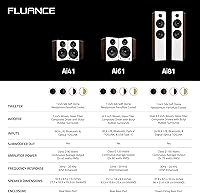
  • Driver: Each speaker uses a 5″ woven glass fiber composite woofer with butyl rubber surrounds for controlled, low-distortion bass reproduction.
  • Tweeter: A 1″ silk soft dome neodymium tweeter with ferrofluid cooling handles high-frequency reproduction in each cabinet.
  • Amplifier: An integrated Class D amplifier delivers 90W continuous average output, rated at 2x45W RMS across both channels.
  • Frequency Response: The system covers 35Hz to 20kHz, with DSP enhancement applied to extend and balance the frequency curve.
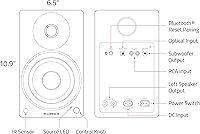
  • Inputs: Available inputs include RCA L/R analog, Optical TOSLINK digital, and Bluetooth 5.0 wireless — all on the active speaker unit.
  • Subwoofer Output: A dedicated subwoofer pre-out port allows connection of a powered subwoofer for expanded low-frequency performance.
  • Bluetooth Range: Bluetooth 5.0 provides a rated wireless range of up to 15 meters under typical conditions.
  • Cabinet Construction: Cabinets are built from internally braced MDF with a rear bass port and a natural walnut wood veneer finish.
  • Dimensions: Each speaker measures 10.9″ H x 6.5″ W x 7.6″ D (27.7 x 16.5 x 19.3 cm).
  • Weight: The pair weighs 15.96 pounds combined, making individual units manageable for shelf placement and repositioning.
  • Configuration: The system is a 2.0 stereo configuration designed for shelf mounting without requiring a separate amplifier or receiver.
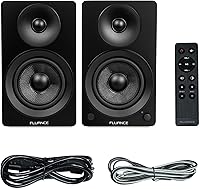
  • In the Box: Package includes the active and passive speaker pair, remote control, 2x AAA batteries, 6ft power cable, and 8ft 18-gauge speaker wire.
  • Warranty: Covered by a 2-year manufacturer warranty with lifetime customer support provided directly by Fluance.
  • Power Source: The active speaker unit is corded electric, requiring a standard AC wall connection via the included 6ft power cable.
  • Connectivity Tech: The unit supports three simultaneous connection types: analog RCA, digital optical TOSLINK, and Bluetooth 5.0 wireless.
  • Control Method: A handheld remote control is included for volume, input switching, and power functions from across the room.
  • Speaker Type: Bookshelf-format, rear-ported enclosure designed for placement on shelves, desks, or stands in small to medium rooms.
  • Audio Output Mode: Stereo 2.0 output only — no surround processing, center channel, or multi-channel configuration is supported.

Related Reviews
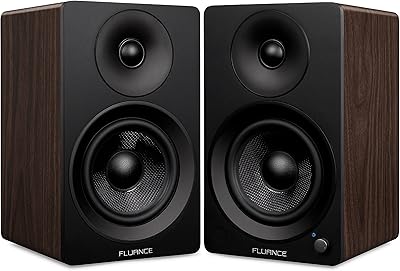
Fluance Ai61 Powered Bookshelf Speakers
81%
88%
Sound Quality
74%
Bass Performance
91%
Build Quality
86%
Connectivity & Inputs
63%
Bluetooth Performance
More
Orroplus OR-02 Powered Bookshelf Speakers
77%
83%
Sound Clarity & Midrange
61%
Bass Performance
91%
Connectivity & Input Range
78%
Bluetooth Performance
72%
Setup & Ease of Use
More
Fluance XL8SW Bookshelf Speakers
87%
90%
Sound Quality
84%
Bass Response
91%
Clarity of Midrange
87%
Ease of Installation
88%
Design & Build Quality
More
Klipsch The Fives Powered Bookshelf Speakers
86%
92%
Sound Quality
89%
Connectivity Options
85%
Setup & Installation
88%
Build Quality
91%
Bass Performance
More
Micca PB42X Powered Bookshelf Speakers
83%
87%
Sound Quality
91%
Value for Money
76%
Bass Performance
89%
Ease of Setup
85%
Build Quality
More
Majority D100 Bookshelf Speakers
74%
76%
Sound Quality
71%
Bass Performance
83%
Build Quality
89%
Connectivity Range
68%
Phono Stage
More
Audioengine A5 Powered Bookshelf Speakers
83%
94%
Sound Quality
89%
Bass Performance
91%
Build Quality
85%
Ease of Setup
72%
Connectivity Options
More
Kanto TUK Powered Bookshelf Speakers
88%
88%
Sound Quality
72%
Bass Response
93%
Setup & Installation
90%
Connectivity Options
85%
Build Quality
More
Fluance Elite SX6WH Bookshelf Speakers
84%
87%
Sound Quality
91%
Build Quality
72%
Bass Performance
89%
Value for Money
82%
Ease of Setup
More
Victrola M1 Monitors Powered Bookshelf Speakers
86%
89%
Sound Quality
92%
Bluetooth Connectivity
85%
Bass Performance
88%
Build Quality
90%
Ease of Setup
More

FAQ

No, that is the whole point of this design. The active speaker has a built-in Class D amplifier, so you connect your source directly and you are ready to go. No receiver, no extra boxes.

You can connect a turntable, but only if it has a built-in phono preamp or if you use a separate phono preamp between the turntable and the RCA input. The speakers do not have a phono stage built in, so a direct cartridge connection will not work.

Only one speaker connects to the wall — the active unit houses the amplifier and all the inputs. The second passive speaker connects to the active one via the included speaker wire. Only the active unit needs a power outlet.

Switching is manual, done via the remote control or the button on the speaker itself. There is no automatic source detection, so if you want to jump from your TV optical connection to your phone over Bluetooth, you press the input button to cycle to it.

They perform best in small to medium-sized rooms — think a bedroom, home office, or a modest living area up to around 150 to 200 square feet. In a large open-plan space, the bass can feel thin and the overall volume may not fill the room the way you would hope. Adding a subwoofer through the pre-out helps, but the amp ceiling is still a real factor.

Yes, and it is a straightforward connection. The active speaker has a dedicated subwoofer pre-out port — you run a standard RCA cable from that port to your powered subwoofer's input. Volume blending is controlled by the subwoofer's own gain dial since there is no onboard level adjustment for the sub output.

Most owners find it solid for daily use — pairing is quick and the connection holds well within a normal apartment or room. The 15-meter range is adequate for across-the-room streaming. Just know that for critical listening, a wired optical or RCA connection will sound noticeably cleaner.

It works and covers the basics, but several buyers are underwhelmed by how it feels in hand. The buttons are functional but mushy, and the range requires fairly direct line-of-sight. For a desktop setup where the speaker is nearby, you may end up just using the knob. For a living room couch, the remote earns its keep despite its shortcomings.

The two-year manufacturer warranty covers defects in materials and workmanship. Fluance also offers lifetime customer support, which goes beyond the warranty window. Buyers who have contacted them report responsive, practical help — it is not a corporation that makes you fight through a ticket system for weeks.

Yes, and the optical TOSLINK input makes this a natural fit. Connect the TV optical out to the speaker optical in, switch to that input, and you get clean stereo audio from a proper speaker pair instead of the thin built-in TV sound. It is a 2.0 stereo setup, so there is no center dialogue channel, but for music, movies, and general TV use it works very well.