Overview

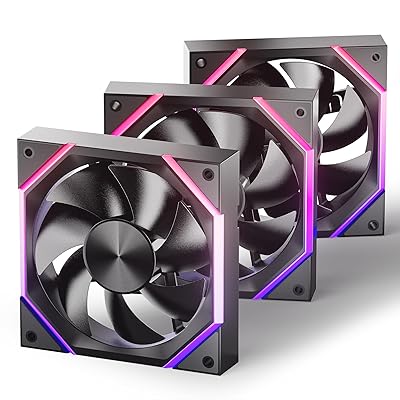
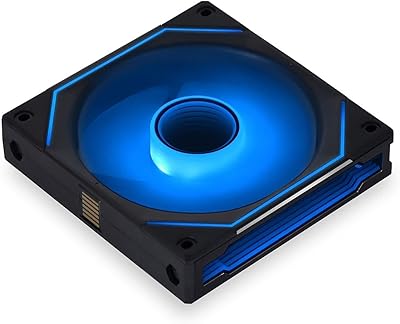
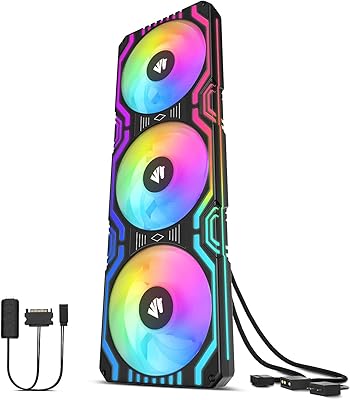
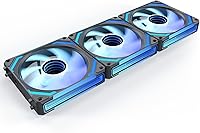
The AsiaHorse COSMIQ 120mm RGB Case Fans 3-Pack sits in a crowded mid-range market, but it earns attention for one genuinely practical reason: the daisy-chain connector system that lets you run a single cable per fan cluster rather than a tangled mess of individual leads. Beyond cable tidiness, the kit offers a forward and reverse blade design option — you can mount fans to push or pull air without losing the lit-up face, a small but useful detail most fan makers ignore. Performance is solid for typical builds, though buyers should know upfront that lighting control runs through the included hub, not directly through motherboard software.
Features & Benefits

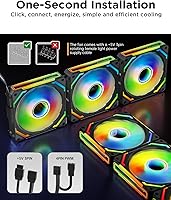
The daisy-chain wiring is the headline here — instead of running separate RGB and PWM cables from each fan to the motherboard or controller, you link them together and use a single cable per cluster, which saves real time during a build. These COSMIQ fans use FDB bearings rather than the cheaper hydraulic type found in most budget options; in practice, that means quieter operation over a longer service life. The PWM range spans 800 to 2000 RPM, giving you meaningful headroom to dial back noise during light workloads and push airflow when thermals demand it. Airflow and static pressure figures are competitive for 120mm fans at this tier.

Best For

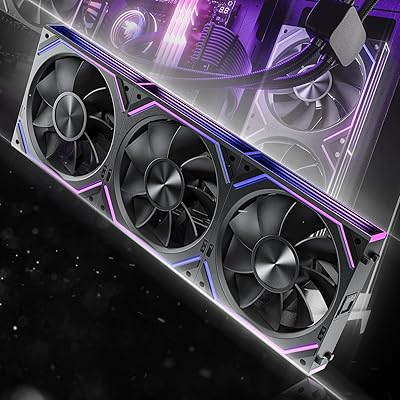
This RGB fan kit makes the most sense for builders putting together a mid-tower with three standard 120mm fan slots — intake, exhaust, or radiator — where the 3-pack count fits naturally without leftovers. If you run a windowed side panel, the lighting quality and forward/reverse blade flexibility genuinely pay off visually. The hub-based controller is actually an advantage for anyone who finds motherboard RGB software like iCUE or Armoury Crate frustrating; you get a standalone remote and no ecosystem lock-in. That said, if you rely heavily on motherboard sync to unify all your lighting, the hub-first design requires some adjustment. The music-sync mode is a nice bonus for open-bench or show builds.

User Feedback

The AsiaHorse fan set holds a 4.4-star rating, and the aggregated feedback paints a consistent picture. Most buyers praise the installation experience — the daisy-chain connectors click together intuitively and the hub works straight out of the box. Lighting brightness and color accuracy also earn consistent compliments. On the critical side, a handful of users note that running at full 2000 RPM produces more audible noise than the rated spec suggests — not unusually loud, but noticeable in a quiet room. The music-sync feature draws mixed reactions; enthusiasts love it for show builds, but many admit they rarely use it daily. Hub reliability occasionally surfaces as a concern in longer-term reviews.

Pros

  • The daisy-chain connector system drastically cuts cable clutter — one lead per cluster instead of a separate run for every fan.
  • FDB bearings offer a meaningful lifespan and noise advantage over the hydraulic bearings common at this price point.
  • Forward and reverse blade variants let you orient airflow in either direction while keeping the lit face visible.
  • The 3-pack count fits standard mid-tower layouts right out of the box with no extras needed.
  • PWM speed range from 800 to 2000 RPM gives real flexibility between quiet idle and aggressive cooling.
  • The standalone hub controller works without any software installation — plug in, turn on, go.
  • Airflow and static pressure figures are genuinely competitive for 120mm fans in this market tier.
  • Music-sync lighting via the wireless receiver is a fun, no-software-required feature for show or streaming builds.
  • 26 lighting modes give plenty of variety without needing third-party apps or complex configuration.
  • The 4.4-star rating reflects consistently positive install experiences from a broad range of builders.

Cons

  • At full RPM, real-world noise levels run noticeably higher than the official 29.2 dB rating suggests.
  • The hub-first design can complicate builds where full motherboard ARGB software sync is a priority.
  • Hub reliability has come up in longer-term reviews, with occasional connectivity or mode-reset issues reported.
  • The music-sync mode is a novelty for most users — entertaining at first, but rarely practical for daily use.
  • Buyers needing more than three fans will need an additional pack, adding cost and potential hub wiring complexity.
  • The interlocking daisy-chain connectors have a short learning curve that can be fiddly during a first installation.
  • No dedicated control software means advanced fan curve customization depends entirely on motherboard PWM settings.
  • These COSMIQ fans do not compete with purpose-built quiet fans if near-silent operation is a hard requirement.

Ratings

The scores below for the AsiaHorse COSMIQ 120mm RGB Case Fans 3-Pack were generated by our AI system after analyzing verified purchase reviews from buyers worldwide, with automated filtering applied to remove incentivized, bot-generated, and outlier feedback. Each category reflects the genuine distribution of praise and frustration found across real builder experiences — strengths and pain points weighted equally. Where scores dip, the reasons are explained honestly.

Cable Management
93%
The daisy-chain connector system is the single feature buyers mention most positively, and for good reason — linking fans together and running one cable to the hub instead of three separate runs makes a visible difference inside a windowed case. Builders describe the interior as looking noticeably cleaner compared to previous fan setups.
The interlocking connectors have a short learning curve, and a few users report that the clips feel a little stiff on first connection, requiring more force than expected. Once assembled, the chain holds firmly, but the initial setup can feel uncertain if you have not done it before.
Lighting Quality
88%
Color saturation and brightness are consistently praised by buyers with windowed panels, with many noting that the LEDs look vibrant even in a well-lit room. The even spread across all 24 LEDs means there are no obvious hot spots or dark sections when the fans are spinning.
A handful of users note that colors can look slightly washed out at lower brightness settings, and a few report minor color inconsistency between fans from the same pack. Neither issue is a dealbreaker, but buyers with a critical eye for lighting uniformity may notice it.
Ease of Installation
86%
Beyond the daisy-chain wiring, the physical mounting process is standard and straightforward — no unusual screw patterns or adapter plates required. Most builders report completing a full three-fan installation faster than comparable setups with individually wired fans.
The hub placement requires some forethought, as it needs to be mounted or secured inside the case with no dedicated bracket included. A few buyers also mention that identifying which cable goes where on the first install takes a moment of study, particularly for less experienced builders.
Cooling Performance
79%
21%
With 68.5 CFM airflow and 2.05mmH2O static pressure, these fans move air effectively for both open intake positions and radiator-mounted configurations. Users running mid-range gaming systems report stable thermal performance with CPU and GPU temperatures landing where expected.
These fans are solid performers but not class leaders in raw airflow or static pressure — dedicated high-performance options from Noctua or Arctic push measurably more air at equivalent noise levels. For heavily overclocked systems or high-TDP builds, the cooling headroom may feel limited.
Noise Level
67%
33%
At mid-range RPMs — roughly 1000 to 1400 — these COSMIQ fans are genuinely quiet, and builders running them in a PWM-controlled range during everyday tasks report not noticing them at all. The FDB bearing contributes a smooth, consistent tone without the rattle or whine associated with cheaper hydraulic options.
At or near maximum 2000 RPM, real-world noise runs noticeably above the 29.2 dB specification — a gap that multiple reviewers flag specifically. For systems that regularly hit thermal targets requiring full fan speed, this kit is louder in practice than the official rating implies.
Bearing Durability
83%
The FDB bearing choice is a genuine differentiator at this price point, and buyers who have owned the fans for six months or more report no change in noise character or vibration — a good sign for long-term reliability. FDB bearings are well-established in the industry as a step above hydraulic alternatives.
Long-term durability data beyond a year of ownership is limited given the product's relatively recent release date. A small number of users report early bearing noise in isolated units, suggesting some variance in manufacturing consistency across the batch.
Hub Reliability
71%
29%
For most users the hub works consistently from day one — lighting modes switch cleanly, the physical button is responsive, and the wireless audio receiver picks up ambient sound reliably in typical room conditions. The no-software approach is broadly appreciated for its simplicity.
Hub reliability is the most commonly cited longer-term concern in the review base, with a recurring pattern of lighting modes resetting unexpectedly or the hub becoming unresponsive after extended use. It is not a universal issue, but it appears often enough to be a real consideration for buyers who want a set-and-forget setup.
Motherboard RGB Sync
61%
39%
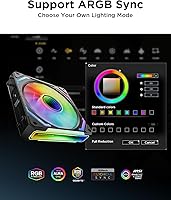
The fans do support 5V ARGB motherboard headers, and users who connect them directly report functional lighting sync with platforms like Armoury Crate and Mystic Light for basic color and effect control. For simple sync needs, the connection works.
The hub-first design means the experience is not optimized for deep motherboard software integration — some lighting modes are only accessible through the hub controller, not through software. Builders expecting the same level of per-LED software control they get from ecosystem-native fans will find this kit falls short.
Music Sync Feature
62%
38%
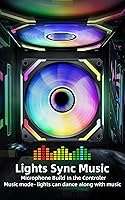
The wireless audio receiver is a genuinely novel hardware feature that works without any drivers, cables, or app permissions — the hub just listens and reacts. For open-bench show builds or streaming setups where the case interior is always visible, it adds a fun layer of interactivity.
In practice, most buyers use the music-sync mode briefly and then settle on a static or streaming lighting effect. The lighting response is broad rather than precise, and in a quiet room it reacts to ambient fan noise and keyboard sounds in ways that can feel more distracting than impressive.
Build Quality & Finish
77%
23%
The fan frames feel solid with no obvious flex or warping, and the blade finish is consistent across all three units in the pack. Most builders describe the overall physical quality as appropriate for the mid-range price tier — nothing feels flimsy or cheaply made at first handling.
The hub housing feels noticeably less substantial than the fans themselves — a thin plastic shell that does not inspire confidence when tucked inside a case. A sturdier hub enclosure would better match the quality impression the fans create.
Value for Money
81%
19%
For a 3-pack that includes an RGB controller hub, daisy-chain wiring, FDB bearings, and a wide selection of lighting modes, buyers broadly feel the pricing is fair relative to competing kits that offer fewer features or worse cable management. The convenience factor of the daisy-chain system alone is cited as worth the cost of admission.
Buyers comparing these fans strictly on cooling performance per dollar may find options from Arctic or Corsair more compelling. The premium here is largely tied to the lighting ecosystem and cable management features, which not every builder will value equally.
Lighting Modes Variety
74%
26%
Twenty-six modes across streaming, monochrome, and rhythmic categories gives enough variety that most buyers find at least two or three they genuinely use. The single-button cycling through modes is quick and does not require memorizing sequences or navigating a menu.
With 26 modes to cycle through using a single physical button, finding a specific effect requires patience — there is no direct mode select or remote control included. Some users also note that several of the 26 modes look similar enough in motion that the real practical variety feels closer to twelve or fifteen distinct looks.
Forward & Reverse Blade Flexibility
84%
The availability of reverse blade variants is a thoughtful design choice that most competing fan makers skip entirely. Builders mounting fans in positions where they want airflow moving away from the lit face — common in certain radiator or push-pull setups — appreciate having the option without needing a workaround.
The forward and reverse variants are sold as separate products rather than offering both orientations within the same pack, so buyers who need a mixed configuration must purchase and manage two separate orders. Clearer labeling on packaging would also help avoid selection errors at the point of purchase.
Packaging & Out-of-Box Experience
76%
24%
The kit arrives with fans, hub, cables, and mounting hardware organized clearly, and most buyers report finding everything they need without hunting for missing accessories. The included cable lengths are adequate for typical mid-tower case dimensions.
The instruction documentation is thin — a single small sheet with minimal detail on the hub wiring and daisy-chain setup. First-time builders or those unfamiliar with RGB controllers may find themselves relying on third-party video guides to get the full setup right on the first attempt.

Suitable for:

The AsiaHorse COSMIQ 120mm RGB Case Fans 3-Pack is a strong pick for PC builders who prioritize a clean interior just as much as cooling performance. If you are putting together a mid-tower with three standard 120mm mounting positions and you dread the usual rat's nest of individual RGB and PWM cables, the daisy-chain design will genuinely make your build day easier. Gamers running open-bench setups or cases with a large windowed panel will appreciate the lighting quality and the option to orient blades in either direction without sacrificing the illuminated front face. The standalone hub controller is a real advantage for anyone who finds motherboard RGB software ecosystems unreliable or frustrating — you are not locked into a proprietary platform to get full lighting functionality. Builders who enjoy reactive, music-synced lighting as part of a show build or streaming setup will also find the audio-responsive mode a fun, low-effort addition that requires no extra software installation.
Not suitable for:

The AsiaHorse COSMIQ 120mm RGB Case Fans 3-Pack is not the right choice for builders who expect native, seamless integration with motherboard lighting software like iCUE, Armoury Crate, or Mystic Light. While the fans do support 5V ARGB headers, the hub-first design means the experience is primarily built around the included controller, and deep software sync can require extra steps or workarounds. Anyone running a near-silent workstation build should also think twice — at full 2000 RPM load, real-world noise is noticeably higher than the rated spec implies, and the fan curve may not suit ultra-quiet environments. If you need more than three 120mm fans, you will need to buy additional packs, which can add up and may complicate the hub wiring depending on your case layout. Finally, buyers who want premium acoustic performance comparable to purpose-built silent fans from Noctua or be quiet! will find these fans prioritize lighting and aesthetics over pure noise suppression.
Specifications

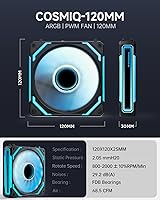
  • Fan Dimensions: Each fan measures 120×120×25mm, the standard size that fits the vast majority of mid-tower and full-tower PC cases.
  • Pack Quantity: The kit includes 3 individual fans, sized to fill a typical triple-fan intake or exhaust configuration without needing extras.
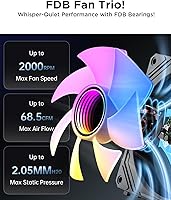
  • Bearing Type: All three fans use FDB (Fluid Dynamic Bearing) construction, which reduces friction compared to common hydraulic bearings and contributes to a longer operational lifespan.
  • Speed Range: Fan speed is PWM-controlled between 800 and 2000 RPM, allowing the system to scale airflow quietly under light loads and ramp up when temperatures rise.
  • Max Airflow: Each fan moves up to 68.5 CFM at full speed, which is a competitive output for a 120mm fan at this market tier.
  • Static Pressure: Rated static pressure reaches 2.05mmH2O, making these fans capable of pushing air effectively through radiators or dense mesh front panels.
  • Noise Level: Noise is rated at under 29.2 dB(A) at full load, though real-world impressions at maximum RPM tend to run slightly higher than this figure.
  • RGB Connector: Lighting connects via a 5V 3-pin ARGB connector, which is compatible with standard 5V ARGB headers found on most modern motherboards.
  • PWM Connector: Fan speed is managed through a standard 4-pin PWM connector, giving the system or hub precise control over RPM without manual switching.
  • Rated Voltage: Fans operate at DC 12V, consistent with standard PC fan power delivery from both motherboard headers and fan hubs.
  • Power Draw: Each fan consumes 6.25W at full load, so three fans together draw approximately 18.75W total — well within the capacity of any modern PSU.
  • Lighting Modes: The included hub provides access to 26 lighting modes in total, spanning streaming effects, solid monochrome colors, and audio-reactive rhythmic patterns.
  • Music Sync: The hub features a built-in wireless audio receiver that picks up ambient sound and translates it into reactive lighting changes without any software or audio cable required.
  • Daisy-Chain: Fans link together using proprietary interlocking connectors so that one cable run per cluster replaces the individual cable routing typical of most fan bundles.
  • Blade Design: The COSMIQ line is available in forward and reverse blade orientations, letting builders choose airflow direction while keeping the illuminated face of the fan visible.
  • Motherboard Sync: These fans are compatible with 5V ARGB motherboard headers, though primary lighting control is designed around the included standalone hub controller.
  • Hub Control: The included controller supports quick switching between lighting modes via a physical button, requiring no PC software or USB connection to operate.

Related Reviews

Asiahorse Dawn 120mm ARGB Case Fan
77%
91%
Cable Management
78%
Airflow Performance
84%
Noise Level
87%
RGB Lighting Quality
76%
Value for Money
More
Asiahorse Nyota 120mm ARGB Case Fan
75%
88%
ARGB Lighting Quality
76%
Cooling Performance
71%
Noise Level
74%
Motherboard Sync Compatibility
61%
Bearing & Long-Term Durability
More
Lian Li UNI Fan SL-INF 120 RGB Infinity Mirror ARGB 120mm Fan
86%
93%
Aesthetics and RGB Lighting
88%
Noise Level/Quiet Operation
91%
Build Quality and Durability
85%
Ease of Installation
87%
Cooling Efficiency
More
AsiaHorse AMICI-5GT ARGB PC Fans
79%
91%
Lighting & Visual Impact
83%
Airflow Performance
78%
Noise Level
89%
RGB Ecosystem Compatibility
76%
Build Quality & Materials
More
Corsair iCUE Link QX120 RGB 120mm Case Fan
79%
93%
Lighting Quality
88%
Noise Level
82%
Airflow & Cooling Performance
91%
Cable Management & Daisy-Chain System
84%
Build Quality & Materials
More
WDERAIR P1238 120mm PWM Computer Case Fan
70%
94%
Airflow Performance
31%
Noise Level
81%
Build Quality
83%
Durability & Longevity
76%
PWM Speed Control
More
AsiaHorse Matrix 360mm ARGB Case Fans
78%
91%
RGB Lighting Quality
88%
Installation Ease
67%
Case Compatibility
82%
Noise Level
74%
Airflow Performance
More
NZXT F120RGB Duo 120mm Dual-Sided RGB Fan
88%
88%
Performance
91%
RGB Lighting Quality
85%
Noise Level
87%
Airflow & Cooling Efficiency
89%
Build Quality
More
Lian Li UNI Fan TL Wireless 120mm Triple Pack
85%
88%
Performance
85%
Noise Levels
92%
RGB Lighting Customization
90%
Ease of Installation
87%
Cable Management
More
Wathai Triple 120mm AC Cabinet Cooling Fans
78%
93%
Ease of Setup
88%
Airflow Performance
67%
Noise Level
79%
Build Quality
62%
Speed Controller Quality
More

FAQ

They can connect to a 5V ARGB header on your motherboard, so basic sync is possible. That said, the AsiaHorse COSMIQ 120mm RGB Case Fans 3-Pack is really built around its own standalone hub controller. If deep software integration with your motherboard's ecosystem is a priority, expect to do some extra configuration — it is not as plug-and-play as fans designed natively for those platforms.
Each fan has interlocking connectors on both sides, so you click them together in a chain and then run a single cable from the last fan in the cluster to the hub. It is a bit different from what most builders are used to, but once it clicks — literally — it makes cable management noticeably cleaner. The connectors can feel a little fiddly on the first attempt, so take your time.

At lower RPMs, these fans are genuinely unobtrusive — you will barely notice them during everyday tasks. At full 2000 RPM, though, real-world noise runs a bit higher than the official spec implies. If your system regularly pushes the fans to maximum speed under heavy load, you will hear them. For most gaming and productivity workloads where PWM keeps speeds moderate, they stay reasonably quiet.

Standard fans push air from the front face to the back. A reverse blade fan does the opposite — it pulls air from what looks like the back and pushes it out the front. This matters when you want to, say, mount a fan with its lit side facing into the case while still pushing air in the right direction. It is a small detail, but one that makes a real difference in certain case layouts and open-bench builds.

The hub that comes in the 3-pack is sized for three fans, which matches the kit. If you want to add more fans — for a 6-fan setup, for instance — you would need to look into whether AsiaHorse offers a larger hub or whether a second hub can be synced. It is worth checking compatibility before assuming you can just chain more fans indefinitely.

The hub has a small wireless audio receiver built in — no cables, no software, no microphone permission prompts. It just picks up ambient sound in the room and uses it to drive the rhythmic lighting patterns. In a quiet workspace it responds to keyboard clicks and fan hum; in a louder gaming environment it reacts to in-game audio or music playing nearby. It is a fun effect, but most users find it more of a novelty than something they run every day.

Yes. At 120×120×25mm, these are the most common fan size around, and virtually every mid-tower case with dedicated fan mounts will accommodate them. The 3-pack is specifically well-suited for cases with three front intake slots or a triple-fan radiator position.

These COSMIQ fans use FDB (Fluid Dynamic Bearing) rather than the hydraulic bearings you find in cheaper options. In practical terms, FDB bearings generate less friction, which translates to lower noise at equivalent speeds and a longer lifespan before the bearing starts to degrade. It is a meaningful upgrade over budget fans, even if the difference is subtle in day-to-day use.

No software is required at all. The hub has a physical button that cycles through the 26 lighting modes, and the music-sync receiver is hardware-based. You can have the fans running with full lighting control straight out of the box without touching your PC's operating system. This is actually one of the reasons some builders prefer this kit over software-dependent alternatives.

Yes, completely. Fan compatibility has nothing to do with CPU platform — these fans connect via standard 4-pin PWM for speed control and 5V ARGB for lighting. Whether you are on an Intel or AMD system, as long as your motherboard or hub provides those headers, this RGB fan kit will work without any compatibility concerns.