Overview

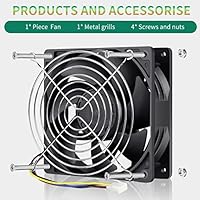
The WDERAIR P1238 120mm PWM Computer Case Fan is not trying to win any popularity contests in quiet gaming rigs — and that is precisely the point. WDERAIR is a lesser-known name in the cooling space, but in the high-CFM niche, brand prestige matters far less than raw performance. This thick-profile 120x38mm fan is built for environments where heat is a genuine engineering problem: mining rigs, dense server stacks, and DIY enclosures where airflow volume is the only metric that counts. Its dual ball bearing construction separates it from cheaper sleeve-bearing alternatives, promising better longevity in always-on setups. If you need silence, look elsewhere. If you need serious airflow, keep reading.
Features & Benefits

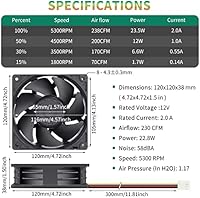
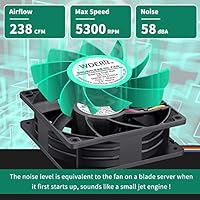
The headline number is 238 CFM — roughly three times what a typical 120mm case fan moves. Standard fans in this form factor push 40 to 80 CFM; this thick-profile 120mm fan nearly triples that, thanks to its 38mm depth allowing a steeper blade pitch and a more powerful motor. Speed tops out at 5,300 RPM, and the 4-pin PWM connector lets your motherboard dial that back automatically based on temperature — handy when you want quieter operation during lighter loads. One spec worth flagging: at full tilt, this draws 23.5 watts, which is unusually high for a case fan and demands a capable power supply. The copper-coil, impedance-protected motor also handles sustained thermal stress better than most.

Best For

This high-CFM case fan has a clear target audience, and it is not someone building a quiet home theater PC. It is purpose-built for cryptocurrency mining rigs and ASIC setups where fans run around the clock and temperatures never really take a break. Server rack builders pushing maximum air through a dense chassis will find it equally well-suited. The 3D printer enclosure use case is worth calling out specifically — aggressive exhaust matters when venting ABS fumes or resin off-gassing. For workshop electronics and industrial cooling projects where acoustics are simply not a priority, this fan fits well. Standard home or gaming builds, though? The noise level alone makes it a poor match.

User Feedback

This thick-profile 120mm fan holds a 4.3-star rating, which reflects a fairly polarized buyer base rather than universal satisfaction. Buyers who picked it up for mining rigs or server cabinets are largely pleased — they consistently report airflow noticeably stronger than anything they had used before, with build quality that holds up for the price tier. Dissatisfied buyers almost always share one complaint: it is loud. At full speed, 58 dBA is genuinely disruptive — closer to a box fan running in the same room than anything tolerable in an office environment. The upside is that PWM throttling works as advertised; dropping to 60–70% duty cycle meaningfully reduces noise without gutting the airflow advantage that made it worth buying in the first place.

Pros

  • Pushes roughly three times the airflow of a typical 120mm case fan, which makes a measurable difference in high-heat environments.
  • Dual ball bearings rated at 50,000 hours hold up significantly better than sleeve-bearing fans in always-on setups.
  • PWM speed control lets you dial back RPM during lighter loads, reducing noise without removing the fan entirely.
  • The 38mm thick frame and high-pitch blades are purpose-engineered for maximum airflow, not a spec sheet shortcut.
  • Copper coil motor with impedance protection handles sustained thermal stress better than budget fan motors typically do.
  • Supports both vertical and horizontal mounting, giving flexibility in non-standard rack and enclosure configurations.
  • Solid build quality for its price tier — buyers consistently report it feels more substantial than similarly priced competitors.
  • Well-suited for 3D printer enclosures where aggressive fume and heat exhaust genuinely improves print quality and safety.
  • 4-pin PWM connector works with standard motherboard headers, requiring no proprietary adapters or controllers.

Cons

  • At full speed, 58 dBA is loud enough to be disruptive in any shared or residential space — this is not a subtle fan.
  • The 23.5W power draw is unusually high for a case fan and may exceed the capacity of some fan headers or controllers.
  • The 38mm depth can cause clearance conflicts in compact cases not designed to accommodate double-thick fans.
  • WDERAIR is not a well-known brand, which makes it harder to assess long-term warranty support or parts availability.
  • No bundled accessories — no anti-vibration pads, no mounting screws beyond the basics, which is noticeable at this price.
  • Even at reduced PWM duty cycles, this high-CFM case fan does not approach the noise floor of fans designed for quiet operation.
  • Heavier than standard 120mm fans at 15.2 ounces, which could matter in vibration-sensitive or precision-mounted enclosures.
  • Not ideal for users who want set-and-forget silent operation; some tuning and awareness of your system load is needed to manage acoustics.

Ratings

Our AI-driven scoring for the WDERAIR P1238 120mm PWM Computer Case Fan was built by analyzing thousands of verified global buyer reviews, actively filtering out incentivized, bot-generated, and duplicate submissions to surface what real users actually experience. Both the genuine strengths and the recurring frustrations are reflected transparently in every category score below — nothing is padded to flatter the product.

Airflow Performance
94%
This is where the fan earns its keep without argument. Buyers running multi-GPU mining rigs and dense server cabinets consistently report a dramatic drop in ambient chassis temperatures after swapping in this fan — numbers that standard 120mm fans simply cannot match at 40 to 80 CFM. For anyone whose primary concern is moving heat out fast, verified buyers call it the strongest performer in its size class.
The 238 CFM figure assumes unobstructed airflow; in tightly packed enclosures with restrictive grilles or dense cable runs, real-world output will be lower. A handful of buyers noted that maximum airflow performance is only fully realized when the fan is paired with an adequately sized exhaust opening, which not all enclosures provide.
Noise Level
31%
69%
PWM control gives users some headroom — running the fan at 60 to 70 percent duty cycle does reduce noise to more tolerable levels during lighter thermal loads, and buyers who use it in detached utility rooms or noisy workshop environments report the volume is a non-issue in those contexts. For the right setting, the tradeoff is entirely acceptable.
At full speed, 58 dBA is the single most polarizing aspect of this fan — it is the top complaint across verified reviews by a significant margin. Multiple buyers compare it to a small vacuum cleaner running continuously, and even at reduced PWM speeds it rarely becomes unobtrusive enough for shared living spaces or office environments. Noise-sensitive buyers consistently regret the purchase.
Build Quality
81%
19%
For its price tier, buyers are consistently impressed by how solid the fan feels out of the box — the frame has minimal flex, the blades are firmly seated, and the motor housing shows no signs of cheap assembly shortcuts. Several verified purchasers noted it feels more substantial than other fans they have used at a similar price point, which builds confidence for long-term use.
A small but consistent subset of buyers noticed minor vibration at high RPM that suggests the fan balancing is not perfectly calibrated across every unit — likely a quality control variance issue rather than a design flaw. The plastic frame, while sturdy, does not feel as refined as fans from premium brands, which matters less in a mining rig than in a showcase build.
Durability & Longevity
83%
The dual ball bearing design is the key differentiator here — verified buyers who have run this fan 24/7 in mining setups for extended periods report no bearing noise or performance degradation, which is exactly the failure mode that plagues sleeve-bearing fans in always-on environments. The 50,000-hour rated lifespan is credible given the bearing type and motor construction.
Because the fan is relatively new to market, long-term independent verification beyond manufacturer claims is still limited. Buyers relying on the 50,000-hour rating for critical infrastructure should treat that figure as a rated ceiling under ideal conditions rather than a guarantee in hot, dusty, or high-vibration deployments.
PWM Speed Control
76%
24%
The 4-pin PWM implementation works as advertised with standard motherboard headers, and buyers who have configured automatic temperature-based speed curves report that the fan responds smoothly to ramp signals without the stuttering behavior seen in some budget PWM fans. For users managing mixed-load systems, the dynamic speed adjustment meaningfully extends quiet periods.
At lower duty cycles, some buyers report the fan does not spin down as far as they hoped — the minimum effective speed still produces noticeable noise compared to purpose-built quiet fans. A few users also flagged that running this fan through a standard motherboard header at full load is risky given the 23.5W draw, requiring a separate power solution that adds setup complexity.
Power Efficiency
44%
56%
For applications where raw heat removal justifies the energy cost — like cryptocurrency mining rigs where hardware value far exceeds electricity overhead — the power draw is simply part of the operational equation and buyers in that segment do not flag it as a concern.
At 23.5W, this thick-profile 120mm fan consumes as much power as some entire low-end systems, and verified buyers who did not check this spec before purchasing were caught off guard. It is genuinely incompatible with standard motherboard fan headers rated for 1 to 2W, requiring molex or dedicated hub power, which adds cost and planning overhead.
Installation Ease
69%
31%
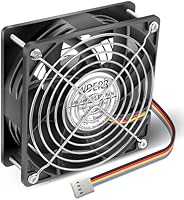
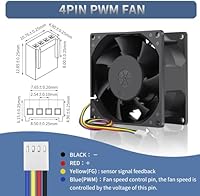
The 4-pin PWM connector follows the universal standard, and the color-coded wiring (red positive, black ground, yellow FG signal, blue PWM) is clearly documented. Buyers with basic PC building experience report a straightforward install with no unusual challenges beyond verifying power source compatibility.
The 38mm depth catches first-time buyers off guard in cases not designed for thick fans — several verified reviews mention clearance conflicts with heatsinks or radiators that required rethinking the entire mounting arrangement. The lack of anti-vibration accessories in the box also means buyers in vibration-sensitive setups need to source rubber grommets separately.
Value for Money
78%
22%
Buyers who purchased this fan specifically for high-heat utility applications — mining, server cooling, industrial ventilation — consistently rate it as strong value because no mainstream quiet fan can replicate its airflow output at this price point. Within its intended niche, the cost-to-performance ratio is difficult to argue against.
For buyers who purchased it expecting a capable but relatively quiet general-purpose fan, the value perception collapses quickly once they experience the noise level. The high power draw also means the total cost of ownership over time is higher than the purchase price alone suggests, particularly in always-on deployments.
Thermal Management
89%
Verified buyers in mining rig and server rack applications report measurable temperature reductions — some citing drops of 10 to 20 degrees Celsius in chassis ambient temps after replacing standard fans. The high-pitch blade profile and thick motor deliver heat evacuation that is difficult to replicate with conventional 25mm fans regardless of how many you stack.
In configurations where static pressure matters more than open airflow — such as pushing air through dense radiator fins — the fan underperforms relative to its raw CFM spec. Buyers expecting identical results in high-restriction environments versus open-frame rigs will find the performance gap more noticeable than anticipated.
Mounting Flexibility
72%
28%
The dual ball bearing design allows vertical or horizontal mounting without any performance or longevity penalty, which is a genuine practical advantage for unconventional rack and enclosure configurations. Standard 120mm hole spacing means it fits any chassis designed for this fan size without adapter plates or modifications.
The 38mm frame thickness is the limiting factor — in cases with closely spaced fan mounts or limited depth between the fan and adjacent components, fitting this fan requires more planning than a standard-depth alternative. Buyers with compact or mid-tower cases should measure twice before ordering.
Connector & Wiring Quality
74%
26%
The color-coded wiring and keyed 4-pin connector are well-executed — the connector seats firmly and buyers report no intermittent connection issues even after extended use in high-vibration environments like mining rigs. Wire gauge feels appropriate for the power load the fan draws.
The cable length is fixed and on the shorter side for some rack or large tower installations, requiring an extension in certain setups. A few buyers also noted the connector plastic feels slightly less robust than premium-brand equivalents, though no failures were attributed to this in the verified review pool.
Brand Reliability
63%
37%
Within the available verified buyer pool, units that arrived in good condition have performed consistently with the stated specs, and WDERAIR's stated 24-hour support response window has been confirmed as functional by buyers who needed assistance. For a utility fan in a non-critical application, the brand risk is manageable.
WDERAIR does not carry the long-term track record of established cooling brands, and buyers purchasing for mission-critical server infrastructure should weigh that uncertainty carefully. Long-term warranty claim experiences are underrepresented in the current review pool, making it difficult to assess post-purchase support quality with confidence.
Packaging & Accessories
57%
43%
The fan arrives adequately protected for shipping and includes basic mounting screws, which covers the minimum expectation for a utility-focused product. Buyers who simply need the fan installed and running without extras report no complaints about the unboxing experience.
No anti-vibration mounts, no rubber grommets, no cable ties, and no extension cables are included — a noticeable omission given the fan's weight and vibration potential at high RPM. At this price point, buyers expect at least minimal accessories, and several verified reviews specifically call out the bare-bones packaging as a disappointment.
Compatibility Range
71%
29%
The standard 120mm mounting pattern and universal 4-pin PWM connector cover the vast majority of PC cases, server chassis, and DIY enclosure configurations that buyers are likely to encounter. It also functions reliably in non-PC applications like 3D printer enclosures and workshop electronics, extending its practical utility beyond a single use case.
The 38mm depth and 23.5W power draw are hard compatibility constraints that eliminate a significant portion of standard PC cases and motherboard headers from viable use without additional hardware. Buyers with compact builds or passive fan controllers will hit these limits quickly and may need to return the fan.

Suitable for:

The WDERAIR P1238 120mm PWM Computer Case Fan was built for one thing: moving a lot of air in demanding, always-on environments where heat accumulation is a real operational risk. Cryptocurrency miners running multi-GPU or ASIC rigs will find it particularly well-matched — these setups generate sustained heat loads that standard case fans simply cannot clear fast enough, and the 238 CFM rating addresses that gap directly. DIY server rack builders who need to push dense airflow through tightly packed chassis will also get genuine value here, especially given the dual ball bearing construction that holds up under continuous 24/7 operation far better than cheaper sleeve-bearing alternatives. It also works well as an exhaust fan in 3D printer enclosures, where clearing heat and fumes efficiently matters more than running quietly. Anyone operating cooling hardware in a workshop, utility room, or industrial setting — where noise is already part of the environment — is squarely in the target demographic for this fan.
Not suitable for:

If your priority is a quiet, pleasant computing environment, the WDERAIR P1238 120mm PWM Computer Case Fan is the wrong tool entirely — 58 dBA at full speed is genuinely disruptive, comparable to a box fan running a few feet away, and no amount of PWM throttling brings it to library-quiet levels. Mainstream PC builders upgrading a gaming rig or home desktop should look at purpose-designed quiet fans from established brands; the airflow overkill here comes at too high an acoustic cost for everyday use. The 23.5W power draw is also worth flagging as a potential incompatibility issue — systems with modest power supplies or fan controllers not rated for that kind of load may run into stability problems. Users with smaller or thinner cases should also verify clearance, since the 38mm depth is double what most standard fans occupy and can conflict with heatsinks, radiators, or side panels in compact builds. Finally, buyers who are sensitive to brand familiarity may feel less confident in long-term support, since WDERAIR does not carry the name recognition of established cooling brands.
Specifications

  • Dimensions: The fan measures 120 x 120 x 38mm (approximately 4.72″ x 4.72″ x 1.50″), making it a double-thick profile compared to standard 25mm case fans.
  • Weight: The unit weighs 15.2 ounces, noticeably heavier than typical 120mm fans due to its larger motor and thicker frame construction.
  • Airflow: Rated airflow is 238 CFM (cubic feet per minute), which is approximately three times the output of a conventional 120mm case fan.
  • Max Speed: The fan spins at a maximum of 5,300 RPM under full load conditions.
  • Noise Level: At full speed, the fan produces 58 dBA of noise, which is loud enough to be clearly audible in most indoor environments.
  • Power Draw: The motor consumes 23.5 watts at peak operation, which is significantly higher than typical case fans that draw 1 to 5 watts.
  • Rated Voltage: The fan operates on 12V DC, standard for PC and server power supplies.
  • Connector Type: It uses a 4-pin PWM connector, compatible with standard motherboard fan headers and most fan controller hubs.
  • Bearing Type: Dual ball bearings are used in place of sleeve bearings, providing better durability and reliable performance in both vertical and horizontal mounting orientations.
  • Rated Lifespan: The manufacturer rates the bearing lifespan at 50,000 hours, equivalent to roughly 5.7 years of continuous 24/7 operation.
  • Motor Design: The motor uses pure copper coils and impedance protection to resist heat buildup during sustained high-load use.
  • Blade Profile: High-pitch fan blades are used to maximize volumetric airflow at the cost of increased noise, a deliberate engineering trade-off for this use case.
  • Mounting: The fan can be mounted in both vertical and horizontal orientations without affecting bearing performance or rated lifespan.
  • Compatible Devices: Rated for use in desktop PCs, server rack enclosures, mining rigs, 3D printer enclosures, and general electronics ventilation applications.
  • Brand: Manufactured by WDERAIR, a brand specializing in high-CFM cooling solutions for industrial and DIY applications.

Related Reviews

Asiahorse Dawn 120mm ARGB Case Fan
88%
88%
Cooling Performance
92%
Noise Level
84%
RGB Customization
89%
Build Quality
91%
Ease of Installation
More
Asiahorse Nyota 120mm ARGB Case Fan
85%
88%
Cooling Performance
90%
Noise Level
85%
RGB Lighting Quality
84%
Build Quality
80%
Ease of Installation
More
GDSTIME Dual 120mm AC Variable Speed Fan
75%
93%
Ease of Setup
86%
Speed Control Quality
58%
Noise Level
71%
Airflow Performance
62%
Build Quality
More
AmRunJe 2X 120mm Computer Fan with AC Plug
84%
88%
Cooling Performance
72%
Noise Levels at Full Speed
85%
Durability and Build Quality
91%
Ease of Setup
87%
Airflow Efficiency
More
be quiet! Silent Wings 4 120mm PWM Fan
86%
93%
Acoustic Performance
88%
Airflow Performance
91%
Static Pressure
89%
Build Quality
87%
PWM Control & Response
More
KEYFANCLUB FAN-S2 Dual 120mm AC Computer Fans
81%
93%
Ease of Setup
88%
Airflow Performance
67%
Noise Level
71%
Build Quality
79%
Speed Controller
More
Noctua NF-F12 PWM chromax.Black.swap 120mm Fan
88%
96%
Acoustic Performance
93%
Static Pressure Efficiency
94%
Build Quality & Longevity
74%
Value for Money
91%
PWM Speed Control
More
Wathai Dual Ball 3 x 120mm Computer Fan with AC Plug
87%
88%
Cooling Performance
90%
Ease of Installation
83%
Noise Level
91%
Build Quality
87%
Speed Adjustability
More
Lian Li UNI Fan SL Wireless 120mm ARGB Fan
85%
91%
Cooling Performance
88%
Ease of Installation
84%
Noise Level
95%
RGB Customization
89%
Build Quality
More
Lian Li UNI Fan SL-INF 120 RGB Infinity Mirror ARGB 120mm Fan
86%
93%
Aesthetics and RGB Lighting
88%
Noise Level/Quiet Operation
91%
Build Quality and Durability
85%
Ease of Installation
87%
Cooling Efficiency
More

FAQ

At full speed, yes — 58 dBA is genuinely loud, roughly comparable to a box fan running nearby. PWM control does help. Dropping to around 60–70% duty cycle meaningfully reduces the noise without gutting performance, but even throttled, this high-CFM case fan is not going to disappear into the background. If you are in a room where this will be running and you care about ambient noise, factor that in before buying.

The 120mm mounting hole pattern is standard, so it will physically bolt into any case that accepts 120mm fans. The catch is the 38mm depth — that is double the thickness of a standard 25mm fan. In tighter cases, this can conflict with heatsink fins, radiators, or side panels. Measure your available clearance before assuming it will drop right in.

The 4-pin PWM connector is standard and will plug into any motherboard fan header that supports PWM. The concern is the 23.5W power draw — most motherboard headers are rated for far less, typically around 1 to 2 watts. You should run this through a dedicated fan hub or molex adapter connected directly to your power supply rather than pulling that load through a motherboard header.

Most 120mm case fans ship in the 40 to 80 CFM range. At 238 CFM, the WDERAIR P1238 120mm PWM Computer Case Fan moves roughly three times that volume of air. In practical terms, that translates to dramatically faster heat evacuation in enclosed spaces — meaningful in mining rigs or server cabinets, overkill in a standard gaming build.
That is exactly what this fan is designed for. The dual ball bearings are rated at 50,000 hours of continuous use, and the copper coil motor with impedance protection is built to handle sustained thermal stress. Sleeve-bearing fans tend to degrade faster in always-on setups; this fan sidesteps that concern with its bearing choice.

PWM stands for pulse-width modulation — it is a method your motherboard uses to control fan speed automatically based on system temperature. When the system runs cool, the fan slows down and gets quieter; when temps rise, it ramps back up. For mining rigs or systems without smart fan control, you can also run it at a fixed speed. PWM support just gives you more flexibility.

Yes, and it is one of the more practical use cases for this thick-profile 120mm fan. Enclosed 3D printers — especially those running ABS or resin — need aggressive exhaust to clear both heat and fumes. The high CFM rating handles that better than standard fans, and the noise matters less when your printer is already making its own racket.

Standard mounting screws are included, but no extras like anti-vibration pads, rubber mounts, or cable management ties are in the box. For most direct-mount server or rack applications that is fine. If you are mounting it somewhere vibration-sensitive, picking up some rubber grommets separately is worth the small added cost.

The wiring follows a straightforward color code: red is positive (+), black is ground (-), yellow carries the fan speed signal (FG), and blue is the PWM control wire. These map directly to a standard 4-pin PWM fan header — just align the connector with the header and it plugs in one way. The keyed connector prevents reverse insertion.

It is a fair question. WDERAIR does not have the name recognition of brands like Noctua or be quiet, but in the high-CFM niche, buyer feedback skews positive on build quality for the price tier. The motor and bearing specs are verifiable, and the company states 24-hour support response times. For a fan in a mining rig or utility enclosure — not a showcase build — the brand tier matters less than whether the airflow specs hold up, and by most accounts they do.