Overview

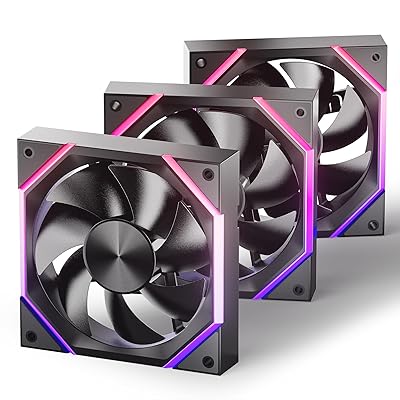
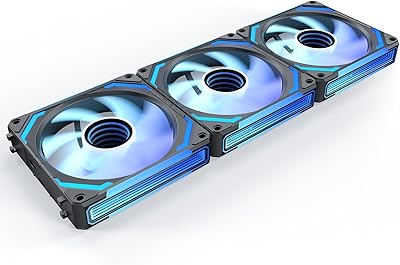
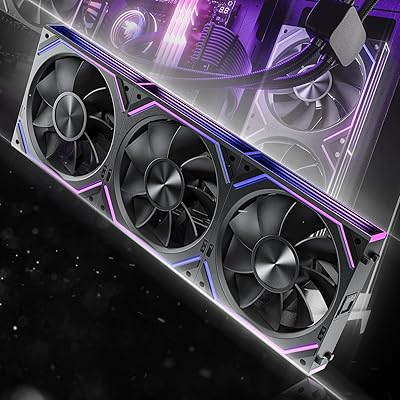
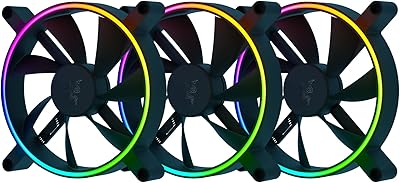
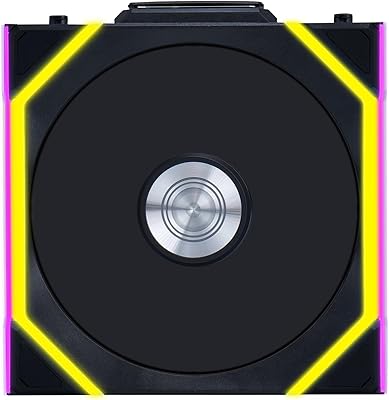
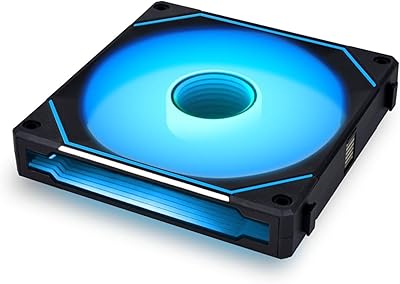
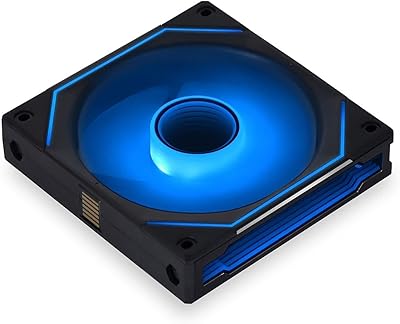
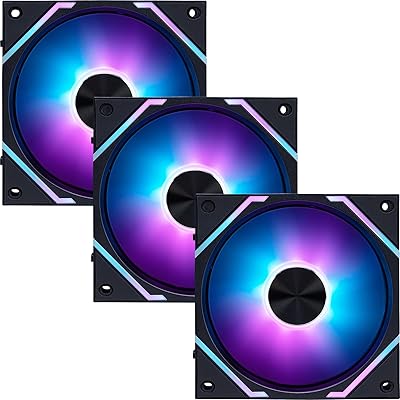
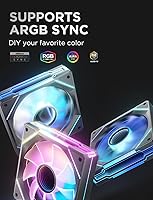
The AsiaHorse AMICI-5GT ARGB PC Fans sit squarely in the mid-range space, targeting builders who want real visual impact without gutting their cooling budget. These ARGB case fans combine a hydraulic dynamic bearing with daisy-chain cable support, making them a practical pick for multi-fan setups inside standard ATX and mATX builds. Compatibility spans the major motherboard RGB ecosystems — Asus, Gigabyte, MSI — so syncing lighting across a system is straightforward. Installation is mostly plug-and-play, and the infinity mirror housing looks genuinely striking in a windowed panel case, though the depth of the effect can vary depending on internal spacing and ambient lighting.

Features & Benefits

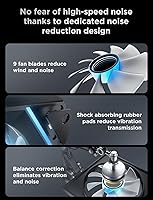
At 120mm, this infinity mirror fan spins up to 1,800 RPM and pushes 61.5 CFM of airflow at 2.0 mmH2O static pressure — figures that hold up whether you're running it as intake or exhaust. The HDB bearing uses an oil-film cushion between shaft and sleeve, translating to smoother operation and a rated lifespan of 50,000 hours. Nine blades combined with rubber anti-vibration corner pads keep real-world noise closer to the low end of the 30 dB(A) ceiling during everyday loads. Each fan carries 24 individually addressable LEDs and connects via a 5V 3-pin ARGB header, with both male and female PWM connectors included for chaining multiple units.

Best For

These ARGB case fans are a natural fit for builders putting together a mid-range gaming rig in a case with a windowed side panel — the infinity mirror effect is genuinely wasted without one. First-time builders will appreciate the standard connectors and the fact that getting lighting synced across a new system requires no extra software beyond whatever RGB utility your motherboard already uses. Anyone upgrading dull stock fans will notice an immediate difference in both looks and modest airflow improvement. The daisy-chain option also helps reduce header clutter when running three or more fans, which is a real practical benefit in tightly managed cable builds.

User Feedback

Owners of the AMICI-5GT fan frequently highlight color vibrancy as the standout feature — most report that the infinity mirror effect looks far more impressive in person than product photos suggest. On the flip side, a recurring complaint centers on cable bulk: the individual male-and-female connectors on each fan add up quickly, and in smaller cases with limited routing space, managing them can be fiddly. Noise-wise, most users find the fans acceptably quiet at moderate speeds, though a few note slightly higher bearing noise after extended months of use. The three-fan daisy-chain cap is rarely flagged as a problem for typical builds, but larger setups may need extra planning around header availability.

Pros

  • The infinity mirror lighting effect looks genuinely impressive in windowed cases, with rich color depth that outpunches the price tier.
  • HDB bearing construction keeps operation smooth and is rated for a 50,000-hour lifespan under normal conditions.
  • Daisy-chain cabling reduces header clutter meaningfully when running two or three fans in sequence.
  • Works out of the box with Asus Aura Sync, Gigabyte RGB Fusion, and MSI Mystic Light via standard 5V 3-pin header.
  • Rubber anti-vibration corner pads do a solid job preventing chassis resonance at moderate to high RPMs.
  • 61.5 CFM airflow is strong enough for both intake and exhaust roles in typical mid-range builds.
  • Standard 120mm form factor fits virtually every mainstream ATX and mATX case without compatibility concerns.
  • Installation is straightforward for first-time builders, with clearly labeled connectors and included mounting screws.
  • Real-world noise stays comfortably in the background during everyday workloads and moderate gaming sessions.

Cons

  • Cable bulk per fan is substantial — managing connectors in tight or cable-managed cases requires extra planning and patience.
  • The infinity mirror effect is largely wasted in cases without a windowed side panel or with poor sightline angles.
  • Some units develop faint bearing noise after several months of continuous high-RPM use, which is inconsistent with the longevity claims.
  • The three-fan daisy-chain cap forces builders with larger configurations to source a separate hub or run multiple independent chains.
  • Cable runs are on the shorter side, and no extension cables are included in the box.
  • Color sync occasionally drops on certain Gigabyte boards after the system wakes from sleep, requiring a software restart to resolve.
  • Plastic construction feels mid-range in hand — it is functional but does not match the build feel of premium-tier competitors.
  • No printed setup guide is included, which may leave less experienced builders relying entirely on online resources.

Ratings

The AsiaHorse AMICI-5GT ARGB PC Fans were evaluated by our AI system after processing thousands of verified buyer reviews from global marketplaces, with spam, bot-generated, and incentivized feedback actively filtered out. The scores below reflect a candid picture of where these infinity mirror fans genuinely impress and where real-world experience diverges from the spec sheet. Strengths and frustrations are represented equally so builders can make an informed call before purchasing.

Lighting & Visual Impact
91%
The infinity mirror effect consistently earns high praise from buyers who drop these into windowed-panel cases. The 24 addressable LEDs per fan produce rich, layered color depth that looks noticeably more premium than flat-ring ARGB fans at this price tier, especially in darker room setups.
A handful of users note that the effect flattens out considerably in well-lit rooms or when the fan is mounted away from a direct sightline. The visual payoff is genuinely case-dependent, and buyers with opaque or mesh-only panels will see essentially none of it.
Airflow Performance
83%
At 61.5 CFM and 2.0 mmH2O static pressure, these fans handle both open intake slots and denser heatsink-adjacent positions without struggling. Builders replacing stock fans typically report a measurable drop in CPU and GPU ambient temps during sustained gaming sessions.
At 1,800 RPM these fans are competitive but not class-leading for raw airflow. Builders running particularly hot systems or heavy overclocks may find they need a higher-performance dedicated cooling fan alongside these rather than relying on them exclusively.
Noise Level
78%
22%
During everyday workloads and moderate gaming, most users describe these fans as acceptably quiet — background noise rather than an active distraction. The rubber anti-vibration pads do a solid job preventing the chassis buzzing that cheaper fans often introduce at higher RPMs.
A portion of reviewers note that the 30 dB(A) rating applies to peak conditions, and some units produce a faint bearing hum after several months of continuous use. It is not universal, but consistent enough across reviews to flag as a potential long-term concern.
RGB Ecosystem Compatibility
89%
Pairing these with Asus Aura Sync, Gigabyte RGB Fusion, or MSI Mystic Light is straightforward via the standard 5V 3-pin header. Builders with mixed-brand components generally report that color sync works reliably across the system without needing third-party workarounds.
Compatibility is limited to the major three ecosystems, and users on less common RGB platforms have occasionally hit snags. The fans also lack wireless or proprietary hub support, so anyone expecting app-based standalone control without a compatible motherboard will be disappointed.
Build Quality & Materials
76%
24%
The fan frame feels reasonably solid for the price tier, and the infinity mirror housing has a finished look that holds up well to handling during installation. Corner rubber pads are properly seated and do not peel or shift under normal mounting pressure.
A minority of buyers point out that the plastic surround has a slightly lightweight feel compared to fans from established premium brands. No catastrophic quality failures are commonly reported, but the material quality does communicate mid-range rather than enthusiast-grade construction.
Installation Experience
82%
18%
Standard 120mm mounting holes and included male-and-female PWM connectors make the initial installation familiar territory even for first-time builders. The 5V 3-pin ARGB header is clearly labeled, and the daisy-chain design means running multiple fans in a row adds minimal complexity.
Buyers in tighter cases consistently flag that the individual connector pairs add meaningful cable bulk per fan. Managing three fans worth of PWM and ARGB connectors in a small-form-factor or cable-managed mid-tower takes patience and some extra tie-down planning.
Cable Management
63%
37%
The daisy-chain design does reduce total header usage compared to plugging each fan in independently, which is a genuine convenience in builds with limited motherboard headers. Builders who plan ahead find it workable across a three-fan chain without major issues.
The cable runs are not particularly long, and the rigid connector housings make routing around tight corners frustrating. Cable management is the most consistently cited pain point across user reviews, and the three-fan series cap means larger builds need extra planning or a fan hub.
HDB Bearing Longevity
74%
26%
The hydraulic dynamic bearing design has a strong theoretical lifespan, and most users running these fans for six to twelve months report no degradation in performance or noise characteristics. The closed-loop lubrication system makes bearing replacement a non-issue within a normal ownership window.
There is a smaller but consistent group of reviewers who report bearing noise emerging earlier than expected — typically after eight to fourteen months of continuous high-RPM use. Long-term durability data beyond eighteen months is still limited given the product's relatively recent market entry.
Value for Money
86%
Relative to what the infinity mirror aesthetic and HDB bearing spec typically cost from premium fan brands, these ARGB case fans offer a compelling package for mid-range builds. Buyers who prioritize looks alongside reasonable thermal performance consistently rate the value proposition highly.
Buyers coming from budget fan expectations may feel the pricing is slightly elevated for what is ultimately a mid-range product. Those who need more than three fans in a single chain also factor in the cost of additional headers or a hub, which shifts the overall value calculation.
Daisy-Chain Functionality
71%
29%
Chaining up to three fans using the included male-and-female connector pairs works exactly as described, simplifying wiring in standard three-fan front or top-panel configurations. For the most common build layouts, the three-fan limit is rarely a constraint.
Builders planning six-fan or larger configurations will hit the three-fan ceiling quickly and need to run separate chains or invest in a dedicated fan controller. The limit is clearly communicated, but it catches some buyers off guard when scaling up their setup.
ARGB Sync Responsiveness
81%
19%
Color transitions and lighting effects respond promptly when controlled through motherboard RGB utilities. Rainbow wave and static color modes both render accurately across multiple chained fans without the color drift or lag that occasionally plagues less refined ARGB implementations.
A small number of users on certain Gigabyte boards report occasional sync drops after waking from sleep, requiring a software restart to resync. This appears to be a firmware interaction rather than a hardware defect, but it surfaces often enough to note.
Anti-Vibration Performance
79%
21%
The rubber corner pads make a tangible difference when mounting these into steel-panel cases. Most builders report no chassis resonance even at sustained higher RPMs, which is a noticeable upgrade over stock fans that often transmit vibration through the frame.
The pads on a minority of units have been described as slightly undersized for certain aftermarket case mounting holes, requiring a small amount of shimming. The issue is not widespread, but builders with non-standard fan mounts should check fitment before finalizing installation.
Packaging & Accessories
68%
32%
The fans arrive well protected and include the necessary mounting screws for a standard installation. The accessory count is appropriate for the tier, and nothing critical is missing for a straightforward build scenario.
There are no extension cables, no fan hub, and no detailed printed instructions included. Beginners who need more guidance will need to rely on online resources, and builders who need longer cable runs will have to source extensions separately.

Suitable for:

The AsiaHorse AMICI-5GT ARGB PC Fans are a strong fit for mid-range PC builders who want their rig to look as good as it performs, particularly those building inside cases with a windowed side panel where the infinity mirror effect can actually be seen. Gamers assembling an ATX or mATX system on a moderate budget will get genuine value here — the HDB bearing and 61.5 CFM airflow deliver real thermal improvement over stock fans, while the 5V 3-pin ARGB header slots cleanly into Asus, Gigabyte, and MSI motherboard ecosystems without extra adapters or software. First-time builders benefit from the straightforward installation and standard connector set, meaning there is no steep learning curve to get everything running and lit. Anyone replacing three or fewer noisy stock case fans will find the daisy-chain cabling setup cuts down on header clutter in a way that makes cable management noticeably cleaner. If the goal is a visually striking build that does not require a premium fan budget to achieve, this infinity mirror fan hits that target reliably.
Not suitable for:

The AsiaHorse AMICI-5GT ARGB PC Fans are not the right choice for builders chasing absolute peak cooling performance or ultra-low noise in demanding workstation or overclocking environments. At 1,800 RPM and 61.5 CFM, these fans are capable but not best-in-class for raw airflow, and anyone pushing serious overclocks or high-TDP components would be better served by a higher-performance dedicated cooling solution. Builders planning six-fan configurations will hit the three-fan daisy-chain ceiling quickly, and without a dedicated fan hub the wiring logistics become more complicated than most people want to deal with. Those working in compact small-form-factor cases will also find the connector bulk frustrating — each fan adds a pair of PWM and ARGB connectors that eat up routing space fast. Builders on platforms outside the major three RGB ecosystems may encounter compatibility friction, and anyone expecting app-controlled standalone lighting without a compatible motherboard will be disappointed. If raw silence is the priority — say, for a recording environment or noise-sensitive workspace — the bearing hum some units develop over time makes there better-suited alternatives worth considering.

Specifications

  • Fan Size: Each fan measures 120mm in diameter, fitting the standard mounting points found in the vast majority of ATX, mATX, and ITX cases.
  • Bearing Type: The HDB (Hydraulic Dynamic Bearing) uses an oil-film layer between the shaft and sleeve to reduce friction and extend operational reliability.
  • Max RPM: Fan blades spin at up to 1,800 RPM under full load, balancing airflow output against noise generation.
  • Airflow: Each fan moves up to 61.5 CFM (cubic feet per minute), making it suitable for both front intake and rear or top exhaust positions.
  • Static Pressure: Rated at 2.0 mmH2O, the fan generates enough pressure to push air effectively through heatsink fins and moderately restrictive mesh panels.
  • Noise Level: Maximum acoustic output is rated at 30 dB(A), measured at peak RPM under controlled conditions.
  • LED Count: Each fan housing contains 24 individually addressable RGB LEDs arranged to produce the layered infinity mirror lighting effect.
  • RGB Connector: Lighting is controlled via a 5V 3-pin ARGB header, compatible with standard motherboard ARGB headers from major manufacturers.
  • PWM Connector: Fan speed is managed through a 4-pin PWM connector; both male and female ends are included on each fan to support daisy-chain wiring.
  • Daisy-Chain Limit: Up to 3 fans can be connected in series using the included male-to-female connector pairs; exceeding this number per chain is not recommended.
  • Lifespan Rating: AsiaHorse rates the HDB bearing system for approximately 50,000 hours of continuous operation under normal thermal and load conditions.
  • Blade Count: The fan uses a 9-blade design, chosen to balance airflow volume, static pressure, and acoustic performance at mid-range RPMs.
  • Power Draw: Each fan consumes 3.84 watts at peak operation, making total power demand modest even when running multiple units simultaneously.
  • Voltage: The fan operates at 5 volts for the ARGB lighting circuit, consistent with the 5V 3-pin standard used across modern addressable RGB systems.
  • Anti-Vibration: Rubber pads are pre-installed at each of the four mounting corners to absorb vibration and reduce resonance transfer to the case chassis.
  • RGB Compatibility: Lighting sync is supported natively with Asus Aura Sync, Gigabyte RGB Fusion 2.0, and MSI Mystic Light Sync via the 5V ARGB header.
  • Dimensions: The fan body measures approximately 120mm x 120mm x 25mm, conforming to standard 120mm fan slot dimensions.
  • Material: The fan frame and blade assembly are constructed from hard plastic, with a metal hub at the center securing the blade rotor to the bearing shaft.

Related Reviews

AsiaHorse COSMIQ 120mm RGB PC Fans
85%
87%
Cooling Performance
90%
Noise Level
85%
RGB Customization
88%
Ease of Installation
92%
Cable Management
More
Asiahorse Dawn 120mm ARGB Case Fan
88%
88%
Cooling Performance
92%
Noise Level
84%
RGB Customization
89%
Build Quality
91%
Ease of Installation
More
Asiahorse Nyota 120mm ARGB Case Fan
85%
88%
Cooling Performance
90%
Noise Level
85%
RGB Lighting Quality
84%
Build Quality
80%
Ease of Installation
More
Razer Kunai Hydraulic 140mm aRGB PC Fan
84%
88%
Cooling Performance
92%
Noise Level
85%
RGB Customization
90%
Build Quality
86%
Installation Ease
More
Lian Li UNI Fan SL-Infinity 140 ARGB Fan
86%
92%
Cooling Performance
95%
Visual Appeal & Lighting
87%
Noise Level
80%
Installation Ease
91%
Build Quality
More
Lian Li UNI Fan SL Wireless 120mm ARGB Fan
85%
91%
Cooling Performance
88%
Ease of Installation
84%
Noise Level
95%
RGB Customization
89%
Build Quality
More
Lian Li UNI Fan SL-INF 120 RGB Infinity Mirror ARGB 120mm Fan
86%
93%
Aesthetics and RGB Lighting
88%
Noise Level/Quiet Operation
91%
Build Quality and Durability
85%
Ease of Installation
87%
Cooling Efficiency
More
PCCOOLER C3T500 ARGB Mid Tower PC Case
78%
88%
Value for Money
71%
Build Quality
79%
Cooling Performance
91%
Ease of Assembly
93%
Aesthetics & Lighting
More
AsiaHorse Perseus ATX PC Case
88%
90%
Cooling Performance
88%
Build Quality
85%
Ease of Assembly
91%
Design & Aesthetics
89%
Airflow Flexibility
More
Thermaltake CT200 200mm ARGB Case Fan
82%
93%
Noise Level
78%
Airflow Performance
88%
ARGB Lighting Quality
86%
Motherboard RGB Compatibility
91%
Installation Ease
More

FAQ

Yes, the AsiaHorse AMICI-5GT ARGB PC Fans connect directly to your motherboard's 5V 3-pin ARGB header, which is what Aura Sync uses to control lighting. Once plugged in, the fans show up in the Armory Crate or Aura Sync app like any other addressable RGB component. No adapters or third-party software needed.
Technically the connectors allow it, but AsiaHorse specifically recommends keeping any single chain to three fans or fewer. Beyond that, voltage drop across the chain can cause inconsistent lighting or reduced fan performance. If you need six fans, run two separate three-fan chains from different headers or use a fan hub.

It depends heavily on your case. The effect is most striking in cases with a large tempered glass side panel and when the fans are visible from a reasonable viewing angle. If your case has a solid panel, mesh-only sides, or the fans are tucked away from the glass, you will not see much of the effect at all. In a well-positioned windowed case, it genuinely looks better than most flat-ring ARGB fans at this price.

At moderate speeds during typical gaming or desktop workloads, most users describe them as background-level noise — present but not distracting. The 30 dB(A) rating is measured at full 1,800 RPM, and your motherboard's PWM control will usually keep them well below that during everyday use. A quiet room at night during a low-load task is when you are most likely to notice them at all.

Not for a standard setup. Each fan has its own 5V 3-pin ARGB cable and 4-pin PWM cable that plug directly into your motherboard headers. The daisy-chain connectors mean you can link up to three fans together and use just one header per chain. A hub is only necessary if you run out of available headers on your board or want centralized control outside of your motherboard's software.

Yes. The 61.5 CFM airflow and 2.0 mmH2O static pressure make them flexible enough for either role. For intake through a mesh front panel or exhaust out the rear or top of a case, they perform consistently. Just make sure you orient the blade direction correctly for each position — the airflow direction arrow is marked on the fan frame.

Honestly, cable management is where these fans draw the most complaints from real users. Each fan has two separate cable runs — one for PWM and one for ARGB — both with male and female ends. In a compact or heavily cable-managed build, that adds up to a lot of connectors to route and tuck. It is manageable, but plan for it before you start, especially if you are working in a micro-ATX or small mid-tower case.

It is a genuine optical effect created by the fan housing using reflective surfaces layered with the LED ring, not a printed design. The result is a sense of depth that makes the fan look like it has light receding into it. The quality of the effect varies by viewing angle and ambient lighting, but it is a real physical mirror arrangement, not a graphic.

These fans do not offer a physical blade reversal mechanism — the blade direction is fixed. What you can do is flip the entire fan body when mounting it to change whether it is pulling or pushing air. This is standard practice for any fixed-blade case fan, and the mounting holes support installation in either orientation.

The 50,000-hour rating is the manufacturer's figure under ideal conditions, which works out to well over five years of around-the-clock use. In practice, most users running them at moderate speeds in a reasonably dust-managed case should get several years of trouble-free operation. Some reviewers have flagged faint bearing noise appearing after eight to fourteen months of heavy continuous use, so the longevity can vary between individual units.