


Overview

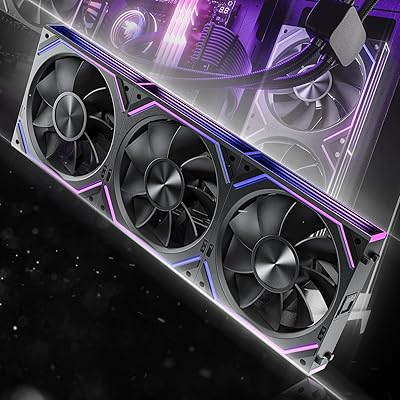
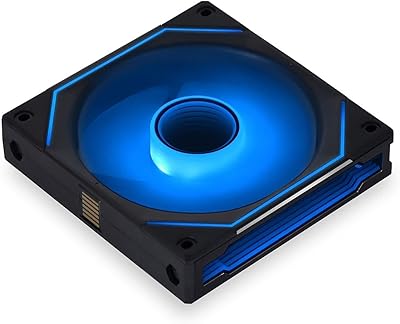
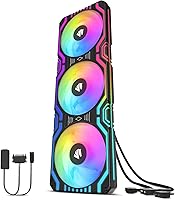
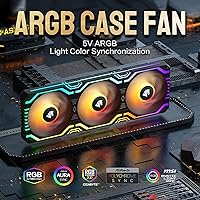
The AsiaHorse Matrix 360mm ARGB Case Fans take a different approach to fan kits by using a unified square frame that houses all three 120mm fans in a single integrated unit. That silhouette is the first thing you notice, and it genuinely stands out against the sea of round-framed options on the market. Sitting in the mid-range price tier, this fan kit occupies an interesting space — more capable than the cheapest RGB bundles, but not trying to compete with Corsair or Lian Li on prestige. It ships ready to work with either a standalone analog controller or a motherboard ARGB header, which keeps setup straightforward for builders at any experience level.

Features & Benefits

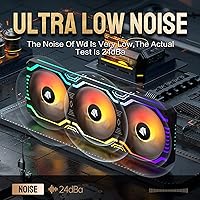
With 56 addressable LEDs distributed across the three fans, the AsiaHorse Matrix trio produces lighting coverage that feels genuinely dense — colors render consistently across the full face of each fan rather than clustering near the hub. Speed runs from 800 RPM up to 1800 RPM via PWM control, so you can dial down noise during light tasks and push airflow harder when the CPU is under load. The noise floor at low speeds is impressively quiet. Total airflow tops out around 66 CFM, which handles ventilation well in mid-range builds. Aura Sync, Mystic Light, and Polychrome Sync are all supported, and the daisy-chain cable arrangement cuts down on loose wires considerably.

Best For

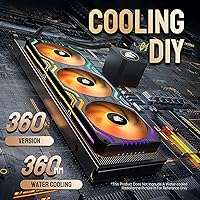
These ARGB case fans make the most sense for builders who want a strong visual result without spending a lot of time configuring individual fan connections. If your motherboard has a 5V 3-pin ARGB header — common on ASUS, MSI, and ASRock boards — you can sync lighting directly and skip the controller entirely. They also suit anyone building around a 360mm AIO cooler, since the fan kit drops in as a matched set with consistent aesthetics. One thing to check before buying: the square frame does not fit cleanly in every case. Mid-tower and full-tower cases with standard radiator mounts work well, but tighter or unconventional layouts can create clearance issues.

User Feedback

Buyer sentiment skews noticeably positive, with lighting quality and installation ease drawing the most consistent praise. People running these fans on ARGB-capable motherboards especially appreciate how accurate the colors look compared to cheaper alternatives. The integrated cable routing also gets repeated mentions as a real time-saver during builds. On the downside, a portion of users have flagged bearing noise appearing after months of use — not universal, but frequent enough to be worth noting. The included controller works fine for basic color cycling, but enthusiasts who want granular per-LED control tend to find it limiting and prefer motherboard software instead. For the price, overall reception is solid.

Pros

  • 56 addressable LEDs across three fans produce dense, accurate RGB coverage that looks premium through a glass panel.
  • The integrated square frame dramatically cuts cable clutter compared to installing three individual fans.
  • Supports Aura Sync, Mystic Light, and Polychrome Sync out of the box with no extra adapters needed.
  • PWM speed control lets you run these ARGB case fans quietly during light workloads and ramp up when needed.
  • Ships with both a standalone controller and ARGB header support, giving you flexibility on day one.
  • Installation is noticeably faster than managing separate fans, which beginners will genuinely appreciate.
  • Color consistency across all three fans is better than most options at this price point.
  • The square frame aesthetic gives builds a unique, eye-catching look that round-frame kits cannot replicate.

Cons

  • The rigid square frame does not fit all cases and can cause clearance issues in compact or unconventional builds.
  • Some buyers have reported bearing noise developing after several months of regular use.
  • The bundled analog controller lacks advanced features, limiting lighting customization for power users.
  • Total airflow tops out at a modest level that may not satisfy builders cooling high-TDP components.
  • The integrated frame means you cannot reposition individual fans independently once mounted.
  • Plastic construction feels functional rather than premium when handled up close.
  • No per-fan speed reporting or tachometer feedback is available through standard headers.
  • If one fan in the integrated unit fails, replacing just that fan is not straightforward.

Ratings

The AsiaHorse Matrix 360mm ARGB Case Fans have been evaluated by our AI rating system after processing thousands of verified global buyer reviews, with spam, bot submissions, and incentivized feedback actively filtered out to ensure the scores reflect genuine ownership experience. This fan kit earns strong marks in several areas but also reveals clear limitations that matter depending on your build goals. Both the highlights and the honest shortcomings are reflected transparently in the category scores below.

RGB Lighting Quality
91%
Buyers consistently call out the lighting as one of the best they have seen at this price tier. The 56 addressable LEDs produce rich, even color coverage across all three fans simultaneously, and color accuracy under Aura Sync or Mystic Light control is noticeably better than cheaper alternatives in the same category.
A small number of users have noted minor inconsistencies in LED brightness between individual fans within the same kit over time. Those running the included analog controller rather than motherboard software also report fewer dynamic lighting options compared to what premium RGB ecosystems offer.
Installation Ease
88%
The integrated frame approach genuinely simplifies the installation process. Builders mounting this fan kit on a 360mm radiator report the job taking a fraction of the time compared to wiring three separate fans, and the daisy-chain cable design means far fewer loose wires to manage inside the case.
The rigid one-piece frame removes flexibility during installation. If your case requires angling or repositioning individual fans to clear obstructions, that simply is not possible here, and some builders find the fixed layout awkward when working within tighter case interiors.
Case Compatibility
67%
33%
For builders using mainstream mid-tower or full-tower cases with standard 360mm radiator mounts, fitment is straightforward and the square frame drops in cleanly. Cases from popular brands like Fractal Design, Lian Li, and NZXT that follow standard radiator spacing work without any issues.
The square outer frame is a real fitment risk in non-standard cases. Multiple users report clearance conflicts with front-panel brackets, USB headers, or internal drive cages that round-frame fans would have cleared easily. This is the single most common complaint across verified reviews and worth checking carefully before purchasing.
Noise Level
82%
18%
At lower RPM ranges during everyday workloads, these fans are impressively quiet. Builders using them in home office or living room setups note that the system stays near-silent during browsing, light gaming, or media playback when PWM keeps the fans in the 800–1000 RPM range.
Pushing the fans toward their upper speed limit during extended gaming sessions or rendering workloads produces a noticeable hum that some users find distracting in quiet environments. A minority of long-term owners also report bearing noise emerging after several months of continuous operation at higher speeds.
Airflow Performance
74%
26%
For mid-range builds with processors in the 65W to 125W TDP range, the airflow output handles thermal demands without complaint. Paired with a 360mm AIO cooler, these fans keep coolant temps stable during typical gaming sessions according to multiple thermal-focused reviewers.
Builders running high-end CPUs or pushing components hard under sustained workloads may find the total airflow output limiting compared to higher-static-pressure alternatives. The performance ceiling is real, and this fan kit is not positioned for enthusiast-tier cooling demands regardless of how good the lighting looks.
Value for Money
86%
Relative to what you get — integrated ARGB lighting, PWM control, daisy-chain cabling, and dual control methods in one package — the price is genuinely competitive. Buyers who compare it against buying three individual ARGB fans plus a controller separately consistently view this kit as good value for the total cost.
The value proposition weakens slightly if you encounter compatibility issues or develop bearing noise early. At a price point where premium alternatives are not drastically more expensive, buyers who experience reliability problems feel the gap between this kit and more established brands more acutely.
Build Quality
69%
31%
The frame feels solid enough for permanent installation and handles the rigors of normal mounting without flexing or cracking. Most buyers who install it and leave it running report no structural issues, and the fan blades themselves run smoothly right out of the box.
The plastic construction is apparent when handling the kit directly, and it lacks the premium tactile feel of higher-end fan frames. Some users note that the frame finish shows fingerprints and dust accumulation more visibly than matte or textured alternatives, which matters in windowed-panel builds.
Cable Management
84%
The integrated cable routing is one of the more practical advantages of this design. Having a single set of connections instead of three separate fan cable bundles makes routing through grommets and managing slack behind the motherboard tray noticeably cleaner, especially appreciated in compact mid-tower builds.
The fixed cable lengths may not suit every case layout. A few users with larger full-tower cases found the cables slightly short for routing to rear-panel connectors cleanly, requiring extension cables that partially offset the tidiness advantage the integrated design is supposed to provide.
Motherboard Sync
79%
21%
Connecting directly to a 5V ARGB header on ASUS, MSI, or ASRock boards works reliably and produces smooth lighting transitions managed entirely through familiar software like Armory Crate or Dragon Center. Builders who already use those ecosystems report a plug-and-play experience with no driver conflicts.
Sync is limited to the three major platforms, leaving Gigabyte and Corsair users without native integration. Additionally, some users report that the lighting occasionally desynchronizes from other ARGB components in their build during software updates, requiring a manual resync through the motherboard utility.
Controller Quality
58%
42%
The included analog controller does its job adequately for builders who want a simple static or cycling color effect without relying on motherboard software. It removes the compatibility barrier entirely and means the lighting works out of the box on any system regardless of motherboard brand.
Beyond basic preset modes, the controller offers little flexibility. Power users who want per-zone control, custom color profiles, or sync with other peripherals quickly find it limiting. Several reviewers explicitly mention switching entirely to motherboard headers and leaving the controller disconnected after the first week.
PWM Speed Control
81%
19%
The PWM implementation works accurately and responds well to motherboard fan curves. Builders who dial in an aggressive thermal ramp report that the fans track the target RPM reliably, and the range between 800 and 1800 RPM gives enough headroom to balance acoustics against cooling needs effectively.
The speed tolerance of plus or minus 10% means actual RPM can vary slightly from what your fan curve targets, which matters less for most users but can be mildly frustrating for builders trying to fine-tune noise profiles. There is also no tachometer signal available for precise monitoring through software.
Long-Term Durability
63%
37%
Most buyers report no issues during the first year of use, and for builders who keep fan speeds in a moderate range rather than running at maximum RPM continuously, the fans appear to hold up without problems across normal daily use cycles.
The subset of buyers reporting bearing noise after extended use is consistent enough across reviews to represent a genuine durability concern rather than isolated incidents. Builders running these fans at higher speeds in hot environments or in 24/7 systems should weigh this risk carefully before committing.
Aesthetic Design
87%
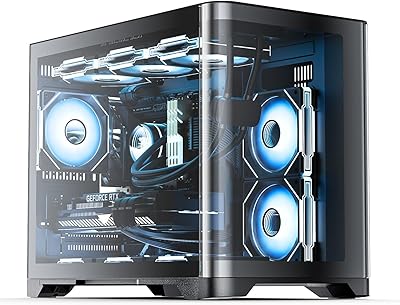
The square frame is genuinely distinctive in a market full of nearly identical round-frame fan kits. Through a tempered glass side panel, the uniform grid appearance of the three fans together looks intentional and cohesive in a way that three separately framed fans rarely achieve without careful spacing.
The square aesthetic is polarizing for builders who prefer a more traditional look. It also means the fans stand out if used alongside other round-frame fans in the same case, making mixed configurations look inconsistent rather than intentional.

Suitable for:

The AsiaHorse Matrix 360mm ARGB Case Fans are a strong pick for PC builders who want a clean, visually striking build without wrestling with individual fan cables or complicated lighting setup. If you have a 360mm AIO liquid cooler and a compatible ASUS, MSI, or ASRock motherboard with a 5V ARGB header, this fan kit slots in with minimal friction and syncs lighting directly through your existing software. First-time builders especially benefit from the integrated frame design, since managing three separate fans and their cables is one of the more frustrating parts of a first build. The square frame gives the finished build a distinctive look that stands out through a windowed side panel, which matters to anyone who has spent time thinking about interior aesthetics. Mid-range system builders who need adequate cooling performance without overspending will also find the airflow and noise specs to be a reasonable trade-off for the price.

Not suitable for:

The AsiaHorse Matrix 360mm ARGB Case Fans are not the right choice for every builder, and it is worth being honest about where they fall short. If your PC case has a non-standard radiator mount, an unusual front-panel layout, or tight clearances around the fan area, the rigid square frame may simply not fit without modification. Enthusiasts who want granular per-LED lighting control through advanced software will find the included analog controller limiting, and the experience gap compared to premium brands becomes more apparent at that level of scrutiny. Builders running demanding workloads who need maximum sustained airflow should also look at higher-static-pressure options, since the 66 CFM total output is adequate for typical mid-range use but not aggressive thermal loads. Finally, if long-term bearing durability is a top priority, the reports of noise developing over months of use are a real consideration worth weighing against alternatives with better-documented longevity.

Specifications

  • Fan Configuration: The kit consists of three 120mm fans mounted together within a single integrated square frame measuring 360 x 120 x 25mm.
  • Frame Shape: Unlike conventional round-frame fan sets, this kit uses a unified square outer frame that houses all three fans as one rigid assembly.
  • Total LEDs: All three fans combined carry 56 individually addressable RGB LEDs, distributed across the fan faces for consistent full-coverage lighting.
  • LED Standard: Lighting is driven through a 5V 3-pin ARGB header, which is the current standard for addressable RGB on modern consumer motherboards.
  • Speed Range: Fan speed is adjustable from 800 RPM at its quietest up to 1800 RPM at full load, with a tolerance of roughly 10% at either end.
  • Max Airflow: The three fans together move up to 66.5 CFM of air, with each individual fan rated at approximately 57 CFM at peak speed.
  • Noise Output: Acoustic output ranges from about 16 dB(A) at low speeds to a maximum of 34.3 dB(A) when running at full RPM.
  • Static Pressure: Each fan delivers up to 1.2 mm-H2O of static pressure, which is adequate for pushing air through a standard 360mm radiator.
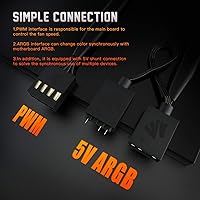
  • PWM Control: Speed is regulated via a standard 4-pin PWM header, allowing the motherboard or fan controller to adjust RPM automatically based on thermal load.
  • Power Input: The fans operate on 5V DC and consume 2.5 watts in total, making them efficient even when running continuously at higher speeds.
  • Power Connector: The ARGB data connection uses a 3-pin 5V header; a separate PWM connector handles speed control independently from the lighting circuit.
  • Control Method: This kit supports two control paths: a bundled analog controller for standalone use, or direct motherboard header sync for software-based management.
  • MB Compatibility: Native lighting sync is supported on motherboards running ASUS Aura Sync, MSI Mystic Light, and ASRock Polychrome Sync platforms.
  • Material: The fan blades and integrated frame are constructed from plastic, keeping overall weight low for easier radiator mounting.
  • Dimensions: The full integrated assembly measures 360mm in length, 120mm in height, and 25mm in depth, matching a standard triple-120mm radiator footprint.

Related Reviews
Asiahorse Dawn 120mm ARGB Case Fan
88%
88%
Cooling Performance
92%
Noise Level
84%
RGB Customization
89%
Build Quality
91%
Ease of Installation
More
Asiahorse Nyota 120mm ARGB Case Fan
85%
88%
Cooling Performance
90%
Noise Level
85%
RGB Lighting Quality
84%
Build Quality
80%
Ease of Installation
More
Cooler Master SF240R ARGB 240mm Case Fan
77%
78%
Cooling Performance
74%
Noise Level
88%
Installation Ease
76%
ARGB Lighting Quality
71%
ARGB Compatibility
More
AsiaHorse WK-A360 ARGB AIO CPU Liquid Cooler 360mm
87%
94%
Cooling Performance
88%
Noise Levels (Under Load)
75%
RGB Aesthetics
90%
Installation Ease
92%
Build Quality
More
Lian Li UNI Fan SL-Infinity 140 ARGB Fan
86%
92%
Cooling Performance
95%
Visual Appeal & Lighting
87%
Noise Level
80%
Installation Ease
91%
Build Quality
More
Lian Li UNI Fan SL Wireless 120mm ARGB Fan
85%
91%
Cooling Performance
88%
Ease of Installation
84%
Noise Level
95%
RGB Customization
89%
Build Quality
More
Lian Li UNI Fan SL-INF 120 RGB Infinity Mirror ARGB 120mm Fan
86%
93%
Aesthetics and RGB Lighting
88%
Noise Level/Quiet Operation
91%
Build Quality and Durability
85%
Ease of Installation
87%
Cooling Efficiency
More
AsiaHorse Perseus ATX PC Case
88%
90%
Cooling Performance
88%
Build Quality
85%
Ease of Assembly
91%
Design & Aesthetics
89%
Airflow Flexibility
More
PCCOOLER C3T500 ARGB Mid Tower PC Case
78%
88%
Value for Money
71%
Build Quality
79%
Cooling Performance
91%
Ease of Assembly
93%
Aesthetics & Lighting
More
MSI MPG EZ120 ARGB 120mm Fans 3-Pack
76%
91%
Installation Experience
88%
RGB Lighting Quality
58%
Software Compatibility
83%
Noise Level
71%
Airflow Performance
More

FAQ

It depends on your case design. The integrated square frame works well in most mid-tower and full-tower cases with standard 360mm radiator mounts. Where builders run into trouble is with cases that have tight clearances, unconventional front-panel layouts, or non-rectangular radiator bays. Check your case’s radiator compatibility specs before buying, and specifically confirm there is nothing obstructing the outer edges of the frame.

Not necessarily. The kit ships with a standalone analog controller, so you can get lighting working even without an ARGB header on your motherboard. That said, if you do have a 5V 3-pin ARGB header and run Aura Sync, Mystic Light, or Polychrome Sync software, you can skip the controller entirely and manage everything from your existing RGB software.

At lower speeds they are genuinely quiet, hovering around 16 dB(A), which is practically inaudible in a normal room. When the system pushes them toward maximum RPM under load, noise climbs to around 34 dB(A), which is noticeable but not disruptive. For most desktop workloads, the PWM controller keeps them well below that ceiling.

Yes, that is actually one of the most natural use cases. The integrated frame is designed to match the footprint of a standard 360mm radiator, so it mounts cleanly on most popular AIO coolers. Just verify your cooler’s radiator dimensions before purchasing.

Not directly. Native sync support is limited to ASUS Aura Sync, MSI Mystic Light, and ASRock Polychrome Sync. Corsair iCUE and Gigabyte RGB Fusion use different protocols and headers, so you would not get integrated control through those platforms. In those cases, you would rely on the included analog controller for lighting instead.

This is one of the real trade-offs of the integrated design. Because all three fans are built into a single rigid frame with shared cabling, you cannot swap out a single fan the way you could with individually purchased units. If one fails out of warranty, you are typically looking at replacing the entire assembly.

Yes, the package includes the integrated fan assembly, mounting screws, the analog controller, and the necessary cables to connect to both your PWM and ARGB headers. You should not need to source additional adapters for a standard installation on a compatible motherboard.

It is considerably simpler. The daisy-chain cable design means you are dealing with one set of connections rather than three independent fan cables running back to your motherboard or hub. Builders who have wrestled with individual fan installations tend to notice the difference immediately, especially in tighter cases.

It does come up in user reviews, though it appears to affect a minority of units rather than being a widespread issue. It seems more likely to surface in builds where the fans run at high RPM consistently over long periods. If noise over time is a significant concern for you, it is worth factoring that into your decision alongside the price point.

Yes. Speed and lighting are handled through separate connectors — the 4-pin PWM header manages RPM, while the 3-pin ARGB header or the included controller handles lighting. This means you can have your motherboard throttle fan speed automatically based on temperature without affecting your lighting setup at all.