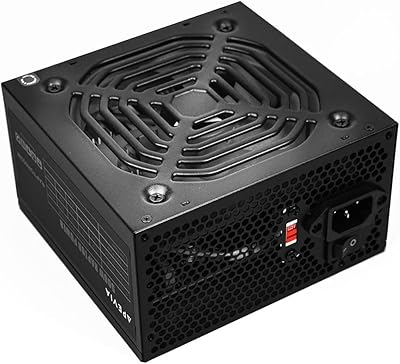
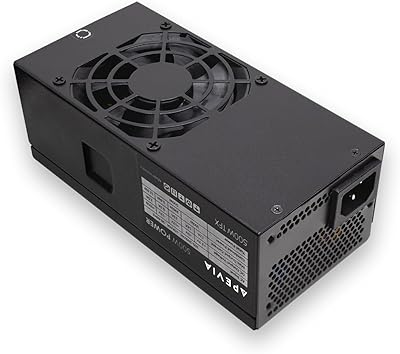
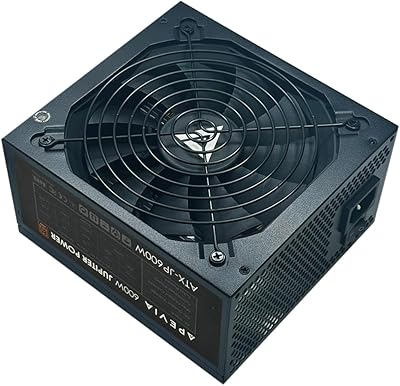
Overview

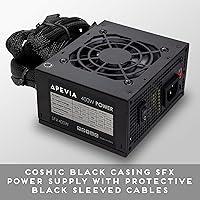
The Apevia SFX-AP400W 400W SFX Power Supply is a budget-oriented option aimed squarely at builders working within the tight confines of Mini-ITX and Micro-ATX cases. Apevia sits firmly in the value tier — don't expect Seasonic-level build quality here — but that's not really the point. For an HTPC tucked behind a TV or a compact office workstation, 400W is plenty. The sleeved cables are a genuine plus at this price point, giving the inside of a small case a cleaner look than you'd typically expect from an entry-level unit. Think of this compact PSU as a practical, no-frills solution for modest builds, not a foundation for a high-performance rig.
Features & Benefits

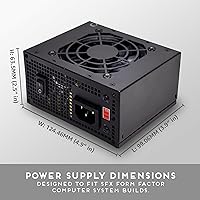
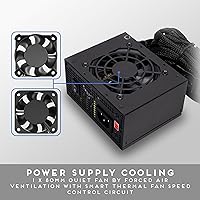
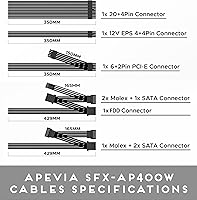
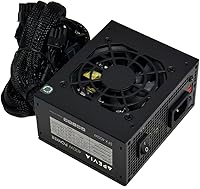
The SFX form factor is the star here — at 125mm x 100mm x 63.5mm, this SFX power supply slides into cases where a standard ATX unit simply won't fit. The 80mm thermal fan adjusts its speed automatically, staying relatively quiet at low loads before spinning up when things get demanding. Connector coverage is sensible for the target audience: you get a 6/8-pin PCIe port, two SATA connectors, two Molex, and a floppy header for legacy drives. The +12V rail delivers 28A — that's 336W on the rail that matters most for your CPU and GPU. Fully sleeved cables round things out, making cable routing inside a cramped enclosure considerably less of a headache.

Best For

This compact PSU is a natural fit for HTPC and Mini-ITX builds where space is tight and power demands are modest — think a living room media center or a quiet desk companion rather than a gaming tower. It works well in budget Micro-ATX office setups too, especially when paired with integrated graphics or something like an entry-level discrete card. Upgraders swapping out a dead SFX unit in a pre-built system will find the Apevia 400W unit a straightforward replacement. If you're running an RX 6600 or an RTX 3060 or below, you're in safe territory. Push beyond that — high-TDP CPUs, power-hungry GPUs, overclocked components — and you'll want to look elsewhere.

User Feedback

With a 3.8 out of 5 rating across more than 500 verified purchases, reception for this SFX power supply is decidedly middle-of-the-road — which, honestly, is about right. Buyers consistently praise the easy case fitment and appreciate that cable lengths are practical for compact enclosures. The sleeved aesthetic gets positive mentions too. On the flip side, the fan does get audible under sustained load, so if near-silent operation is a hard requirement, manage your expectations. A handful of users also flagged compatibility issues with specific Mini-ITX cases, so double-check your case specs before ordering. And like most value-tier PSUs, long-term reliability is the honest question mark — it's not the unit you'd bet on for a mission-critical system.

Pros

  • The SFX form factor fits Mini-ITX and Micro-ATX cases where standard ATX units simply cannot go.
  • At 400W, this SFX power supply covers HTPCs, office rigs, and light gaming builds comfortably.
  • Fully sleeved cables make routing inside cramped cases noticeably cleaner and easier.
  • The 80mm auto-sensing fan stays quiet at idle, which matters in living room or bedroom builds.
  • One 6/8-pin PCIe connector supports entry-level to mid-range discrete GPUs without issue.
  • Connector variety is solid for the price: SATA, Molex, and even a floppy header for legacy drives.
  • The Apevia 400W unit is priced accessibly, making it a realistic option for tight build budgets.
  • Cable lengths are practical for compact cases and received consistent praise from verified buyers.
  • Straightforward installation with no proprietary quirks — standard SFX fitment for most compatible cases.
  • The value-to-function ratio is hard to argue with for low-demand, non-critical PC builds.

Cons

  • Fan noise becomes noticeable under sustained load — not ideal for quiet or acoustically sensitive spaces.
  • Long-term reliability is an open question; budget PSUs carry real tradeoffs in component quality.
  • Only two SATA connectors limit storage expansion for anyone running multiple drives.
  • No 80 Plus efficiency certification listed, meaning energy draw may be higher than certified alternatives.
  • The +12V rail's 28A cap leaves almost no headroom for high-performance CPU and GPU combinations.
  • A small number of buyers reported fitment issues with certain Mini-ITX cases — case research is essential.
  • This compact PSU lacks the build quality assurances or warranty depth of premium SFX brands.
  • Single PCIe connector rules out multi-GPU configurations or high-end cards requiring dual connectors.
  • No modular cable option means you manage all cables whether you use them or not.
  • Apevia's brand reputation doesn't inspire confidence for builds meant to run continuously or long-term.

Ratings

The scores below reflect an AI-driven analysis of verified global buyer reviews for the Apevia SFX-AP400W 400W SFX Power Supply, with spam, incentivized, and bot-generated feedback actively filtered out before scoring. Each category is weighted against real-world usage patterns from builders across HTPC, office, and light gaming scenarios. Both the genuine strengths and the honest pain points are reflected — nothing is glossed over.

Value for Money
81%
19%
For builders on a strict budget who need an SFX-compatible unit, the price-to-function ratio is hard to argue with. Buyers consistently noted that getting a sleeved-cable SFX supply at this price point felt like a genuine deal, especially for low-stakes builds like HTPCs or office machines.
The value equation weakens if the unit fails early, and a handful of buyers factored in the lack of efficiency certification as a hidden running cost. For anyone building something they intend to run for years, the savings up front may not outweigh the reliability uncertainty.
Form Factor Fit
76%
24%
The SFX dimensions work exactly as advertised in the majority of compatible cases, and buyers replacing failed units in pre-built small form factor systems found installation straightforward. The compact footprint is the core reason most people choose this unit, and it generally delivers on that promise.
A notable minority of buyers ran into fitment issues with specific Mini-ITX enclosures that have non-standard PSU bay tolerances or awkward mounting points. This compact PSU is not a guaranteed drop-in for every SFX-labeled case, so verifying compatibility before purchasing is genuinely necessary.
Power Delivery
67%
33%
For the target workloads — integrated graphics, entry-level discrete GPUs, and light productivity tasks — the 28A on the +12V rail handles things without issue. Builders pairing this SFX power supply with an RX 6600 or similarly classed card reported stable operation during everyday gaming and media playback.
The 400W ceiling is real and unforgiving. Buyers who pushed the unit with higher-TDP processors or more demanding GPUs reported instability and unexpected shutdowns. There is very little overhead for future upgrades, which limits the long-term flexibility of this compact PSU.
Noise Level
58%
42%
At idle and during light workloads — web browsing, video streaming, general office use — the 80mm fan remains relatively unobtrusive. For daytime use in a living room HTPC or office desk setup, many buyers found it acceptably quiet during the hours it mattered most.
Under sustained load, the fan becomes audibly noticeable, and this was one of the most repeated criticisms across buyer reviews. In a quiet bedroom media center or a recording environment, the spin-up behavior during demanding tasks is a genuine nuisance that the auto-sensing fan does not fully mitigate.
Cable Quality
78%
22%
The fully sleeved cables were consistently called out as a standout feature at this price tier, making routing inside cramped Mini-ITX cases noticeably cleaner. Buyers appreciated that the cable lengths were practical — long enough to reach common mount points without excessive bunching.
The sleeving is basic rather than premium, and a few buyers noted that the cables feel stiffer than expected, which can make tight bends inside very compact enclosures frustrating. The overall cable count is also limited, with only two SATA connectors restricting multi-drive configurations.
Connector Coverage
69%
31%
For a single-GPU, single-drive compact build, the connector selection covers everything needed without requiring adapters. The inclusion of a floppy header and dual Molex connectors also gives legacy system builders more flexibility than they might expect from a unit at this tier.
Only one PCIe connector and two SATA ports put a hard ceiling on build complexity. Anyone running two storage drives plus a GPU is already at the limit, and the absence of a second PCIe connector rules out higher-end graphics cards that require dual power inputs.
Build Quality
61%
39%
The unit feels solid enough for its price category, and the external finish is clean. Buyers who used it in low-demand, light-use scenarios reported no physical issues with the housing or connectors after extended periods of service.
Compared to certified brands, the internal component quality is unverified and the absence of any efficiency certification signals corner-cutting at the manufacturing level. Buyers who opened failed units described build quality consistent with cost-reduction priorities rather than reliability engineering.
Long-Term Reliability
53%
47%
Many buyers reported months or even over a year of trouble-free operation in light-use builds, particularly HTPCs and office machines that are not under sustained heavy load. For low-stakes systems, the Apevia 400W unit does hold up in less demanding conditions.
This is where buyer sentiment is most divided. A meaningful portion of the negative reviews described early failures or unexpected shutdowns, and concerns about longevity were the single most repeated reservation across critical feedback. Budget PSUs carry real reliability tradeoffs, and this unit is not an exception.
Thermal Management
63%
37%
The auto-sensing fan does its job under light loads, keeping temperatures in check without making noise a constant issue. In a well-ventilated SFX case with reasonable ambient temperatures, thermal performance is adequate for the use cases this unit targets.
In tight enclosures with limited airflow — a common scenario for Mini-ITX builds — the single 80mm fan has limited ability to compensate. Under sustained high-load conditions, heat becomes a concern that likely contributes to the reliability issues some buyers have reported over time.
Installation Experience
82%
18%
Most buyers described a hassle-free installation process, with standard SFX mounting and clearly labeled connectors that made the build process intuitive even for first-timers. The sleeved cables also made the physical routing process easier than bare-wire alternatives at this price.
The previously noted fitment issues in certain Mini-ITX cases introduced frustration for a minority of buyers who assumed SFX compliance meant universal compatibility. Documentation included in the box is minimal, which can leave less experienced builders without guidance when problems arise.
Efficiency
49%
51%
For casual, low-load use cases — an HTPC running a few hours an evening — the absence of efficiency certification has minimal real-world impact on electricity costs. In absolute terms, the wasted energy is unlikely to be noticeable on a monthly utility bill for light users.
No 80 Plus rating of any tier is a meaningful omission in a market where even budget competitors often achieve at least 80 Plus White certification. For buyers running the system for extended daily sessions, the efficiency gap translates to measurably higher energy draw and more waste heat inside an already compact enclosure.
Compatibility Range
66%
34%
The 20+4 pin main connector and standard SFX footprint give this compact PSU broad compatibility with modern Mini-ITX and Micro-ATX motherboards. The inclusion of legacy connectors like Molex and floppy also extends usability to older hardware repurposing scenarios.
The single 4-pin CPU connector limits compatibility with higher-end motherboards that require an 8-pin EPS connector for full power delivery. Builders using premium or overclocking-oriented motherboards may find the power connector insufficient for their platform's requirements.
Aesthetics
74%
26%
The sleeved cables give the inside of a compact build a noticeably cleaner look than bare-wire alternatives, and buyers appreciated this at a price point where aesthetic attention is uncommon. For glass-panel Mini-ITX cases where cable management is visible, this matters more than it might seem.
The external finish is functional rather than distinctive, and the unit offers no RGB, modular design, or premium surface treatment. For buyers building a showcase system, the aesthetics stop at cable sleeving and do not extend to the unit itself.

Suitable for:

The Apevia SFX-AP400W 400W SFX Power Supply is a practical choice for builders whose priority is fitting a working, cable-managed power supply into a compact enclosure without overspending. It's particularly well-suited for home theater PC enthusiasts who need a low-profile unit tucked inside a living room-friendly Mini-ITX case, where the smaller SFX footprint is a hard requirement rather than a preference. Budget-conscious office PC builders running integrated graphics or a modest discrete card — something in the RX 6600 or RTX 3060 range — will find the 400W output more than adequate for their workloads. It also makes a sensible, cost-effective replacement for a failed SFX unit inside a pre-built small form factor system, where swapping to a full ATX supply simply isn't an option. If your build is straightforward, your power draw is low to moderate, and your wallet has limits, this compact PSU covers the basics without unnecessary complexity.
Not suitable for:

Builders pushing the performance envelope should look elsewhere before considering the Apevia SFX-AP400W 400W SFX Power Supply. The 28A on the +12V rail leaves very little headroom for high-TDP CPUs paired with power-hungry GPUs — anything above the RTX 3060 or RX 6700 class is likely to stress this unit uncomfortably under sustained gaming loads. Overclockers and enthusiasts who run their components at elevated voltages should treat 400W as a hard ceiling, not a starting point. Users who work in acoustically sensitive environments — recording setups, quiet home offices — may also find the fan noise under sustained load more disruptive than expected. And if long-term reliability is non-negotiable, this value-tier unit carries the same tradeoffs as most budget PSUs: it's not the foundation you'd want under a mission-critical workstation or a system that runs 24/7. Always verify your specific case's SFX compatibility before purchasing, as a handful of Mini-ITX enclosures have reported fitment quirks.

Specifications

  • Form Factor: This unit follows the SFX standard, measuring 125mm x 100mm x 63.5mm, designed specifically for compact Mini-ITX and Micro-ATX enclosures.
  • Output Wattage: Total continuous output is rated at 400W, suitable for low-to-moderate power demand systems.
  • Weight: The unit weighs approximately 921g (around 2 lbs), which is typical for an SFX-class power supply.
  • +12V Rail: The primary +12V rail delivers 28A of current, providing up to 336W for CPU and GPU power delivery combined.
  • +3.3V Rail: The +3.3V rail is rated at 12A, supplying stable power to memory and low-voltage logic components.
  • +5V Rail: The +5V rail outputs 12A, covering USB controllers, storage devices, and other mid-voltage system components.
  • -12V Rail: A minor -12V rail rated at 0.3A is present primarily for legacy motherboard compatibility.
  • +5V Standby: The +5Vsb rail provides 2.5A, keeping the system in a low-power standby state when the PC is off but plugged in.
  • Main Connector: A 20+4 pin ATX main power connector is included, compatible with virtually all modern consumer motherboards.
  • CPU Connector: One 4-pin 12V (P4) CPU power connector is supplied, supporting mainstream desktop processors.
  • GPU Connector: A single 6/8-pin PCIe connector is included, supporting entry-level to mid-range discrete graphics cards.
  • Storage Connectors: Two SATA power connectors and two 4-pin Molex connectors are provided for drives and auxiliary devices.
  • Legacy Connector: One 4-pin floppy connector is included for compatibility with older or niche legacy hardware.
  • Cooling System: An 80mm auto-sensing thermal fan adjusts its speed based on internal temperature, remaining quieter at idle and spinning faster under sustained load.
  • Cable Style: All cables are fully sleeved, improving airflow management and cable routing aesthetics inside compact enclosures.
  • Compatibility: This power supply is compatible with Mini-ITX and Micro-ATX form factor cases that accept the SFX standard footprint.
  • Brand: Manufactured by Apevia, a value-oriented PC component brand known for budget-accessible hardware solutions.
  • Model Number: The official model designation is SFX-AP400W, as listed by the manufacturer.
  • Availability: This model has been available in the market since October 2016 and is not listed as discontinued by the manufacturer.
  • Efficiency Rating: No 80 Plus efficiency certification is listed for this unit, which is consistent with its budget-tier market positioning.

Related Reviews
Apevia SFX-AP500W 500W SFX Power Supply
70%
83%
Value for Money
89%
Form Factor Fit
81%
Ease of Installation
52%
Cable Management
61%
Noise Level
More
Apevia ITX-PFC400W 400W Flex ATX Power Supply
73%
88%
Modular Design
83%
Value for Money
91%
Form Factor Fit
54%
Fan Noise
63%
Cable Length
More
Apevia CAPTAIN550 550W ATX Power Supply
70%
78%
Value for Money
54%
Reliability
83%
Cable Quality & Aesthetics
81%
Connector Compatibility
84%
Ease of Installation
More
Apevia Raptor 500W ATX Power Supply
72%
83%
Value for Money
88%
Ease of Installation
74%
Connector Availability
58%
Reliability & Longevity
79%
Fan Noise
More
Apevia Venus 500W ATX Power Supply
86%
92%
Value for Money
88%
Cooling Efficiency
91%
Protection Features
84%
Build Quality
85%
Compatibility with Components
More
CHANNEL WELL 650W SFX Power Supply
88%
93%
Performance & Efficiency
88%
Noise Level
90%
Build Quality & Durability
85%
Ease of Installation
92%
Cable Management & Modularity
More
Apevia TFX-PFC500W 500W TFX Power Supply
67%
91%
Form Factor Fit
78%
Value for Money
83%
Connector Coverage
61%
Reliability
58%
Noise Level
More
Apevia Venus 450W ATX Power Supply
70%
83%
Value for Money
88%
Installation Ease
81%
Noise Level
74%
Connector Availability
62%
Build Quality
More
Lian Li SP750 White SFX Power Supply
84%
92%
Power Efficiency
88%
Noise Level
90%
Build Quality
91%
Modular Cable Management
85%
Compactness for Small Builds
More
Apevia Jupiter 600W ATX Power Supply
72%
81%
Value for Money
58%
Long-Term Reliability
63%
Voltage Stability
86%
Installation Experience
78%
Noise Level
More

FAQ

It follows the standard SFX footprint at 125mm x 100mm x 63.5mm, so it will fit in most SFX-compatible cases. That said, some Mini-ITX enclosures have tight tolerances or non-standard mounting, so it's worth cross-referencing your case's PSU specification before ordering — a few buyers have run into fitment surprises.

For mid-range cards like an RX 6600 or an RTX 3060 paired with a mainstream CPU, yes — 400W is workable. The +12V rail gives you 28A to share between the CPU and GPU, so you do have a real ceiling. Anything above that performance tier, like an RTX 3070 or RX 6700 XT, starts pushing this unit uncomfortably close to its limits under gaming loads.

At idle and light loads it stays fairly quiet, but several buyers have noted that sustained gaming or rendering workloads cause the 80mm fan to become audible. It's not extraordinarily loud, but if you're building a near-silent HTPC for a bedroom or home theater, it's something to factor in.

For a straightforward single-GPU build it does — you get a 20+4 pin main connector, a 4-pin CPU connector, one 6/8-pin PCIe, two SATA, two Molex, and a floppy header. That covers the essentials for most compact builds without any extras to worry about.

It works in both. Micro-ATX cases that support an SFX power supply will accept this unit without issue. Just confirm your Micro-ATX case actually specifies SFX support in its PSU bay, since many Micro-ATX enclosures are designed around standard ATX supplies.

They're genuinely useful in a small case. Sleeved cables are stiffer and easier to route than bare wires, and they help keep things tidy when space is at a premium. Buyers in compact builds consistently called this out as a practical plus, not just a visual one.

It's a reasonable option if your budget is tight and the system it's going into has modest power demands. Verify that your case accepts standard SFX dimensions and that the wattage covers your components. If you're replacing a failed unit in a pre-built HTPC or office machine, it fits the job well.

This is the honest part: budget PSUs like this one carry real reliability tradeoffs compared to certified units from premium brands. For occasional-use or low-load systems it tends to hold up, but it's not what you'd want powering a machine that runs 24/7 or one holding critical data. Think of it as a cost-effective solution, not a long-haul investment.

No. This compact PSU includes a single 6/8-pin PCIe connector only. High-end GPUs requiring a 12VHPWR or 16-pin connector are not supported, and frankly a 400W supply would not have sufficient headroom to power them anyway.

No 80 Plus efficiency rating is listed for this unit. That means it may draw somewhat more power from the wall compared to a certified equivalent, though at 400W the difference in energy cost is unlikely to be significant for light-use scenarios. If efficiency is a priority, look toward 80 Plus Bronze or higher certified options.

Where to Buy