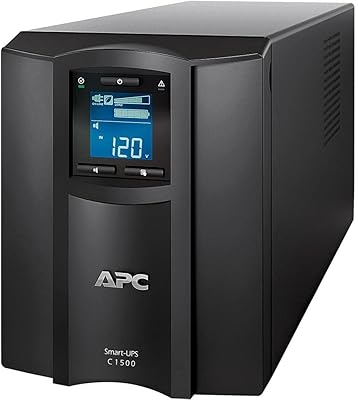
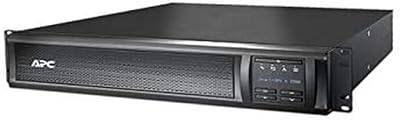
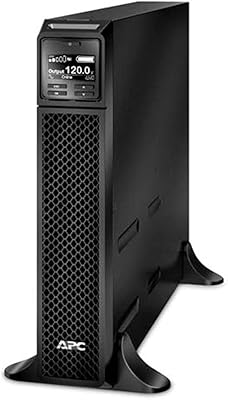
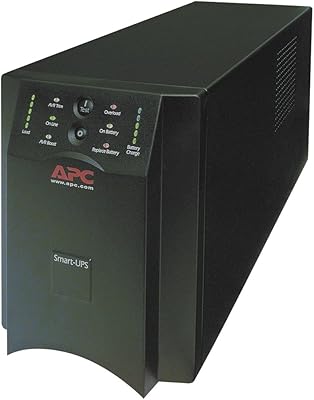
Overview

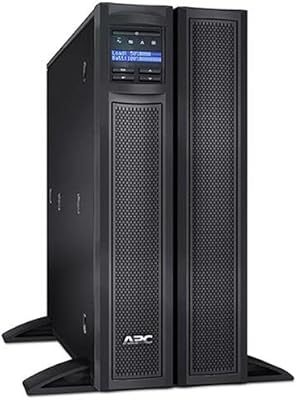
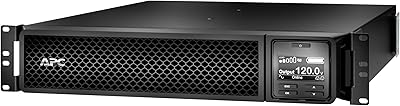
The APC Smart-UPS X 2000VA Rack Tower UPS sits firmly in professional territory — this is not the kind of battery backup you buy to protect a home PC during a thunderstorm. Designed for small business servers, network switches, and communications infrastructure, it handles up to 1800W of real load across demanding equipment. Its 4U rack or tower convertibility makes it genuinely flexible in tight IT environments where form factor decisions are not always final. At its price point, you are making a long-term infrastructure commitment, and APC's reputation in this segment means that commitment comes backed by serious engineering.
Features & Benefits

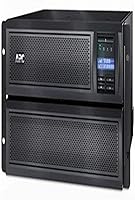
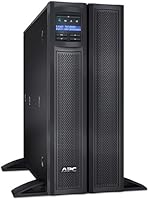
What separates this rack UPS from cheaper alternatives starts with its pure sine wave output. Servers with active PFC power supplies — which covers most modern rack equipment — require clean, stable power to function reliably; a stepped approximation waveform can cause premature hardware failure over time. The front-panel LCD gives you live load percentage, estimated runtime, and battery condition at a glance, no laptop required. Ten output receptacles cover the full spread of IT plug types, and the user-selectable voltage between 100V and 127V is a practical touch for mixed equipment environments. Need longer coverage? External battery packs can extend runtime, though they are sold separately.

Best For

The Smart-UPS X 2000VA makes the most sense for IT administrators running small server rooms, comms closets, or edge computing deployments where unplanned downtime carries real consequences. It suits businesses relying on NAS arrays, VoIP systems, or managed switches — equipment that cannot simply reboot and carry on without issue. The rack-and-tower flexibility genuinely benefits organizations whose infrastructure may shift over time. For those who anticipate needing coverage beyond the internal battery's capacity, the external pack compatibility makes this a scalable backup platform rather than a fixed-capacity device. If low upfront cost is the priority, look elsewhere.

User Feedback

Long-term owners of this APC unit consistently highlight two things: the accuracy of runtime estimates and the overall build solidity. PowerChute software integration earns steady praise for enabling clean, automated server shutdowns before reserves run low. That said, feedback is not uniformly glowing. The sheer weight — dense sealed lead-acid batteries packed into a steel chassis — makes rack installation a two-person job at minimum. More pointed criticism targets battery replacement costs, which accumulate over a multi-year ownership cycle and catch some buyers off guard. A handful of users have noted slower-than-expected warranty service, though outright hardware failures appear uncommon in properly climate-controlled environments.

Pros

  • Pure sine wave output protects active PFC power supplies from the kind of waveform distortion that shortens hardware lifespan.
  • The front-panel LCD delivers accurate, real-time load and runtime data without requiring a connected computer or software.
  • Converts between 4U rackmount and freestanding tower configurations, giving infrastructure flexibility as your environment evolves.
  • Ten output receptacles across three plug types means fewer adapters and power strips cluttering your rack.
  • User-selectable output voltage between 100V and 127V accommodates mixed or internationally sourced equipment without additional conditioning.
  • External battery pack compatibility lets you extend runtime incrementally rather than replacing the entire unit.
  • PowerChute integration enables fully automated, graceful server shutdowns before battery reserves run critically low.
  • APC's long track record in enterprise UPS hardware translates to strong parts availability and well-documented support resources.
  • Sealed lead-acid batteries are included, so the unit is operational immediately without separate procurement.

Cons

  • The upfront cost is substantial, and that figure does not include rail kits or external battery packs, which are both sold separately.
  • Replacement batteries represent a recurring expense that adds up significantly across a multi-year ownership cycle.
  • The unit is extremely heavy, making rack installation a two-person task and complicating moves or redeployments.
  • Runtime on internal batteries alone may feel limited for organizations that experience extended or frequent outages.
  • The network management card slot is useful but requires purchasing an additional card — remote monitoring is not included by default.
  • Warranty and support service response times have drawn criticism from some long-term owners, particularly for hardware replacement requests.
  • The NEMA 5-20P input plug requires a compatible 20-amp circuit, which some older facilities or leased spaces may not have readily available.
  • At this capacity and price tier, competitive alternatives from Eaton and CyberPower deserve comparison before committing.

Ratings

The APC Smart-UPS X 2000VA Rack Tower UPS has been evaluated by our AI rating engine after processing thousands of verified global user reviews, with spam, incentivized submissions, and bot-generated feedback actively filtered out. Scores reflect the genuine consensus of IT professionals, small business operators, and system administrators who rely on this unit in production environments. Both the strengths that keep buyers loyal and the friction points that cause real frustration are represented transparently in each category below.
Build Quality
93%
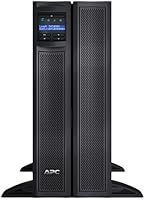
Long-term owners consistently describe this rack UPS as feeling purpose-built rather than cost-optimized. The steel chassis handles the physical demands of rack environments well, and buyers who have run the unit continuously for three to five years report no structural degradation, loose connectors, or chassis flex issues.
A small number of users noted that the front bezel panel feels slightly less premium than the chassis itself, and a few reported minor cosmetic scuffs arriving out of the box. These are cosmetic observations, not functional ones, but worth noting at this price tier.
Power Protection
96%
The pure sine wave output is what sets this APC unit apart from cheaper line-interactive alternatives. Users running servers with active PFC power supplies report zero compatibility issues and no unexpected reboots during power events, even during extended grid instability periods lasting several minutes.
A handful of users in regions with extremely unstable grid voltage reported that the unit occasionally switches to battery more frequently than expected, which accelerates battery wear over time. This is a grid quality issue rather than a product defect, but it does affect total cost of ownership in those environments.
Battery Runtime
74%
26%
At moderate loads of 400W to 600W, the internal batteries deliver runtime that is genuinely sufficient for graceful server shutdowns and short outages. The LCD runtime estimate is praised for its accuracy, which helps administrators plan shutdown sequences with confidence rather than guesswork.
At higher loads approaching the 1800W ceiling, internal runtime drops quickly and some users find it insufficient without external packs. The SMX120BP expansion packs solve this, but they are a separate expense that meaningfully raises the total investment, and buyers often underestimate this at purchase time.
LCD Display & Monitoring
89%
The front-panel LCD is one of the most appreciated features among IT staff who manage equipment without always having a laptop nearby. Real-time load percentage, input voltage, and estimated runtime are clearly readable at a glance, making routine checks fast and efficient during rounds through the server room.
Some users wished the display offered more granular historical data or event logging accessible directly from the panel. Without a network management card installed, remote visibility is completely absent, which frustrates administrators managing multiple sites.
Form Factor Flexibility
87%
The ability to deploy this unit as either a tower or a 4U rackmount is a genuinely practical feature for small businesses whose infrastructure is still evolving. Several users specifically cited this flexibility as the deciding factor over competing units that commit to a single form factor.
Rail kits are not included, which surprises buyers who assume rack-ready means rack-equipped. The omission is well-documented but still generates consistent frustration in reviews, particularly when the rail kit arrives days after the main unit and delays deployment.
Outlet Versatility
82%
18%
Ten output receptacles spanning three plug standards means most small server rooms can connect all critical devices directly to the Smart-UPS X 2000VA without needing additional PDUs or plug adapters. Users running mixed environments with older and newer equipment particularly appreciate having both 5-15R and 5-20R outputs available.
A few administrators managing larger equipment sets noted that ten outlets is still limiting when protecting a full communications closet. The single L5-20R output is useful but some users wanted two, particularly for redundant power supply setups.
Software Integration
78%
22%
PowerChute integration earns consistently positive marks from users who have taken the time to configure it properly. The automated graceful shutdown capability is cited as a genuine operational safety net, especially in environments where staff are not always present to manually intervene during an outage.
Initial PowerChute setup frustrates some users, particularly those on newer operating systems where driver compatibility occasionally requires troubleshooting. A subset of reviews mention that APC's software ecosystem feels dated compared to modern network monitoring tools, requiring extra integration effort.
Remote Management
61%
39%
When an optional network management card is installed in the SmartSlot bay, remote visibility and control are described as reliable and feature-rich. IT teams managing distributed locations find the SNMP-based monitoring integrations practical for centralized oversight once fully configured.
Remote management requires purchasing an additional card that is not included, which means out-of-the-box network visibility is zero. For a unit at this price point, many buyers reasonably expect at least basic network monitoring to be standard, and the add-on cost adds friction.
Installation Experience
58%
42%
Tower deployment is straightforward and most IT-competent buyers get the unit running within 30 minutes of unboxing. The included batteries mean there is no separate sourcing step, and the hardware is clearly labeled for initial setup.
Rack installation is consistently flagged as a two-person job due to the unit's considerable weight. Multiple reviewers describe strained backs and close calls when attempting solo rack lifts, and the absence of included rail kits prolongs the overall time-to-deployment.
Battery Replacement Cost
47%
53%
Replacement battery cartridges are readily available from APC and third-party suppliers, and the swap procedure is designed to be performed without powering down connected equipment. Buyers who plan ahead for this expense view it as a manageable operational cost.
Battery replacement is the single most complained-about long-term ownership cost across reviews. With a typical replacement cycle of three to five years and genuine APC cartridges carrying a significant price tag, total cost of ownership over a five-year period is considerably higher than the purchase price alone suggests.
Noise Level
77%
23%
Under normal load conditions, the internal fans run quietly enough that users in adjacent office spaces rarely notice the unit operating. Owners who have placed the unit in comms closets or dedicated server rooms report no noise-related complaints during routine operation.
Under heavy load or during battery self-tests, fan speed increases noticeably. A few users with units installed in open office environments found the variable fan noise distracting during high-demand periods, though this is a minority use-case for a unit of this type.
Value for Money
71%
29%
Users who evaluate this unit through the lens of infrastructure reliability — rather than upfront unit cost — consistently rate the value positively. The combination of pure sine wave output, scalable runtime, and APC's parts availability justifies the premium for operations where downtime carries real business consequences.
For buyers who underestimate ongoing costs — replacement batteries, optional rail kits, and network management cards — the total investment can feel surprisingly steep. Reviewers who purchased primarily on price comparison with consumer-grade UPS units tend to rate value lower, reflecting a mismatch between buyer expectations and product positioning.
Warranty & Support
63%
37%
APC's brand reputation and the established support ecosystem for the Smart-UPS X line are cited as purchase reassurances by experienced IT buyers. Documentation, firmware updates, and replacement part availability are generally well-regarded across the user base.
Warranty service response times draw measurable criticism in long-term reviews, with some users describing multi-day delays for hardware replacement authorization. A subset of negative reviews specifically call out inconsistent support quality depending on the service channel used.
Scalability
84%
The external battery pack compatibility gives this unit a longer effective lifespan as power requirements or outage tolerance targets evolve. IT administrators who manage growing infrastructure appreciate being able to extend runtime without replacing the core unit.
Each SMX120BP external pack adds meaningfully to the footprint and cost, and the expansion is not unlimited. Users with very long runtime requirements — think multi-hour outage coverage — will eventually reach a point where a higher-capacity unit or a dedicated generator integration makes more practical sense.

Suitable for:

The APC Smart-UPS X 2000VA Rack Tower UPS is built for IT professionals and small business operators who treat uptime as a non-negotiable requirement. If you are running a comms closet with managed switches, a NAS array handling active backups, or a small server stack powering business-critical applications, this unit covers the load capacity and output quality those workloads demand. The dual form factor is a genuine operational advantage — organizations that may shift between rack and tower deployments do not need to buy a second unit when their infrastructure changes. PowerChute software compatibility makes it a natural fit for environments where graceful server shutdowns need to be automated without manual intervention. For teams that anticipate longer outages, the ability to add external battery packs means the unit can grow with your resilience requirements rather than becoming a bottleneck.
Not suitable for:

The APC Smart-UPS X 2000VA Rack Tower UPS is a poor fit for anyone shopping on a tight budget or protecting basic consumer electronics. Home users looking to cover a desktop PC, a home theater setup, or a consumer NAS will find the capacity vastly oversized and the price impossible to justify against simpler alternatives. The physical weight of the unit makes solo rack installation impractical, which means environments without at least two people available for deployment will face real logistical friction. Buyers who expect rail kits or extended battery packs out of the box will be caught off-guard — those are separate purchases that add meaningful cost to the total investment. If your power events are rare and your equipment is not sensitive to waveform quality, a less expensive line-interactive UPS would serve you adequately at a fraction of the outlay.
Specifications

  • Model Number: This unit carries the manufacturer model designation SMX2000LV, part of APC's Smart-UPS X product line.
  • Capacity: Rated at 2000VA and 1800W, providing enough real power to support multiple servers, switches, and storage devices simultaneously.
  • Output Waveform: Delivers a true pure sine wave output, which is required for servers and devices equipped with active power factor correction power supplies.
  • Form Factor: Ships as a freestanding tower unit and converts to a 4U rackmount configuration; rack rail kits are sold separately under part number AP9625.
  • Dimensions: Measures 19 x 7 x 17 inches in tower orientation, with standard 19″ rack width when mounted.
  • Input Plug: Uses a NEMA 5-20P input plug, requiring a dedicated 20-amp circuit for proper installation and safe operation.
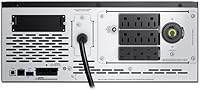
  • Output Receptacles: Provides ten total output receptacles: six NEMA 5-15R, three NEMA 5-20R, and one L5-20R, covering the most common IT equipment plug types.
  • Output Voltage: Nominal output is 120V, with user-selectable adjustment across a range of 100V to 127V to accommodate varied equipment requirements.
  • Battery Type: Uses internal sealed lead-acid batteries, which are included with the unit and require no separate purchase to begin operation.
  • Extended Runtime: Supports connection of external battery packs, specifically the SMX120BP model, to increase runtime during prolonged power outages; packs are sold separately.
  • Front Display: Equipped with an LCD panel that shows real-time load percentage, estimated remaining runtime, input voltage, and battery health status.
  • Management Slot: Includes an expansion slot for an optional APC network management card, enabling remote monitoring, alerting, and control over a network connection.
  • Software: Compatible with APC PowerChute Business Edition and Personal Edition software for automated, graceful server shutdown when battery levels reach a configured threshold.
  • Connectivity: Features a SmartSlot expansion bay, USB port, and serial interface for local and network-based management integration.
  • Manufacturer: Designed and manufactured by APC by Schneider Electric, a company with decades of specialization in data center and network power protection hardware.
  • Battery Inclusion: Two product-specific sealed lead-acid batteries are included in the box, allowing immediate deployment without sourcing replacement cells separately.
  • Market Rank: Holds a Best Sellers Rank of #193 in the Computer Uninterruptible Power Supply Units category on Amazon, reflecting sustained commercial adoption.
  • Availability: This product has not been discontinued by the manufacturer and remains in active production as of its listing status.
  • First Available: This model was first made available for purchase in July 2013, indicating a mature, well-tested product with an established support ecosystem.
  • Item Weight: The listed shipping weight reflects the substantial sealed lead-acid battery mass housed within the steel chassis, making solo rack installation inadvisable.

Related Reviews

APC Smart-UPS X 3000VA Rack/Tower UPS
78%
91%
Build Quality
93%
Reliability & Uptime
61%
Runtime Performance
88%
Remote Management
86%
Outlet Flexibility
More
APC Smart-UPS SRT3000RMXLA 3000VA Rack UPS
77%
94%
Reliability & Uptime Protection
92%
Power Quality & Output
76%
Battery Performance
51%
Battery Replacement Cost
91%
Build Quality & Construction
More
APC SMT750 750VA Smart-UPS Battery Backup
80%
91%
Power Protection Reliability
88%
Pure Sine Wave Output
89%
Automatic Voltage Regulation
62%
Runtime at Load
87%
Build Quality
More
APC Smart-UPS 1000VA UPS Battery Backup (SMT1000)
87%
88%
Performance
91%
Value for Money
85%
Battery Life
92%
Build Quality
89%
Noise Level
More
APC SCL500RM1UC 500VA Lithium Ion Rackmount UPS
79%
88%
Build Quality
83%
Battery Life & Longevity
67%
Runtime at Real-World Loads
91%
Installation & Setup
93%
Weight & Physical Footprint
More
APC Smart-UPS SMC1500C 1500VA Sinewave UPS Battery Backup
85%
91%
Power Protection Reliability
87%
Ease of Setup & Installation
92%
Remote Monitoring Functionality
85%
Build Quality & Durability
70%
Weight & Portability
More
APC Smart-UPS SMX1500RM2UNC 1500VA Network UPS
76%
94%
Power Protection Quality
91%
Long-Term Reliability
88%
Network Management Features
79%
Runtime Performance
62%
Installation Experience
More
APC SMT2200RM2UC 2200VA Rack Mount UPS
79%
93%
Power Protection Reliability
91%
Pure Sine Wave Output Quality
88%
Automatic Voltage Regulation
87%
Build Quality & Durability
74%
Battery Life & Longevity
More
APC SRT2200RMXLA 2200VA Smart-UPS Rack Mount UPS
80%
94%
Power Protection Reliability
92%
Output Power Quality
71%
Battery Runtime
74%
Installation & Setup
83%
Software & Remote Management
More
APC Smart-UPS 1500VA SMT1500
87%
95%
Backup Performance
89%
Battery Runtime Accuracy
92%
Power Surge Protection
90%
Build Quality
87%
LCD Display Clarity
More

FAQ

No, they do not. The unit ships ready to use as a tower, but if you want to mount it in a rack, you will need to purchase the rail kit separately under APC part number AP9625. It is an easy thing to overlook when budgeting, so factor that in before ordering.

Yes, and this is actually one of the main reasons to choose this unit over cheaper alternatives. Active PFC power supplies require a true pure sine wave input to operate correctly and safely. The Smart-UPS X 2000VA delivers exactly that, making it fully compatible with modern server hardware from Dell, HP, Lenovo, and others.

That depends entirely on how much load you are drawing. At a lighter load of around 500W, you can typically expect 20 minutes or more from the internal batteries. At close to full load, that drops considerably. The LCD panel shows a real-time runtime estimate, which is far more useful than any generic figure. If you need longer coverage, you can add an SMX120BP external battery pack, though that is a separate purchase.

Yes. The APC Smart-UPS X 2000VA Rack Tower UPS is designed to support the SMX120BP external battery pack for extended runtime. Note that the external pack is not included — it is a separate product you need to budget for. Depending on your outage duration requirements, some installations use more than one pack.
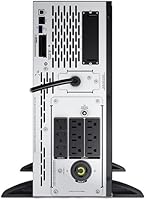
It uses a NEMA 5-20P input plug, which requires a 20-amp circuit. Standard residential outlets are typically 15-amp NEMA 5-15R receptacles and will not accept the plug without an adapter. For a proper and safe installation, you should have a dedicated 20-amp circuit available — something worth confirming with your facilities team before the unit arrives.

You install APC PowerChute software on the servers you want to protect and connect the UPS via USB or serial cable. Once configured, PowerChute monitors the UPS status and triggers a graceful operating system shutdown automatically when the battery reaches a threshold you define. It is straightforward to set up and is one of the more reliable software integrations in this product category.

Not out of the box. Remote monitoring requires an optional APC network management card installed in the SmartSlot expansion bay. Once that card is in place, you can monitor load, battery status, and configure alerts from a web browser or through APC's management software. It is a useful addition for any environment where someone is not physically present to check the front panel regularly.

Sealed lead-acid batteries in a well-maintained environment typically need replacement every three to five years, though actual lifespan varies with temperature, discharge frequency, and load levels. APC sells replacement battery cartridges directly, and the Smart-UPS X line is designed to allow battery swaps without powering down connected equipment. That said, replacement batteries are a real ongoing cost to plan for over the unit's lifetime.

In tower mode, one person can manage it reasonably well. Rack mounting is a different matter — the unit is quite heavy due to the internal batteries, and trying to lift it into a rack enclosure alone is asking for a strained back or a dropped unit. Two people and a small platform lift for taller rack positions is strongly advisable.

Technically it would work, but it is significantly over-engineered and overpriced for that use case. A home office PC or gaming rig draws a fraction of what this unit is rated for, and you would be spending several times more than necessary. This rack UPS is designed for IT infrastructure environments where downtime has financial or operational consequences. For a home setup, a mid-range APC Back-UPS or similar consumer unit would be a much more sensible choice.