Overview

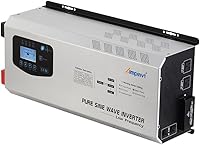
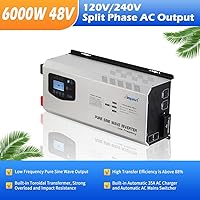
The Ampinvt 6000W 48V Split Phase Power Inverter is a low-frequency inverter-charger built for people who are serious about off-grid power — not weekend campers dabbling with a small battery bank. What sets this inverter-charger apart at this price point is its ability to output true split-phase 120V/240V AC from a 48V DC battery system, which is exactly what you need to power a whole home or a well-equipped RV. It combines three functions in one enclosure: an inverter, a battery charger, and an automatic transfer switch. That consolidation matters for both cost and installation complexity. This unit is aimed squarely at DIY solar builders, homesteaders, and serious backup power users who want capable hardware without premium brand pricing.
Features & Benefits

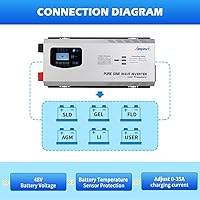
The pure sine wave output is the baseline expectation for a unit like this, and the Ampinvt 6000W unit delivers it cleanly — your sensitive electronics, variable-speed motors, and medical equipment won't experience the distortion that modified sine wave inverters can introduce. The 6,000W continuous rating is what you should actually plan your system around; the 18,000W peak figure covers motor-start surges but is not a sustained capacity. The adjustable charging current, ranging from zero to 35 amps, lets you match charging behavior to your battery bank's size and chemistry. Five operating modes — including ECO, battery priority, and an unattended mode with configurable low-voltage cutoffs — add meaningful real-world flexibility. An RS485 port rounds things out for users who want optional WiFi monitoring or an external display.

Best For

This split-phase inverter is the right fit for off-grid cabin and homestead owners who have committed to a 48V battery bank and need true 240V output to run standard household circuits — a capability most budget inverters in this class simply don't offer. Solar system builders will appreciate the all-in-one design, since fewer components mean fewer failure points. It also suits whole-home RV setups where generator compatibility and LiFePO4 battery support are non-negotiable requirements. That said, this unit is genuinely aimed at buyers comfortable reading wiring diagrams and working through multi-mode configuration. If you're new to off-grid electrical systems, the learning curve here is real and worth factoring into your decision before purchasing.

User Feedback

Across roughly 135 reviews, this inverter-charger holds a 3.9-star average — a score reflecting solid satisfaction from most buyers alongside a vocal minority with legitimate complaints worth understanding. The positives are consistent: buyers highlight the value for the wattage, the sturdy metal build, and the relative rarity of split-phase output at this price tier. Where things get complicated is setup. Several reviewers note that documentation is thin, and the five operating modes aren't always intuitive without prior inverter experience. There are also occasional reports of unit-to-unit variability suggesting quality control isn't perfectly uniform across every shipment. The one-year warranty and US-based customer service help offset that uncertainty, and buyers running established solar systems generally report reliable long-term performance once everything is properly commissioned.

Pros

  • True split-phase 240V output is genuinely rare at this price tier, covering whole-home circuit needs most budget inverters cannot.
  • The 3-in-1 design consolidates inverter, battery charger, and automatic transfer switch into a single enclosure, reducing installation complexity.
  • Pure sine wave output makes it safe for sensitive electronics, variable-speed motors, and medical devices.
  • The 6,000W continuous rating is substantial enough to handle real household loads without constant worry about overdrawn capacity.
  • Charging current is fully adjustable from zero to 35 amps, letting you tailor battery charging to your specific bank size and chemistry.
  • LiFePO4, AGM, gel, and flooded battery types are all supported, so this inverter-charger works with most modern battery investments.
  • Under 4ms transfer time makes it viable for loads that cannot tolerate a noticeable power interruption.
  • Five operating modes, including ECO and unattended mode with configurable low-voltage cutoffs, add flexibility for varied real-world scenarios.
  • An RS485 port enables optional WiFi monitoring, which is useful for remote off-grid installations.
  • Buyers consistently cite solid build quality and good value relative to the wattage and feature set on offer.

Cons

  • Included documentation is frequently described as thin and difficult to follow, especially for first-time inverter-charger owners.
  • Unit-to-unit consistency is not airtight — a small but notable share of buyers report receiving units that underperform or require early intervention.
  • At nearly 60 pounds, installation requires planning and typically a second person; wall-mounting alone is a real physical undertaking.
  • Configuring the five operating modes has a learning curve that can frustrate buyers without prior off-grid electrical experience.
  • The WiFi monitoring module and external display are sold separately, so remote visibility costs extra beyond the base purchase.
  • The 18,000W peak figure in the product name can mislead buyers — actual sustained capacity is 6,000W, and planning around anything higher is a mistake.
  • Generator and grid compatibility requires careful wiring and configuration; incorrect setup can cause transfer issues that are hard to diagnose without experience.
  • Customer service response times have been inconsistent based on buyer reports, which matters when troubleshooting a critical power system component.

Ratings

Our AI rating system analyzed verified global buyer reviews for the Ampinvt 6000W 48V Split Phase Power Inverter, actively filtering out incentivized, repeated, and bot-generated submissions to surface what real users actually experience. The scores below reflect both the genuine strengths that make this inverter-charger stand out at its price tier and the honest pain points that have frustrated a meaningful share of buyers. Nothing has been smoothed over — the highs and the rough edges are both accounted for.

Value for Money
83%
For an inverter-charger that delivers true split-phase 240V output, an adjustable battery charger, and automatic transfer switching in a single unit, buyers consistently feel they are getting more capability per dollar than comparably priced competitors. Off-grid builders in particular note that the all-in-one design saves real money on additional components.
A small but consistent group of buyers who received defective or underperforming units feel the value proposition collapses quickly when warranty claims or troubleshooting time are factored in. Unit-to-unit inconsistency makes the value equation feel less predictable than it should at this price level.
Split-Phase Output
91%
The ability to output true 120V/240V split-phase AC from a 48V battery bank is the single feature that differentiates this inverter-charger from the crowded field of single-phase budget units. Homesteaders powering well pumps and RV owners running 240V air conditioning praise this capability as the primary reason they chose it.
A handful of buyers note that the split-phase output labeling can be confusing without prior electrical knowledge, and incorrect wiring of the two 120V legs has led to load problems in a few reported cases. This is a wiring competency issue rather than a product flaw, but it does reinforce that this unit is not beginner-friendly.
Build Quality
76%
24%
The metal enclosure feels solid and appropriately heavy-duty for a unit intended for permanent off-grid installation. Most buyers who open the unit report tidy internal construction and describe the overall fit and finish as better than expected for the price bracket.
There are enough reports of inconsistent manufacturing — loose terminal connections, cosmetic imperfections, and occasional early failures — to suggest quality control is not uniform across every production run. Buyers who receive a well-built unit are happy; those who do not face a frustrating return process.
Ease of Setup
54%
46%
Buyers with prior inverter or solar system experience generally find the physical wiring and initial configuration manageable, and the LCD display gives useful real-time feedback during commissioning. Those who know what they are doing report getting the unit running correctly without excessive difficulty.
The included documentation is widely described as inadequate — instructions are sparse, translations are inconsistent, and the five operating modes are not explained in enough depth for anyone without hands-on background. First-time off-grid builders have reported hours of troubleshooting that more thorough documentation could have prevented.
Operating Modes Flexibility
79%
21%
Having five selectable modes — including ECO, unattended, and battery priority with configurable low-voltage cutoffs — gives experienced users meaningful control over how the system behaves under different conditions. Solar users especially appreciate the ability to fine-tune battery discharge behavior without external controllers.
The mode configuration interface, while functional, is not intuitive, and the logic behind some settings is not clearly explained in the manual. Several buyers have accidentally misconfigured modes during setup, leading to unexpected behavior that took significant time to diagnose and correct.
Charging Performance
78%
22%
The ability to dial charging current from zero to 35 amps gives genuine flexibility for users with smaller or larger battery banks, and the support for multiple battery chemistries including LiFePO4 means it works well across a wide range of modern battery investments. Buyers with well-matched systems report healthy, consistent charging behavior.
A few buyers note that the default charging parameters are not always optimal out of the box for lithium battery banks, requiring manual adjustment to avoid overcharging concerns. The lack of detailed guidance on recommended settings for specific battery types is a recurring gap.
Transfer Speed
86%
The sub-4-millisecond transfer time between AC input and battery-inverted output is fast enough that most sensitive electronics — computers, networking equipment, and smart home devices — do not register the switchover. Users running home offices or critical monitoring systems have reported no disruptions during grid or generator outages.
A small number of buyers with highly sensitive equipment, such as certain medical devices or precision industrial tools, note that even a sub-4ms gap is not equivalent to a true UPS and may cause brief resets in edge cases. For most household loads this is not a practical concern, but it is worth knowing before installing.
Pure Sine Wave Quality
88%
The output waveform is consistently clean based on buyer reports, with no reported issues running sensitive appliances, variable-frequency drives, or audio equipment. Users powering refrigerators, medical CPAP machines, and electronics-heavy setups describe the sine wave quality as indistinguishable from grid power in practice.
While the waveform quality itself is not a common complaint, buyers in regions with inconsistent generator input have noted occasional voltage instability that the AVR stabilizer does not fully suppress under extreme input fluctuations. This is an edge case but worth noting for generator-dependent installations.
Battery Compatibility
84%
Support for gel, AGM, SLA, flooded, and LiFePO4 chemistries makes this inverter-charger a flexible anchor for a wide range of existing battery investments. Users upgrading from older lead-acid banks to newer lithium systems appreciate not having to replace the inverter when they switch chemistry.
While the supported battery types are broad, buyers with specialized lithium battery management systems have reported needing to carefully verify communication compatibility. The customization options are useful but require a level of technical knowledge to configure safely, particularly for LiFePO4 banks with strict charge limits.
Thermal Management
71%
29%
The unit handles sustained loads reasonably well in installations with adequate airflow, and the over-temperature protection prevents damage during periods of high ambient heat or heavy use. Buyers in hot climates running the unit in well-ventilated enclosures report acceptable thermal behavior over long periods.
Under continuous heavy load in warm ambient conditions, the cooling fan becomes audibly prominent and the unit runs noticeably warm. Buyers who mounted it in enclosed battery boxes without adequate ventilation have reported premature thermal shutdowns, making installation environment a meaningful variable in long-term reliability.
Communication and Monitoring
67%
33%
The RS485 port provides a real upgrade path to WiFi monitoring and external display control for users who want remote visibility into system status, which is a genuinely useful capability for unattended off-grid installations. Buyers who invested in the optional WiFi module generally report stable connectivity.
The WiFi adapter and external display are sold separately with no bundled option, which adds unexpected cost for buyers who assumed monitoring capability was included. Setup of the RS485 communication link is also sparsely documented, making it harder to integrate for users without networking experience.
Weight and Portability
58%
42%
The robust weight of nearly 60 pounds is partly a reflection of the low-frequency transformer inside, which is a design choice that contributes to durability and output stability compared to lighter high-frequency alternatives. For permanent installations, the weight is a non-issue once the unit is mounted.
At 59.9 pounds, moving, positioning, and wall-mounting the unit is a genuine physical challenge that requires at least two people and proper structural anchoring. Buyers who underestimated the installation effort have described the mounting process as significantly more demanding than anticipated.
Documentation Quality
41%
59%
The unit does ship with a manual covering the basic electrical connections and a summary of the operating modes, which is enough to get a knowledgeable user started. Some buyers have found supplementary guidance through the brand's support channels when the manual fell short.
The manual is widely considered the weakest aspect of the ownership experience — translations are rough, explanations of operating mode logic are incomplete, and troubleshooting guidance is minimal. For a unit with this level of configurability, the documentation quality falls noticeably short of what buyers reasonably expect.
Warranty and Support
74%
26%
The one-year warranty with a US-based customer service center is a meaningful reassurance for buyers wary of purchasing from a lesser-known brand, and some buyers report positive resolution experiences when issues arise. The existence of a domestic support contact rather than an overseas-only channel is a genuine differentiator in this category.
Support response times have been described as inconsistent by buyers dealing with warranty claims, and the resolution process can require patience. For a product installed as a critical power system component, delays in warranty service are more impactful than they would be for a lower-stakes purchase.

Suitable for:

The Ampinvt 6000W 48V Split Phase Power Inverter is built for a specific type of buyer: someone who has already committed to a 48V battery-based power system and needs true split-phase 120V/240V AC output to run standard household loads. That profile covers off-grid homesteaders powering well pumps, refrigerators, and power tools; solar system builders who want a single unit to handle inversion, charging, and grid or generator transfer without bolting together separate components; and RV owners with larger electrical demands that a single 120V inverter simply cannot meet. The broad battery chemistry support — including LiFePO4, AGM, and flooded lead-acid — means it can anchor a system regardless of which battery technology you have already invested in. Buyers who are comfortable with DIY electrical work and are willing to spend time configuring operating modes to match their specific setup will get the most out of this inverter-charger.
Not suitable for:

The Ampinvt 6000W 48V Split Phase Power Inverter is not the right choice for beginners who expect a plug-and-play experience. The documentation has been a recurring frustration among reviewers, and the five operating modes require a genuine understanding of how inverter-chargers interact with battery banks, solar charge controllers, and grid or generator inputs — that is not knowledge you can skip. Buyers running a 12V or 24V battery system will need to look elsewhere entirely, since this unit is designed exclusively around 48V DC input. If your loads are modest — a camper van, a small weekend cabin — the physical size and weight of this unit (nearly 60 pounds) may be more than your installation can reasonably accommodate. There have also been enough reports of unit-to-unit variability to give pause to anyone who cannot confidently troubleshoot electrical hardware if a problem arises out of the box.
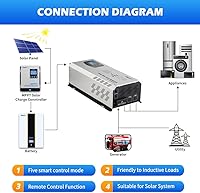
Specifications

  • Continuous Power: This inverter-charger delivers a sustained 6,000W of continuous AC output, which is the figure you should use when sizing your loads.
  • Peak Power: The unit can handle up to 18,000W momentarily to absorb motor-start surges from compressors, pumps, and similar inductive loads.
  • DC Input Voltage: Designed exclusively for 48V DC battery systems; it is not compatible with 12V or 24V configurations.
  • AC Output: Outputs true split-phase 120V/240V AC at 60Hz, suitable for powering standard North American household circuits and appliances.
  • Wave Form: Produces a pure sine wave, ensuring compatibility with sensitive electronics, variable-speed motors, and other loads that require clean power.
  • AC Input Range: Accepts AC input between 180V and 300V (240VAC ±25%) at 60Hz ±5Hz when connected to grid or generator.
  • Transfer Time: Automatic transfer between AC input and battery-inverter output occurs in under 4 milliseconds, fast enough for most critical loads.
  • Charge Current: The maximum AC charging current is 35A and is fully adjustable from 0% to 100%, allowing precise control over battery charging rate.
  • Battery Compatibility: Supports sealed lead-acid, AGM, gel, flooded, and lithium LiFePO4 battery chemistries, covering most modern battery bank configurations.
  • Overcharge Protection: Battery overcharge protection activates at 64V DC to prevent damage to the connected battery bank.
  • Operating Modes: Five selectable operating modes are available: AC priority, battery priority, generator, ECO, and unattended, each suited to different usage scenarios.
  • Communication Port: An RS485 port is included for integration with an optional WiFi monitoring module or external control display, sold separately.
  • AVR Stabilizer: A built-in automatic voltage regulator (AVR) stabilizes output voltage against input fluctuations before they reach connected loads.
  • Operating Temperature: The unit is rated to operate in ambient temperatures between 0°C and 60°C (32°F to 140°F).
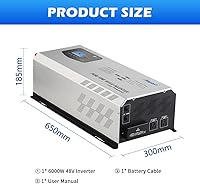
  • Dimensions: Physical footprint measures 25.59 × 6.7 × 10.2 inches, requiring adequate clearance on all sides for ventilation.
  • Weight: The unit weighs 59.9 pounds, which requires two people and appropriate mounting hardware for safe installation.
  • Warranty: Covered by a one-year manufacturer warranty that includes free repair or product replacement, backed by a US-based customer service center.
  • Model Number: The official model designation is FT-6000W48V, manufactured by Top One Power under the AMPINVT brand.

Related Reviews
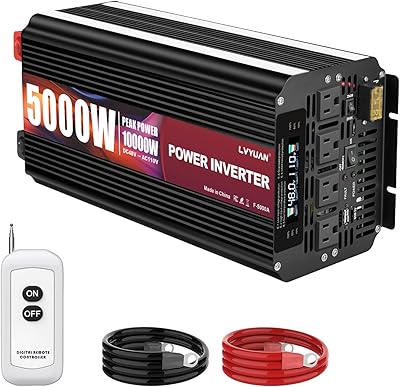
LVYUAN 5000W Power Inverter 48V to 120V
84%
92%
Power Output
88%
Build Quality
85%
Ease of Setup
90%
Safety Features
65%
Noise Level Under Load
More
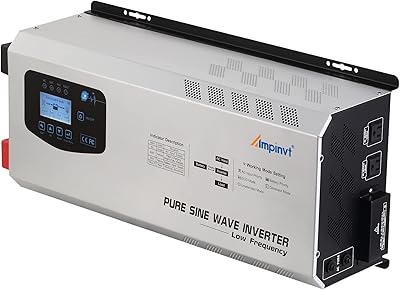
Ampinvt 48V 5000W Split Phase Power Inverter
67%
78%
Build Quality
86%
Surge Handling
89%
Pure Sine Wave Output
84%
Automatic Transfer Switch
82%
Battery Compatibility
More
Ampinvt 5000W 24V Split Phase Power Inverter
72%
83%
Power Output Reliability
78%
Build Quality
86%
Pure Sine Wave Quality
81%
Battery Charger Performance
54%
Installation Experience
More
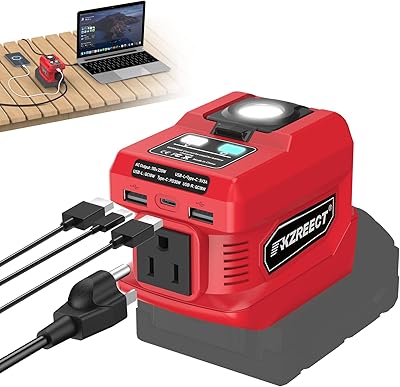
Kzreect Inverter-MK 220W Portable Power Inverter
85%
94%
Portability and Size
89%
Charging Speed (USB-C & USB-A)
82%
Battery Compatibility
88%
Ease of Use
90%
Safety Features (Overload, Overcurrent)
More
Tebrol 2000W Power Inverter
86%
88%
Performance & Power Output
90%
Ease of Use & Setup
85%
Portability & Size
75%
Cooling System & Noise
91%
Safety Features
More
HONOURLIGHT 3000W Power Inverter
79%
88%
Value for Money
83%
Power Performance
91%
Ease of Setup
89%
LED Display Clarity
84%
Remote Control
More
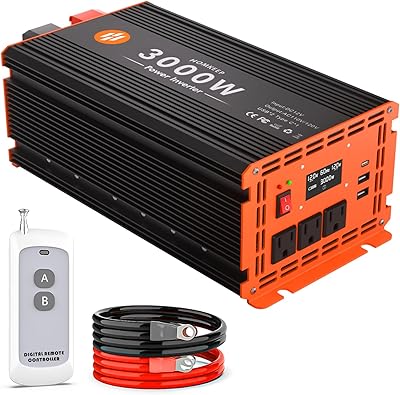
Homkeep 3000W Power Inverter
86%
91%
Value for Money
88%
Performance
85%
Build Quality
93%
Ease of Use
89%
Energy Efficiency
More
OLTEANP 3000W Power Inverter
87%
91%
Power Output
88%
Portability & Size
85%
Ease of Use
87%
Durability & Build Quality
92%
Safety Features
More
Cantonape 1500W 24V Power Inverter
76%
82%
Power Output Reliability
91%
Ease of Setup
88%
LED Display & Diagnostics
74%
Build Quality
69%
Thermal Management
More
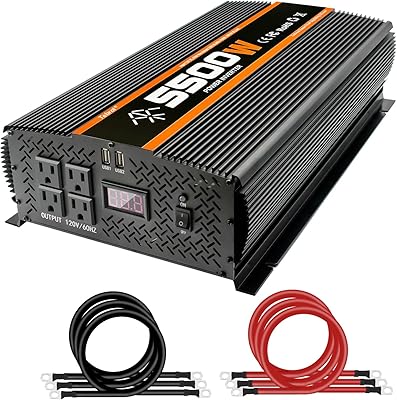
Cantonape 1200W Power Inverter
76%
78%
Power Output Reliability
88%
LCD Display Usefulness
74%
Build Quality
61%
Modified Sine Wave Compatibility
83%
USB Charging Performance
More
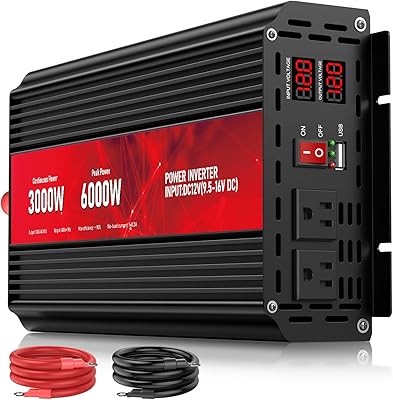
Tebrol 5500W Power Inverter
83%
88%
Performance
91%
Ease of Setup
85%
Build Quality
73%
Cooling System Efficiency
80%
Portability
More

FAQ

Yes, that is one of the main reasons to choose a split-phase unit like this. The inverter outputs both 120V legs simultaneously, giving you true 240V between them — exactly what a well pump, dryer, or range requires. Just make sure your continuous load stays within the 6,000W rated capacity.

The 6,000W is the continuous output — what the inverter can sustain indefinitely under normal operating conditions. The 18,000W peak is a very short-duration burst capacity designed to handle the startup surge of motors and compressors, which can momentarily draw three to five times their running wattage. Plan your system around the 6,000W figure; the peak number should not factor into your load calculations.

Yes, LiFePO4 is one of the supported battery types. You can select the appropriate battery type in the settings menu, and the adjustable charge current (up to 35A) lets you set a charging rate that suits your specific battery bank's recommended parameters. That said, always verify the charge voltage settings match your battery manufacturer's specifications before running it continuously.

It works with both. The unit includes a generator operating mode specifically for this use case. When the generator is running, the inverter-charger can accept its AC output, charge your batteries, and pass power through to your loads simultaneously — a standard hybrid operation for off-grid setups.

Honestly, this is not a beginner unit. The wiring itself is straightforward if you understand DC and AC electrical systems, but configuring the five operating modes and getting parameters like charge current and low-voltage cutoffs dialed in correctly takes some time and knowledge. The included manual has been a common complaint among buyers — it is functional but thin. If you are new to off-grid systems, budget time for research or consult someone with experience before commissioning the unit.

WiFi monitoring is not included out of the box. The unit has an RS485 communication port that supports an optional WiFi adapter module, which you would need to purchase separately. If remote monitoring is important to your setup, factor that additional cost in when budgeting.

The transfer time is rated at under 4 milliseconds, which is fast enough that most loads, including computers and networking equipment, will not notice the interruption. It is not quite UPS-grade, but for the vast majority of household and off-grid applications it performs well.

Technically possible, but not recommended. At that weight, safely lifting and aligning the unit to mounting hardware while managing wiring connections is genuinely a two-person job. Plan for a helper and use lag bolts into studs or appropriate structural anchors; a falling inverter is a significant safety hazard.

The overall picture from buyers is cautiously positive — most who set it up correctly report solid ongoing performance. However, there are enough accounts of unit-to-unit variability to suggest quality control is not perfectly consistent. Buying from a seller with a clear return or replacement path is worthwhile, and keeping the one-year warranty documentation handy is a good idea given that small percentage of units that arrive with issues.

The product listing does not specify or support parallel operation as a feature for this model. If you need more than 6,000W of continuous capacity, you would be better served looking at a unit that explicitly supports parallel stacking rather than attempting it with this inverter-charger, which could lead to instability or damage.