Overview

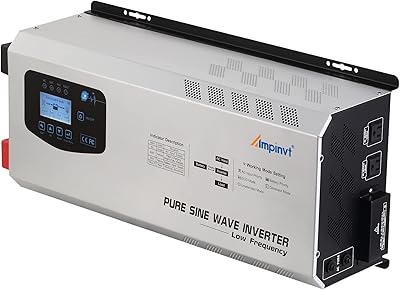
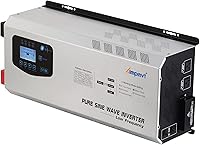
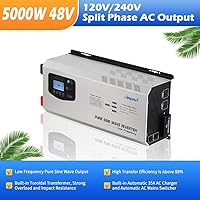
The Ampinvt 48V 5000W Split Phase Power Inverter is a low-frequency inverter-charger built for serious off-grid and home backup applications — not a weekend camping toy. It takes 48V DC from your battery bank and delivers both 120V and 240V AC simultaneously, which means it can actually run a whole house the way a utility grid does. The continuous 5000W rating handles heavy loads like well pumps and central air conditioners, while the 15000W peak covers short startup surges — not sustained output, just the brief spike motors need to get going. Three functions in one box — inverter, battery charger, and automatic transfer switch — put it in a different league from basic inverters at this price point.
Features & Benefits

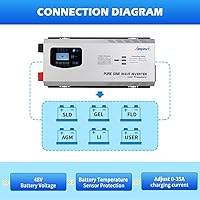
What separates this split-phase inverter-charger from cheaper high-frequency alternatives is the low-frequency transformer design, which handles surge loads more reliably and tends to run cooler under sustained use. The pure sine wave output exceeds 90% efficiency, making it safe for sensitive electronics, motors, and medical devices. Five operating modes — AC priority, battery priority, generator, ECO, and unattended — give you genuine flexibility across different scenarios. The AC charging current is adjustable from 0 to 35A, and it supports Gel, AGM, Flooded, SLA, and LiFePO4 batteries. An RS485 port enables optional WiFi monitoring, though that module costs extra and does not come in the box — a detail easy to miss.

Best For

The Ampinvt 48V unit is built for people who need real power delivered cleanly across a full home electrical panel — not just a few lights and a phone charger. Off-grid homeowners with a 48V solar battery bank are the natural fit, especially those running appliances that require 240V, like dryers or water heaters. Cabin owners and serious RV builds with high-demand loads will find the headroom here that smaller portable units simply cannot provide. It also suits DIY solar installers who specifically want a low-frequency design for its superior surge handling. If you are building an all-in-one system with LiFePO4 batteries, the adjustable charge profiles make this a strong candidate.

User Feedback

With a 3.9-star average across 135 ratings, this low-frequency inverter earns cautious praise rather than universal applause. Buyers who got their setup right tend to highlight the solid build quality, reliable automatic transfer switching, and the flexibility of multiple operating modes. The criticism side is harder to ignore: the included documentation is thin, and for anyone new to inverter-charger wiring, the learning curve can be genuinely frustrating. Several reviewers mention that fan noise under load is noticeable, and a handful raised concerns about support response times despite the US service center being active since 2019. For experienced installers it earns its place; for beginners, budget extra time for research.

Pros

  • Delivers true split-phase 120V and 240V output simultaneously, enabling whole-home power from a single unit.
  • Low-frequency transformer design handles motor startup surges far more reliably than comparable high-frequency inverters.
  • Pure sine wave output above 90% efficiency keeps sensitive electronics, motors, and medical devices safe.
  • Five operating modes — including ECO and unattended — give real flexibility across diverse off-grid and backup scenarios.
  • Adjustable AC charging current from 0 to 35A lets you tune battery charging to match your specific bank size.
  • Compatible with nearly every battery chemistry in use today, including LiFePO4, AGM, Gel, and flooded lead-acid.
  • Sub-4ms transfer time provides UPS-like behavior that most loads will not even notice during a grid switchover.
  • Consolidating the inverter, charger, and automatic transfer switch cuts installation time and reduces potential failure points.
  • Built-in AVR voltage stabilizer adds a meaningful layer of protection when input power quality is inconsistent.
  • A US-based customer service center provides at least a domestic point of contact for warranty and support issues.

Cons

  • The included manual is thin and poorly translated, making initial setup genuinely difficult for anyone without prior inverter experience.
  • WiFi monitoring and the external display screen are sold separately, despite being implied features in marketing materials.
  • Fan noise under sustained heavy load is noticeable and can be disruptive in living spaces where the unit is installed nearby.
  • At over 66 pounds, moving or repositioning this unit after installation is a two-person job at minimum.
  • Customer support response times have drawn repeated criticism in reviews, undermining the value of the US service center.
  • The 15000W peak figure refers to a very brief startup surge window, not a sustained output level — easy to misread when comparing specs.
  • Setup complexity puts this unit out of reach for beginners without an electrician or experienced solar installer involved.
  • Only a one-year warranty is included, which feels limited given that this is intended as a long-term infrastructure component.
  • The 3.9-star average across 135 reviews reflects a meaningful minority of buyers who had frustrating early experiences.
  • No native display is included in the base unit; checking system status requires either an optional add-on screen or the separately purchased WiFi module.

Ratings

The Ampinvt 48V 5000W Split Phase Power Inverter has been evaluated by our AI rating system after analyzing verified global buyer reviews, with spam, bot-generated, and incentivized feedback actively filtered out to reflect genuine ownership experiences. Scores below represent a transparent synthesis of both what this split-phase inverter-charger does well and where real buyers have run into friction. No category has been softened — the pain points are weighted just as heavily as the strengths.
Build Quality
78%
22%
Most buyers who opened the box were pleasantly surprised by the physical construction — the chassis feels solid and the internal components appear well-assembled for the price tier. Installers with experience handling competing units note that the transformer-based low-frequency design gives it a reassuring heft that high-frequency alternatives lack.
A minority of buyers reported loose terminal connections or minor cosmetic inconsistencies out of the box, suggesting quality control is not perfectly uniform across production runs. The exterior finish shows wear more quickly than expected when installed in garage or outdoor-adjacent environments.
Surge Handling
86%
The low-frequency transformer core genuinely earns its keep when motor-driven loads like well pumps and air conditioner compressors kick on. Buyers who switched from high-frequency inverters specifically noted fewer nuisance trips during startup events, which translates to real reliability in off-grid homes.
A handful of reviewers found the inverter tripped under load conditions they expected to fall within the surge rating, raising questions about real-world peak tolerance versus advertised figures. The 15000W peak is a very brief millisecond-level window, and buyers who misread it as a usable extended capacity were disappointed.
Pure Sine Wave Output
89%
Sensitive electronics — including variable-speed appliances, medical devices, and audio equipment — operated without issues on this unit, which is exactly what a pure sine wave inverter should deliver. Several reviewers confirmed clean waveform behavior using a Kill-A-Watt meter, giving confidence that the output quality claim holds up in practice.
There are no widespread complaints about waveform quality itself, but a small number of buyers noticed voltage fluctuations under very heavy combined loads near the continuous rating ceiling. This is worth monitoring closely if you are running at or near capacity consistently.
Automatic Transfer Switch
84%
The sub-4-millisecond transfer time proved reliable in real installations — buyers reported that desktop computers, NAS devices, and networking equipment stayed online without interruption during grid outages, which is the practical benchmark that matters most. The automatic handoff back to grid power when utility returned was consistently described as smooth.
A few users noted that the transfer behavior under generator input was less predictable than under clean grid power, with occasional relay chatter reported during generator startup. This is a manageable issue but worth noting for buyers planning generator integration specifically.
Battery Compatibility
82%
18%
Supporting Gel, AGM, SLA, Flooded, and LiFePO4 in a single unit is a genuine advantage for buyers who have mixed battery banks or plan to upgrade chemistry later. LiFePO4 owners in particular praised the adjustable charge current for allowing precise tuning to their battery manufacturer's specifications.
The charge profiles are not fully programmable in the way that a dedicated MPPT charge controller would be, which means advanced LiFePO4 users with tight BMS tolerances may need to set charge current conservatively. Documentation on exactly how to configure each chemistry is thin.
Operating Modes
77%
23%
Having five distinct modes — including ECO and unattended — means experienced users can genuinely optimize for their specific scenario, whether that is minimizing battery cycling in a grid-tied backup setup or maximizing solar self-consumption in a full off-grid cabin.
The modes are not well explained in the included manual, and buyers frequently resort to YouTube tutorials or community forums to understand the practical difference between AC priority and battery priority configurations. Unattended mode in particular left several buyers unsure of how the low-voltage restore thresholds interact.
Adjustable Charging
74%
26%
The ability to dial the AC charge current anywhere from 0 to 35A is useful for buyers with smaller battery banks who do not want to stress their batteries with a full charge rate, or for those who want to use grid charging only as a top-up rather than a primary charging source.
The charging rate adjustment interface is not intuitive based on the existing documentation, and some users accidentally left the unit in a zero-amp charge state without realizing the battery was not being replenished. A clearer indicator of current charging state would reduce this confusion significantly.
Installation Experience
51%
49%
For buyers with a background in DC electrical systems and inverter wiring, the physical installation is straightforward — terminals are accessible, labeling is present, and the unit follows conventional inverter-charger wiring logic that experienced DIYers will recognize quickly.
For everyone else, the installation experience is a real obstacle. The manual is widely criticized as sparse, poorly translated, and missing critical configuration steps. Multiple buyers reported spending several hours piecing together setup instructions from third-party sources before they felt confident powering the unit on.
Documentation Quality
38%
62%
The unit ships with a basic manual that covers the core connection points and mode descriptions at a surface level, which provides at least a starting framework for experienced installers to work from.
This is one of the most consistently criticized aspects across all buyer reviews. The translation quality is poor, wiring diagrams lack critical detail, and the configuration instructions for battery type settings and operating modes leave too much to inference. It is genuinely not adequate for safe independent installation by anyone without prior experience.
Fan Noise
59%
41%
The cooling fan does its job effectively — thermal management under sustained load appears adequate, and there are no widespread reports of overheating or thermal shutdowns during normal operation within rated parameters.
The fan is loud enough under moderate to heavy loads that multiple buyers specifically flagged it as a concern. For installations in utility closets near living spaces, it is a real quality-of-life issue. It is not a dealbreaker for garage or outbuilding installs, but it is not a quiet unit.
Remote Monitoring
44%
56%
The RS485 port provides a legitimate expansion path for buyers who want to add WiFi monitoring or an external display screen down the road, and third-party compatible accessories do exist in the market.
Neither the WiFi module nor the display screen is included, and this catches buyers off guard regularly — it is presented in marketing materials in a way that implies more out-of-box connectivity than is actually delivered. Buyers who expected smartphone monitoring from day one felt misled, and the cost of the accessories adds up.
Value for Money
71%
29%
Relative to what a comparable split-phase low-frequency inverter-charger costs from established North American or European brands, the Ampinvt 48V unit lands at a price point that is genuinely competitive — experienced buyers recognize they are getting meaningful capability for the money.
The value equation weakens if you factor in the time cost of working around the poor documentation, the additional spend on monitoring accessories, and the uncertainty around long-term support. Buyers who expected a fully turnkey experience at this price were disappointed more often than those who came in with realistic expectations.
Customer Support
46%
54%
Having a US-based customer service operation rather than routing all support through overseas channels is a meaningful structural advantage, and some buyers have reported positive resolution experiences when issues were straightforward.
Response times are the most persistent complaint in negative reviews — buyers describe days-long waits for replies on technical questions and inconsistent guidance when they do get a response. For a product that requires precise configuration to operate safely, slow support carries real risk.
Warranty Coverage
57%
43%
A one-year warranty backed by a domestic service center is a reasonable baseline, and the brand has been operating long enough — since 2013 in manufacturing, with US presence since 2019 — to have an actual claims history that buyers can reference in forum discussions.
One year is on the short side for a permanent electrical installation component that buyers expect to run for a decade or more. Competitors in the same category increasingly offer two- or three-year coverage, and the gap becomes a factor when buyers are deciding between brands.
Thermal Management
66%
34%
Under typical mixed loads in a well-ventilated installation space, the thermal management holds up adequately — the operating temperature ceiling of 60°C gives reasonable headroom for warm environments like garages and outbuildings in most climates.
Buyers running the unit at sustained high loads in poorly ventilated spaces have reported elevated chassis temperatures, and a few noted the fan cycling behavior was inconsistent under those conditions. Proper airflow clearance around the unit is not optional — it is a functional requirement.

Suitable for:

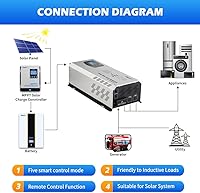
The Ampinvt 48V 5000W Split Phase Power Inverter is purpose-built for people who are serious about off-grid living or whole-home backup power — not casual users dipping their toes into solar. If you have a 48V battery bank and need to run standard 240V household appliances like a well pump, electric dryer, or central air conditioner, the split-phase output is a genuine necessity that most inverters at this price simply cannot offer. DIY solar installers who understand the advantages of low-frequency transformer designs — better surge tolerance, more robust performance under sustained load — will appreciate what this unit brings to a permanent installation. It is also a strong fit for off-grid cabin builds and high-demand RV setups where consolidating the inverter, battery charger, and automatic transfer switch into one enclosure saves both cost and wiring complexity. Buyers running LiFePO4 battery systems will find the adjustable charge current and compatible charge profiles particularly useful.
Not suitable for:

The Ampinvt 48V 5000W Split Phase Power Inverter is not the right choice for buyers who are new to inverter-charger systems and expect plug-and-play simplicity right out of the box. The documentation that ships with the unit has been a consistent complaint — if you are not already comfortable with DC wiring, charge controller integration, and inverter configuration, the learning curve here can be steep and potentially hazardous. This split-phase inverter-charger also will not suit anyone running a 12V or 24V battery system, since the 48V input requirement is fixed. Those hoping to monitor or remotely control the unit via WiFi should know upfront that the wireless module is a separate purchase — it does not come included, and discovering that after installation is frustrating. Finally, buyers who want a compact, lightweight unit for occasional or portable use should look elsewhere; at over 66 pounds, this low-frequency inverter is a permanent-installation piece of equipment.
Specifications

  • Continuous Output: This unit delivers a steady 5000W of continuous AC power, sufficient for running multiple high-draw household appliances simultaneously.
  • Peak Surge: The 15000W peak rating covers brief motor startup surges lasting only milliseconds — it is not a sustained output level and should not be used to size your load calculations.
  • DC Input Voltage: The inverter requires a 48V DC battery bank as its power source; it is not compatible with 12V or 24V systems.
  • AC Output: Output is delivered as split-phase 120V and 240V AC simultaneously at 60Hz, matching the standard North American residential grid configuration.
  • AC Input: When grid or generator power is available, the unit accepts 240VAC input within a ±25% tolerance range at 60Hz ±5Hz.
  • Wave Form: Output is pure sine wave, making it safe for sensitive electronics, variable-speed motors, and equipment that would be damaged or impaired by modified sine wave power.
  • Charge Current: The built-in AC battery charger is adjustable from 0 to 35A, and setting it to 0A disables the charging function entirely if needed.
  • Battery Compatibility: Supported battery chemistries include Gel, AGM, SLA, Flooded lead-acid, and LiFePO4 lithium iron phosphate, covering virtually all common battery bank configurations.
  • Transfer Time: The automatic transfer switch switches between grid and battery power in under 4 milliseconds, fast enough that most connected equipment will not register any interruption.
  • Overcharge Protection: The unit triggers overcharge protection automatically when battery voltage reaches or exceeds 64VDC, helping to protect the battery bank from damage.
  • Operating Temperature: The inverter is rated for ambient operating temperatures between 0°C and 60°C, suitable for most indoor installation environments.
  • Communication Port: An RS485 port is included for integration with an optional WiFi monitoring module or external control display, both of which are sold separately and not included in the box.
  • Operating Modes: Five selectable modes — AC priority, battery priority, generator, ECO, and unattended — allow the unit to be configured for a wide range of off-grid and backup scenarios.
  • AVR Stabilizer: A built-in automatic voltage regulation circuit helps smooth out input voltage fluctuations before they reach connected loads.
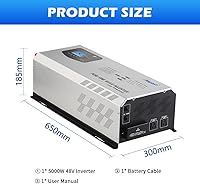
  • Dimensions: The unit measures 23.8″ in length, 6.7″ in width, and 10.2″ in height, requiring dedicated wall or rack space for permanent installation.
  • Weight: At 66.2 lbs, this is a heavy unit that requires two people and secure mounting hardware for safe installation.
  • Efficiency: Transfer efficiency is rated above 90%, meaning relatively little energy is lost in the DC-to-AC conversion process under normal operating conditions.
  • Warranty: A one-year warranty is included, backed by a customer service center based in the United States that has been operational since 2019.

Related Reviews

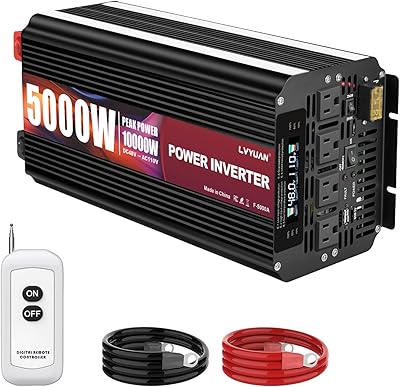
LVYUAN 5000W Power Inverter 48V to 120V
84%
92%
Power Output
88%
Build Quality
85%
Ease of Setup
90%
Safety Features
65%
Noise Level Under Load
More
Ampinvt 5000W 24V Split Phase Power Inverter
72%
83%
Power Output Reliability
78%
Build Quality
86%
Pure Sine Wave Quality
81%
Battery Charger Performance
54%
Installation Experience
More
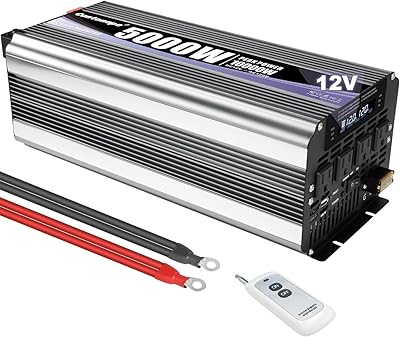
Cantonape 5000W Power Inverter
73%
83%
Power Output Reliability
61%
Modified Sine Wave Compatibility
79%
Build Quality
88%
LCD Display Usefulness
84%
Ease of Installation
More
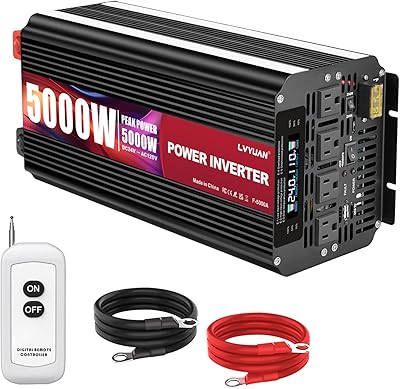
LVYUAN 5000W 24V Power Inverter
77%
88%
Power Output Reliability
82%
Installation & Setup
84%
LCD Display Usefulness
71%
Wireless Remote Performance
76%
Fan Noise & Thermal Management
More
Kzreect Inverter-MK 220W Portable Power Inverter
80%
84%
Build Quality
71%
Power Output
89%
Battery Compatibility
88%
USB Charging Speed
86%
LED Light Quality
More
Tebrol 2000W Power Inverter
86%
88%
Performance & Power Output
90%
Ease of Use & Setup
85%
Portability & Size
75%
Cooling System & Noise
91%
Safety Features
More
HONOURLIGHT 3000W Power Inverter
79%
88%
Value for Money
83%
Power Performance
91%
Ease of Setup
89%
LED Display Clarity
84%
Remote Control
More
Cantonape 1200W Power Inverter
76%
78%
Power Output Reliability
88%
LCD Display Usefulness
74%
Build Quality
61%
Modified Sine Wave Compatibility
83%
USB Charging Performance
More
Homkeep 3000W Modified Sine Wave Power Inverter
83%
86%
Power Output Accuracy
81%
Surge Handling
92%
Display & Monitoring
84%
Remote Control Range
88%
Safety Protection
More
OLTEANP 3000W Car Power Inverter
82%
88%
Power Output & Wattage Performance
86%
Build Quality & Durability
83%
Value for Money
91%
Safety Protection Systems
71%
Waveform & Device Compatibility
More

FAQ

It outputs both simultaneously. That is the whole point of a split-phase design — you get a standard North American panel configuration where 120V is available on each leg and 240V is available across both legs. You can run your refrigerator and your well pump at the same time without any switching.

Low-frequency inverters use a physical transformer to handle the conversion, which makes them heavier but significantly better at handling sudden spikes in current demand — like when a motor or compressor kicks on. High-frequency designs are lighter and cheaper to manufacture but can struggle or trip under those same surge conditions. If you are running a well pump, air conditioner, or any motor-driven appliance, the low-frequency design is the safer choice.

Not for sizing purposes, no. That peak figure refers to a very short burst — measured in milliseconds — that the unit can handle during motor startup. Your continuous load must stay within the 5000W rating. Use the peak number only to confirm the unit can handle the startup surge of a specific motor, not as a general capacity figure.

Yes, LiFePO4 is explicitly supported. You will want to configure the charge voltage and current settings to match your battery manufacturer's recommendations, since lithium chemistries have tighter charge parameters than lead-acid. The adjustable charge current (down to 0A if needed) gives you enough control to do that properly.

No, and this catches a lot of buyers off guard. The unit has an RS485 communication port that supports a WiFi module and an external display screen, but both of those accessories are sold separately. If remote monitoring matters to you, factor in the additional cost before purchasing.

Several owners describe the fan noise as noticeable, particularly under heavier loads. It is not silent by any measure. If you are installing this in a utility room or garage away from living areas, it probably will not bother you. In a bedroom-adjacent space, it could be an issue worth thinking through before installation.

Technically yes, but practically speaking it is a project that demands real electrical knowledge. The wiring involves high-current DC connections and a split-phase AC panel connection — mistakes here can cause fires or serious injury. The included manual has been widely criticized for being sparse and difficult to follow. If you are not already comfortable with this type of work, bring in a licensed electrician or an experienced solar installer.

The Ampinvt 48V 5000W Split Phase Power Inverter switches over to battery power automatically in under 4 milliseconds, which is fast enough that most equipment — including computers and some sensitive electronics — will not detect the transition. When grid power returns, it switches back and resumes charging the battery bank based on whichever operating mode you have selected.
That depends on how long you want to run at full load. At 5000W continuous draw from a 48V system, you are pulling roughly 104 amps DC at peak. A larger bank — 200Ah or more at 48V — gives you meaningful runtime and keeps the depth of discharge at a safer level for battery longevity. The exact sizing depends on your load profile and battery chemistry.

The one-year warranty is backed by a US-based service center, which is better than dealing with overseas support. That said, buyer reviews are mixed on response times — some report quick resolution while others describe slow or frustrating experiences. Keeping your purchase records organized and reaching out via email with clear documentation of any issue seems to produce the best results based on what buyers report.