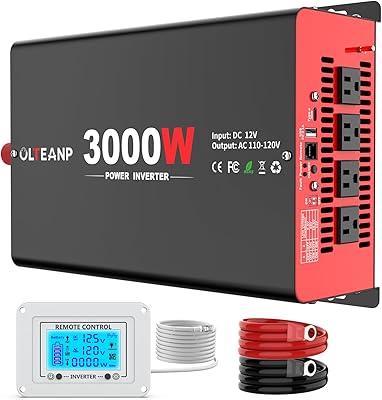
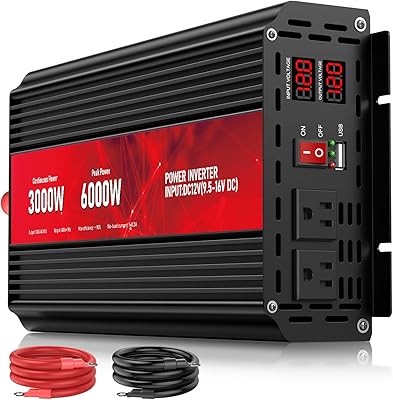
Overview

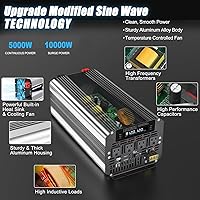
The Cantonape 5000W Power Inverter is a heavy-duty modified sine wave unit built for off-grid and mobile power users who need serious wattage without paying pure sine wave prices. It delivers a continuous 5000W output — that's the number that matters day-to-day — with a 10,000W peak for motor startup surges. One thing worth flagging upfront: the model number printed on the unit reads MSW1500W-LED-US, which can cause confusion when the box arrives. That's a labeling quirk, not a performance issue. Cantonape is a Chinese OEM brand that only started appearing on Amazon in mid-2024, so the track record is still being built. If you're running sensitive electronics like a CPAP or variable-speed tools, modified sine wave output may cause problems — that's a real consideration before buying.
Features & Benefits

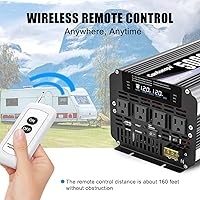
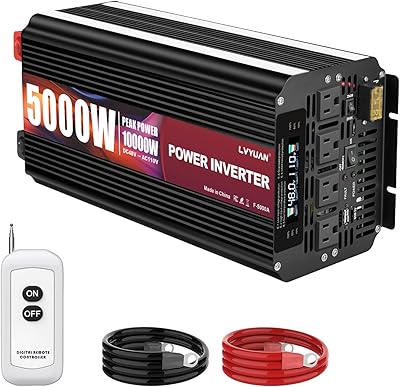
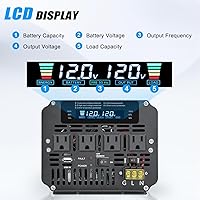
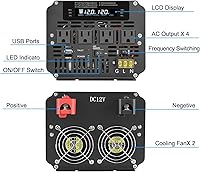
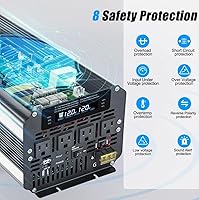
The LCD display is genuinely one of the more practical additions here — it shows battery voltage, output voltage, load percentage, and error codes in real time, so you're not guessing how hard the system is working. The included remote controller is handy for installations tucked into an RV bay or behind a truck panel, though you'll need to grab a 12V 23A battery separately to actually use it. Four AC outlets mean you can run multiple appliances at once without daisy-chaining power strips. The aluminum chassis pairs with a temperature-controlled cooling fan that only ramps up when heat builds, and six onboard protections cover the most common failure scenarios. AC frequency switching between 50Hz and 60Hz is a thoughtful touch for anyone using imported appliances.

Best For

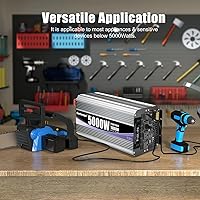
This 5000W inverter makes the most sense for people who need real wattage on the move and can work within the limits of modified sine wave power. RV owners and van-lifers running microwaves, electric skillets, or power tools off a 12V battery bank will find the capacity genuinely useful. It also fits well into off-grid solar builds as the DC-to-AC conversion stage between a battery bank and household loads. Tradespeople who want worksite power without hauling a generator, and anyone prepping for emergency home backup, are solid candidates too. Just be clear-eyed: if your setup includes a CPAP machine, audio equipment, or other sensitive electronics, the modified sine wave output is a real limitation you should not overlook.

User Feedback

The Cantonape unit sits at 4.2 out of 5 stars across roughly 80 reviews — a decent signal, but a fairly thin sample for a high-wattage inverter. Buyers consistently praise how straightforward the installation is and how readable the LCD readout is under real working conditions. Build quality gets positive mentions too, with the aluminum body feeling substantial for the price tier. On the downside, fan noise under heavy load comes up regularly, and a handful of users flag compatibility issues with devices that do not play well with modified sine wave power. The separate battery requirement for the remote is a minor setup catch buyers notice after unboxing. Given this launched in mid-2024, long-term durability data is still accumulating — worth factoring into your decision.

Pros

  • 5000W continuous output handles demanding appliances like microwaves and power tools without throttling.
  • The LCD display gives you real, actionable data — voltage, load percentage, and error codes at a glance.
  • Four AC outlets mean you can run multiple devices at once without extra hardware.
  • Six onboard protection modes cover the most common failure scenarios, adding meaningful peace of mind.
  • The aluminum chassis feels solid and handles heat better than plastic-bodied competitors at this price point.
  • Remote on/off control is a genuine convenience when the unit is installed in a tight or inaccessible space.
  • AC frequency switching between 50Hz and 60Hz adds flexibility for users with imported or international appliances.
  • Hard-wire connection option gives installers a cleaner, more permanent setup choice beyond clamp-style cables.
  • Early buyer feedback consistently praises straightforward installation, even for first-time inverter users.

Cons

  • Modified sine wave output is incompatible with CPAPs, some medical devices, and certain sensitive electronics.
  • The model number on the unit (MSW1500W-LED-US) does not match the advertised 5000W spec, which can cause unnecessary confusion at unboxing.
  • The remote controller is useless out of the box — it requires a 12V 23A battery that is not included.
  • Fan noise under heavy load is a recurring complaint, which matters if the unit is installed in a living or sleeping area.
  • With fewer than 100 reviews since a mid-2024 launch, long-term durability under sustained use is still unproven.
  • At 12.23 pounds and over 16 inches on two sides, this heavy-duty inverter is bulky to mount in space-constrained vehicles.
  • Cantonape has a limited support footprint compared to established inverter brands, which could be a concern if warranty service is needed.
  • Peak wattage of 10,000W applies only to brief startup surges — sustained loads must stay at or under 5,000W or protection circuits will trigger.

Ratings

The scores below reflect an AI-driven analysis of verified global buyer reviews for the Cantonape 5000W Power Inverter, with spam, bot-generated, and incentivized feedback actively filtered out to ensure accuracy. Every category score is calibrated to reflect real ownership experiences — not marketing claims — so both the standout strengths and the genuine frustrations are represented fairly. If a category scores low, there is a real pattern behind it worth understanding before you buy.

Power Output Reliability
83%
Most buyers confirm the unit sustains its rated continuous output without thermal shutdowns during typical use — running a microwave, power drill, or small appliance bank in an RV or truck setup. The overload protection triggers predictably rather than erratically, which builds confidence over time.
A portion of users pushing loads close to the 5000W ceiling report the protection circuits tripping sooner than expected, suggesting real-world headroom is somewhat tighter than the spec implies. Extended high-load sessions require careful load management.
Modified Sine Wave Compatibility
61%
39%
For resistive loads like heaters, incandescent lighting, and basic power tools, the modified sine wave output works without issue. Many users running microwaves, fans, and basic appliances in off-grid setups report completely normal operation with no complaints.
This is the most polarizing aspect of the unit. CPAP users, people running variable-speed tools, and those with audio equipment frequently flag interference, humming motors, or outright incompatibility. The wave type is a hard dealbreaker for a meaningful subset of buyers.
Build Quality
79%
21%
The aluminum chassis earns consistent praise — buyers coming from plastic-bodied inverters at similar prices note the difference immediately. It feels like something designed to tolerate vibration, heat cycles, and rough handling in a truck bed or marine environment.
A few buyers note that terminal connections and internal wiring feel less premium than the exterior suggests, and there are occasional reports of minor cosmetic inconsistencies out of the box. For the price tier it sits in, these are tolerable but worth noting.
LCD Display Usefulness
88%
The real-time display gets high marks across the board. Being able to see battery voltage, load percentage, and error codes without guessing is genuinely useful when you are managing power draw in a solar or RV setup and need to avoid draining your battery bank dangerously low.
A small number of users report the display is difficult to read at certain angles or in direct sunlight, which can be frustrating in outdoor or vehicle-mounted installations. There is no backlight intensity adjustment, which limits usability in very bright environments.
Ease of Installation
84%
First-time inverter buyers consistently highlight how straightforward the setup process is. Clear labeling, a sensible terminal layout, and the option to either clamp directly to battery posts or hard-wire the unit make it accessible even without prior electrical experience.
At over 12 pounds and with dimensions exceeding 16 inches on two sides, physically fitting this unit into tight spaces — under a van floor, inside an RV utility bay — requires planning. The size catches some buyers off guard who did not check dimensions before purchasing.
Cooling & Thermal Management
74%
26%
The temperature-controlled fan is a smart design choice — it stays quiet at light loads and only spins up when the unit actually needs cooling. Buyers running moderate loads for extended periods report no thermal shutdowns, which speaks well of the heat management design.
Under sustained heavy loads, the fan becomes noticeably loud — loud enough that users with the unit mounted inside living spaces flag it as disruptive. In a sealed or poorly ventilated compartment the unit also gets warm faster than expected.
Remote Controller Quality
58%
42%
When it works, the remote is a convenient add-on for installations where the inverter is mounted out of easy reach. Buyers who use it in fixed RV or truck setups appreciate not having to crawl into a utility bay just to toggle the unit on and off.
The omission of the required 12V 23A battery from the package frustrates buyers who discover it only after installation. The remote itself feels plasticky relative to the rest of the unit, and a handful of users report inconsistent responsiveness over time.
Value for Money
77%
23%
Against pure sine wave inverters at the same wattage, this unit comes in at a notably lower price point, and for buyers whose loads do not require clean sine wave power, that gap represents real savings. The feature set — LCD, remote, four outlets, six protections — justifies the cost tier well.
Buyers who later discover their key appliances are incompatible with modified sine wave output feel the value proposition collapses quickly, since the alternative is buying again. The price looks less competitive once you factor in that gap versus purpose-built alternatives.
Fan Noise Level
55%
45%
At idle or very light loads, the fan is effectively silent, which is a genuine plus for users who run the inverter in a quiet environment like a sleeping van setup overnight with minimal draw.
At moderate to high loads, fan noise is among the most consistently flagged complaints in the review pool. Users mounting this in bedroom or living areas of an RV or boat find the noise level incompatible with comfort, particularly during nighttime use.
Overload & Safety Protection
81%
19%
The six-way protection system works as advertised for most buyers — the unit shuts down cleanly under overload or fault conditions rather than failing silently or dangerously. Reverse polarity protection in particular gives peace of mind during DIY installations.
Some users find the under-voltage threshold triggers earlier than expected with aging or partially discharged battery banks, cutting power before the battery is actually critically low. Calibrating your battery bank capacity expectations matters here.
Multi-Outlet Usability
82%
18%
Having four AC outlets built in is a practical advantage that eliminates the need for an external power strip in most setups. Users powering a mix of a refrigerator, charging hub, and small appliance simultaneously in an off-grid cabin or RV find the layout genuinely convenient.
The outlets are grouped closely together, which means wide-body adapters or angled plugs can block adjacent sockets. A slightly wider spacing between outlet pairs would have made this a near-perfect layout for mixed plug types.
Brand Trust & Support
52%
48%
The 12-month warranty and responsive early Amazon seller feedback give some reassurance. Buyers who have had straightforward setup experiences with no issues report feeling adequately supported by available documentation.
Cantonape is a very new brand with limited long-term track record, and buyers needing warranty service report difficulty getting timely, substantive support responses. The model number discrepancy on the unit also erodes some confidence in the brand's quality control process.
AC Frequency Flexibility
78%
22%
The 50Hz/60Hz switching capability is a thoughtful inclusion that most competing units in this price range skip entirely. Users with Japanese or European appliances — common among international travelers and off-grid enthusiasts — flag this as a genuine differentiator.
The switching mechanism is not clearly documented in the included manual, and some users have had to rely on online forums to figure out how to toggle it correctly. Better in-box guidance would make this feature far more accessible.
Long-Term Durability
63%
37%
Early buyers who have run the unit for several months without heavy sustained loads report it holding up well, with no degradation in output quality or protection responsiveness. The aluminum body shows no signs of heat-related warping in normal operating conditions.
With the product only on the market since mid-2024, there is simply not enough field data to make confident claims about multi-year reliability. Buyers planning to depend on this unit in critical or full-time applications should factor in that uncertainty explicitly.

Suitable for:

The Cantonape 5000W Power Inverter is a strong match for anyone who needs serious, sustained AC power drawn from a 12V battery bank and can work within the boundaries of modified sine wave output. RV owners and van-lifers running high-draw appliances — microwaves, electric skillets, power drills — will find the 5000W continuous rating genuinely capable for that kind of daily use. It also slots in well as the conversion stage in an off-grid solar build, sitting between a battery bank and standard household loads. Tradespeople who want jobsite power without hauling a generator, and households assembling an emergency backup setup with multiple devices running simultaneously, are equally good candidates. The four built-in outlets, real-time LCD monitoring, and remote controller all make practical sense for installations where the unit is mounted in a fixed, hard-to-reach spot like a truck cab or RV utility bay.
Not suitable for:

The Cantonape 5000W Power Inverter is not the right tool if your load list includes sensitive electronics that require clean, stable power. Modified sine wave output can interfere with CPAP machines, certain medical devices, variable-speed power tools, laser printers, and audio equipment — in some cases causing humming, reduced efficiency, or outright malfunction. Buyers expecting a set-it-and-forget-it solution from a well-established brand with years of field data may also want to pause: this unit only appeared on the market in mid-2024, and long-term reliability under sustained heavy loads is still an open question. Anyone building a high-stakes system — a full-time off-grid home, a critical backup for medical equipment, or a professional mobile workstation — would be better served by a pure sine wave inverter from a brand with a longer proven track record, even at a higher cost.
Specifications

  • Continuous Output: Delivers a sustained 5000W of AC power under normal operating conditions.
  • Peak Output: Handles up to 10,000W momentarily to accommodate motor startup surges from appliances and tools.
  • Input Voltage: Accepts 12V DC input, compatible with standard vehicle and solar battery banks.
  • Output Voltage: Produces 110V/120V AC output suitable for standard North American appliances.
  • Wave Type: Generates a modified sine wave, which works well for resistive and most motor loads but may cause issues with sensitive electronics.
  • AC Outlets: Equipped with 4 standard AC output receptacles for simultaneous multi-device use.
  • AC Frequency: Switchable between 50Hz and 60Hz to support appliances from different regions including Japan.
  • Display: Built-in LCD screen shows battery voltage, output voltage, remaining battery capacity, load percentage, and error codes in real time.
  • Remote Control: Includes a wired remote controller for on/off operation; requires one 12V 23A battery (not included) to function.
  • Protections: Six onboard protection systems guard against overload, short circuit, overheating, reverse polarity, under-voltage, and over-voltage conditions.
  • Cooling System: Uses a temperature-controlled internal fan that adjusts speed based on operating heat rather than running continuously at full speed.
  • Body Material: Constructed from aluminum alloy for structural durability and improved passive heat dissipation.
  • Wiring Option: Supports both clamp-style battery connection and a hard-wire installation option for permanent mounting setups.
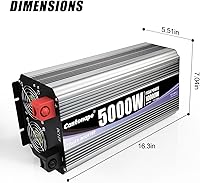
  • Dimensions: Measures 16.3 x 7.04 x 16.3 inches, making it a sizable unit that requires adequate mounting space.
  • Weight: Weighs 12.23 pounds, which is typical for an aluminum-chassis inverter at this wattage tier.
  • Model Number: Listed internally as MSW1500W-LED-US; note this label on the unit does not reflect the 5000W output specification.
  • Brand: Manufactured by Cantonape, a Chinese OEM brand that began its Amazon presence in mid-2024.
  • Warranty: Backed by a 12-month manufacturer warranty as stated in the product listing.
  • User Rating: Holds a 4.2 out of 5 star average based on approximately 80 verified Amazon reviews as of the time of writing.
  • Availability: First listed on Amazon in June 2024, placing it as a relatively recent entrant in the high-wattage inverter category.

Related Reviews

Cantonape 1500W 24V Power Inverter
76%
82%
Power Output Reliability
91%
Ease of Setup
88%
LED Display & Diagnostics
74%
Build Quality
69%
Thermal Management
More
Cantonape 1200W Power Inverter
76%
78%
Power Output Reliability
88%
LCD Display Usefulness
74%
Build Quality
61%
Modified Sine Wave Compatibility
83%
USB Charging Performance
More
Cantonape 1000W Car Power Inverter
86%
88%
Performance
85%
Build Quality
91%
Ease of Use
83%
Portability
90%
Charging Capability
More
LVYUAN 5000W Power Inverter 48V to 120V
84%
92%
Power Output
88%
Build Quality
85%
Ease of Setup
90%
Safety Features
65%
Noise Level Under Load
More
LVYUAN 5000W 24V Power Inverter
77%
88%
Power Output Reliability
82%
Installation & Setup
84%
LCD Display Usefulness
71%
Wireless Remote Performance
76%
Fan Noise & Thermal Management
More
Ampinvt 5000W 24V Split Phase Power Inverter
72%
83%
Power Output Reliability
78%
Build Quality
86%
Pure Sine Wave Quality
81%
Battery Charger Performance
54%
Installation Experience
More
Kzreect Inverter-MK 220W Portable Power Inverter
85%
94%
Portability and Size
89%
Charging Speed (USB-C & USB-A)
82%
Battery Compatibility
88%
Ease of Use
90%
Safety Features (Overload, Overcurrent)
More
HONOURLIGHT 3000W Power Inverter
79%
88%
Value for Money
83%
Power Performance
91%
Ease of Setup
89%
LED Display Clarity
84%
Remote Control
More
ROARBATT 3000W Power Inverter
77%
83%
Build Quality
78%
Power Output Accuracy
86%
Value for Money
88%
Ease of Setup
91%
LCD Display
More
Tebrol 5500W Power Inverter
83%
88%
Performance
91%
Ease of Setup
85%
Build Quality
73%
Cooling System Efficiency
80%
Portability
More

FAQ

This is one of the most important questions to ask before buying. The Cantonape 5000W Power Inverter produces modified sine wave output, and many CPAP machines — especially newer models with motor controllers and humidifiers — require clean pure sine wave power to operate correctly. Running a CPAP on modified sine wave can cause the motor to run hotter, reduce efficiency, or in some cases damage the device. Check your CPAP manual or contact the manufacturer before connecting it to this unit.
At 5000W continuous draw from a 12V source, you are looking at roughly 417 amps of current — that is a significant load. In practice, you would need a very large battery bank (multiple 100Ah or 200Ah batteries in parallel) and heavy-gauge cabling to sustain that output without voltage sag or triggering the under-voltage protection. Most real-world users run well under the 5000W ceiling and find 200–400Ah of battery capacity adequate for moderate loads.

No, this is a known labeling inconsistency with this unit. The model number printed on the inverter and packaging does not match the 5000W output specification advertised in the listing. It is a manufacturer labeling issue and does not affect the actual performance of the inverter. If you are still concerned, you can verify by checking the wattage rating on the unit itself or contacting the seller directly.

Not quite — the remote controller is included in the box, but it requires a 12V 23A battery to operate, and that battery is not provided. It is a small, inexpensive battery available at most hardware or electronics stores. Just pick one up before your installation if you plan to use the remote from day one.

The fan is temperature-controlled, so it is quiet or completely off at light loads. Under sustained heavy loads, it does ramp up noticeably — multiple buyers have flagged the noise level as something to factor in if the inverter is mounted inside a living space like a camper van or RV interior. For engine bays, truck beds, or external utility compartments, the noise is a non-issue.

Yes, this is one of the better use cases for this heavy-duty inverter. It connects between your 12V battery bank (charged by your solar panels via a charge controller) and your AC loads. Just make sure your battery bank is sized to handle your expected draw, and keep in mind the modified sine wave output when selecting which appliances to power.

No — the 10,000W figure is the peak rating, which only applies to brief startup surges, typically lasting a second or two. The number that matters for anything sustained is the 5000W continuous rating. If you try to run 8,000W of load continuously, the overload protection will kick in and shut the unit down. Plan your system around the 5000W continuous figure.

Yes, the unit supports a hard-wire connection option, which is ideal for permanent installations in trucks, RVs, or solar setups where you want a clean, secure connection rather than clamps that can work loose over time. Use appropriately rated cable for a 5000W, 12V application — undersized wire is a serious safety risk at this current level.

Yes, the inverter includes an AC frequency switching feature that lets you toggle between 50Hz and 60Hz output. This makes it compatible with appliances originally designed for 50Hz grids. Just make sure the appliance also accepts 110V/120V input voltage, since European appliances typically run on 220V/240V — frequency switching alone does not solve a voltage mismatch.

Honestly, it is too early to say with confidence. This unit only hit the market in mid-2024, and the current review pool of around 80 ratings is solid for initial feedback but thin for long-term reliability data. Early buyers report good build quality and consistent performance, which is encouraging. For a part-time or backup use case, that is probably enough reassurance. If you are planning full-time, high-load use and need a unit with a proven multi-year track record, you may want to consider a more established brand while keeping this one on your shortlist as it accumulates more field data.