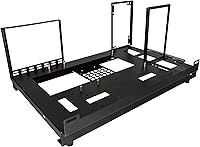
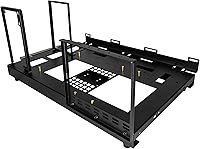
Overview

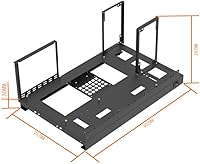
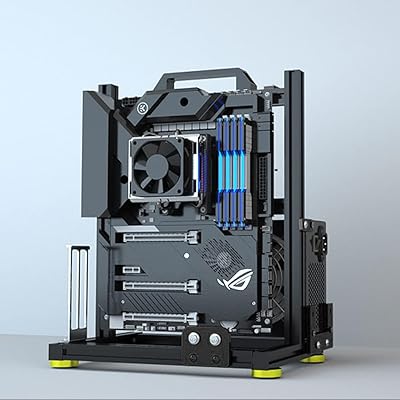
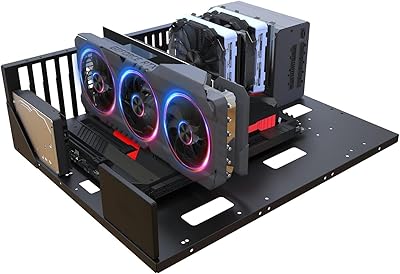
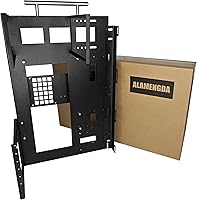
The ALAMENGDA Open Air Mini ATX Test Bench is the kind of tool PC builders and technicians reach for when they need to fire up components quickly without wrestling them into a full enclosure. Open-air benches exist for one practical reason: they make diagnostics, test builds, and hardware tinkering faster and far less frustrating. Before anything else, know that this is a Mini ATX-sized platform — full ATX motherboards will likely have misaligned screw holes, so check your board format before ordering. Built from 1mm steel plate, it can stand upright or lie flat depending on your workspace needs. At its price point, it targets hobbyists and small shops, not professional lab setups.
Features & Benefits

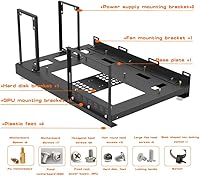
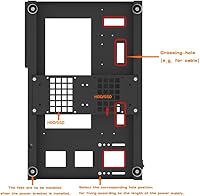
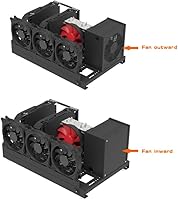
The steel construction is worth paying attention to. Unlike acrylic or budget MDF alternatives that flex under the weight of a heavy GPU, the 1mm steel frame holds its shape reliably. Mounting points accommodate both M-ATX and ITX boards, and the PSU can be installed front or rear, giving you real flexibility when routing cables in a tight workspace. A genuinely useful inclusion is the industrial startup cable — no more shorting header pins with a screwdriver just to POST a bare board. GPU support tops out at 256mm, meaning longer current-generation cards simply will not fit. The frame also accepts up to a 360mm radiator, handy if you need to stress-test a liquid-cooled system outside a case.

Best For

This mini ATX bench fits a specific crowd, and knowing that upfront saves a frustrating return. PC technicians and repair shop staff will find it genuinely useful as a quick-swap diagnostic platform — install a board, test, pull it out, repeat. DIY builders wanting to validate component compatibility before committing to a permanent case will also get solid use from it. ITX and M-ATX enthusiasts building compact open-air display rigs are another natural fit. What it is not suited for: anyone running a standard full ATX board or a flagship GPU longer than 256mm should be looking at a larger bench. The size constraint is real, not a footnote.

User Feedback

With a 4.1 out of 5 rating across 69 reviews, this steel test stand has earned cautious approval rather than wild enthusiasm. Buyers consistently highlight the solid build quality relative to the asking price, and most report that assembly is straightforward without much confusion. The included startup cable gets repeated praise as a thoughtful practical touch. On the critical side, the most frequent complaint involves the sizing limitation — buyers who assumed standard ATX compatibility ran directly into the misalignment problem. A handful flagged the 256mm GPU restriction as a dealbreaker for modern high-end builds. Packaging feedback is mixed, with a few buyers noting minor surface scuffs on arrival.

Pros

  • Steel construction feels noticeably more rigid than the acrylic or plastic frames common at this price range.
  • Supports both M-ATX and ITX motherboards, covering the two most popular small form factor standards.
  • Included industrial startup cable is a practical touch that saves you hunting for a screwdriver every time.
  • PSU can mount front or rear, giving you flexibility to manage cables however your workspace demands.
  • Runs upright or flat — a small but genuinely useful option when desk space is tight.
  • Accepts up to a 360mm radiator, so liquid-cooled test builds are possible without improvising a mounting solution.
  • Lightweight at just over 4 lbs, making it easy to move around a workshop or pack for a house call.
  • Assembly is reported as straightforward by most buyers, with no steep learning curve.
  • At its price point, it delivers a level of sturdiness that most budget benches in this category do not match.
  • Clean, minimal black finish works well as a low-key open-air display frame for compact builds.

Cons

  • Full ATX motherboards will not mount correctly — this is a hard compatibility wall, not a minor inconvenience.
  • 256mm GPU length limit excludes most modern high-performance graphics cards right out of the box.
  • Some buyers received units with minor surface scuffs or finish marks, suggesting quality control is inconsistent.
  • No cable management features whatsoever, so the bench can look cluttered with a full component load.
  • The 360mm radiator support works in theory, but practical liquid cooling setups on an open bench require extra planning.
  • Only 69 ratings at the time of writing — not enough long-term feedback to judge durability with confidence.
  • No included hardware standoffs or extra mounting accessories reported, which may require separate sourcing.
  • Vertical stability with a heavy GPU installed has not been widely verified by reviewers — worth checking before trusting it unattended.

Ratings

The scores below reflect an AI-driven analysis of verified global buyer reviews for the ALAMENGDA Open Air Mini ATX Test Bench, with spam, incentivized submissions, and bot activity actively filtered out to ensure the ratings represent genuine hands-on experience. Each category is scored to honestly capture what real users praised and where they ran into frustration. Both the strengths and the hard limitations of this open-air test bench are reflected without varnish.

Build Quality
78%
22%
For a budget test bench, the 1mm steel plate construction genuinely surprised buyers who had previously used flimsy acrylic alternatives that flex under a heavy GPU. The frame holds its shape during typical diagnostics work, and most users noted it feels like a real workshop tool rather than a hobby kit.
A handful of buyers pointed out that 1mm steel is on the thinner side and the frame can show minor flex when significant lateral force is applied — something that becomes more apparent with heavier GPU and cooler combinations. Surface finish inconsistencies, including light scuffs on arrival, were noted in a minority of orders.
Value for Money
83%
Buyers who purchased this as a first dedicated test bench repeatedly called out the price-to-utility ratio as the main reason they were satisfied. For hobbyists and small repair shops that do not need a premium open-frame setup, this steel test stand delivers a functional, tool-like experience at a cost that is hard to argue with.
The value equation shifts considerably if you run into the ATX compatibility wall or own a GPU longer than 256mm, since either situation effectively renders the bench useless for your specific hardware. Buyers who had to return it after discovering the size mismatch understandably felt the value proposition collapsed fast.
Compatibility Range
49%
51%
Within its intended scope, the bench handles both ITX and M-ATX boards without issue, and most technicians working exclusively with small form factor hardware found the mounting points lined up reliably. For that narrower use case, the compatibility story is clean and uncomplicated.
The compatibility ceiling is genuinely restrictive — full ATX boards are out entirely due to misaligned screw holes, and the 256mm GPU limit eliminates most current mid-range and high-end discrete cards. This is arguably the single biggest source of buyer disappointment across the review pool, particularly from users who did not read the product specs carefully before ordering.
Motherboard Fitment
71%
29%
Buyers using M-ATX and ITX boards consistently reported clean, secure mounting with standard standoffs, and the layout of the mounting field felt logical to anyone familiar with SFF builds. The frame does not require any unusual hardware or adapters for supported board sizes.
The Mini ATX sizing is not always clearly communicated at first glance in the product title, and a recurring theme in negative reviews is buyers discovering the full ATX incompatibility only after the bench arrived. Even among supported formats, a few users noted that standoff placement felt slightly tight with certain ITX board layouts.
GPU Clearance
44%
56%
For diagnostics or test builds using older, shorter graphics cards — which is a completely valid use case for a repair technician running basic POST checks — the 256mm clearance is adequate and the GPU seating felt stable according to reviewers using compact cards.
The 256mm limit is a real problem for anyone trying to test or display a modern discrete GPU, where even entry-level current-generation cards frequently exceed that length. Several buyers specifically flagged this as a dealbreaker after the fact, and it is the most cited hardware limitation in the entire review set.
Assembly Experience
84%
The overall assembly process earned consistent praise for being intuitive, even from buyers who described themselves as casual hobbyists rather than experienced builders. Most reported getting the frame together in under 30 minutes without needing to reference any external guides.
A small number of buyers mentioned that included instructions were minimal or unclear in places, requiring some trial-and-error with panel orientation. Missing or mismatched hardware in a few shipments also added unnecessary friction to what should have been a smooth out-of-the-box experience.
Stability
73%
27%
On a flat workbench surface, the steel frame sits solidly in horizontal orientation, and most buyers running component tests in this position had no complaints about wobble or shifting during use. The weight of the steel construction itself contributes meaningfully to its ground feel.
Vertical stability is less convincing, particularly with a heavier GPU and cooler installed — the center of gravity shifts in ways that make unattended upright operation feel slightly precarious. Buyers using the bench as a semi-permanent open-air display rig in vertical orientation mentioned the need for extra caution when working nearby.
Cable Management
38%
62%
The dual PSU mounting orientation — front or rear — gives users at least one meaningful way to route cables based on their specific workspace layout, which is a practical detail that budget benches at this level often skip entirely.
Beyond the PSU placement option, there is essentially no cable management infrastructure built into this open-air test bench — no routing channels, tie-down points, or velcro anchor spots. With a full component load, the result is a tangle of cables that makes the bench feel cluttered and can interfere with airflow during extended testing sessions.
Cooling Support
69%
31%
The ability to mount a 360mm radiator is a legitimate differentiator at this price point, and users who needed to stress-test liquid-cooled ITX systems on an open bench appreciated not having to improvise a mounting solution. Open-air airflow also means standard air coolers run without restriction.
Practical liquid cooling on an open bench is more involved than the spec sheet implies — hose routing, radiator positioning, and coolant spill risk all require careful planning that the bench itself offers no help with. Users expecting plug-and-play AIO compatibility found the reality more DIY-intensive than anticipated.
Included Accessories
66%
34%
The industrial-style startup cable stands out as a genuinely thoughtful inclusion that eliminates the mildly annoying ritual of using a screwdriver to short power header pins during bare-board testing. For technicians doing frequent POST checks, this small detail has real daily workflow value.
Outside the startup cable, the accessory package is sparse, and buyers hoping for a comprehensive hardware kit including standoffs, screws, or a PSU bracket were often disappointed. Having to source basic mounting hardware separately adds a small but real layer of inconvenience to the initial setup.
Packaging Quality
57%
43%
The flat-pack shipping format is sensibly chosen for a steel frame of this size, and the majority of buyers received their units intact with the structural components undamaged. The compact box dimensions also made it easy to store before assembly.
A recurring theme in lower-rated reviews is cosmetic damage on arrival — light surface scuffs and finish marks that suggest the internal packaging protection is not quite sufficient for the steel panels. While this does not affect function, it is a quality control signal that the brand has room to improve.
Portability
81%
19%
At just over 4 lbs, this mini ATX bench is light enough to carry between workstations or take along to a client repair call without any real burden. The compact footprint when broken down also means it does not monopolize limited workshop storage space.
The bench has no dedicated carry handle or transport bag, so moving a fully assembled build with components still attached requires care to avoid stressing the frame joints. It is portable in the raw weight sense, but not purpose-built for frequent transport with hardware installed.
Versatility
54%
46%
Within the narrow band of Mini ATX and ITX use cases, this steel test stand handles a reasonable variety of tasks — component testing, open-air display builds, and thermal benchmarking with supported coolers — without requiring secondary tools or significant modification.
The moment a build requirement falls outside the Mini ATX or sub-256mm GPU envelope, the bench has no answer. It cannot grow with a user whose hardware library expands into full ATX or longer GPU territory, making it a limited-lifespan solution for anyone who does not work exclusively with small form factor components.

Suitable for:

The ALAMENGDA Open Air Mini ATX Test Bench is a natural fit for PC technicians and repair shop staff who regularly need to POST bare boards, swap components, and run quick diagnostics without the overhead of a full case build. DIY builders who want to validate that a new CPU, RAM kit, or GPU actually works before committing everything to a permanent enclosure will find this steel test stand a genuinely practical addition to their bench. ITX and M-ATX enthusiasts who enjoy open-air display builds — where the hardware itself is part of the aesthetic — will appreciate the clean, minimal frame and the option to run it upright or flat. Budget-conscious hobbyists who just need something functional and sturdy for occasional tinkering will get real value here without paying for features they do not need. If your builds consistently revolve around compact small form factor platforms, this open-air test bench slots in very naturally.
Not suitable for:

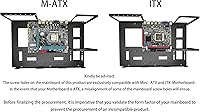
Anyone working with standard full-size ATX motherboards should look elsewhere — this is explicitly a Mini ATX platform, and trying to mount a full ATX board will result in misaligned screw holes that make a proper install impossible. Builders running current high-end discrete GPUs will also hit a wall quickly, since the frame only clears cards up to 256mm in length, which rules out most flagship and upper-mid-range graphics cards from recent generations. If your workflow demands a permanent, always-on open-air rig that will host the same hardware for months at a time, the relatively basic construction of this mini ATX bench may feel limiting compared to more purpose-built or premium open-frame options. Professionals running a high-volume repair operation who need rock-solid long-term durability and precise component fitment across a wide variety of board sizes would be better served by investing in a more versatile, larger-format bench. This is a budget tool for a specific job — treat it as such.

Specifications

  • Brand: This open-air test bench is manufactured by ALAMENGDA, a brand focused on budget-accessible PC building accessories.
  • Compatibility: Supports Mini ATX and ITX (M-ATX) motherboard form factors; full-size ATX boards are not officially supported due to screw hole misalignment.
  • Material: The frame is constructed from 1mm thick steel plate, offering more rigidity than comparably priced acrylic or MDF alternatives.
  • Finish: The entire frame has a black finish, giving it a clean and neutral appearance suitable for open-air display builds.
  • Max GPU Length: Graphics cards up to 256mm in length are supported; longer cards will not physically fit within the frame.
  • Radiator Support: The frame can accommodate water cooling radiators up to 360mm, useful for thermal testing with liquid-cooled components.
  • PSU Mounting: The power supply unit can be mounted in either a front or rear position, providing flexibility for cable routing preferences.
  • Orientation: The bench can be used in a vertical (standing) or horizontal (flat) orientation depending on workspace requirements.
  • Startup Cable: An industrial-style power and reset cable is included, allowing POST without needing to short the header pins manually.
  • Item Weight: The assembled bench weighs 4.02 lbs (1.83 kg), making it light enough to move around a workbench or carry to a client site.
  • Package Dimensions: The product ships in a box measuring 17.17 x 11.57 x 2.24 inches, arriving in a flat-pack style for compact shipping.
  • Steel Thickness: Frame panels are processed from 1mm gauge steel plate, which is the primary structural material throughout the build.
  • Availability Date: This product was first listed on Amazon in December 2023, making it a relatively recent entry in the budget test bench category.
  • Amazon Ranking: At the time of evaluation, this steel test stand held a Best Sellers Rank of #563 in the Computer Cases category on Amazon.
  • User Rating: The bench carries an average rating of 4.1 out of 5 stars based on 69 customer ratings on Amazon.

Related Reviews

egowz ITX ATX MATX/EATX Open Aluminum Frame Chassis (ATX)
85%
88%
Cooling Performance
85%
Build Quality
92%
Ease of Assembly
80%
Graphics Card Compatibility
90%
Flexibility for Custom Builds
More
ALAMENGDA V500 Mini-Tower mATX PC Case
66%
78%
Value for Money
84%
Aesthetics
43%
PSU Compatibility
57%
Thermal Performance
76%
Hardware Compatibility
More
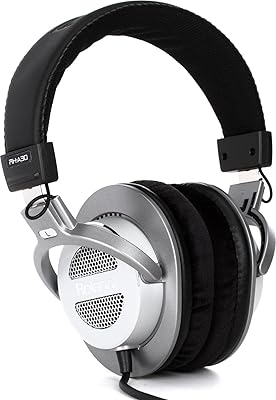
Roland RH-A30 Premium Open-Air Headphones
84%
92%
Sound Clarity
88%
Comfort for Long Sessions
85%
Build Quality
91%
Soundstage & Audio Balance
60%
Noise Isolation
More
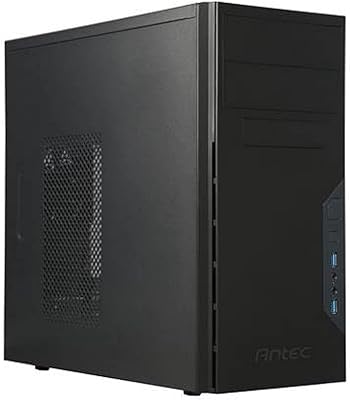
Antec VSK3000E-U3 Micro ATX Mini Tower Case
72%
78%
Build Quality
86%
Value for Money
57%
Cooling Performance
83%
Front I/O & Connectivity
84%
Drive Bay Versatility
More
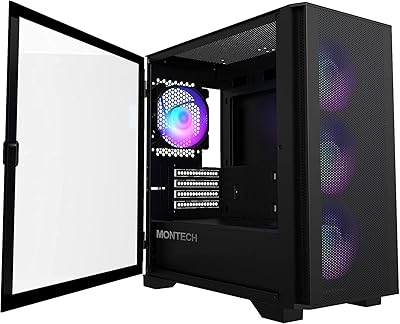
Montech AIR 100 ARGB Micro-ATX Tower Case
79%
91%
Value for Money
88%
Airflow Performance
93%
Side Panel Design
84%
Build Experience
82%
ARGB Lighting Quality
More
TGDGAMER E-ATX-Open Open Frame Test Bench
79%
61%
Build Quality
89%
Value for Money
93%
Compatibility
84%
Ease of Assembly
91%
Airflow & Thermals
More
BlitzRock CT3 Mini Open Ear Earbuds
76%
91%
Wearing Comfort
78%
Fit & Stability
63%
Sound Quality
93%
Situational Awareness
86%
Battery Life
More
Jonsbo TK-1 Micro-ATX PC Case
76%
91%
Build Quality
93%
Aesthetic Design
74%
Thermal Performance
72%
Hardware Compatibility
86%
Value for Money
More
Audio-Technica ATH-AD500X Open-Air Headphones
72%
91%
Soundstage & Imaging
88%
Vocal Clarity
61%
Bass Response
93%
Wearing Comfort
74%
Build Quality
More
Segotep Memphis Micro-ATX Mini Tower PC Case
76%
83%
Build Quality
89%
Aesthetic Design
77%
Airflow Performance
86%
GPU Compatibility
61%
Cable Management
More

FAQ

No — the ALAMENGDA Open Air Mini ATX Test Bench is specifically designed for Mini ATX and ITX form factors. If you try to mount a standard full ATX board, the screw holes will not line up correctly, which makes a secure installation impossible. If you have a full ATX board, you will need to look at a larger test bench.
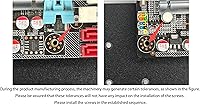
The product listing does not specifically confirm that a full hardware kit is included, and a small number of buyers have noted uncertainty about included mounting hardware. It is worth having a set of standard M3 standoffs and screws on hand before you start assembly, just to avoid any delays.

Almost certainly not. This open-air test bench supports GPUs up to 256mm in length, and most current flagship or upper-mid-range cards significantly exceed that. Before assuming a card will fit, measure its PCB length — not just the shroud — and compare it against the 256mm limit.

Buyers generally report adequate stability for typical use, but running a heavy GPU in vertical orientation on any open bench introduces some risk of tipping if the surface is uneven or bumped. It is sensible to keep this on a flat, stable workbench and avoid leaving an unattended high-value build in the upright position without extra precautions.

The frame does physically accommodate a radiator up to 360mm, so mounting one is technically possible. That said, running an open-loop or AIO liquid cooling setup on an open bench requires careful planning around hose routing and radiator positioning. It works for thermal testing purposes, but it is not a plug-and-play experience.

The bench is designed to support standard ATX power supplies, which can be installed in either a front or rear mounting position. There is no mention of support for smaller SFX or SFX-L units, so if you are using a non-standard PSU format, double-check the mounting dimensions before assuming it will fit cleanly.

Most buyers describe the assembly process as straightforward, with no steep learning curve involved. For someone with basic PC building experience, expect to spend around 15 to 30 minutes getting everything together. The steel panel design is fairly intuitive once the pieces are laid out.

Reviewer feedback on the included industrial-style power and reset cable is generally positive — it does the job and removes the need to short header pins with a screwdriver every time you want to POST a bare board. It is not a premium cable, but for the purpose it serves on a budget test stand, it is a welcome inclusion.

It can certainly be used as a longer-term open-air display build, especially for compact ITX or M-ATX systems. The steel construction holds up better than acrylic for that kind of sustained use. Just keep in mind there are no dust filters or cable management channels, so the build will accumulate dust faster and may look messier over time compared to a purpose-built open-frame case.

Steel has a meaningful practical advantage over acrylic in this context — it does not flex under the weight of components, it resists cracking if knocked, and it generally feels more like a real tool than a hobby kit. The trade-off is that steel adds a little weight. For anyone using a test bench regularly, the steel construction of this mini ATX bench is worth the slight premium over typical acrylic alternatives in the same price bracket.