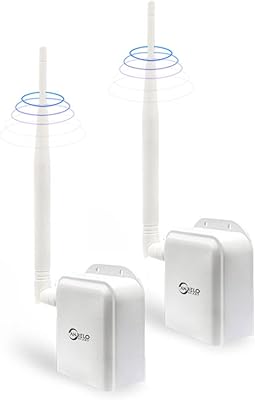
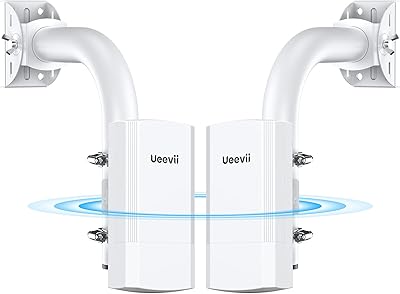
Overview

The AdaLov CPE660 Wireless Bridge is a practical mid-range solution for anyone who needs to connect two separate buildings without running a long cable through the ground or across a roof. It operates as a point-to-point wireless link, pushing a signal across distances that can reach roughly 3KM — provided you have a clear, unobstructed line of sight between the two endpoints. One of its more appealing qualities is that it arrives pre-configured in WDS mode, so most people can get up and running without touching a web interface. It also works with Starlink, which has made it genuinely useful for rural users who need to extend satellite internet from the dish to a barn or workshop. Just keep in mind: this is a dedicated bridge, not a general Wi-Fi extender.
Features & Benefits

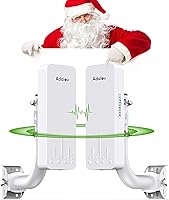
The CPE660 runs on the 5.8GHz band and can push wireless throughput high enough to handle live camera feeds or file transfers between sites without much strain. The real standout here is the 14dBi directional antenna, which focuses the signal in a tight beam rather than broadcasting it in all directions — critical for maintaining a strong link over longer distances. Each unit has two Ethernet ports, though they top out at 100Mbps, which is the practical ceiling for your actual data transfer speed regardless of the wireless spec. Power is delivered through the included PoE adapters, so you do not need an outlet right at the mounting point. The IP65 enclosure and adjustable bracket mounts round out a package built to live outdoors year-round.

Best For

This outdoor bridge unit fits a fairly specific need, and it does that job well. Rural and farm users are probably the most natural audience — particularly those running Starlink, where the dish often has to sit somewhere with a clear sky view, far from where you actually want internet access. Extending that connection to a detached garage, equipment shed, or workshop is exactly what this hardware was designed for. Small business owners with cameras spread across a large lot will also find it useful, as will site managers who need a quick, temporary network link across a job site. It assumes a basic understanding of networking, but the pre-configured setup keeps the learning curve manageable for most.

User Feedback

Buyers have responded well to this wireless bridge overall, and the praise tends to focus on two things: how quickly it connects and how reliably it holds a signal once it is up. Most people who followed the basic instructions had both units communicating within minutes. That said, a few consistent criticisms are worth noting. Some users point out that the included documentation is thin, which can leave first-timers second-guessing themselves during setup. There are also comments about real-world range falling short of the 3KM ceiling — not surprising, since that figure assumes ideal open-air conditions. The 100Mbps port cap catches some buyers off guard who expected the full wireless speed to pass through to their devices. Long-term build quality feedback has been mostly positive.

Pros

  • Arrives pre-configured for instant point-to-point use — most buyers are connected within 30 minutes.
  • Works reliably with Starlink to extend satellite internet from a dish to a detached structure.
  • Both units, PoE adapters, and all mounting hardware are included in a single box.
  • The IP65-rated housing holds up well through rain, dust, and seasonal temperature changes.
  • The 14dBi directional antenna maintains a usable signal at distances where cheaper gear drops out.
  • Passive PoE delivery means no power outlet is needed right at the outdoor mounting point.
  • Adjustable brackets allow fine-tuning of antenna alignment after initial installation.
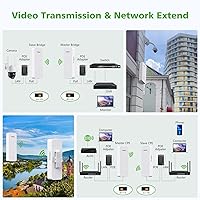
  • Handles continuous security camera feeds and shared internet connections without noticeable strain.
  • At its price point, the CPE660 competes favorably against better-known networking brands for this use case.
  • Supports multiple operating modes, giving technically confident users flexibility beyond the default setup.

Cons

  • The 100Mbps Ethernet port cap is a real ceiling that the wireless throughput figure on the listing obscures.
  • Included documentation is thin — anything beyond the default setup leaves buyers largely on their own.
  • Precise antenna alignment is a trial-and-error process with no on-unit signal strength indicator.
  • The 3KM range claim requires perfect open-air conditions most real-world installations will not have.
  • Bracket mounting hardware showed early surface rust in wet climates for some long-term users.
  • Passive 24V PoE is incompatible with standard 802.3af PoE switches buyers may already own.
  • A subset of buyers reported one unit failing within a few months, suggesting some manufacturing variance.
  • No Ethernet cables are included, which can catch less-experienced buyers off guard at installation time.
  • Switching operating modes requires GUI access, and the interface is dated and sparsely documented.
  • Official customer support response times draw consistent criticism when post-purchase issues arise.

Ratings

The scores below for the AdaLov CPE660 Wireless Bridge were generated by AI after analyzing verified buyer reviews from multiple global markets, with spam, bot-submitted, and incentivized feedback actively filtered out. The result is an honest, balanced picture of where this outdoor bridge unit genuinely excels and where real-world experience falls short of expectations. Both the strengths that keep buyers recommending it and the frustrations that surface after extended use are reflected transparently in each category.
Ease of Setup
83%
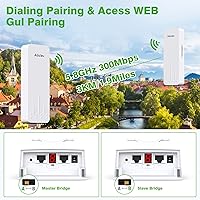
The pre-configured WDS mode is the single biggest reason buyers give this unit high marks for installation. Most users report having both ends communicating within 15 to 30 minutes without ever opening a browser-based interface, which is a genuine relief for people who just want internet in their barn, not a networking lesson.
A meaningful number of first-time bridge users found the included paper guide too sparse to follow confidently. When something does not connect on the first attempt, there is not enough troubleshooting guidance in the box, and finding help online requires digging through forums rather than official resources.
Real-World Range
71%
29%
Across open fields and clear sightlines — the kind of layout common on farms and rural properties — buyers consistently report solid, stable links at distances between 300 meters and just over a kilometer. For the typical barn-to-house or shop-to-warehouse use case, that is more than enough working range.
The advertised 3KM ceiling is a best-case figure that most buyers will never reach. Any obstruction — trees, a slight hill, even heavy rain — noticeably shortens effective range. Buyers who purchased expecting near-3KM performance across moderately obstructed land reported disappointment, so realistic expectations matter here.
Actual Data Throughput
63%
37%
For the most common workloads — streaming a couple of security camera feeds, sharing a Starlink connection with a workshop, or moving moderate file sizes between buildings — the CPE660 delivers enough bandwidth to feel responsive and stable in everyday use.
The 100Mbps Ethernet port cap is a hard ceiling that catches buyers off guard, particularly those who noticed the higher wireless throughput figure in the listing and assumed that speed would reach their devices. Anyone running bandwidth-heavy operations like 4K multi-camera NVR systems will hit this wall quickly.
Build Quality & Weather Resistance
84%
The IP65-rated housing has earned genuine confidence from buyers who have left units mounted outdoors through full winters, heavy rain seasons, and summer heat. The plastic shell feels solid rather than flimsy, and multiple long-term owners note no cracking, discoloration, or water ingress after a year or more of outdoor exposure.
A small subset of buyers noted that the mounting bracket hardware — particularly the metal clamps — showed early surface rust after prolonged wet weather exposure. The main unit itself holds up well, but the mounting components are a slightly weaker link in the overall durability picture.
Value for Money
79%
21%
Getting two complete bridge units, two PoE adapters, and all mounting hardware in a single box at this price point compares favorably to comparable outdoor CPE solutions from more established networking brands. For rural buyers or small businesses avoiding a trenching job, the cost-per-use calculation looks very attractive.
Buyers who discover the 100Mbps throughput limitation after purchase often feel the value proposition is less clear, since the spec sheet implies higher performance than the hardware actually delivers at the Ethernet level. It is a fair price for what it does, but some feel slightly misled by how the speeds are presented.
Signal Stability
77%
23%
Under good line-of-sight conditions, the directional antenna holds a steady, low-dropout connection that buyers describe as reliable enough to run continuous camera feeds and remote desktop sessions without interruption. The 5.8GHz band also helps avoid interference from neighboring 2.4GHz networks in semi-rural areas.
Signal consistency degrades more than expected when environmental conditions change — wind moving tree branches into the signal path, or seasonal foliage growth, can introduce noticeable drops. A few buyers noted they had to remount and realign units after the initial season change to restore stable performance.
Mounting & Alignment
74%
26%
The included pole brackets are adjustable in both vertical and horizontal axes, which gives you enough flexibility to fine-tune aim after initial installation without removing the unit entirely. Buyers mounting to wood posts or metal poles found the hardware compatible and reasonably sturdy once tightened down.
Precise antenna alignment — the kind required to maximize range — is a trial-and-error process without a signal strength indicator on the unit itself. Buyers working alone, especially at height on a ladder, found it frustrating to adjust the bracket, walk to the other end, and check the connection repeatedly.
PoE Power Delivery
81%
19%
Including two 24V passive PoE adapters in the box is a practical decision that saves buyers an extra purchase and means each unit can be powered from wherever an indoor outlet is accessible, with the Ethernet cable carrying power to the outdoor mount. This works cleanly for most barn or garage installations.
The passive PoE standard used here is not universally compatible with third-party networking gear. Buyers who wanted to use existing 802.3af PoE switches to power the units found they could not, and a few reported confusion around why the units would not power on when connected to standard PoE infrastructure.
Documentation & Support
52%
48%
For the straightforward plug-and-play WDS scenario the product is optimized for, the brief setup card included in the box is technically sufficient. Buyers doing a basic two-unit point-to-point install between two buildings often get through it without needing anything more.
Anything beyond the default WDS configuration — switching modes, adjusting channel settings, or troubleshooting a failed link — leaves buyers largely on their own. The official documentation online is minimal, and AdaLov's customer support response rate draws criticism from buyers who needed post-purchase help.
Compatibility with Starlink
86%
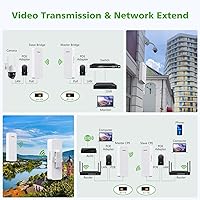
This is one of the more compelling real-world use cases for the CPE660, and buyers using it specifically to extend Starlink internet from a dish location to a detached structure report it works cleanly without any special configuration. The plug-and-play setup aligns well with how Starlink itself is designed to be used.
Starlink hardware changes — particularly the newer rectangular dish and its router — occasionally require buyers to double-check network mode settings before the bridge links up correctly. It works, but it is not entirely foolproof, and a small number of buyers needed community forum help to get the two systems to cooperate.
Antenna Performance
82%
18%
The 14dBi directional gain is meaningfully higher than the antennas found on cheaper consumer-grade extenders, and it shows in real-world use. Buyers comparing this unit against lower-gain alternatives on the same site found the CPE660 maintains a usable signal at distances where cheaper gear simply drops out.
Because the antenna is highly directional, even a few degrees of misalignment can cause a significant drop in signal quality. This is a known trade-off with high-gain directional antennas, but buyers new to point-to-point hardware are sometimes surprised by how unforgiving the alignment requirement is in practice.
Package Completeness
88%
Opening the box and finding two fully equipped units — each with a PoE adapter, mounting bracket, and cable ties — means most buyers can go from unboxing to installed hardware in a single session without a trip to the hardware store. That kind of ready-to-deploy completeness is genuinely appreciated in buyer reviews.
The Ethernet cables themselves are not included, which a handful of buyers overlooked when ordering. For a product aimed at non-technical users who may not have spare Cat5e or Cat6 runs on hand, including even basic cable lengths would remove one more potential friction point from the installation process.
Mode Versatility
69%
31%
Having CPE, client bridge, PTP, and PTMP modes available in a single device gives technically inclined buyers flexibility to adapt the hardware to non-standard network layouts — useful for small business owners who want to serve multiple endpoints from one transmitter in PTMP configuration.
Switching between modes requires accessing the device GUI, and the interface is functional rather than polished. Buyers accustomed to consumer-grade router UIs found it dated and occasionally confusing, and the lack of step-by-step mode-switching guides means some users stick with the default WDS setup out of caution rather than choice.
Long-Term Reliability
76%
24%
Buyers who have run these units continuously for six months to over a year generally report that the hardware holds up without neticeable performance degradation or unexpected reboots. For a device that sits outside in all weather, that kind of set-and-forget dependability is exactly what the target buyer needs.
There is a smaller but notable cohort of buyers who experienced one unit failing within a few months, with the failure pattern suggesting either a manufacturing variance issue or sensitivity to particular climate extremes. Warranty support experiences in these cases appear inconsistent based on buyer-reported outcomes.

Suitable for:

The AdaLov CPE660 Wireless Bridge is a strong fit for rural and semi-rural property owners who need to share an internet connection or run camera feeds across buildings without the cost and disruption of burying cable. If you have a Starlink dish mounted somewhere with a clear sky view but the actual living or working space is a separate structure — a barn, a shop, a garage — this outdoor bridge unit is one of the more practical and affordable ways to close that gap. Small business owners running security cameras across a large parking lot or multiple adjoining structures will find that the hardware handles that workload comfortably. Contractors and site managers who need a reliable temporary network link between a site office and another location on the same plot will also get solid value here. The pre-configured setup means you do not need to be a networking professional to get it working — if you can mount a bracket and plug in an Ethernet cable, you can likely have it running the same afternoon.
Not suitable for:

The AdaLov CPE660 Wireless Bridge is not the right tool for buyers expecting consumer-grade Wi-Fi extension across a home or office building — it is a point-to-point bridge, meaning it links two specific locations rather than spreading coverage broadly. Anyone who needs to transfer large volumes of data quickly between sites should also reconsider, because the Ethernet ports on each unit cap out at 100Mbps, which is the hard limit on what your connected devices will actually receive regardless of the wireless link speed. If your two locations do not have a clear, unobstructed line of sight, the advertised range becomes largely theoretical — trees, buildings, or even heavy foliage between the two endpoints will significantly reduce what you can realistically achieve. Buyers who rely on standard 802.3af PoE infrastructure to power outdoor devices will hit compatibility issues, since the CPE660 uses passive 24V PoE rather than the more universal active standard. And if you need strong after-sales support or detailed technical documentation for complex network configurations, the current state of AdaLov's support resources may leave you frustrated.
Specifications

  • Frequency Band: Operates on the 5.8GHz single-band spectrum, which provides cleaner long-distance signal focus with less interference than 2.4GHz in most outdoor environments.
  • Wireless Throughput: Maximum wireless link speed reaches up to 300Mbps under ideal line-of-sight conditions between the two units.
  • LAN Ports: Each unit is equipped with two 100Mbps Ethernet ports, which represent the practical data transfer ceiling for any device connected at either end.
  • Antenna Gain: A built-in 14dBi directional high-gain antenna focuses the signal in a narrow beam optimized for long-distance point-to-point transmission rather than broad area coverage.
  • Max Range: Rated for up to 3KM under clear, unobstructed line-of-sight conditions; real-world performance in typical environments with partial obstructions will be shorter.
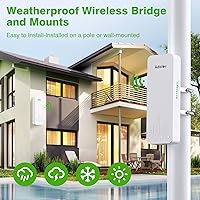
  • Weather Rating: The outer enclosure carries an IP65 rating, meaning it is fully protected against dust ingress and resistant to direct water jets from any direction.
  • Power Method: Powered via 24V passive PoE, with two compatible PoE adapters included in the box — one per unit — eliminating the need for a power outlet at the outdoor mounting location.
  • Wireless Standards: Compatible with 802.11a, 802.11n, and 802.11ac wireless standards for broad interoperability with modern networking equipment.
  • Operating Modes: Supports CPE, client bridge, point-to-point (PTP), and point-to-multipoint (PTMP) modes, selectable through the device management interface.
  • Default Setup Mode: Ships pre-configured in WDS bridge mode, allowing plug-and-play installation between two units without requiring access to the GUI for standard deployments.
  • Dimensions: Each unit measures 3.54 x 2.17 x 9.84 inches, a slim elongated form factor designed for low-profile pole or wall mounting.
  • Unit Weight: Each bridge unit weighs 15.8 ounces, light enough for single-person mounting on a standard pole or eave bracket.
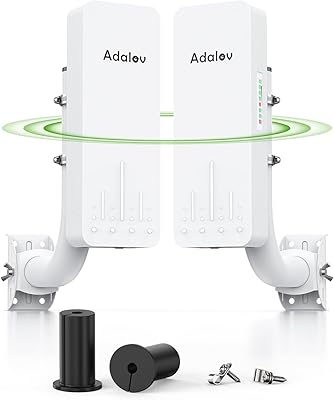
  • Mounting Hardware: Two adjustable bracket mounts are included, each supporting both vertical and horizontal angle adjustment for precise antenna alignment after installation.
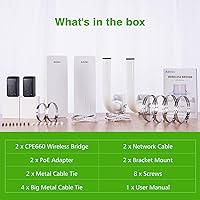
  • Box Contents: The package includes two CPE660 bridge units, two 24V PoE adapters, two pole mounts, two small metal cable ties, and four large metal cable ties.
  • Compatible Devices: Designed to work with routers, security cameras, network access points, personal computers, and Starlink internet systems.
  • Connectivity Ports: Each unit connects via RJ45 Ethernet, with the PoE adapter handling both data and power delivery over a single cable run to the outdoor unit.
  • Brand & Model: Manufactured by AdaLov under the model designation CPE660, first made available in March 2023.

Related Reviews

AdaLov CPE661 Gigabit Wireless Bridge
84%
88%
Performance at Long Range
91%
Ease of Setup
84%
Build Quality and Durability
87%
Signal Stability
92%
Value for Money
More
AdaLov CPE366 Gigabit Wireless Bridge
84%
92%
Ease of Setup
89%
Long-Range Performance
88%
Signal Strength
65%
Durability in Harsh Conditions
90%
Power Options (Dual PoE Support)
More
ANJIELO SMART Wireless Bridge AH9066
84%
94%
Outdoor Signal Range
88%
Signal Penetration
91%
Ease of Setup
90%
Waterproof and Durability
87%
Value for Money
More
UeeVii CPE58G Flex Wireless Bridge
86%
91%
Signal Range
89%
Ease of Setup
94%
Weather Resistance
85%
Security Features
90%
Build Quality
More
EnGenius EnStation6-KIT Outdoor Wireless Bridge
86%
89%
Signal Strength
91%
Range Performance
85%
Ease of Setup
93%
Build Quality
95%
Weatherproof Durability
More
UeeVii CPE450 5.8G Wireless Bridge
84%
89%
Range Performance
93%
Ease of Setup
85%
Build Quality
88%
Weather Resistance
90%
Video Surveillance Support
More
EnGenius ENH500-AX Outdoor Wireless Bridge
85%
93%
Long-Range Performance
90%
Weatherproofing & Durability
78%
Installation & Setup
85%
Wi-Fi Speed & Stability
88%
Signal Strength
More
EOQO CPE355 5.8GHz Outdoor Wireless Bridge
87%
88%
Long-Range Performance
93%
Ease of Setup
90%
Build Quality and Durability
85%
Signal Strength and Coverage
92%
Weatherproofing and Outdoor Use
More
Ubiquiti Litebeam M5 Wireless Bridge LBE-M5-23
86%
91%
Performance & Reliability
94%
Long-Range Connectivity
83%
Setup & Installation
88%
Build Quality & Durability
92%
Value for Money
More
GOOD STORY WB504H Wireless Bridge Point to Point Outdoor WiFi
85%
94%
Ease of Setup
88%
Long-Range Performance
90%
WiFi Speed/Connectivity
85%
Durability/Build Quality
89%
Installation Flexibility
More

FAQ

The package includes two complete units, so everything you need for a full point-to-point link is in one box. Each unit also comes with its own PoE adapter and mounting bracket, so there are no extra purchases required beyond Ethernet cable.

Yes, and this is honestly one of the most common reasons people buy the CPE660. You mount one unit near your Starlink router, run an Ethernet cable from the router to that unit, then mount the second unit at your barn and connect it to whatever device needs internet there. As long as the two units have a reasonably clear line of sight between them, it works reliably without any special configuration.

The 3KM figure assumes perfectly clear, open-air conditions — think flat open farmland with nothing in between. In practice, most buyers with light obstructions like scattered trees or a gentle slope report solid performance up to around 500 meters to 1 kilometer. If you have a clear straight shot between two rooftop or pole mounts, you can push further, but planning around 3KM as a guaranteed working distance will lead to disappointment.

The real-world speed ceiling is set by the 100Mbps Ethernet ports on each unit, not the wireless link speed you may have seen in the specs. So even if the wireless connection between the two units is running at full capacity, the maximum data rate reaching your connected device is 100Mbps. For most uses — shared internet, camera feeds, remote access — that is more than enough, but it is worth knowing upfront if you were expecting gigabit throughput.

For the standard two-unit bridge setup, it is genuinely straightforward. The units arrive pre-configured, so you just mount them, point them at each other, plug in the Ethernet and PoE adapters, and they should find each other automatically. Where things get trickier is if the default setup does not work on the first attempt — the included instructions are sparse, so troubleshooting without prior networking knowledge can be frustrating.

Only if your switch supports passive 24V PoE. The AdaLov CPE660 Wireless Bridge uses passive PoE rather than the active 802.3af or 802.3at standard found on most commercial PoE switches. Connecting it to an active 802.3af switch will not power the unit and could potentially cause issues, so if you want to ditch the included adapters, verify your switch supports passive 24V PoE first.
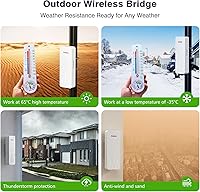
Generally quite well. The IP65 rating means water and dust are not going to get inside the unit, and buyers in rainy or cold climates report no problems with the main housing after a year or more outdoors. The one area to watch is the metal mounting bracket hardware, which a few buyers noted showed surface rust after extended exposure in consistently wet conditions. The unit itself holds up; the mounting clamps are a slightly weaker point.

Yes, the hardware supports point-to-multipoint (PTMP) mode, which lets one transmitting unit link to several receiving units at different locations. However, switching from the default point-to-point WDS mode into PTMP requires accessing the device interface and doing some manual configuration, so it is not a plug-and-play process like the standard two-unit setup.

Yes, each outdoor unit needs an Ethernet cable connecting it back to the included PoE adapter indoors, which is also how the unit receives power. So you will need to run a cable from an indoor outlet location, through a wall or conduit, up to wherever you mount the unit outside. The upside is that a single cable handles both data and power, so you only need one run per unit.

This is worth checking with the seller before purchasing, as individual unit availability varies and AdaLov is not among the largest networking brands with guaranteed parts availability. A few buyers who had a single unit fail reported difficulty sourcing a lone replacement, which meant purchasing a full pair again. If long-term serviceability matters to your setup, it is a reasonable question to put to the seller before you commit.