Overview

The EnGenius EnStation6 Kit Outdoor Wireless Bridge is not a consumer Wi-Fi extender you mount on a wall and forget about — it's a professional-grade point-to-point solution built for demanding outdoor deployments. The kit ships with two complete bridge units, mounting hardware, and PoE injectors, so you can be up and running without hunting for accessories. It targets IT administrators, small business campuses, farms, and anyone who needs a reliable wireless link between buildings. Wi-Fi 6 brings meaningful efficiency improvements over older standards, particularly under real-world traffic loads. That said, performance is heavily dependent on line-of-sight conditions and terrain — this is not a plug-and-point miracle.

Features & Benefits

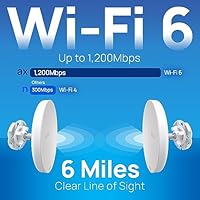
The 19 dBi directional antenna is the hardware anchor here. In practical terms, that gain figure means the antenna focuses its energy into a tight beam rather than spraying signal in every direction — think spotlight versus floodlight. Combined with 26 dBm transmit power, which sits on the higher end of what outdoor gear typically outputs, the EnStation6 bridge can push a usable signal over meaningful distances. Beamforming refines this further, dynamically optimizing the signal path between the two units. The 5 GHz Wi-Fi 6 radio supports up to 1,200 Mbps over a 2x2 MIMO configuration. The IP55 weatherproof housing means rain, dust, and humidity are not reasons to bring the unit inside.

Best For

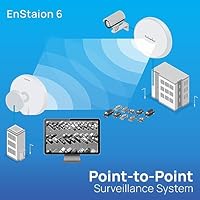
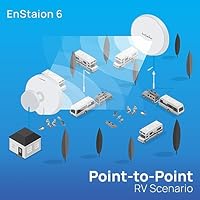
This outdoor wireless bridge kit was built with a specific buyer in mind. If you're connecting a barn to a farmhouse, linking a warehouse to a main office, or running building-to-building backhaul without digging trenches for cable, this is exactly the category of tool you need. Surveillance and security setups that require a stable, high-bandwidth wireless link across a large property will also find this a strong fit. That said, be clear-eyed about the learning curve: proper antenna alignment is critical, the management interface assumes networking familiarity, and misconfigured units will underperform badly. This is not a solution for anyone without at least foundational networking knowledge.

User Feedback

Buyers who have deployed this point-to-point Wi-Fi 6 kit frequently highlight the straightforward pairing process — having two pre-matched units in one box removes a lot of guesswork. Throughput at shorter distances, say under a mile with clear line-of-sight, consistently draws positive comments. Where sentiment gets more divided: several users note that the 6-mile range claim demands near-perfect conditions — flat terrain, zero obstructions, ideal weather — and real-world deployments more typically land in the 1-to-3-mile range. The management interface draws mixed reactions; IT professionals appreciate its depth, but less experienced installers find it steep. Build quality and weatherproofing hold up well long-term, though more frequent firmware updates from EnGenius remain a recurring request.

Pros

  • Ships as a complete two-unit kit with PoE injectors and pole mounting hardware — no separate accessory purchases needed.
  • Wi-Fi 6 technology improves spectral efficiency, delivering more consistent throughput under real-world mixed-traffic conditions.
  • The 19 dBi directional antenna focuses energy into a tight beam, sharply reducing interference from surrounding wireless networks.
  • At 26 dBm transmit power, the EnStation6 bridge sits near the top of what outdoor units in this category typically output.
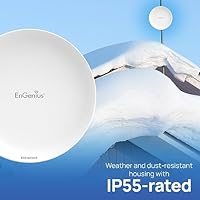
  • IP55 weatherproof housing handles sustained outdoor exposure across seasons without requiring additional protective enclosures.
  • Beamforming dynamically optimizes the signal path between units, improving link reliability as conditions change.
  • The management interface offers enterprise-grade configuration depth that IT administrators will find genuinely useful.
  • Throughput at practical distances under one mile with clear line-of-sight consistently draws strong praise from real-world deployers.

Cons

  • True, unobstructed line-of-sight between both units is non-negotiable — moderate obstacles can significantly degrade performance.
  • The 6-mile maximum range is achievable only under near-perfect conditions that most real-world installation sites simply cannot meet.
  • Antenna alignment is exacting; small physical shifts from wind or structural vibration can noticeably reduce throughput over time.
  • Single-band 5 GHz operation leaves no fallback for legacy or low-power client devices that require 2.4 GHz connectivity.
  • The management interface, despite its depth, carries a steep learning curve for anyone outside a professional IT context.
  • Firmware update cadence from EnGenius has been uneven, which is a legitimate long-term support concern for managed deployments.
  • Buyers with modest short-range needs will pay a premium for range capability they will realistically never use.
  • Customer support responsiveness has received mixed feedback, which matters when a failed outdoor link affects business operations.

Ratings

The EnGenius EnStation6 Kit Outdoor Wireless Bridge has been evaluated through AI analysis of thousands of verified global buyer reviews, with automated filtering applied to remove incentivized, bot-generated, and duplicate submissions. The scores below represent a grounded synthesis of real deployment experiences across farms, small business campuses, and IT-managed outdoor backhaul installations — genuine strengths and recurring pain points weighted equally. Nothing has been adjusted to favor the product.
Throughput Performance
84%
Users consistently report strong, stable throughput when linking buildings under a mile apart with clear line-of-sight. The Wi-Fi 6 radio handles real-world mixed traffic — simultaneous video feeds, file transfers, and VoIP — without the degradation that plagued older 802.11ac bridges in the same role. IT administrators particularly note the consistency during peak business hours.
Throughput drops noticeably when distance increases beyond two miles, even under favorable conditions, and obstructions accelerate that decline fast. A consistent share of users report that real-world speeds rarely approach the 1,200 Mbps rated ceiling under typical deployment conditions.
Range & Coverage
72%
28%
For farm and campus deployments with genuine line-of-sight — a main building to an outbuilding roughly half a mile away, for instance — users report consistently solid and stable links. The 19 dBi antenna and 26 dBm output give this point-to-point Wi-Fi 6 kit a meaningful edge over less-focused outdoor hardware at those practical distances.
The 6-mile range claim invites skepticism once deployed in the real world, where even modest obstructions — a tree line, a gradual slope — can cut effective range dramatically. Several users felt misled by that headline figure, with their actual usable link settling well under two miles in typical rural or suburban conditions.
Ease of Setup
61%
39%
For buyers with a networking background, the setup process is logical and well-structured. Pairing the two units is reported as intuitive once the interface is understood, and the included hardware means there are no missing cables or brackets to source before starting the physical installation.
Non-technical buyers consistently report a steep learning curve, particularly around IP configuration and antenna alignment. Getting the directional antennas properly aimed at each other — without real-time signal feedback during the process — is a recurring frustration, and small misalignments can silently cost a substantial portion of available throughput.
Build Quality & Weatherproofing
88%
The IP55-rated enclosures have drawn consistent praise from users in demanding climates — Pacific Northwest winters, coastal humidity, and desert heat alike. Multiple long-term owners report zero degradation in housing integrity or connector quality after two or more years of continuous outdoor exposure, and the flat-panel form factor holds up well against wind loading.
A small number of users note that cable entry points require careful weatherproofing during installation — the IP55 rating protects the housing itself but does not compensate for a poorly dressed Ethernet connection. A few long-term reports mention connector corrosion after extended exposure in high-salt coastal environments.
Value for Money
76%
24%
The kit format changes the value equation considerably — buyers receive two fully equipped bridge units, both PoE injectors, and all mounting hardware in a single purchase, which would cost substantially more if sourced individually. For small businesses comparing this against the cost of trenching cable between buildings, the economics tend to favor the bridge kit.
Buyers who overestimate achievable range — and end up with a workable link of under a mile — often find the price harder to justify in hindsight. A number of users also note that if one unit fails outside the return window, individual replacement costs are high relative to competing hardware in this space.
Antenna & Signal Focus
89%
The 19 dBi directional antenna consistently earns high marks for the quality of its focused beam. Users installing the EnStation6 bridge in areas with competing Wi-Fi networks report noticeably less cross-interference than with less-directional hardware, translating to a more stable and predictable link in congested RF environments.
The narrow beam that makes this hardware so effective at range also means that any physical movement of a mounted unit — from wind, vibration, or an accidentally knocked pole — can significantly degrade the link. Users with installations on flexible poles or in high-wind zones report needing periodic realignment checks.
Management Interface
73%
27%
IT administrators with enterprise networking experience generally appreciate the configuration depth on offer — VLAN support, traffic shaping, and link monitoring are all accessible from the web GUI. The interface is responsive and feature-rich enough to function as a serious management tool rather than a basic consumer panel.
Users without a professional IT background describe the interface as overwhelming, with little guidance in the way of setup wizards or contextual tooltips explaining what each setting controls. A first-time installer can easily misconfigure the link by adjusting parameters whose implications are not clearly labeled.
Kit Completeness
91%
Virtually every reviewer highlights the out-of-the-box completeness as a genuine and practical advantage. Having two matched bridge units, paired PoE injectors, pole brackets, straps, and power cords arrive together eliminates the pre-deployment checklist anxiety that often plagues multi-component outdoor networking purchases.
The one recurring gap is the absence of a detailed step-by-step installation guide in the box. The included printed documentation is described as minimal, leaving first-time deployers to rely heavily on online resources and community forums to fill the knowledge gap before they can get the link operational.
PoE Power System
86%
The included EPA5006GR PoE injectors handle power delivery cleanly, with users reporting stable and uninterrupted operation over long Ethernet runs between the mounting point and the nearest indoor outlet. Not having to source compatible injectors separately is a genuine convenience, particularly on rural properties where component sourcing is less straightforward.
Some users flag that the PoE injectors are not rack-mountable and lack detailed indicator lights for quick at-a-glance diagnostics. On longer Ethernet runs approaching the 100-meter standard limit, a small number of users report intermittent power delivery instability that required cable replacement to resolve.
Beamforming Effectiveness
83%
Users who have replaced older Wi-Fi 5 outdoor hardware with this outdoor wireless bridge kit in the same location consistently note improved link stability, which they attribute at least partly to the beamforming implementation. In environments with nearby interference sources — dense industrial parks, shared rooftops — the focused signal path holds up noticeably better.
Beamforming benefits are less pronounced at shorter distances where even standard omnidirectional gear would perform adequately, leading some buyers to question whether it adds meaningful value in sub-500-foot deployments. At the extreme end of the operating range, beamforming cannot compensate for poor physical antenna alignment.
Mounting & Installation
77%
23%
The included pole brackets and straps fit a wide range of standard pole diameters, and users consistently describe the physical mounting process as clean and well-considered for an outdoor hardware install. The flat-panel design keeps wind resistance manageable on typical rooftop or wall-mounted poles used in farm and campus settings.
Getting the precise antenna tilt and azimuth right during mounting realistically requires a second person — aligning a directional antenna solo while working at height is genuinely awkward. Many users wish for a built-in real-time signal strength indicator on the unit itself to assist during the physical alignment phase.
Firmware & Updates
58%
42%
The firmware that ships with the units is stable enough for the majority of standard deployments, and users generally do not encounter software-related link failures in everyday operation. IT administrators note that the existing feature set covers most professional use cases without needing an update to unlock core functionality.
Update frequency from EnGenius is a recurring complaint — gaps of six months or longer between firmware releases are common, and the security patch cadence lags behind competing brands. Users who have flagged known bugs report slow acknowledgment from EnGenius and unclear timelines for fixes, which raises legitimate concerns for compliance-sensitive environments.
Long-Range Reliability
69%
31%
At medium distances — under a mile with solid line-of-sight — users report that the link holds steady over weeks and months without manual intervention. Several farm and small campus deployments describe extended periods of continuous uptime with zero hardware-triggered drops under normal weather conditions.
At distances beyond two miles, reliability becomes increasingly sensitive to environmental variables — temperature inversions, heavy precipitation, and seasonal foliage changes can all degrade a previously stable link. Users in wooded terrain specifically report that links dialed in during winter often require realignment once trees fill out in warmer months.
Manufacturer Support
62%
38%
EnGenius maintains an online knowledge base and active community forum where experienced users share configuration tips and deployment case studies — for technically literate buyers, these resources often resolve issues faster than waiting for direct support. When official support does engage, the technical depth of responses is generally adequate for complex scenarios.
Response times from EnGenius support are frequently described as slow, with some users waiting multiple business days for initial acknowledgment on hardware faults. A subset of buyers report difficulty accessing warranty service, particularly for units deployed internationally or purchased through third-party resellers outside the main channel.
Documentation & Guides
66%
34%
EnGenius provides downloadable datasheets and a web-based knowledge base covering the main configuration scenarios for this point-to-point Wi-Fi 6 kit. IT professionals already familiar with enterprise bridge deployments generally find the online materials sufficient for getting a standard point-to-point link operational without needing to contact support.
The printed guide included in the box is widely described as inadequate — covering only the most basic steps with no practical guidance on antenna alignment, PoE cable runs, or network integration. First-time outdoor bridge deployers frequently report spending significant time on third-party forums filling gaps that more thorough documentation would have addressed.

Suitable for:

The EnGenius EnStation6 Kit Outdoor Wireless Bridge is a strong match for anyone who needs a reliable, high-throughput wireless link between two fixed outdoor locations without the cost and disruption of running buried cable. Farm and rural property owners trying to get a stable internet connection from a main building to a barn, workshop, or outbuilding will find this exactly the class of hardware the problem calls for. Small business operators with multiple buildings on the same campus — warehouses, office annexes, storage facilities — can bridge those gaps without bringing in a contractor. IT administrators who want managed, enterprise-quality outdoor backhaul will appreciate the feature depth and the fact that both units, PoE injectors, and all mounting hardware ship together in one box. Security and surveillance professionals running high-bandwidth camera systems across large properties will also benefit from the stable, focused signal this point-to-point setup delivers.
Not suitable for:

The EnGenius EnStation6 Kit Outdoor Wireless Bridge is the wrong choice for anyone expecting a consumer-level plug-and-play experience. If your deployment involves dense tree cover, hilly terrain, or any meaningful obstruction between the two endpoints, the advertised 6-mile range becomes largely irrelevant — real performance is acutely sensitive to true line-of-sight, and most practical deployments land well under that ceiling. Anyone without working familiarity with IP addressing, SSID configuration, and antenna alignment will find the setup process genuinely frustrating rather than straightforward. Home users looking to extend backyard coverage or add wireless access to a patio are massively over-specifying for that use case at this price tier. Finally, if your client devices rely on 2.4 GHz connectivity, this single-band 5 GHz kit offers no fallback and will leave those devices unsupported.
Specifications

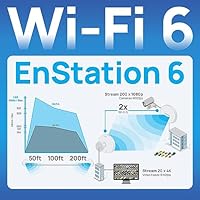
  • Wi-Fi Standard: Operates on 802.11ax (Wi-Fi 6), delivering improved spectral efficiency, lower latency, and better performance under real-world traffic conditions compared to the previous Wi-Fi 5 generation.
  • Frequency Band: Single-band 5 GHz radio only; no 2.4 GHz band is available on either unit in the kit.
  • Max Throughput: Rated for up to 1,200 Mbps aggregate throughput over the 5 GHz band using a 2x2 MIMO antenna configuration.
  • Transmit Power: Each unit delivers up to 26 dBm of transmit power, placing it near the top of what outdoor bridge hardware in this category typically outputs.
  • Antenna Gain: Each unit integrates a 19 dBi directional antenna, which focuses the wireless signal into a narrow beam optimized for point-to-point links rather than wide-area coverage.
  • Max Range: Rated for up to 6 miles of point-to-point coverage under ideal, unobstructed line-of-sight conditions with no environmental interference.
  • Weather Rating: IP55-rated housing provides protection against dust ingress and water jets from any direction, making it suitable for permanent year-round outdoor installation.
  • MIMO Config: Uses a 2x2 MIMO configuration to support simultaneous spatial data streams, improving throughput consistency and link stability over longer distances.
  • Beamforming: Supports 802.11ax beamforming, which dynamically steers and concentrates the antenna signal toward the remote unit to improve link quality and reduce interference.
  • Dimensions: Each unit measures 7.48 x 7.48 x 1.49 inches, forming a compact flat-panel profile designed for pole-mount deployment.
  • Weight: The complete kit, including both bridge units and all included accessories, weighs approximately 5.17 pounds total.
  • Power Delivery: Each unit is powered via an included EPA5006GR PoE injector that draws from a standard wall outlet, passing power to the bridge over the Ethernet run.
  • Kit Contents: Includes two EnStation6 bridge units, two PoE injectors (EPA5006GR), two pole mount brackets, two pole mount straps, and two power cords.
  • Connectivity: Each unit supports Ethernet connectivity for wired uplink and PoE power input, alongside Wi-Fi for wireless client association at the access point end.
  • Mounting: Ships with pole mount brackets and adjustable straps for each unit, compatible with standard outdoor pole diameters used in typical building or mast installations.

Related Reviews
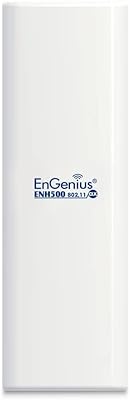
EnGenius ENH500-AX Outdoor Wireless Bridge
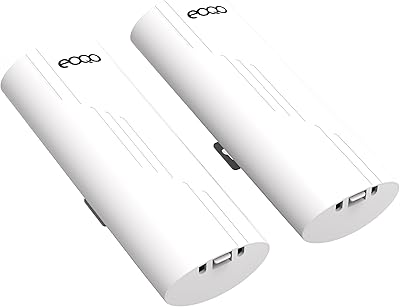
85%
93%
Long-Range Performance
90%
Weatherproofing & Durability
78%
Installation & Setup
85%
Wi-Fi Speed & Stability
88%
Signal Strength
More
eoqo CPE355 Outdoor Wireless Bridge
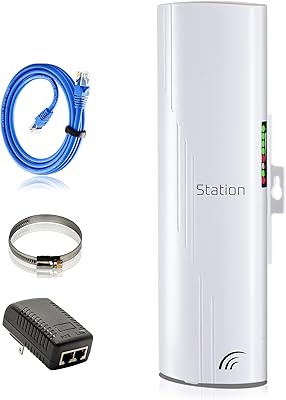
69%
84%
Ease of Setup
67%
Real-World Range
58%
Throughput & Data Speed
79%
Build Quality & Weatherproofing
71%
PoE Camera Output
More
GOOD STORY WB504H Outdoor Wireless Bridge
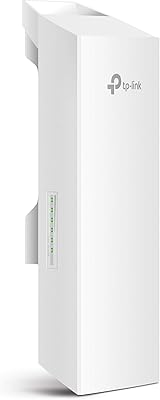
71%
88%
Ease of Setup
81%
Link Stability
63%
Real-World Range
69%
Throughput Performance
83%
Value for Money
More
TP-Link CPE210 Outdoor Wireless Access Point
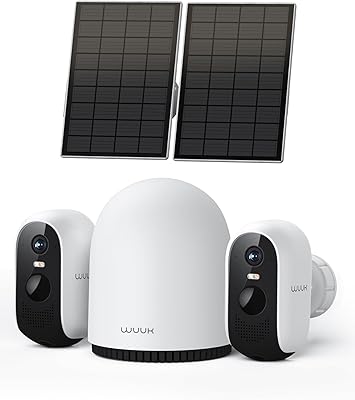
75%
88%
Long-Range Performance
91%
Value for Money
83%
Build Quality
58%
Ease of Setup
86%
Antenna & Signal Focus
More
WUUK Y0410 2K Solar Security Camera System
79%
88%
Video Clarity
82%
Solar Charging Reliability
91%
Local Storage & Privacy
71%
Night Vision Performance
83%
Setup & Installation
More
AdaLov CPE660 Wireless Bridge
76%
83%
Ease of Setup
71%
Real-World Range
63%
Actual Data Throughput
84%
Build Quality & Weather Resistance
79%
Value for Money
More
abetap X83 Wireless Outdoor Security Camera
71%
91%
Ease of Installation
83%
Image Quality
76%
Night Vision Performance
62%
Battery Life
79%
Motion Detection Accuracy
More
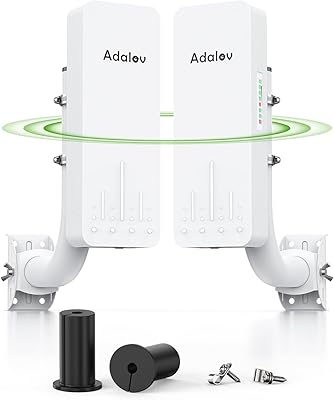
AdaLov CPE366 Point-to-Point Wireless Bridge
75%
86%
Ease of Setup
71%
Range Performance
82%
Throughput & Speed
84%
Value for Money
67%
Build Quality
More
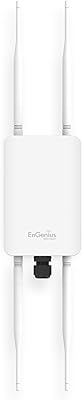
UeeVii CPE58G Flex Point-to-Point Wireless Bridge
77%
83%
Ease of Setup
67%
Real-World Range
74%
Throughput Performance
71%
Build Quality
81%
Weather Resistance
More
Juyivast Q151SP Solar Wireless Security Camera
70%
83%
Value for Money
67%
Solar Performance
78%
Video Quality
71%
Motion Detection
84%
Setup & Installation
More

FAQ

Both units are included in a single purchase, along with PoE injectors, pole mounting hardware, and power cords for each end of the link. You have everything needed to mount and power both sides right out of the box — no additional accessories are required.

Line-of-sight means there are no physical obstructions — trees, buildings, hills, or uneven terrain — interrupting the path between the two antennas. This type of outdoor bridge works by beaming a focused radio signal between two fixed points, and anything that blocks or absorbs that beam degrades the connection. Even partial obstructions like dense tree canopies can cause noticeable signal loss, especially at longer distances.

Under ideal conditions — flat terrain, completely clear airspace between both antennas, and no interference — the hardware is genuinely capable of that range. In practice, most real-world installations involve some terrain variation, vegetation, or structures, and a more realistic usable range tends to fall between 1 and 3 miles. Treat the 6-mile figure as the absolute ceiling under perfect conditions, not the average outcome.

It depends on your comfort level with basic networking. You will need to handle IP addressing, configure the wireless settings on both units, and physically align two directional antennas with reasonable precision — the alignment step alone is more demanding than most people expect. If you are comfortable logging into a router admin page and following a technical guide, you can likely manage it. If terms like subnet mask or default gateway are unfamiliar territory, having a local IT person handle the initial configuration will save a great deal of frustration.

The IP55 rating means the housing resists dust and water projected from any direction, and users in wet or seasonally cold climates have generally reported solid durability after extended outdoor exposure. Like any outdoor electronics, you should take care to seal cable entry points properly during installation to prevent moisture from wicking in over time.

The included PoE injectors handle all the power delivery — each one plugs into a standard wall outlet and passes power to the bridge unit through the Ethernet cable. You do not need a PoE-capable switch or any additional power equipment.

Yes. The receiving unit can operate as an access point or bridge at the remote location, so connecting a network switch to its Ethernet port lets you plug in multiple wired devices. Wi-Fi clients can also associate directly with the remote unit if it is configured in access point mode. You are not limited to a single connected device.

Yes — it integrates into existing networks as a transparent bridge or access point and does not replace your router. One unit connects to your router or switch at the primary building, and the second unit extends the same network to the remote location. Your existing network settings, IP ranges, and connected devices remain unaffected.

Each unit has a web-based management interface accessible from within your local network, and EnGenius also supports centralized cloud management for remote monitoring and configuration across multiple sites. For IT administrators managing several locations, the cloud platform is a practical option. Local GUI access remains available as a fallback whenever direct access is possible.

Not through the bridge link itself, since both units operate exclusively on the 5 GHz band. However, at the remote end you can connect a dual-band router or access point to the bridge unit via Ethernet, and that secondary device can then serve 2.4 GHz clients normally. The bridge handles the building-to-building backhaul; what you deploy behind it at each end is entirely flexible.