Overview

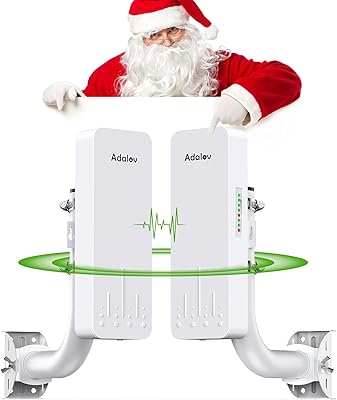
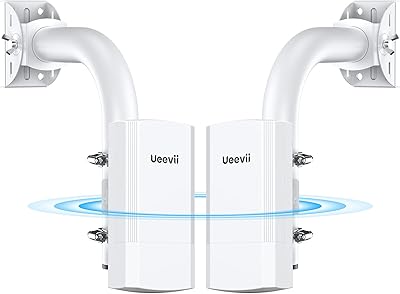
The AdaLov CPE366 Point-to-Point Wireless Bridge is a practical solution for anyone who needs reliable network connectivity across a property without the cost and hassle of burying cable. This wireless bridge kit ships as a complete pair — two units, two PoE adapters, pole mounts, and patch cables — so you're not sourcing accessories separately. Sitting in a mid-range price bracket, it occupies useful territory between cheap units that cut corners and professional-grade hardware most home users will never need. With over 350 ratings and a top-30 rank in its Amazon category, there's enough real-world feedback to make an informed assessment.
Features & Benefits

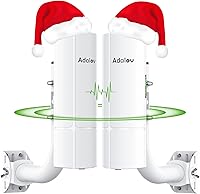
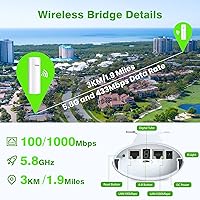
Operating on the 5.8GHz band, the CPE366 bridge delivers up to 900Mbps throughput between the two units, with client devices on the receiving end getting up to 433Mbps over the LAN port. The 3KM line-of-sight range is the headline spec, though real-world performance depends heavily on terrain, obstructions, and antenna alignment — clear open fields will get you close to that figure; wooded or hilly land will not. Setup uses a dial-pair method that genuinely simplifies deployment for non-technical users. One spec worth noting carefully: the two LAN ports handle different PoE voltages — the gigabit port requires 48V, while the 100Mbps port works with 24V — never mix them up during installation.

Best For

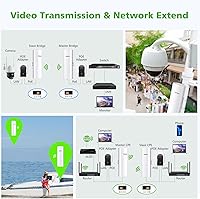
This outdoor bridge unit is a strong fit for rural property owners who need to connect a barn, garage, or workshop to their main home network without trenching cable across the yard. It works equally well for small farms running IP surveillance cameras over open land — the directional antenna and gigabit backhaul handle HD video streams without much fuss. Starlink users looking to extend satellite coverage to a second structure will find it compatible, though you'll want to verify your Starlink router's ethernet output configuration before assuming it'll work out of the box. Temporary use cases like outdoor markets or construction sites are also viable given the quick plug-and-play setup.

User Feedback

Across a substantial pool of reviews, the pattern is fairly consistent. Most buyers highlight easy initial setup and appreciate that the mounting hardware is included rather than sold separately — that detail matters more than it might seem when you're doing a rooftop or pole install. Range performance earns solid marks in open rural environments. Where complaints appear, they typically involve wireless interference or situations where line-of-sight wasn't truly achievable. A smaller but notable group of buyers found the PoE port labeling confusing on first read, which connects back to the voltage mismatch risk. Build quality draws mixed reactions — most find it adequate for the price, though it doesn't feel particularly rugged up close.

Pros

  • Ships as a complete kit — both bridge units, PoE adapters, pole mounts, and patch cables are included out of the box.
  • Dial-pair setup is genuinely straightforward; most users report getting both units communicating within minutes.
  • Up to 900Mbps bridge-to-bridge throughput is more than enough for HD surveillance feeds or shared internet connections.
  • The 16dBi directional antenna delivers focused signal that holds up well across open rural distances.
  • Gigabit LAN port on each unit means wired devices at the remote end are not bottlenecked by older 100Mbps infrastructure.
  • Adjustable mounting brackets allow precise antenna aiming without needing aftermarket hardware.
  • Mid-range pricing makes it accessible without dropping to the reliability risks of the cheapest units on the market.
  • Works reliably as a Starlink extender in open environments where ethernet output is available from the router.
  • Lightweight build makes solo pole or rooftop installation manageable for one person.
  • Consistent 4.4-star average across a meaningful review pool suggests the performance claims hold up for the intended use case.

Cons

  • The 3KM range claim only applies under ideal, unobstructed line-of-sight conditions — real-world results in mixed terrain are notably lower.
  • PoE voltage requirements differ between the two LAN ports, and the labeling is easy to misread during installation.
  • Single-band 5.8GHz operation offers no fallback if local wireless interference becomes a problem in your area.
  • Build materials feel adequate rather than rugged — long-term durability in harsh outdoor climates is a question mark for some buyers.
  • No formal weatherproofing rating is listed, which matters for installations in regions with heavy rain, snow, or extreme heat.
  • Starlink compatibility depends on your specific Starlink hardware configuration and is not guaranteed without some pre-setup verification.
  • Only two locations can be bridged per kit; expanding to a third building requires purchasing an additional unit separately.
  • Customer support responsiveness from the brand has received mixed feedback, which is worth considering for a networking device.
  • The included patch cables are short, so additional cabling will likely be needed depending on where you mount the units.
  • No dedicated management interface or mobile app means troubleshooting relies on indicator LEDs and basic network diagnostics.

Ratings

The scores below for the AdaLov CPE366 Point-to-Point Wireless Bridge were generated by our AI engine after analyzing verified global buyer reviews, actively filtering out incentivized, bot-generated, and spam submissions to surface only genuine user experiences. Both the strengths that earned this kit its loyal following and the friction points that frustrated a meaningful portion of buyers are reflected transparently in every category score.
Ease of Setup
86%
The dial-pair pairing system is consistently praised by buyers who have no networking background. Farmers and property owners report getting both units communicating in under 30 minutes without touching a router admin page, which for this category of hardware is genuinely unusual.
Antenna alignment is where easy setup ends — getting the directional beam precisely aimed over longer distances takes patience and often a second person. A few buyers also reported needing to reset units when the pairing did not register on first attempt.
Range Performance
71%
29%
In open rural environments — flat fields, clear sightlines between a farmhouse and a barn — buyers consistently report stable connections well beyond a few hundred meters, covering the vast majority of residential outbuilding scenarios comfortably without any signal degradation.
The 3KM headline figure misleads buyers with wooded or hilly properties, where real-world range drops substantially. Reviewers in suburban settings with neighboring structures or trees between units frequently report disappointing distances compared to advertised specs.
Throughput & Speed
82%
18%
For the primary use cases — HD security camera feeds, shared internet access, and basic file transfers — the bridge delivers throughput that buyers describe as more than adequate. Running multiple 1080p or 4K IP cameras simultaneously without frame drops is a commonly cited win.
The client-side LAN rate caps at 433Mbps rather than the 900Mbps bridge link figure, which surprises some buyers expecting full gigabit delivery to end devices. Heavy simultaneous workloads across multiple connected clients can push closer to the practical ceiling.
Value for Money
84%
Buyers regularly note that the all-in-one kit — two bridge units, PoE adapters, mounts, and cables included — compares favorably to assembling a similar setup from individual components. For the price tier, getting functional gigabit bridging hardware with mounting hardware bundled in lands well with cost-conscious buyers.
A subset of reviewers who compared this directly against similarly priced competitors found the build materials did not fully justify the mid-range cost. Those coming from a background with enterprise-grade outdoor networking gear tend to find the price-to-durability ratio less compelling.
Build Quality
67%
33%
The plastic housing holds up adequately in temperate outdoor conditions, and most buyers who have run units through a full season of normal weather report no physical degradation. The overall construction feels intentional rather than flimsy for the weight class.
The enclosure does not carry a published IP weatherproofing rating, which creates real concern for buyers in regions with heavy precipitation, prolonged freezing temperatures, or intense UV exposure. Several long-term reviewers noted cosmetic and minor structural wear after extended outdoor use in harsher climates.
Mounting Hardware
88%
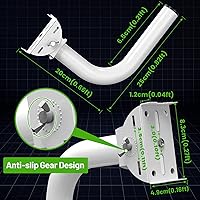
The included pole and wall brackets are one of the most consistently praised elements of this kit. Buyers appreciate the adjustability — being able to fine-tune the antenna angle after mounting without removing the unit makes alignment considerably less frustrating during initial installation.
The mounting clamps are sized for standard utility poles, and a few buyers with non-standard post diameters or unusual wall surfaces found them fiddly to adapt. The included short network cables are also frequently noted as too short for real installation runs.
PoE Power System
73%
27%
Powering the units via PoE avoids the need for a separate power outlet at the mounting point, which is a practical advantage when mounting on a pole far from any electrical infrastructure. The included adapters are pre-matched and work reliably out of the box.
The dual-port PoE voltage distinction — 24V on the 100Mbps port and 48V on the gigabit port — is a genuine hazard that the labeling does not make clear enough. Multiple buyers have reported confusion during installation, and at least some report hardware damage from connecting the wrong voltage source to the wrong port.
Interference Resistance
66%
34%
In low-density rural areas where 5.8GHz spectrum is largely unoccupied, the bridge holds a clean, stable link with minimal reported dropouts. The directional antenna design naturally rejects off-axis interference sources, which helps in open-field deployments.
In suburban or semi-urban environments where the 5.8GHz band is crowded with neighboring Wi-Fi networks, buyers report noticeably degraded stability. Unlike dual-band or frequency-agile systems, there is no fallback option when the single operating band becomes congested.
Starlink Compatibility
74%
26%
For Starlink users who have a wired ethernet handoff available — typically via the official Starlink ethernet adapter or a router in bypass mode — the bridge extends that connection to a secondary building reliably and without reported configuration headaches.
Compatibility is conditional on Starlink hardware generation and configuration, which catches some buyers off guard. Those expecting a truly plug-and-play Starlink extension without any router-side adjustments are frequently disappointed, and the marketing language around this use case overstates the simplicity.
CCTV & IP Camera Support
87%
Running IP surveillance cameras over this wireless bridge is arguably its most natural application, and buyer feedback backs that up strongly. The gigabit backhaul handles multiple simultaneous HD streams without frame drops, and the PoE connectivity at each end integrates cleanly into typical camera network setups.
Buyers running very large camera arrays — eight or more high-bitrate 4K feeds — occasionally note that total bandwidth starts to approach practical limits. Network latency, while generally low, can vary in degraded signal conditions in ways that affect motion detection responsiveness in some NVR setups.
Antenna Alignment
72%
28%
The 16dBi directional antenna gives a focused beam that rewards precise pointing with strong, stable signal, and the adjustable mount makes it possible to fine-tune without specialized tools. Buyers who take time with alignment report significantly better performance than those who estimate by eye.
Directional antennas are inherently less forgiving than omni alternatives, and buyers in windy locations report that pole-mounted units can shift enough over time to degrade the link noticeably. Re-alignment after storms or seasonal ground movement is a recurring maintenance point mentioned in reviews.
Long-Term Reliability
69%
31%
A meaningful number of reviewers have run this outdoor bridge kit continuously for over a year and report stable, uninterrupted operation in moderate outdoor conditions. The hardware does not appear prone to early electronic failure under normal use.
The absence of a weatherproofing certification and some reports of performance drift after extended exposure to humidity or temperature extremes make long-term outdoor reliability a genuine question mark. Buyers in coastal or high-humidity environments report more variability than those in drier inland locations.
Documentation & Support
58%
42%
The included manual covers the dial-pair setup process clearly enough that most buyers can complete installation without additional resources. The basic LED indicator system also helps with quick troubleshooting during initial setup.
Beyond the basic setup guide, documentation for advanced configurations, firmware updates, or network troubleshooting is sparse. Brand support responsiveness has received consistently mixed feedback in reviews, which is a real concern when a networking device forms the backbone of a property surveillance or connectivity system.

Suitable for:

The AdaLov CPE366 Point-to-Point Wireless Bridge is purpose-built for rural and semi-rural property owners who need to connect a secondary structure — a barn, detached garage, workshop, or guest house — to their main network without the expense or disruption of running buried cable. Farmers and ranchers deploying IP surveillance cameras across open land will find the gigabit backhaul and directional antenna well-matched to that workload. Starlink users who want to share their satellite connection with a nearby outbuilding are a natural fit here, provided they have a clear line of sight between mounting points and an ethernet handoff available from their Starlink router. Small business operators setting up temporary outdoor networking — think markets, events, or active construction sites — will also appreciate how quickly the dial-pair setup gets both units talking. Anyone comfortable with basic networking concepts and a ladder will find this kit delivers solid value for the problem it is designed to solve.
Not suitable for:

The AdaLov CPE366 Point-to-Point Wireless Bridge is not the right tool for buyers expecting true all-weather, obstructed, or non-line-of-sight performance. The 3KM range figure is a best-case scenario measured across flat, clear terrain — wooded lots, hilly land, or buildings with intervening structures will significantly reduce that number. Urban or suburban environments with dense 5.8GHz wireless traffic may see interference that degrades reliability, making this a poor choice for crowded neighborhoods or office parks. It is also not suited to buyers who need more than two locations bridged simultaneously without additional hardware. Those with limited technical confidence should note the PoE voltage distinction between the two LAN ports carefully — connecting the wrong power source to the wrong port is a real risk that has caused hardware damage for some buyers. If you need enterprise-grade durability, centralized management, or certified weatherproofing ratings, this kit falls short of those expectations.

Specifications

  • Frequency Band: Operates on the 5.8GHz single-band spectrum, which offers lower interference than 2.4GHz in most rural environments.
  • Bridge Throughput: Achieves up to 900Mbps wireless throughput between the two bridge units under optimal line-of-sight conditions.
  • Client LAN Rate: Devices connected to the station-side LAN port can receive up to 433Mbps data throughput.
  • Range: Supports up to 3KM transmission distance, strictly requiring clear, unobstructed line-of-sight between both units.
  • Antenna Gain: Each unit is equipped with a built-in 16dBi directional antenna for focused, long-range signal projection.
  • Wireless Standards: Compatible with 802.11a, 802.11g, 802.11n, and 802.11ac wireless communication protocols.
  • LAN Port 1: The 100Mbps LAN port accepts 24V passive PoE power input only; connecting higher voltage will damage the device.
  • LAN Port 2: The 1000Mbps gigabit LAN port supports 48V PoE, suitable for use with standard 802.3at PoE switches.
  • Power Method: Both units are powered via PoE using the included adapters, eliminating the need for a separate power outlet at the mounting point.
  • Dimensions: Each unit measures 3.54 x 2.17 x 9.84 inches, making it compact enough for pole or wall mounting without a large footprint.
  • Weight: Each bridge unit weighs 3.52 ounces, which simplifies single-person installation on poles or rooftop brackets.
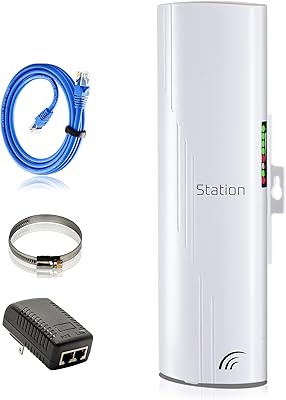
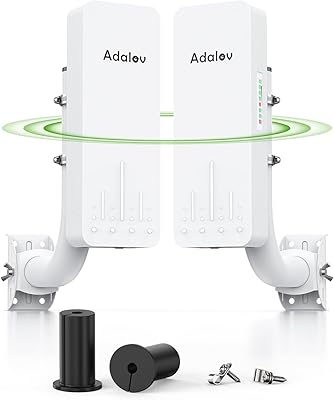
  • Kit Contents: The package includes 2 wireless bridge units, 2 PoE adapters, 2 pole mounting kits, and 2 short network cables.
  • Mounting Type: Adjustable wall or pole bracket mounts are included, allowing vertical and horizontal antenna angle adjustment after installation.
  • Setup Method: Uses a dial-pair plug-and-play pairing process that links both units without requiring access to a router admin interface.
  • Color: Both units are finished in white, which blends reasonably well on exterior walls or light-colored utility poles.
  • Operating Modes: Supports multiple modes including Access Point, wireless bridge, and wireless ethernet bridge configurations.
  • Special Features: Includes beamforming, guest mode support, internet security features, and LED status indicators for quick diagnostics.
  • Compatible Devices: Works with PoE switches, standard routers, IP and CCTV security cameras, desktop computers, and Starlink routers with ethernet output.

Related Reviews

GOOD STORY WB504H Outdoor Wireless Bridge
71%
88%
Ease of Setup
81%
Link Stability
63%
Real-World Range
69%
Throughput Performance
83%
Value for Money
More
AdaLov CPE660 Wireless Bridge
76%
83%
Ease of Setup
71%
Real-World Range
63%
Actual Data Throughput
84%
Build Quality & Weather Resistance
79%
Value for Money
More
AdaLov CPE661 Outdoor Wireless Bridge
80%
83%
Ease of Setup
76%
Real-World Range
71%
Throughput & Speed
89%
Dual WiFi Broadcasting
88%
Build Quality
More
ANJIELO SMART AH9066 Outdoor Wireless Bridge
65%
83%
Ease of Setup
71%
Outdoor Range Performance
67%
Signal Stability
74%
Weatherproofing & Durability
63%
Indoor Penetration
More
UeeVii CPE58G Flex Point-to-Point Wireless Bridge

77%
83%
Ease of Setup
67%
Real-World Range
74%
Throughput Performance
71%
Build Quality
81%
Weather Resistance
More
Ubiquiti U6+
Ubiquiti U6+
80%
88%
Wireless Performance
54%
Setup & Configuration
84%
Range & Coverage
82%
Build Quality & Design
91%
PoE+ Implementation
More
NETGEAR WAX615 Wireless Access Point
86%
91%
Performance
88%
Ease of Setup & Installation
93%
Coverage & Range
89%
Security Features
87%
App & Remote Management
More
BrosTrend AC1200 Dual-Band WiFi Access Point
76%
88%
Ease of Setup
71%
WiFi Signal Strength
74%
Connection Stability
81%
Build Quality & Design
76%
Dual-Band Performance
More
TP-Link EAP653 Wi-Fi 6 Access Point
83%
88%
Wireless Performance
79%
Setup & Installation
83%
Omada App & Controller Experience
91%
Build Quality & Design
84%
Range & Coverage
More
UeeVii CPE450 Point-to-Point Wireless Bridge Kit
76%
88%
Ease of Setup
82%
Signal Stability
67%
Real-World Range
61%
Throughput & Speed
79%
Build Quality & Durability
More

FAQ

It can work with Starlink, but there is an important condition: your Starlink setup needs to provide an ethernet output, which typically means you need the Starlink router in bypass mode or a Starlink ethernet adapter, depending on which generation of hardware you have. Once you have a wired ethernet handoff from your Starlink equipment, the CPE366 bridge can extend that connection to another building. It is not a plug-in-and-forget add-on for every Starlink configuration, so check your specific hardware before buying.

The 3KM figure is achievable, but only across completely flat, open terrain with zero obstructions between the two units — think large open fields or flat farmland. In practice, most buyers with wooded lots, hilly ground, or any structures between the mounting points will see meaningfully shorter effective range. For typical barn-to-house or garage-to-home scenarios within a few hundred meters, the range is not a concern at all.

For the most part, yes. The dial-pair method means you physically set matching channel dials on both units and plug them in — they find each other and establish the link without needing to log into any admin panel or configure IP addresses. Most users with basic comfort around networking hardware report getting both units online in under 30 minutes. Where people run into trouble is usually antenna alignment, not the software side of things.

Each unit has two LAN ports that serve different purposes. The 100Mbps port uses 24V passive PoE, which is supplied by the included adapter — that is how you power the unit. The gigabit port uses 48V PoE and is intended for connecting to a PoE-capable network switch or device at that end. The critical thing to remember is never to plug a 48V switch or injector into the 100Mbps port; the voltage mismatch can damage the hardware. The included adapters are matched correctly for each port, so if you stick to the included cables and adapters during initial setup, you will be fine.

Not with a single kit, no. Each kit creates a point-to-point link between exactly two locations. If you need to connect a third building, you would need a second kit or a different network topology — for example, using a switch at the midpoint location to branch out further. For most single-outbuilding scenarios, one kit is all you need.

The units are designed for outdoor use and appear to handle typical rain and temperature variation reasonably well based on user reports. That said, no formal IP weatherproofing rating is published for this product, which is worth noting if you are in an area with extreme conditions like heavy snow, prolonged freezing temperatures, or intense sun exposure. For most temperate climates, outdoor durability seems adequate, but if you are in a harsh environment, look for a product with a certified IP65 or IP67 rating.

The 900Mbps figure refers to the wireless link between the two bridge units themselves. Devices physically connected via ethernet to the station-side unit can pull up to 433Mbps, which is still very respectable for most use cases including HD video surveillance, file transfers, or shared internet connections. You will not see a full gigabit throughput to end devices, but for most practical applications at that distance, 433Mbps is more than sufficient.

The included brackets are designed to work on both flat wall surfaces and cylindrical poles, with adjustable clamps that accommodate standard round utility or fence posts. They also allow you to tilt and rotate the antenna after mounting, which matters a lot for getting precise alignment between the two units — especially over longer distances where a few degrees off-axis can noticeably affect signal quality.

This is a fair concern and worth checking with the seller before purchasing. Typically, point-to-point bridge kits like this are sold as matched pairs, and buying a single replacement unit may not always be straightforward from the same brand. It is worth keeping this in mind if you are deploying this in a critical application where downtime would be a serious problem.

For most IP camera setups, the bandwidth headroom is quite comfortable. A typical 4K IP camera streams at roughly 8 to 16Mbps, meaning the bridge can theoretically support a dozen or more HD cameras before the wireless link becomes a bottleneck. Where you are more likely to hit limits is at the individual camera end — the LAN port on the station side connects to a switch, and the quality of that switch and cabling will matter as much as the wireless link itself.