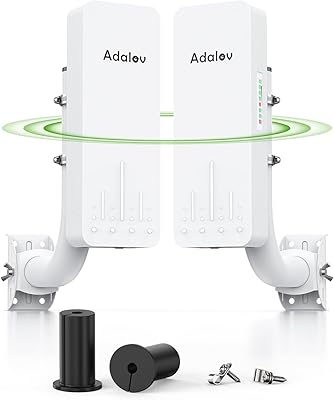
Overview

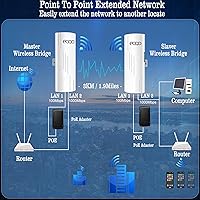
The eoqo CPE355 Outdoor Wireless Bridge is a mid-range point-to-point CPE kit built for one specific job: connecting two locations wirelessly without running a long cable between them. Whether you need to pull network access into a detached garage, link a barn to your home router, or get a security camera online at the far end of a property, this outdoor wireless bridge covers distances up to 2km in open conditions. It sits comfortably between cheap consumer range extenders and expensive enterprise gear. The IP66-rated enclosure and included PoE power adapter make it practical for a permanent outdoor installation from day one.
Features & Benefits

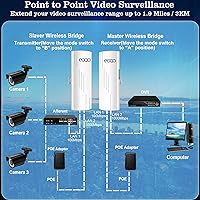
Running on 5.8GHz single-band radio, the CPE355 complies with 802.11a/n standards and advertises 300Mbps throughput — though real-world speeds will land noticeably lower depending on distance and environment. What actually sets this point-to-point CPE kit apart for most buyers is the factory-configured WDS mode: plug both units in, point them at each other, and the bridge forms without touching a configuration page. The directional antenna is listed as either 10dBi or 12dBi depending on where you look in the product listing — a minor inconsistency worth noting. Beyond WDS, it supports AP, repeater, and client bridge modes, and the software-enabled PoE output on the secondary port can power a downstream IP camera directly.

Best For

This outdoor wireless bridge is a natural fit for homeowners and small businesses who need a fixed wireless link to a building that is too far for a standard Wi-Fi extender but not worth the cost or disruption of trenching cable. Think a shop at the back of a large property, a gate camera 300 meters from the house, or a barn that needs a stable network connection for a PoE NVR. It is also a practical pick for security installers looking to power and connect a single IP camera at a remote spot without a separate injector. Just do not expect it to hold up well through dense foliage or multiple walls.

User Feedback

With 58 ratings averaging 3.8 stars, the reception for this point-to-point CPE kit is genuinely mixed. Satisfied buyers tend to praise the straightforward setup process and the fact that the weatherproof housing holds up through winters and wet seasons without issue. The PoE camera output also earns positive mentions from installers who got it working cleanly. On the flip side, a recurring frustration is the gap between the 300Mbps headline figure and actual throughput, which buyers notice quickly in real transfers. Range expectations also need calibrating — in anything less than a clear line of sight, 500 to 800 meters is a more honest ceiling. A few buyers additionally flagged the antenna rating inconsistency in the listing as a trust concern.

Pros

  • Ships pre-configured in WDS mode — most users get a working bridge in under 20 minutes.
  • IP66-rated housing holds up through rain, frost, and summer heat without degrading.
  • The secondary Ethernet port can power a PoE camera directly, saving a separate injector.
  • 5.8GHz operation reduces interference in neighborhoods crowded with 2.4GHz networks.
  • Compact and lightweight enough for a single-person rooftop or fence-post installation.
  • Supports AP, repeater, and client bridge modes in addition to WDS for future flexibility.
  • Performs reliably for low-bandwidth tasks like single camera feeds and basic internet access.
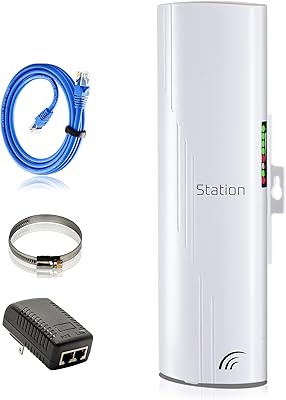
  • Included PoE adapters and mounting hardware mean the kit is ready to deploy out of the box.
  • Consistent long-term performance reported by buyers in stable, moderate climates.

Cons

  • Real-world throughput falls well short of the 300Mbps headline figure at most practical distances.
  • The 2km range claim is misleading — obstructed environments often cut usable range by half or more.
  • Antenna gain is listed inconsistently as both 10dBi and 12dBi depending on which part of the listing you read.
  • The admin firmware interface is outdated and offers minimal guidance for mode-switching or troubleshooting.
  • PoE output wattage is limited and incompatible with some higher-draw IP camera models.
  • Mounting bracket hardware has shown early rust in coastal or high-humidity environments.
  • Silent WDS pairing failures occasionally occur, requiring a manual firmware login to diagnose.
  • Quality control appears inconsistent — some buyers received units with signs of prior use or cosmetic wear.
  • Customer support response quality is mixed, leaving buyers with complex issues largely on their own.

Ratings

The eoqo CPE355 Outdoor Wireless Bridge earned a 3.8-star average across 58 verified global ratings, and our AI scoring system has processed that feedback in full — filtering out incentivized reviews and bot patterns to surface what real installers, homeowners, and small business owners actually experienced. The scores below reflect both where this point-to-point CPE kit genuinely delivers and where it falls short of its own marketing claims, so you can make a grounded buying decision.
Ease of Setup
84%
The factory-configured WDS mode is the single most praised aspect of the CPE355 among non-technical buyers. Users setting up a garage or barn link report having both units online and bridged within 15 to 20 minutes, with no router configuration pages or pairing codes required. That out-of-the-box experience is a genuine differentiator at this price point.
A minority of buyers encountered situations where the default WDS pairing failed silently, requiring a manual login to the admin interface to troubleshoot — something that can frustrate users who expected true zero-configuration operation. The admin UI itself is functional but dated, with limited guidance for those who need to switch operating modes.
Real-World Range
67%
33%
In genuinely open, unobstructed environments — flat farmland, clear line-of-sight between rooftops — the CPE355 performs respectably, with several buyers reporting stable links at 800 meters to just over 1km. For typical residential use cases like connecting a detached shop or outbuilding within a few hundred meters, most users hit their target without issue.
The advertised 2km range is a best-case figure that most buyers will never reach in practice. Users in suburban settings with trees, fences, or even moderate foliage between units consistently report signal degradation beyond 500 to 700 meters. Managing range expectations before purchase would prevent a meaningful share of the negative reviews this kit has received.
Throughput & Data Speed
58%
42%
For low-bandwidth tasks — streaming a single security camera feed, accessing a NAS remotely, or basic internet browsing from an outbuilding — the CPE355 delivers enough throughput to be genuinely useful. Users running a single PoE camera over the bridge report smooth, uninterrupted video without dropped frames under normal conditions.
The 300Mbps headline figure is theoretical and far removed from real-world performance. Buyers attempting file transfers or running multiple devices through the bridge report actual speeds closer to 40 to 80Mbps at mid-range distances, which is adequate but not what the spec sheet implies. Anyone expecting near-gigabit performance will be disappointed.
Build Quality & Weatherproofing
79%
21%
The IP66-rated housing earns consistent praise from buyers who have left units mounted outdoors through full winters, heavy rain cycles, and summer heat. The enclosure feels solid for the price, and several users specifically mention that the seals held up without visible degradation after a year or more of continuous outdoor exposure.
A handful of long-term users noted that the mounting bracket hardware showed early rust signs in coastal or high-humidity climates, even though the main unit itself remained functional. The plastic housing, while weather-sealed, does not inspire the same confidence as the metal enclosures found on pricier enterprise-grade units.
PoE Camera Output
71%
29%
The software-enabled PoE output on the secondary Ethernet port is a legitimately useful feature for security installers. Being able to mount the CPE355 at a gate or fence post and power a single IP camera from the same unit eliminates the need for a separate PoE injector or additional wiring at the remote end — a real time and cost saving in practice.
The PoE output is limited in wattage and does not support all camera models, which a few installers discovered only after mounting the unit. There is also inconsistency in how the feature is documented, with some buyers unsure whether it is enabled by default or requires toggling in the firmware before the camera powers on.
Antenna Performance
63%
37%
The directional antenna does a reasonable job of focusing signal in a narrow beam, which helps reduce interference from neighboring 5.8GHz networks and keeps the link more stable than an omnidirectional antenna would at equivalent distances. Buyers who take the time to align units carefully report noticeably better performance.
The product listing references both 10dBi and 12dBi gain in different sections, and that inconsistency has not gone unnoticed by technically savvy buyers. Whether the actual installed antenna meets either figure is impossible to verify without test equipment, and it has eroded some trust in the product specs more broadly.
Value for Money
72%
28%
For buyers with modest range requirements — under 600 meters, minimal obstructions, single camera or basic internet extension use cases — the CPE355 delivers a functional solution at a price that undercuts most comparable branded alternatives by a meaningful margin. The included PoE adapter and weatherproof housing add tangible value to the package.
Buyers who purchased expecting enterprise-level throughput or the full 2km range often feel the value proposition weakens considerably once real-world performance sets in. At its price point the kit is reasonable; pushed to its advertised limits, it struggles to justify the spend versus slightly pricier alternatives with better-documented specs.
Operating Mode Flexibility
74%
26%
Supporting AP, repeater, client bridge, and WDS modes gives the CPE355 more versatility than a single-purpose bridge, and technically inclined users appreciate being able to repurpose the hardware for different network roles as their setup evolves. Having a fallback repeater or AP mode is a genuine plus for future-proofing.
Switching between modes requires navigating the firmware interface, which is not particularly intuitive and lacks helpful in-line documentation. For the non-technical buyer who bought this specifically for plug-and-play bridging, the additional modes are mostly inaccessible in practice.
Long-Term Reliability
68%
32%
A portion of buyers have run the CPE355 continuously for 12 to 18 months without hardware failure, which is encouraging for a mid-range outdoor device. Units installed in stable, dry climates with consistent temperatures tend to attract the strongest long-term reliability feedback.
There are enough reports of units failing or degrading in performance after 6 to 12 months — particularly in harsher climates — to suggest quality control is not entirely consistent across production batches. Buyers in extreme climates should factor in the possibility of a shorter-than-expected lifespan.
Mounting & Physical Installation
76%
24%
The compact form factor and included mounting hardware make physical installation relatively painless for a single person. Users mounting units to fence posts, eaves, or exterior walls report that the bracket accommodates standard pole diameters and holds the unit at the correct angle without additional hardware in most setups.
Precise directional alignment between two units at distance can be time-consuming without a second person or a signal-strength meter, since the admin UI signal indicator updates slowly. A few buyers noted that the mounting bracket does not allow for fine azimuth adjustment once tightened, which complicates alignment on longer links.
Documentation & Support
47%
53%
For the most common use case — WDS bridging between two units — the included quick-start guide covers the basics adequately, and buyers who stick to the default mode rarely need to look further. Setup videos shared by eoqo online fill some of the gaps the printed guide leaves.
Beyond the default WDS setup, documentation quality drops sharply. Advanced configuration, troubleshooting steps, and mode-switching instructions are sparse or absent, and eoqo customer support receives mixed feedback on response quality and technical depth. Buyers who run into edge cases often turn to community forums rather than official channels.
Interference Resistance
66%
34%
Operating on 5.8GHz gives the CPE355 a natural advantage over 2.4GHz bridges in congested suburban environments, where channel interference from neighboring Wi-Fi networks is common. Buyers in areas with heavy wireless traffic generally report a more stable link than they experienced with 2.4GHz alternatives.
In environments with multiple 5.8GHz devices — including other outdoor CPEs, video senders, or cordless phone systems — some users report link instability that requires manual channel selection to resolve. The default channel assignment does not always pick the least congested option automatically.
Packaging & Out-of-Box Contents
73%
27%
The kit ships as a matched pair with both CPE units, PoE adapters, and mounting hardware included, which simplifies ordering and ensures compatibility. Buyers appreciate not having to source accessories separately, and the packaging is adequate for protecting the hardware during transit.
Some buyers received kits where one unit appeared to have been a return or showed minor cosmetic wear, raising concerns about quality consistency. The Ethernet cables included in some shipments were also noted as short, requiring buyers to source longer runs independently for real-world installations.

Suitable for:

The eoqo CPE355 Outdoor Wireless Bridge is a practical fit for homeowners and small property owners who need to extend a network connection to a detached building — a garage, a barn, a workshop, or a gate — without the cost or disruption of digging a cable trench across a yard. It works especially well when the two locations share a relatively clear line of sight and are within about 600 to 800 meters of each other, which covers the vast majority of residential and small farm scenarios. Non-technical users will appreciate that the kit ships pre-configured for WDS bridging, meaning both units typically form a link without any firmware tinkering. Security installers handling modest jobs will also find real value here: the secondary Ethernet port can output PoE power to a single IP camera, eliminating the need for a separate injector at the remote end. If your goal is basic, reliable connectivity for a camera feed or occasional file access — not a high-throughput backbone — this point-to-point CPE kit punches reasonably well for the money.
Not suitable for:

The eoqo CPE355 Outdoor Wireless Bridge is not the right tool for buyers who need high throughput, long verified range, or enterprise-grade reliability. The 300Mbps figure on the box is theoretical — real transfers through this kit will land considerably lower, and anyone planning to run multiple devices, stream 4K video, or use the link as a primary high-speed connection will hit a ceiling quickly. The 2km range claim should also be treated with skepticism: in anything other than flat, open terrain, expect usable performance to drop off well before that. Buyers in densely wooded areas, urban environments with lots of wireless interference, or locations requiring links beyond 1km would be better served by a more capable CPE from a brand with more transparent and consistent specifications. The listing itself contains a small but telling inconsistency — the antenna gain is cited as both 10dBi and 12dBi in different sections — and buyers who prioritize spec accuracy and thorough technical documentation will likely find this frustrating rather than reassuring.
Specifications

  • Frequency Band: Operates on the 5.8GHz single-band spectrum, reducing interference from common 2.4GHz household networks.
  • Wireless Standards: Complies with IEEE 802.11a and IEEE 802.11n for broad interoperability with standard networking equipment.
  • Max Throughput: Advertised theoretical maximum of 300Mbps; real-world speeds vary significantly based on distance and environmental conditions.
  • Antenna Gain: Built-in directional antenna rated at either 10dBi or 12dBi depending on the listing section referenced — an inconsistency eoqo has not formally resolved.
  • Max Range: Rated up to 2km in completely open, line-of-sight conditions; practical range in obstructed or suburban environments is typically 500m to 800m.
  • Operating Modes: Supports four modes: Wireless AP, Wireless Repeater, Client Bridge, and WDS point-to-point or point-to-multipoint bridging.
  • Default Mode: Ships pre-configured in WDS bridge mode, allowing two units to pair and operate without manual firmware configuration in most setups.
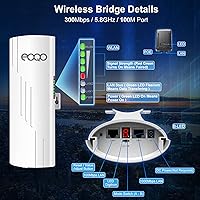
  • Weatherproof Rating: IP66-rated enclosure provides full protection against dust ingress and powerful water jets from any direction.
  • Environmental Protection: Housing includes built-in lightning protection and is rated to withstand freezing temperatures, sustained heat, and continuous moisture exposure.
  • Power Method: Powered via the included PoE (Power over Ethernet) adapter, which eliminates the need for a separate power outlet at the mounting location.
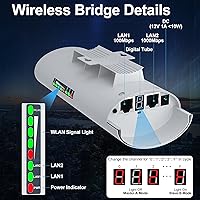
  • PoE Output: The secondary Ethernet port supports software-enabled PoE output, capable of powering a compatible downstream IP camera directly from the unit.
  • Ethernet Ports: Each unit includes two Ethernet ports: one for uplink connection and one secondary port with optional PoE output for a downstream device.
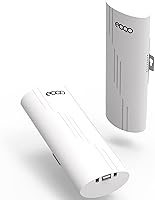
  • Dimensions: Each unit measures 2.36 x 3.55 x 9.8 inches, sized for discreet mounting on poles, eaves, or exterior walls.
  • Weight: Each unit weighs 2.2 pounds, light enough for single-person installation on most standard outdoor mounting surfaces.
  • Kit Contents: The kit ships as a matched pair with both CPE units, PoE adapters, and mounting hardware included for a complete point-to-point installation.
  • Brand & Model: Manufactured by eoqo under model number eoqo-cpe355-sf, first made available in July 2021.
  • Market Rank: Holds a Best Sellers Rank of #263 in the Computer Networking Wireless Access Points category on Amazon.
  • User Rating: Carries an average rating of 3.8 out of 5 stars based on 58 verified ratings at time of review.

Related Reviews

EnGenius ENH500-AX Outdoor Wireless Bridge
85%
93%
Long-Range Performance
90%
Weatherproofing & Durability
78%
Installation & Setup
85%
Wi-Fi Speed & Stability
88%
Signal Strength
More
EnGenius EnStation6-KIT Outdoor Wireless Bridge
86%
89%
Signal Strength
91%
Range Performance
85%
Ease of Setup
93%
Build Quality
95%
Weatherproof Durability
More
GOOD STORY WB504H Wireless Bridge Point to Point Outdoor WiFi
85%
94%
Ease of Setup
88%
Long-Range Performance
90%
WiFi Speed/Connectivity
85%
Durability/Build Quality
89%
Installation Flexibility
More
TP-Link CPE210 2.4GHz N300 Outdoor Wireless Bridge
84%
88%
Performance
92%
Value for Money
91%
Ease of Installation
86%
Build Quality
83%
Weather Resistance
More
AdaLov CPE660 Wireless Bridge
76%
83%
Ease of Setup
71%
Real-World Range
63%
Actual Data Throughput
84%
Build Quality & Weather Resistance
79%
Value for Money
More
UeeVii CPE58G Flex Wireless Bridge
86%
91%
Signal Range
89%
Ease of Setup
94%
Weather Resistance
85%
Security Features
90%
Build Quality
More
AdaLov CPE661 Outdoor Wireless Bridge
80%
83%
Ease of Setup
76%
Real-World Range
71%
Throughput & Speed
89%
Dual WiFi Broadcasting
88%
Build Quality
More
abetap X83 Wireless Outdoor Security Camera
71%
91%
Ease of Installation
83%
Image Quality
76%
Night Vision Performance
62%
Battery Life
79%
Motion Detection Accuracy
More
ANJIELO SMART AH9066 Outdoor Wireless Bridge
65%
83%
Ease of Setup
71%
Outdoor Range Performance
67%
Signal Stability
74%
Weatherproofing & Durability
63%
Indoor Penetration
More
Juyivast Q151SP Solar Wireless Security Camera
70%
83%
Value for Money
67%
Solar Performance
78%
Video Quality
71%
Motion Detection
84%
Setup & Installation
More

FAQ

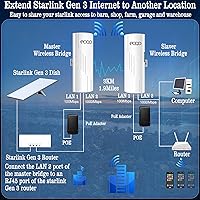
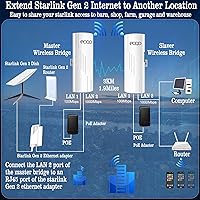
Not for the basic use case. The eoqo CPE355 Outdoor Wireless Bridge ships pre-configured in WDS bridge mode, so for most buyers the process is simply: mount both units, plug in the PoE adapters, and point them at each other. The link forms automatically without logging into any firmware interface. If you hit a snag or want to switch modes, you will need to access the admin UI, which is functional but not the most intuitive.
Only in ideal conditions — think flat open farmland with a true, unobstructed line of sight between the two units. In most real-world settings, including suburban yards with trees, fences, or buildings in between, plan for a reliable working range closer to 500 to 800 meters. The 2km figure is a best-case ceiling, not a typical result.

Some foliage is tolerable, but dense tree cover significantly degrades both range and throughput. Walls, especially masonry or concrete, are more problematic and can reduce the effective range substantially. For best results, mount the units as high as possible to minimize obstructions in the signal path.

The 300Mbps on the packaging is a theoretical maximum that you will not hit in practice. Most users running the bridge at moderate distances report real throughput somewhere between 40 and 80Mbps, which is more than enough for a security camera feed, NAS access, or standard internet use in an outbuilding. If you need a high-throughput backbone link, this CPE kit will likely disappoint.

Yes, that is one of the more useful features here. The secondary Ethernet port on the unit supports software-enabled PoE output, meaning you can connect a compatible IP camera directly to that port and power it from the same unit — no separate PoE injector needed. Just check your camera's PoE wattage requirement first, as the output has limits and will not power higher-draw cameras.

The IP66 weatherproof rating and the included lightning protection make it suitable for permanent outdoor installation in most climates. Buyers in moderate to cold climates report that the housing holds up well through full winters. The one caveat is the mounting bracket hardware, which has shown early rust in coastal or high-humidity environments, so it is worth inspecting that periodically.

That inconsistency exists in the product listing itself, and eoqo has not issued a clear correction. Different sections of the listing cite different figures. Without independent testing equipment it is impossible to verify the actual gain, so treat whichever number you see as an approximate rather than a guaranteed spec. It does not necessarily mean the antenna underperforms, but it is a transparency issue worth knowing about before you buy.

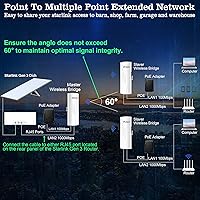
The CPE355 supports point-to-multipoint (PTMP) mode in addition to standard point-to-point, so connecting a central unit to multiple remote units is technically possible. That said, splitting the signal across multiple endpoints will reduce the throughput available to each location, so it works best for low-bandwidth tasks like camera feeds rather than heavy data use at each remote site.

It does not replace a router. The CPE355 is a wireless bridge — its job is to extend your existing wired network wirelessly between two points. You still need a router at the source location providing your internet connection. At the remote end, you connect the CPE unit to whatever device needs network access, such as a switch, a camera, or a Wi-Fi access point for that space.

In WDS mode, the units use a shared network name and password that are pre-configured at the factory to match as a pair. The directional antennas also help by focusing the signal toward each other rather than broadcasting widely in all directions. The risk of accidentally pairing with a neighbor's unit is low, but if you are in a dense area with similar devices, logging into the firmware to set a unique network name and password is a sensible precaution.